The Complete Guide to LLM SEO in 2026
LLM SEO is the practice of optimizing your content so that large language models like ChatGPT, Gemini, and Claude recommend your brand in their responses. This complete guide covers how LLM SEO works, how it differs from traditional SEO, and how to build a strategy.

Key Takeaways
- LLM SEO is the discipline of optimizing content for large language model recommendations rather than traditional search engine rankings
- It differs from traditional SEO in output (recommendation vs. ranking), evaluation (answer quality vs. link signals), and distribution (multi-source presence vs. single-domain focus)
- The four pillars of LLM SEO are authority building, content structure, freshness management, and multi-source validation
- Effective LLM SEO requires optimizing for five AI engines simultaneously: ChatGPT, Perplexity, Gemini, Claude, and Grok
- The optimization framework in this guide covers content strategy, technical implementation, authority development, and measurement, giving you a complete roadmap from zero to recommended
What Is LLM SEO?
LLM SEO is the process of optimizing your brand's online presence so that large language models recommend you when users ask relevant questions. When someone asks ChatGPT "What is the best accounting software for freelancers?" or asks Perplexity "Which CRM should I use for my sales team?", LLM SEO determines whether your brand appears in the answer.
The term "LLM SEO" specifically refers to optimization for large language models, the AI systems that power tools like ChatGPT (GPT-4), Gemini (Google), Claude (Anthropic), Grok (xAI), Perplexity,. These models use a Retrieval-Augmented Generation (RAG) pipeline that searches the web, retrieves relevant content, evaluates it, and synthesizes an answer with specific recommendations.
LLM SEO is closely related to terms like AI search optimization, Generative Engine Optimization (GEO), and AI SEO. While the terminology varies, the core discipline is the same: making your brand the one that AI engines trust enough to recommend. For a full breakdown of these related concepts, see our guide to AI search optimization.
How LLM SEO Differs from Traditional SEO
The differences between LLM SEO and traditional SEO are fundamental, not cosmetic. Understanding them is the first step to building an effective strategy.
Different Output: Recommendation vs. Ranking
Traditional SEO produces a ranked position on a search engine results page. Your brand appears at position 3 or position 15, and each position has some visibility.
LLM SEO produces a recommendation within a conversational answer. Your brand is either recommended or it is not. There is no "position 7" in an AI answer. There is no partial visibility. The outcome is binary: you are mentioned, or you are invisible.
This binary nature makes LLM SEO simultaneously more rewarding when you win and more punishing when you lose. A brand that gets recommended by ChatGPT for a high-intent query captures attention that would have been spread across 10 search results.
Different Evaluation: Answer Quality vs. Link Signals
Google evaluates pages primarily through a signals-based system: backlinks, domain authority, page speed, keyword relevance, user engagement, and over 200 other factors. The output is a numerical ranking.
LLMs evaluate content based on whether it provides the best answer to the user's specific question. The evaluation criteria include: Does the content directly answer the question? Is the answer accurate and well-sourced? Is the content from an authoritative source? Is the information current? Do other sources confirm this information?
Backlinks still matter in LLM SEO, but indirectly. They help your content rank in the traditional search results that LLMs use as their retrieval pool. Once your content is in the retrieval pool, the LLM evaluates it on answer quality, not link count.
Different Distribution: Multi-Source vs. Single-Domain
In traditional SEO, your website is the center of gravity. Everything points to your domain: backlinks, internal links, content clusters, and technical optimizations.
In LLM SEO, your multi-source presence is equally important. LLMs cross-reference information across the web before making recommendations. If your brand is only mentioned on your own website, the LLM has a single data point. If your brand appears on your website, LinkedIn, Wikipedia, Reddit, industry publications, and review sites, the LLM has multiple independent confirmations.
This cross-referencing behavior means LLM SEO extends far beyond your own domain. You need a presence strategy that spans the platforms each AI engine trusts. For a platform-by-platform breakdown, see our analysis of how each AI engine recommends differently.
Different Content Format: Answers First vs. Engagement First
Traditional SEO content can afford to use long introductions, tease answers, and optimize for engagement metrics like time on page and scroll depth. The goal is to get the click and keep the visitor.
LLM SEO content must lead with direct answers in the first 40 to 60 words of each section. LLMs process content in 200 to 500 word chunks, and the re-ranking models that evaluate those chunks heavily weight the opening sentences. If your answer is in paragraph four, a competitor whose answer is in sentence one will win the recommendation.
Where They Overlap
Both LLM SEO and traditional SEO benefit from strong technical foundations: fast page speeds, clean HTML, proper heading hierarchy, XML sitemaps, mobile responsiveness, and HTTPS. Both reward high-quality, authoritative content. And critically, ranking in the top 20 on traditional search engines is often a prerequisite for entering an LLM's retrieval pool, because LLMs use search engine results as their starting data source.
The practical takeaway: LLM SEO does not replace traditional SEO. It builds on top of it. Your traditional SEO work gets your content into the retrieval pool. Your LLM SEO work gets your content recommended once it is in the pool.
The Four Pillars of LLM SEO
LLM SEO success depends on four core pillars. Weakness in any one pillar undermines the others.
Pillar 1: Authority
Authority in LLM SEO means the AI engine recognizes your brand as a trusted source in your domain. Authority signals include:
Entity recognition. Does the LLM "know" who you are? If you ask ChatGPT about your brand and it has no information, your entity recognition is zero. Building entity recognition requires consistent mentions across multiple authoritative sources.
Expert authorship. Content attributed to recognized experts carries more weight. Author pages with credentials, published work, and professional profiles (especially LinkedIn) that the LLM can cross-reference strengthen authority signals.
Citation frequency. How often do other sources reference your content? If industry publications cite your data, if Wikipedia references your research, if Reddit users recommend your product, those citations compound your authority.
Domain expertise signals. A website that consistently publishes authoritative content in a specific topic area builds topical authority over time. A site with 50 well-researched articles on CRM software has more LLM authority for CRM queries than a site with one article on CRM and 49 articles on unrelated topics.
For a deeper dive into authority building, read our guide on building authority signals for AI recommendations.
Pillar 2: Content Structure
Content structure is the pillar where most businesses fail. Their content may be excellent for human readers but poorly formatted for LLM extraction. The structural requirements include:
Answer-first formatting. Every section must open with a direct answer to the question that heading poses. The first 40 to 60 words of each section carry disproportionate weight in the re-ranking stage.
Question-format headings. H2 and H3 headings phrased as questions (or close variations of common user queries) help LLMs match your content to specific questions. "How much does CRM software cost?" is better than "Pricing Considerations."
Self-contained sections. Each section should make sense independently, because LLMs evaluate chunks, not whole pages. A section that starts with "As mentioned above" and requires context from a previous section will score poorly as an independent chunk.
Structured data elements. Tables, lists, comparison matrices, and FAQ sections make information extraction easier and more reliable. LLMs handle structured information better than dense paragraphs.
Logical heading hierarchy. Proper H1, H2, H3 nesting helps LLMs understand the relationship between topics and subtopics on your page.
For detailed formatting guidance, see our post on the content structure AI engines love.
Pillar 3: Freshness
Different LLMs weight freshness differently, but all of them consider recency as a trust signal.
Grok has the shortest freshness window, often prioritizing content from the last 24 hours. This is because Grok integrates heavily with X (Twitter) data.
Perplexity favors content from the last 48 to 72 hours and tends to cite more recently published sources when multiple sources provide similar answers.
ChatGPT and Gemini have longer windows but still factor recency into their evaluations, especially for queries where timeliness matters (pricing, "best of 2026" lists, industry trends).
Claude has the least emphasis on freshness for general queries, drawing more from its training data, but still considers publication dates when web search is invoked.
Freshness management means more than publishing new content. It means updating existing content with current data, refreshing publication timestamps when content is genuinely updated, removing outdated statistics and examples, and using date-based schema markup correctly.
Pillar 4: Multi-Source Validation
LLMs are designed to cross-reference. They do not trust a single source, even an authoritative one. They look for consensus across multiple independent sources.
Building multi-source presence means your brand should appear in:
- Your own website with authoritative, well-structured content
- LinkedIn with active company pages and thought leadership from team members
- Reddit with genuine participation in relevant communities
- Industry publications through guest articles, interviews, and earned media
- Review platforms like G2, Capterra, or Trustpilot (for B2B and B2C respectively)
- Wikipedia where legitimate notability criteria are met
- X/Twitter for Grok visibility specifically
- YouTube for video content that supports text-based authority
- Quora and other Q&A platforms where your expertise is relevant
Each independent mention reinforces the others. Five independent sources saying your product is the best in its category creates a consensus signal that one source alone cannot.
The LLM SEO Content Strategy
With the four pillars understood, here is how to build a content strategy specifically for LLM SEO.
Step 1: Map Your Query Landscape
Identify every question a potential customer might ask where your brand could be recommended. These fall into three categories:
Brand queries: "What is [your brand]?" "Is [your brand] good?" "Reviews of [your brand]." These queries test your entity recognition and reputation.
Category queries: "What is the best [product category]?" "Top [product category] for [use case]." These are the highest-value queries because they capture purchase intent.
Educational queries: "How to [problem your product solves]?" "What is [concept in your domain]?" These queries build topical authority and can lead to brand recommendations within educational answers.
Map 50 to 100 queries across all three categories. Test each query manually across ChatGPT, Perplexity, and Gemini to establish your baseline visibility.
Step 2: Audit Existing Content
For each of your existing high-value pages, evaluate:
- Does the page lead with a direct answer in the first 40 to 60 words?
- Are headings phrased as questions or close to user query patterns?
- Can each section stand alone as a meaningful answer?
- Is the content current with up-to-date data and examples?
- Does the page include FAQ schema?
- Is the author identified with credentials and a linked profile?
Score each page on a 1 to 10 scale and prioritize the lowest-scoring pages that target the highest-value queries. For a comprehensive audit methodology, see our guide on how to audit your AI search visibility.
Step 3: Create and Restructure Content
For new content, build each piece with LLM optimization as a primary (not secondary) goal:
Open every piece with a direct answer. The first one to two sentences should answer the core question the page targets. No preamble, no scene-setting, no "in today's digital landscape."
Structure sections as Q&A pairs. Each H2 should pose a question, and the section body should answer it directly before expanding.
Include comparison tables. Whenever your content involves comparisons (products, features, pricing, approaches), use tables. LLMs extract tabular information more reliably than narrative comparisons.
Add FAQ sections. Every piece should end with 5 to 7 FAQ questions that mirror real user queries. These are high-value targets for LLM extraction because they match the question-and-answer format that LLMs naturally work with.
Use schema markup. Implement Article schema, FAQ schema, and any relevant product or service schema. Schema helps search engines (and by extension, LLMs) understand your content's structure and purpose. GRRO's content studio scores your pages for AI readiness including schema implementation. See our schema markup guide for implementation details.
Step 4: Build Your Multi-Source Presence
Content on your own site is necessary but not sufficient. Develop a multi-source strategy:
LinkedIn (weekly): Publish thought leadership posts from team members. Share insights, data, and perspectives that reinforce your brand's expertise. LinkedIn content is heavily indexed by Bing, which feeds ChatGPT.
Reddit (ongoing): Participate genuinely in relevant subreddits. Provide helpful answers. When appropriate, mention your product naturally. Reddit is a major source for Perplexity and increasingly for other LLMs.
Guest articles (monthly): Contribute expert content to industry publications. Each published article creates an independent authority signal.
Reviews and directories (quarterly): Maintain profiles on relevant review platforms. Encourage genuine reviews from satisfied customers.
Step 5: Measure and Iterate
LLM SEO requires continuous measurement because AI responses change frequently.
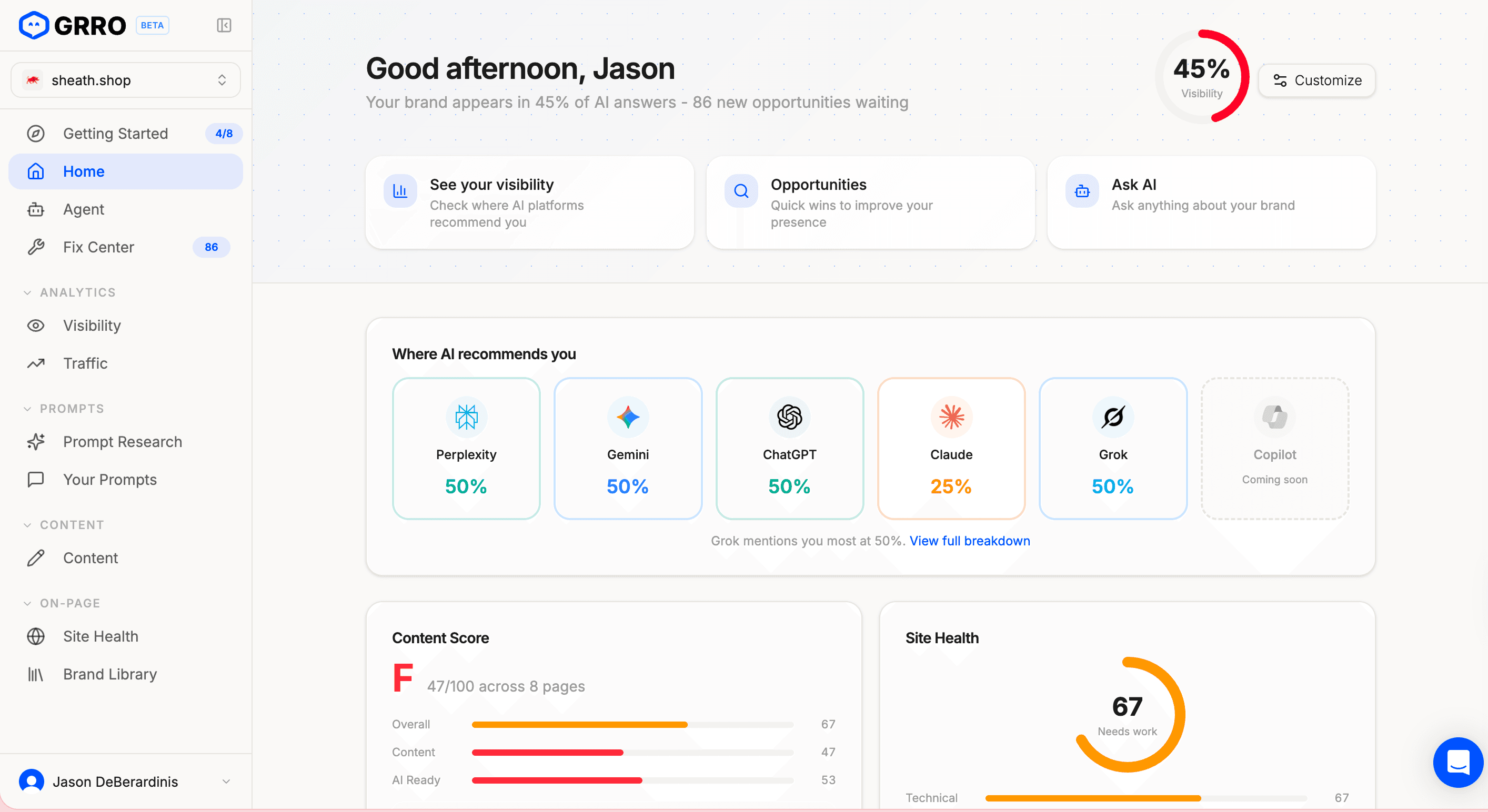
Track your AI Recommendation Score. Use a tool like GRRO to monitor your visibility across all five major AI engines. GRRO's search visibility tracking gives you a single score with trend lines to track improvement over time.
Test queries weekly. Beyond automated monitoring, manually test your most important queries to understand the qualitative aspects of how AI engines present your brand.
Update content monthly. Refresh your highest-value pages with current data, remove outdated references, and add new sections addressing emerging questions.
Monitor competitors. Track which competitors are getting recommended for your target queries. Analyze what they are doing differently and adapt your strategy accordingly.
For a complete measurement framework, see our guide on measuring ROI from AI search visibility.
Technical Requirements for LLM SEO
Beyond content and authority, certain technical foundations are essential.
Page Speed and Crawlability
LLMs retrieve content through search engines, which means your pages need to be fast, crawlable, and properly indexed. Ensure your pages load in under 3 seconds, your XML sitemap is current and submitted to both Google Search Console and Bing Webmaster Tools, and your robots.txt allows search engine crawlers to access all important content.
Structured Data Implementation
Implement these schema types at minimum:
- Article schema on all blog posts and guides (with author information)
- FAQ schema on pages with FAQ sections
- Organization schema on your homepage
- Product schema on product or service pages
- BreadcrumbList schema for navigation context
Heading Structure
Use a logical heading hierarchy: one H1 per page, H2s for major sections, H3s for subsections within H2s. Do not skip levels (going from H2 directly to H4). Each heading should be descriptive enough that a reader (or an AI) can understand the section's topic from the heading alone.
Mobile Optimization
All major search engines (including Bing, which feeds ChatGPT) use mobile-first indexing. Your content must render correctly and load quickly on mobile devices. This is not new advice, but it remains critical because mobile indexing affects your position in the retrieval pool.
HTTPS and Security
HTTPS is a baseline requirement. Search engines penalize non-secure sites, which reduces your chances of entering the LLM retrieval pool. Ensure your entire site runs on HTTPS with a valid SSL certificate.
Common LLM SEO Mistakes
Avoid these frequent errors that undermine LLM optimization efforts.
Mistake 1: Treating LLM SEO as Keyword Stuffing
LLMs do not respond to keyword density the way early search algorithms did. Stuffing your content with target keywords makes it less readable and less likely to provide the clear, direct answers LLMs prioritize. Write naturally. Answer questions clearly. The LLM will understand the relevance.
Mistake 2: Ignoring Multi-Source Presence
Many businesses optimize their website content for LLM readability but neglect everything else. If your brand only exists on your own website, LLMs have a single reference point. That is not enough to earn a confident recommendation. Invest in LinkedIn, Reddit, industry publications, and other platforms equally.
Mistake 3: Publishing and Forgetting
LLMs favor fresh content. A page published six months ago with no updates sends a weaker freshness signal than a page updated last week. Build content refresh cycles into your workflow. Update statistics, add new examples, and refresh timestamps when content is genuinely improved.
Mistake 4: Burying Answers
The most common structural mistake is burying the answer below multiple paragraphs of context. LLMs extract from the opening sentences of each content chunk. If your answer is in the fourth paragraph of a section, a competitor whose answer is in sentence one will win. Lead with the answer. Always.
Mistake 5: Optimizing for One Engine Only
Each AI engine uses different retrieval sources and weighting. ChatGPT uses Bing. Gemini uses Google. Grok prioritizes X. Perplexity uses Brave and Bing. An LLM SEO strategy that only targets ChatGPT misses five other engines. Build a cross-engine strategy that accounts for the retrieval differences between platforms.
For a full breakdown of what keeps brands invisible, read our post on why most brands are invisible to AI.
LLM SEO Timeline: What to Expect
Setting realistic expectations is important. Here is a typical timeline for LLM SEO results.
Weeks 1 to 2: Baseline measurement. Test queries, score content, identify gaps.
Weeks 2 to 6: Content restructuring. Reformat existing pages with answer-first structure, add FAQ sections, implement schema markup.
Weeks 4 to 8: First visibility improvements. Perplexity reflects changes fastest (48 to 72 hours). ChatGPT and Gemini typically show improvements within 2 to 4 weeks of content updates.
Months 2 to 4: Authority building gains traction. Guest articles publish, LinkedIn thought leadership builds, Reddit presence grows.
Months 4 to 6: Compounding effects. Multi-source presence reinforces authority signals. AI engines begin recommending your brand more consistently.
Months 6 to 12: Full competitive positioning. Your brand appears consistently for core queries across multiple AI engines. Ongoing work shifts to defense (maintaining position) and expansion (targeting new query categories).
FAQ
Is LLM SEO the same as AI SEO or GEO?
These terms describe overlapping but slightly different things. LLM SEO specifically focuses on optimization for large language models. AI SEO is a broader term that includes optimization for AI-powered features within traditional search engines (like Google AI Overviews). GEO (Generative Engine Optimization) is an academic term that describes the same core discipline. In practice, the strategies are very similar regardless of which term you use. What matters is that you are optimizing for AI-generated recommendations, not just traditional rankings.
Do I need different content for LLM SEO and traditional SEO?
No. The structural changes that improve LLM visibility (answer-first formatting, question-based headings, FAQ sections, schema markup) also improve traditional SEO performance. You do not need separate content for each channel. You need content that is structured well enough to serve both. The format changes, not the substance.
Which AI engine should I prioritize for LLM SEO?
Start with ChatGPT and Perplexity, which have the largest user bases for AI search. Then expand to Gemini, Claude, and Grok. Each engine has different retrieval sources and preferences, so a comprehensive strategy covers all 5. Use a tool like GRRO to track your visibility across all engines simultaneously rather than guessing where you stand.
How long does LLM SEO take to show results?
Initial improvements typically appear within 4 to 8 weeks. Perplexity reflects content changes fastest (48 to 72 hours). ChatGPT and Gemini take 2 to 4 weeks. Building comprehensive multi-source authority takes 3 to 6 months. Full competitive positioning, where your brand consistently appears for your core queries, usually takes 6 to 12 months of sustained effort.
Can LLM SEO hurt my traditional search rankings?
No. The optimizations that improve LLM visibility are the same changes that improve traditional SEO: clear answers, structured content, FAQ sections, schema markup, and authoritative writing. Google has consistently rewarded content that directly answers user questions. LLM SEO and traditional SEO are complementary strategies, not competing ones.
What tools do I need for LLM SEO?
At minimum, you need an AI search monitoring tool to track your visibility across AI engines. Beyond that, a content scoring tool helps identify structural improvements, and a competitor benchmarking tool shows you who is winning the queries you want. See our full AI search optimization tools comparison for a detailed breakdown of available options.
Is LLM SEO only relevant for B2B companies?
No. LLM SEO is relevant for any business where customers use AI engines to discover, evaluate, or compare products and services. That includes B2B (SaaS, professional services, consulting), B2C (e-commerce, consumer products, local businesses), and even personal brands and publishers. The specifics of the strategy differ by business type, but the core framework applies universally.
Conclusion
LLM SEO is the discipline of getting your brand recommended by large language models instead of just ranked on search results pages. It builds on traditional SEO foundations but adds new requirements: answer-first content structure, multi-source authority, freshness management, and cross-engine optimization.
The four pillars of authority, structure, freshness, and multi-source validation provide the framework. The content strategy, technical requirements, and measurement approach in this guide provide the roadmap. And the timeline sets realistic expectations for what to achieve and when.
The competitive window is still wide open. With 97% of businesses having no LLM SEO strategy, the barrier to entry is low and the potential return is high. AI search traffic converts at 4.4x the rate of traditional search traffic, and the channel is growing at 527% year over year.
Start by measuring where you stand. Run a free AI visibility scan at GRRO to get your baseline AI Recommendation Score. From there, follow the framework in this guide to build a strategy that makes your brand the one AI engines recommend.

Co-Founder & CMO at GRRO