Why 97% of Brands Are Invisible to AI Search (And How to Fix It)
With 800M+ weekly AI search queries, most brands are completely invisible to ChatGPT, Perplexity, and Gemini. Here are the 5 reasons why and exactly how to fix each one.
Key Takeaways
- 97% of businesses have measurable gaps in their AI search visibility, meaning AI engines like ChatGPT, Perplexity, and Gemini are not recommending them to potential customers.
- The 5 core reasons brands stay invisible to AI are: missing structured data, content that is not answer-first, single-source presence, outdated content, and weak entity signals.
- AI search engines process 800M+ queries every week and are growing at 527% year over year, so the cost of invisibility compounds rapidly.
- Each visibility gap has a specific, actionable fix that most brands can implement within 30 to 90 days.
- Brands that close these gaps see an average 4.4x higher conversion rate from AI referral traffic compared to traditional organic search.
The Invisible Majority
Here is a number that should concern every business owner: 97% of brands have significant AI visibility gaps. That means when someone asks ChatGPT "What is the best project management tool for remote teams?" or Perplexity "Which skincare brands are best for sensitive skin?", almost every brand in those categories is missing from the answer.
This is not a minor channel. AI search engines now process over 800 million queries per week. That number has grown 527% year over year. And 40% of Gen Z consumers now turn to AI search before Google.
The brands that show up in these AI-generated answers are capturing a new category of traffic with a 4.4x higher conversion rate than traditional organic search. Everyone else is watching potential customers get sent to competitors they have never heard of.
So why are 97% of brands invisible? It comes down to 5 specific problems.
Problem 1: No Structured Data
AI search engines do not browse the web the way humans do. They rely heavily on structured data, schema markup, and machine-readable signals to understand what a business is, what it offers, and how it relates to a query.
Most business websites have zero structured data beyond basic meta tags. No Organization schema. No Product schema. No FAQ schema. No author markup. To an AI engine crawling the web for authoritative sources to recommend, these sites are effectively blank.
The Fix
Implement comprehensive schema markup across your site. At minimum, every business should have:
- Organization schema on the homepage with name, logo, description, founding date, and social profiles
- Product or Service schema on every product or service page with pricing, features, and reviews
- FAQ schema on pages that answer common customer questions
- Author schema on all content with credentials, expertise, and links to other authoritative profiles
- Article schema on blog posts with publication date, modification date, and author attribution
A well-structured site gives AI engines clear, parseable signals about what your business does and why it is authoritative. Without these signals, you are asking AI to figure it out from raw text, and it usually will not bother.
Problem 2: Content That Is Not Answer-First
Traditional SEO content is built around keywords. A typical blog post might spend 300 words on an introduction before getting to the actual answer. That approach fails completely in AI search.
AI engines are looking for direct, authoritative answers to specific questions. When a user asks "What is the best CRM for small businesses?", the AI scans its source material for content that answers that question clearly and immediately. Content that buries the answer under lengthy preambles gets skipped.
Research shows that 61% of clicks are lost when AI Overviews appear in traditional search results. The content that survives this shift is content that leads with the answer.
The Fix
Restructure your content to be answer-first:
- Lead with the answer. The first 1 to 2 sentences of every piece of content should directly answer the question the page targets.
- Use clear headers as questions. Structure your H2s and H3s as the exact questions your customers ask. AI engines map these directly to user queries.
- Follow the inverted pyramid. Most important information first, supporting details second, background context last.
- Create dedicated answer pages. For your top 20 customer questions, create standalone pages that answer each one definitively in the first paragraph.
- Use comparison tables and lists. AI engines parse structured formats more reliably than narrative paragraphs.
This is not about dumbing down your content. It is about restructuring it so AI engines can extract and recommend your answers efficiently. For a deeper understanding of how AI engines process and rank content, see our guide on building authority signals for AI recommendations.
Problem 3: Single-Source Presence
AI search engines do not trust a single source. Their recommendation algorithms are designed to cross-reference information across multiple independent sources before presenting an answer. If your brand only exists on your own website, AI engines have no way to verify your claims or assess your authority.
This is the multi-source problem. Each AI platform has its own preferred sources:
- ChatGPT pulls heavily from Bing results, Wikipedia (47.9% of citations), and LinkedIn. It actively avoids Reddit.
- Perplexity uses Brave and Bing, with Reddit appearing in 46.7% of citations. It favors content updated within the last 48 to 72 hours.
- Google Gemini relies on Google search results, Quora (14.3% of citations), and Featured Snippets.
- Grok prioritizes X/Twitter content with a freshness window under 24 hours.
If your brand is only present on your own domain, you are invisible to the verification layer that every AI engine uses.
The Fix
Build a deliberate multi-source presence strategy:
- Wikipedia: If your brand qualifies for notability, ensure you have an accurate, well-sourced Wikipedia page. This is the single highest-impact source for ChatGPT recommendations.
- LinkedIn: Publish thought leadership content from company leaders. LinkedIn is a primary source for both ChatGPT and Perplexity in B2B contexts.
- Reddit: Create genuine value in relevant subreddits. Reddit is the dominant third-party source for Perplexity.
- Industry publications: Contribute guest articles, get quoted in industry reports, and build a presence on sites your AI engines already trust.
- Review platforms: Maintain active, well-managed profiles on G2, Capterra, Trustpilot, or whatever review sites are relevant to your industry.
- Quora: Answer questions in your area of expertise with detailed, authoritative responses. This is a primary source for Google Gemini.
The goal is to have your brand mentioned consistently across at least 5 to 7 independent sources that AI engines already trust. For a complete walkthrough of how to assess your current multi-source presence, check out our guide on how to audit your AI search visibility.
Problem 4: Outdated Content
AI engines have strong recency biases. Perplexity favors content published or updated within the last 48 to 72 hours. Grok prioritizes content less than 24 hours old. Even ChatGPT and Gemini weight recently modified content more heavily in their recommendations.
Most brand websites have blog posts and resource pages that have not been updated in months or years. Pricing pages with outdated information. Product pages that do not reflect current features. This staleness signals to AI engines that the content may not be reliable.
The Fix
Implement a content freshness strategy:
- Audit your top 50 pages. Identify every page that has not been updated in the last 90 days.
- Update with new data. Add current statistics, recent examples, and updated recommendations. Change the "last modified" date only when you make substantive updates.
- Publish on a consistent schedule. AI engines track publication frequency. Brands that publish 2 to 4 times per week consistently get more AI recommendations than those that publish sporadically.
- Create evergreen content with regular refresh cycles. Your best-performing content should be reviewed and updated every 30 to 60 days.
- Add "Last Updated" dates visibly on the page. This signals recency to both users and AI engines.
Content freshness is not about publishing more. It is about maintaining what you have and ensuring AI engines see your brand as an active, current source of information.
Problem 5: Weak Entity Signals
AI engines build internal knowledge graphs, networks of entities (people, companies, products, concepts) and the relationships between them. When your brand has weak entity signals, AI engines do not have a clear model of what your company is, what it does, or why it is authoritative.
Weak entity signals look like: no consistent company description across the web, no linked author profiles, no clear product categorization, no association with industry terms or topics, and no connections to other known entities (partners, awards, certifications).
The Fix
Strengthen your entity signals deliberately:
- Consistent NAP+ information. Your company name, description, category, and key attributes should be identical across every platform where you appear.
- Author entities. Every piece of content should have a named author with a linked bio that includes credentials, expertise areas, and connections to authoritative institutions.
- Product entities. Define your products and services with consistent naming, categorization, and feature descriptions across your site and third-party platforms.
- Topic associations. Create content clusters that clearly associate your brand with specific topics and expertise areas. If you want to be recommended for "project management software," you need dozens of pieces of content that establish your authority on project management.
- Entity relationships. Connect your brand to other known entities: "Featured in TechCrunch," "Partner of Salesforce," "Winner of G2 Best Software 2025." These relationships help AI engines place your brand in context.
For a deeper dive into building the authority signals that drive AI recommendations, see our guide on building authority signals that get your brand recommended.
The Compounding Cost of Invisibility
Every week that your brand stays invisible to AI search, the gap between you and visible competitors widens. With 800M+ weekly queries and 527% annual growth, the volume of AI search traffic is doubling roughly every 3 months.
Brands that are already getting recommended by AI engines are building compounding advantages: more AI referral traffic, more conversions (at 4.4x the rate of traditional organic), more data on what AI engines recommend, and stronger entity signals that make future recommendations more likely.
The brands that wait are facing a different compounding effect: their competitors are training AI engines to recommend someone else.
How GRRO Helps
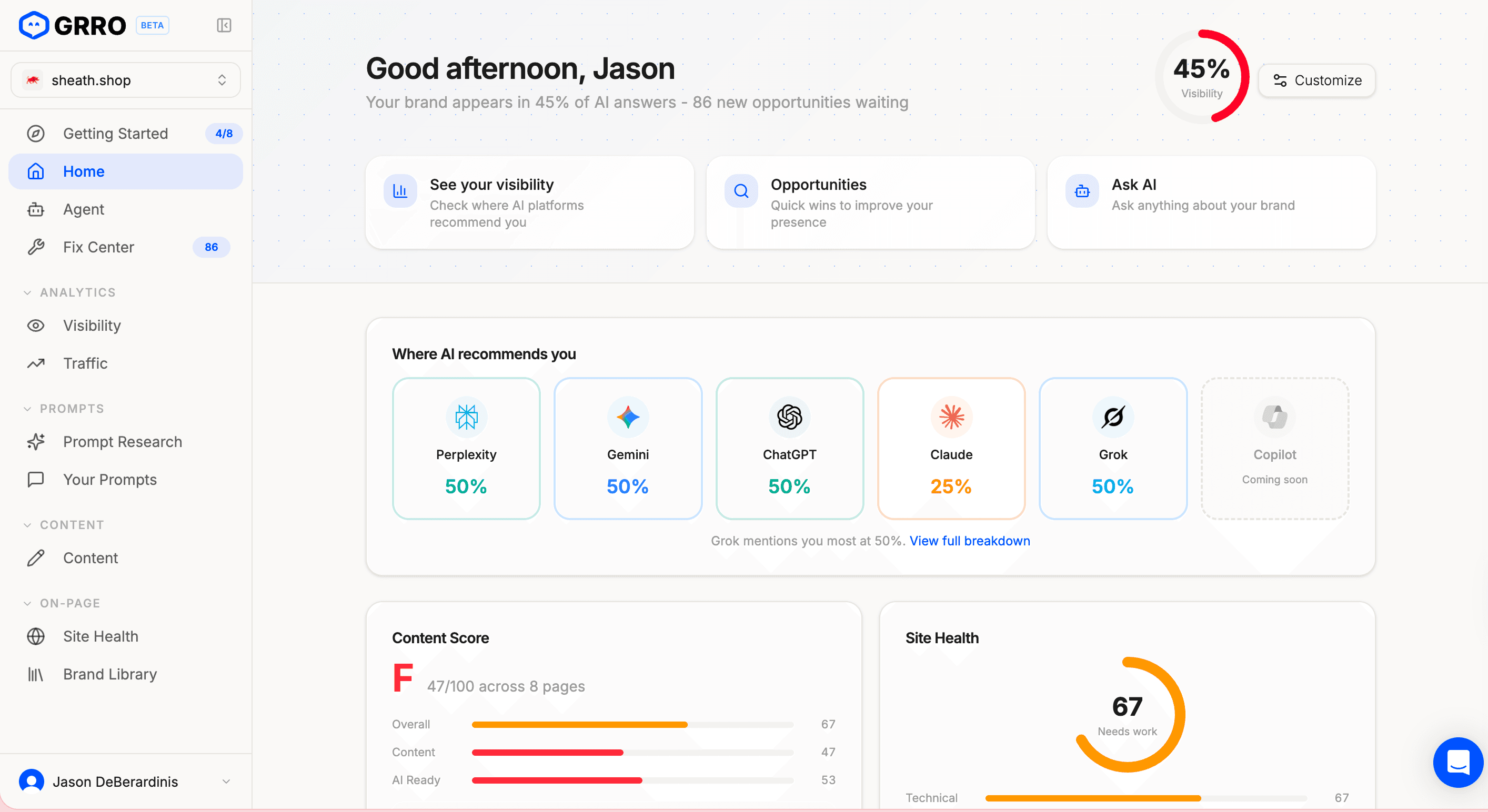
GRRO monitors your brand's visibility across all 5 major AI search engines in real time. Instead of manually checking each platform, you get an AI Recommendation Score that tells you exactly where you stand, which platforms are recommending you, which are not, and specifically what to fix.
The platform's technical optimization tools identify which of these 5 visibility gaps are affecting your brand, prioritize fixes by impact, and track your progress as you implement changes. You can start with a free scan at grro.io to see your current AI visibility in under 60 seconds.
FAQ
How long does it take to go from invisible to recommended by AI?
Most brands see measurable improvements within 30 to 60 days of implementing structured data and answer-first content. Building a full multi-source presence typically takes 60 to 90 days. Consistent brands can move from 0 to being recommended by 4 or more AI engines within one quarter.
Which AI search engine should I focus on first?
Start with where your customers are. For B2B, ChatGPT and Perplexity drive the most high-intent queries. For B2C and ecommerce, Google Gemini and Perplexity tend to have the highest volume. For brands targeting younger demographics, Perplexity and Grok are growing fastest.
Do I need to create entirely new content to be visible to AI?
No. Most brands see significant improvements by restructuring existing content to be answer-first and adding structured data. New content is primarily needed to fill gaps in your multi-source presence and address customer questions you are not currently answering.
Is AI search visibility different from traditional SEO?
Yes, fundamentally. Traditional SEO is about ranking in a list of 10 blue links. AI search visibility is about being the brand that AI engines recommend in a conversational answer. The signals are different, the content format is different, and the conversion dynamics are different. However, traditional search rankings still matter because AI engines use search results as source material.
How does GRRO measure AI visibility?
GRRO's prompt intelligence queries all 5 major AI search engines with the questions your customers actually ask, then tracks whether your brand is mentioned, your position in the response, the sentiment of the mention, and consistency across platforms. This data is combined into an AI Recommendation Score that gives you a single number to track your visibility over time.
Conclusion
97% of brands are invisible to AI search, but the fix is not mysterious. It comes down to 5 specific, addressable problems: missing structured data, content that is not answer-first, single-source presence, outdated content, and weak entity signals. Each one has a clear solution, and most brands can see measurable improvements within 30 to 90 days. The question is not whether AI search matters. With 800M+ weekly queries growing at 527% year over year, that question is settled. The question is whether your brand will be the one AI engines recommend, or whether your competitors will. Start with a free scan at grro.io to see exactly where you stand today.

Co-Founder & CMO at GRRO