The Content Structure AI Engines Love: How to Format for Recommendations
Content structure determines whether AI engines can extract and recommend your content. This tactical guide covers answer-first paragraphs, question-format headings, schema markup, and the specific formatting patterns that earn 340% more AI citations.
Key Takeaways
- Content with Key Takeaways blocks at the top sees a 340% improvement in AI citation rates compared to content without them
- Direct answer blocks of approximately 40 words placed at the start of each section are the single highest-impact formatting change for AI recommendations
- Question-format H2 headings match how users query AI engines, increasing the relevance score during the re-ranking stage
- Internal linking density of 25 to 35 links per post helps AI engines map your topical authority and content relationships
- Schema markup (FAQ, Article, HowTo) provides machine-readable structure that AI engines use to extract and recommend your content
Structure Is Not a Style Choice
When AI engines process your content through their retrieval pipeline, the structure of your content determines whether it survives to become a recommendation or gets discarded at the chunking and re-ranking stages. This is not about aesthetic preference. It is about mechanical compatibility with how AI systems extract information.
Content that follows the patterns in this guide gets recommended. Content that does not, no matter how accurate or well-researched, gets passed over in favor of competitors whose content is easier for the AI to parse.
Here is exactly how to structure content that AI engines can find, extract, and recommend.
Answer-First Paragraphs: The Foundation
The single most impactful structural change you can make is placing your direct answer in the first sentence of every section. AI engines evaluate content in chunks of 200 to 500 words. The re-ranking models that score those chunks heavily weight the opening sentences. If your answer is in sentence four, a competitor whose answer is in sentence one will win the recommendation.
What Answer-First Looks Like
Traditional structure (low AI recommendation potential): "When it comes to choosing the right email marketing platform, there are many factors to consider. Budget, features, ease of use, and integration capabilities all play important roles. Based on our extensive testing across dozens of platforms over the past year, we have identified several standouts. The best email marketing platform for small businesses is Mailchimp, starting at $13 per month."
Answer-first structure (high AI recommendation potential): "The best email marketing platform for small businesses is Mailchimp, starting at $13 per month with features that include automation, A/B testing, and e-commerce integrations. For businesses that need more advanced segmentation, Klaviyo at $20 per month provides superior targeting. Here is how we evaluated each platform."
The answer-first version delivers the core information in approximately 40 words. An AI engine extracting this chunk gets an immediately useful answer. The traditional version forces the AI to parse through 60 words of preamble before reaching the actual answer.
The 40-Word Direct Answer Block
Target approximately 40 words for your direct answer block. This is the sweet spot based on how AI engines extract information:
- Under 20 words: Too brief to be a complete answer, may be skipped for lacking context
- 30 to 50 words: Ideal range for a self-contained, extractable answer
- Over 80 words: Begins to dilute the directness that re-ranking models prefer
After the direct answer block, expand with supporting details, evidence, nuance, and context. The expansion is valuable for human readers and adds depth that helps the overall chunk score. But the direct answer must come first.
How to Restructure Existing Content
For each section of existing content:
- Identify the core answer the section provides
- Write that answer as a single, clear sentence
- Place it as the first sentence of the section
- Follow with 1 to 2 sentences of essential supporting detail
- Then continue with the full explanation
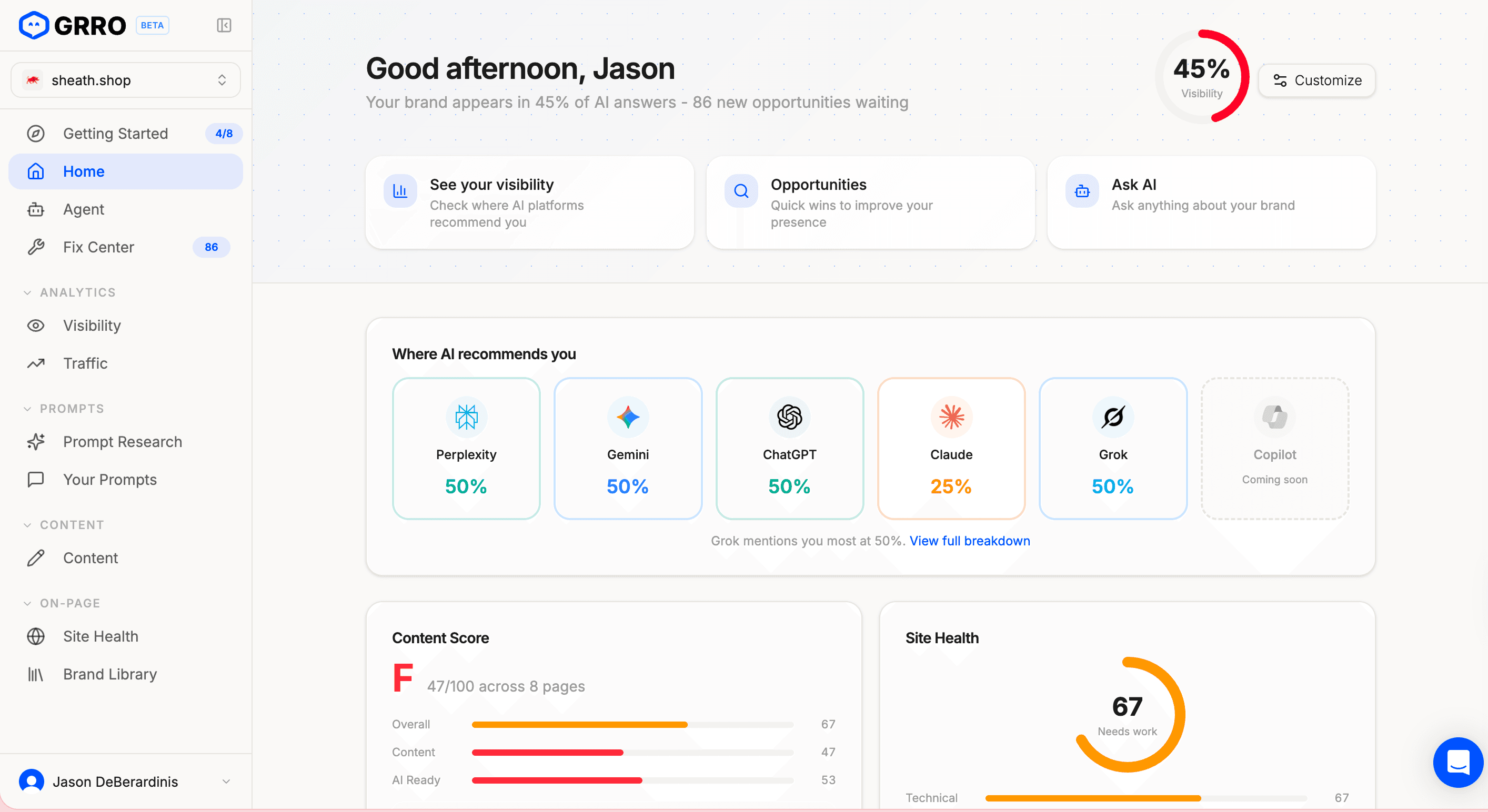
GRRO's content studio analyzes your existing pages and flags sections where the answer is buried, giving you a specific restructuring priority list.
Question-Format H2 Headings
AI engines match user queries to content sections. When a user asks ChatGPT "How much does CRM software cost?" the engine looks for content sections that directly address this question. A heading that reads "## How Much Does CRM Software Cost?" is a direct match. A heading that reads "## Pricing Overview" is a weak match that may lose to a competitor with better heading alignment.
Why Question Headings Work
The retrieval pipeline works by matching query intent to content sections. Question-format headings create explicit intent matches:
- User query: "What are the benefits of remote work?"
- Strong heading: "## What Are the Benefits of Remote Work?"
- Weak heading: "## Remote Work Benefits"
- Poor heading: "## Why You Should Consider Alternative Work Arrangements"
The strong heading is a near-exact match to the query. The re-ranking model scores this chunk higher for relevance because the heading signals that this section directly answers the user's question.
How to Generate Question Headings
Use these sources to find the exact questions your audience asks:
- AI engines themselves: Ask ChatGPT, Perplexity, and Gemini questions about your topic. Note how they phrase related questions.
- Google's "People Also Ask" boxes: These are real user queries that Google has identified as related to your topic.
- Answer the Public and similar tools: Generate question variations for your core topics.
- Customer support logs: The actual questions your customers ask are the most valuable source.
- Reddit and Quora: Find the exact phrasing users choose when asking about your topic.
Heading Hierarchy for AI Parsing
AI engines use heading hierarchy to understand content structure. Follow this pattern:
Your page should have a single H1 as the page title at the top. Below that, use H2 headings for each major question or topic section. Within each H2 section, use H3 headings for sub-questions or supporting details. This creates a clean, nested structure: one H1, then multiple H2s, each containing one or more H3s as needed.
Never skip heading levels (going from H1 directly to H3 without an H2 in between). Never use headings for visual styling purposes. AI engines interpret heading hierarchy as content structure, and incorrect hierarchy confuses the chunking process.
Lists, Tables, and Structured Formats
AI engines can extract structured information (lists, tables, comparison data) more reliably than unstructured prose. When your content includes comparative data, step-by-step processes, or categorical information, using structured formats dramatically increases your recommendation potential.
When to Use Bullet Lists
Use bullet lists for:
- Features and benefits (3 to 7 items)
- Criteria and requirements
- Quick comparisons
- Recommendations with brief explanations
For example, a section titled "What Features Should a CRM Have?" followed by a lead-in sentence and then a bullet list like this:
- Contact management for organizing customer data and interaction history
- Pipeline tracking to visualize deals from lead to close
- Email integration that syncs with Gmail or Outlook automatically
- Reporting with customizable dashboards for revenue and activity metrics
- Mobile access through native iOS and Android apps
When to Use Numbered Lists
Use numbered lists for:
- Step-by-step processes
- Ranked recommendations
- Sequential instructions
- Priority-ordered actions
For example, a section titled "How Do You Set Up Google Analytics 4?" followed by a numbered list:
- Create a Google Analytics account at analytics.google.com
- Set up a new GA4 property for your domain
- Create a data stream for your website
- Copy the measurement ID
- Add the tracking code to your site header or use Google Tag Manager
- Verify data collection in the Real-Time report within 24 hours
When to Use Tables
Use tables for:
- Product comparisons
- Pricing breakdowns
- Feature matrices
- Platform comparisons
For example, a section titled "How Do the Top CRMs Compare on Price?" followed by a comparison table:
| CRM | Starting Price | Free Tier | Best For |
|---|---|---|---|
| HubSpot | $20/month | Yes | Small businesses |
| Salesforce | $25/user/month | No | Enterprise |
| Pipedrive | $14/user/month | No | Sales teams |
| Zoho | $14/user/month | Yes | Budget-conscious |
Tables are particularly effective for AI recommendations because they present multiple data points in a machine-readable format. AI engines can extract specific rows or the entire table as a self-contained answer.
FAQ Sections: The Highest-Impact Addition
FAQ sections are one of the most effective structural elements for AI recommendations. They map directly to the question-answer format that AI engines use to generate responses.
Why FAQs Work So Well
When a user asks an AI engine a question, the engine is looking for content that is explicitly structured as a question followed by an answer. FAQ sections provide exactly this format. The question serves as the intent signal, and the answer provides the extractable content.
FAQ sections also benefit from FAQ schema markup, which makes them machine-readable beyond the HTML structure alone.
How to Build Effective FAQ Sections
Each FAQ entry should follow this structure:
Question: Phrased exactly as a user would ask it (natural language, not keyword-stuffed) Answer: 2 to 4 sentences that directly answer the question with specific information
Here is an example of what a well-structured FAQ section looks like in practice:
"How long does it take to see results from AI search optimization?" followed by: "Most businesses see initial improvements in AI visibility within 4 to 8 weeks of implementing answer-first content structure. Perplexity reflects changes fastest at 48 to 72 hours. ChatGPT and Gemini typically take 2 to 4 weeks. Full competitive positioning across all AI engines usually takes 6 to 12 months."
"What is the difference between AI search optimization and traditional SEO?" followed by: "Traditional SEO positions your content to rank on a search results page. AI search optimization positions your content to be recommended within an AI-generated answer. Both require authoritative content, but AI optimization additionally requires answer-first formatting, multi-source presence, and structured data that AI engines can parse and extract."
Include 3 to 7 FAQ entries per page. Focus on the questions your actual customers ask, which you can find in support tickets, sales calls, and the "People Also Ask" sections on Google.
Key Takeaways Blocks: 340% Citation Improvement
Content that begins with a Key Takeaways block sees a 340% improvement in AI citation rates. This is one of the most significant single-element findings in AI content optimization.
Why Key Takeaways Blocks Work
A Key Takeaways block provides the AI engine with 3 to 5 pre-summarized points before the full content begins. When the AI's re-ranking model evaluates the first chunk of your content, it encounters a section that is already in summary format: concise, specific, and directly useful.
This serves the AI's purpose perfectly. The engine is trying to generate a useful answer for the user. A pre-built summary of key points is exactly what it needs.
How to Format Key Takeaways
Place the Key Takeaways block immediately after your title (or after your frontmatter in a blog post). Use 3 to 5 bullet points, each containing a specific, standalone insight:
Here is an example of what effective Key Takeaways bullet points look like:
- AI search engines process 800M+ queries weekly with 527% YoY growth
- Only 3% of brands have any AI search strategy, leaving 97% invisible
- Answer-first content structure is the single highest-impact change
- Each AI engine uses different data sources requiring platform-specific tactics
- Businesses appearing in AI recommendations see 4.4x higher conversion rates
Each bullet should be independently meaningful. A bullet that says "Structure matters" is too vague. A bullet that says "Content with Key Takeaways blocks sees a 340% improvement in AI citation rates" is specific and extractable.
Entity Density and Topical Depth
AI engines build understanding through entities: recognizable names, concepts, products, and relationships. Content with higher entity density (more specific, named things) signals topical depth and authority to re-ranking models.
What Entity Density Means
Compare these two sentences:
Low entity density: "There are several good tools for managing projects that many teams use."
High entity density: "Asana, Monday.com, and Jira are the three most widely used project management platforms, with Asana leading at 24% market share among mid-size companies."
The second sentence contains 5 entities (Asana, Monday.com, Jira, project management platforms, mid-size companies) and a specific data point. AI engines can extract more useful information from it, cross-reference the entities against other sources, and use it as a basis for recommendations.
How to Increase Entity Density
- Name specific products, companies, and tools instead of using generic references
- Include specific numbers, percentages, and data points
- Reference industry frameworks, methodologies, and standards by name
- Mention specific people (experts, founders, researchers) when relevant
- Use precise terminology rather than general descriptions
Do not force entity density to the point where content becomes unreadable. The goal is specificity, not keyword stuffing. Every entity should be there because it adds real information.
Schema Markup: Machine-Readable Structure
Schema markup is the technical implementation layer that makes your content structure explicitly machine-readable. While AI engines can parse HTML, schema markup removes ambiguity and provides structured data that the retrieval pipeline can process more efficiently.
Essential Schema Types for AI Recommendations
FAQ Schema tells search engines and AI that your page contains question-and-answer pairs. It defines the page as an FAQ, then lists each question along with its accepted answer. For example, your FAQ schema would include a question like "How long does AI search optimization take to show results?" paired with its direct answer text.
Article Schema identifies your content as a published article. It includes your headline, author name (person or organization), publication date, last modified date, and a brief description. This helps AI engines understand the context and freshness of your content.
HowTo Schema marks step-by-step instructional content. It includes the name of the process (for example, "How to Audit Your AI Search Visibility") followed by each step with a title and description. This is ideal for tutorial and process-oriented content.
Implementation Priority
- FAQ schema on every page with question-and-answer content (highest impact)
- Article schema on every blog post and content page
- Organization schema on your homepage
- HowTo schema on tutorial and process content
- Product schema on product and pricing pages
GRRO's technical optimization tools scan your site for schema implementation gaps and provide the exact markup code to add.
Internal Linking: 25 to 35 Links Per Post
Internal linking density is a structural signal that AI engines use to understand your topical authority and the relationships between your content. Pages with 25 to 35 internal links demonstrate a comprehensive content ecosystem that AI engines interpret as a sign of depth and authority.
Why Internal Linking Matters for AI
When an AI engine crawls and chunks your content, internal links serve multiple purposes:
- Topical mapping: Internal links tell the AI engine what other topics you cover and how they relate
- Authority signals: A page that links to 30 related pages on your site signals that you have comprehensive coverage of the subject
- Discovery: AI crawlers follow internal links to find additional content to index
- Entity relationships: Links between pages help AI engines understand how concepts in your domain connect
How to Implement
- Link to relevant blog posts using descriptive anchor text that includes the target page's topic
- Link to product and feature pages where naturally relevant
- Link to foundational/pillar content from supporting articles
- Link to recent content from older posts (update older posts regularly)
- Use a mix of contextual links (within paragraphs) and navigation links (in "related reading" sections)
For example, throughout this article you will find links to our other guides:
- How to get recommended by ChatGPT, Perplexity, and Claude for the overall strategy
- How AI search engines decide what to recommend for the technical pipeline
- How each AI engine recommends differently for platform-specific tactics
- What AI search optimization is for the foundational concepts
- What 800 million weekly queries mean for your business for the industry context
Each link uses descriptive anchor text and points to a genuinely related resource. This is the pattern to follow.
Putting It All Together: A Content Template
Here is the complete structural template that incorporates every element discussed in this guide:
- Start with a question-format title as your H1.
- Add a Key Takeaways section immediately after the title with 3 to 5 bullet points, each containing a specific insight backed by a data point.
- For each major section, use a question-format H2 heading. Open with a 40-word direct answer block, then expand with a paragraph of 150 to 300 words that includes specific data, entity names, and context.
- Within each section, use H3 sub-headings for sub-questions. Each H3 should lead with a direct answer followed by supporting detail and internal links to related content.
- Use structured formats (bullet lists, numbered lists, and tables) wherever comparative data or step-by-step processes appear.
- Add an FAQ section with 3 to 7 entries. Each entry uses a question phrased exactly as users would ask it, followed by a 2 to 4 sentence direct answer with specific information.
- Close with a Conclusion that summarizes the key points and includes a call to action.
Every section is self-contained. Every heading is a question or clear topic. Every section leads with a direct answer. The Key Takeaways block provides an immediate summary. The FAQ section mirrors user queries. Schema markup makes it all machine-readable.
FAQ
How many words should each blog post be for AI recommendations?
The optimal length is 1,500 to 3,000 words. Shorter content often lacks the depth that AI re-ranking models look for. Longer content can dilute the signal-to-noise ratio. Within that range, every section should be 150 to 300 words and independently extractable. Quality and structure matter more than hitting a specific word count.
Do I need to restructure all my existing content?
Start with your top 20 pages by traffic and relevance. Restructuring these pages to follow answer-first formatting, add Key Takeaways blocks, and implement schema markup will give you the highest return on effort. Then work through the rest of your content library systematically. The GRRO content scoring tool prioritizes which pages to restructure first based on their current AI readability score and traffic potential.
Will answer-first formatting hurt my engagement metrics?
No. Studies consistently show that answer-first content performs as well or better than traditional content for engagement metrics like time on page and bounce rate. Users who get their answer quickly are more likely to continue reading for depth and nuance, not less. They trust the content more because it respects their time.
How important is schema markup compared to content structure?
Content structure (answer-first paragraphs, question headings, lists, and tables) has a higher direct impact on AI recommendations than schema markup alone. However, schema markup amplifies the impact of good structure by making it explicitly machine-readable. Implement both. If you must prioritize, fix content structure first, then add schema markup.
Can I use AI tools to help restructure my content?
Yes, but with an important caveat. AI tools can help identify where your content buries answers, suggest question-format headings, and generate initial FAQ entries. However, the factual content, specific data points, expert insights, and unique perspectives must come from your team's genuine expertise. AI engines are increasingly sophisticated at identifying generic AI-generated content and deprioritizing it in favor of content with genuine expertise signals.
Conclusion
Content structure is the mechanical layer that determines whether AI engines can find, extract, and recommend your content. The formatting choices you make, answer-first paragraphs, question-format headings, Key Takeaways blocks, structured lists and tables, FAQ sections, and schema markup, are not cosmetic preferences. They are the technical requirements for surviving the AI retrieval pipeline.
The data supports this: Key Takeaways blocks produce a 340% improvement in citation rates. Direct answer blocks of approximately 40 words maximize extraction success. Internal linking density of 25 to 35 links maps your topical authority for AI crawlers.
Apply these patterns to your existing content starting with your highest-traffic pages. Use the GRRO content scoring tool to identify which pages need the most structural work and track your improvement as AI engines begin recommending your restructured content. The gap between well-structured content and poorly structured content is the gap between being recommended and being invisible.

Co-Founder & CMO at GRRO