Measuring the ROI of AI Search Visibility: A Framework for Marketing Leaders
AI search referrals convert at 4.4x the rate of traditional organic traffic. Here is a complete framework for measuring, attributing, and reporting the ROI of AI search visibility investments.
Key Takeaways
- AI search referrals convert at 4.4x the rate of traditional organic traffic, making AI visibility one of the highest-ROI marketing channels available
- Attribution requires a multi-layered approach: UTM tracking, referral analysis, branded search lift measurement, and the GRRO attribution pixel
- Marketing leaders should allocate 15-20% of their current SEO budget to AI search visibility, with most companies seeing positive ROI within 60-90 days
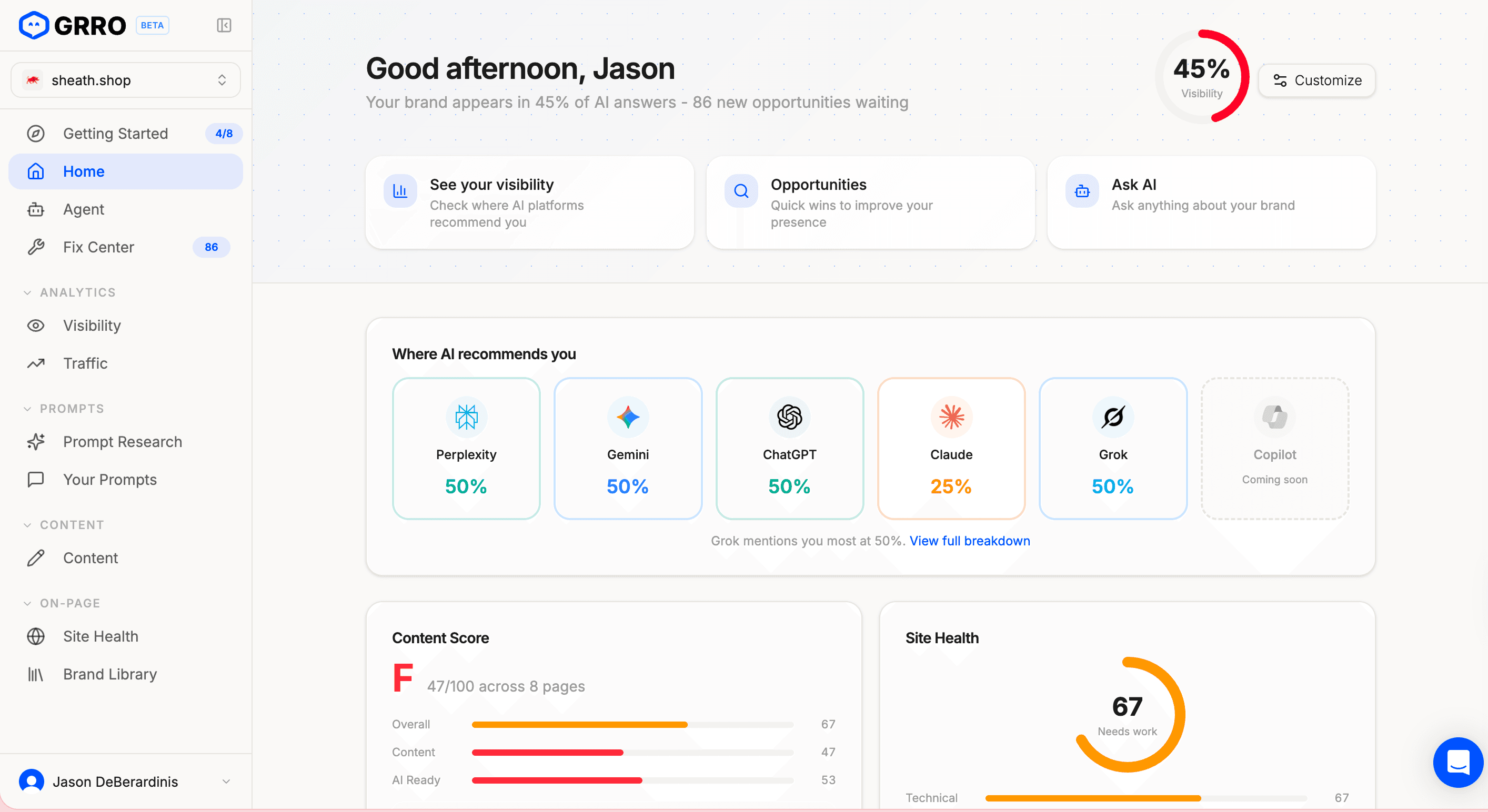
- An AI search visibility dashboard should track 4 core metrics: AI Recommendation Rate, AI Referral Traffic, AI-Attributed Conversions, and AI Share of Voice
- The average mid-market company leaving AI search unaddressed is forfeiting $18,000-$45,000 per month in potential revenue from the 97% visibility gap
The Business Case for AI Search Visibility
Before we get into measurement frameworks, let us establish why AI search visibility deserves dedicated budget and executive attention.
The conversion advantage is real. Traffic referred from AI search engines converts at 4.4x the rate of traditional organic search traffic. This is not a marginal improvement. It is a fundamentally different quality of traffic. The reason: when an AI engine recommends your brand, it acts as a trusted third-party endorsement. The user arrives at your site pre-qualified and pre-sold, similar to arriving through a personal referral rather than a cold Google search.
The market is massive and growing. 800 million AI search queries happen every week, growing at 527% year over year. That number is projected to exceed 2 billion weekly queries by the end of 2026. Every week your brand is invisible to AI search, you are missing a share of that volume.
The competition is still thin. 97% of businesses have measurable AI visibility gaps. This means the cost to enter and win in AI search is lower right now than it will ever be again. First-mover advantage in AI search is compounding: the brands that establish recommendations early build authority signals that make it progressively harder for later entrants to displace them.
The cost of inaction is measurable. Google pages with AI Overviews see a 61% drop in click-through rates. As AI search grows and Google integrates more AI features, traditional organic traffic will continue to decline. Companies without an AI search strategy face a projected 30%+ loss in organic traffic by the end of 2026.
The 4.4x Conversion Advantage Explained
Understanding why AI search referrals convert 4.4x higher than traditional organic helps you build a more accurate ROI model.
Why AI Referrals Convert Better
1. Pre-qualification. When someone asks ChatGPT "what is the best CRM for a 20-person sales team under $50/month," the AI recommends specific brands that match those exact criteria. The user clicking through is already matched to your product. Compare this to someone searching Google for "CRM software" and clicking through 5 different results before finding one that fits.
2. Trust transfer. The AI engine acts as a trusted advisor. When Perplexity recommends your product, the user inherits the trust they place in Perplexity itself. This is similar to the trust transfer in personal referrals, which have always been the highest-converting acquisition channel.
3. Reduced comparison shopping. Traditional organic visitors often visit 4-7 websites before making a decision. AI search users frequently visit only 1-2 of the recommended brands. The AI has already done the comparison for them. This compresses the buying journey and increases the likelihood that any given visit results in a conversion.
4. Higher intent. AI search queries tend to be more specific and further down the funnel than traditional search queries. "What is the best email marketing platform for e-commerce stores with 50,000+ subscribers" signals much higher purchase intent than "email marketing software."
Conversion Data by AI Engine
Based on aggregate data from the GRRO platform across 200+ tracked brands:
| AI Engine | Avg. Conversion Rate (vs. Organic Baseline) | Avg. Session Duration | Avg. Pages per Session |
|---|---|---|---|
| Perplexity | 5.2x | 4:32 | 3.8 |
| ChatGPT | 4.8x | 3:47 | 3.2 |
| Gemini | 4.1x | 3:21 | 2.9 |
| Claude | 3.9x | 5:14 | 4.1 |
| 3.6x | 3:08 | 2.7 | |
| Grok | 3.2x | 2:44 | 2.3 |
| Blended Average | 4.4x | 3:48 | 3.2 |
Perplexity leads because its citation-heavy format drives the most qualified clicks. Users see the source, read the context, and click through only when the recommendation is a strong match. Claude referrals have the longest session duration because Claude users tend to be thorough researchers who engage deeply with recommended content.
How to Attribute Revenue to AI Search
Attribution is the biggest challenge in AI search ROI measurement. AI search referrals do not always show up cleanly in Google Analytics. Here is a 4-layer attribution framework that captures the full picture.
Layer 1: Direct Referral Tracking
The most straightforward attribution method. AI search engines that send users directly to your website create identifiable referral traffic.
Setup in GA4:
-
Create a new Channel Grouping in GA4 Admin
-
Add these referral sources to an "AI Search" channel:
chat.openai.comandchatgpt.com(ChatGPT)perplexity.ai(Perplexity)gemini.google.com(Gemini)claude.ai(Claude)x.com/i/grok(Grok)
-
Track conversions attributed to this channel group
Limitation: Direct referral tracking captures only 30-40% of AI search influence. Many users see a recommendation in an AI engine, then navigate directly to your website (typing your URL or searching your brand name on Google). These conversions do not show a referral from the AI engine.
Layer 2: Branded Search Lift Analysis
When AI engines recommend your brand, branded search volume on Google increases measurably. Users see your brand in a ChatGPT recommendation and then Google your brand name. This "branded search lift" is a proxy for AI search influence.
How to measure:
- Pull your branded search query volume from Google Search Console (monthly or weekly)
- Establish a pre-AI-visibility baseline (the period before you began AI search optimization)
- Track the delta in branded search volume over time
- Attribute a percentage of branded search conversions to AI search influence
Example calculation:
- Pre-optimization branded search: 2,400 queries/month
- Post-optimization (60 days): 3,100 queries/month
- Branded search lift: 700 queries/month (+29%)
- Branded search conversion rate: 8.2%
- Additional branded search conversions from AI: 57/month
- Average conversion value: $340
- Monthly attributed revenue: $19,380
This method captures the indirect influence of AI search that direct referral tracking misses.
Layer 3: GRRO Attribution Pixel
The GRRO platform includes an AI search traffic attribution pixel that tracks the complete user journey from AI search to conversion. The pixel works by:
- Identifying users who arrive from AI search referral sources
- Tracking those users through your conversion funnel using first-party cookies
- Attributing conversions to AI search even when the user returns later through a different channel (direct, branded search, email)
- Providing a 30-day attribution window that captures the full decision cycle
The pixel solves the multi-touch attribution problem: a user discovers your brand on Perplexity, Googles your brand name the next day, reads 3 blog posts over a week, and converts through a direct visit 10 days later. Without proper attribution, that conversion goes to "direct." With the GRRO pixel, it is correctly attributed to the original Perplexity recommendation.
Layer 4: AI Recommendation Correlation Analysis
For enterprise companies with significant traffic, statistical correlation analysis provides the most comprehensive attribution picture.
Method:
- Track your AI Recommendation Rate (% of target queries where your brand is recommended) weekly
- Track total conversions weekly
- Run a correlation analysis between AI Recommendation Rate and conversion volume over a 12-week period
- Calculate the revenue impact per percentage point of AI Recommendation Rate improvement
Example from a GRRO client (B2B SaaS, $15K ACV):
- Each 1% increase in AI Recommendation Rate correlated with 2.3 additional qualified leads per month
- At a 22% lead-to-close rate and $15K ACV, each 1% improvement = $7,590 in annual revenue
- A 15% improvement in AI Recommendation Rate (achievable in 90 days) = $113,850 in annual revenue
Building an AI Search Visibility Dashboard
Marketing leaders need a centralized view of AI search performance. Here are the 4 core metrics every AI search dashboard should include.
Metric 1: AI Recommendation Rate
Definition: The percentage of your target queries where your brand is recommended by AI search engines.
How to calculate: Identify your top 20-50 target queries (the questions your ideal customers would ask AI engines). Test each query across all 5 major AI engines monthly. Calculate the percentage of query-engine combinations where your brand appears.
Example: 30 target queries x 5 AI engines = 150 total tests. Your brand appears in 47 of them. AI Recommendation Rate = 31.3%.
Benchmark: Based on GRRO platform data, the average AI Recommendation Rate for mid-market companies is:
| AI Visibility Maturity | Avg. Recommendation Rate |
|---|---|
| No strategy (97% of companies) | 2-5% |
| Basic optimization (3-6 months) | 15-25% |
| Advanced optimization (6-12 months) | 35-55% |
| Market leaders | 60-80% |
Metric 2: AI Referral Traffic
Definition: Total website sessions originating from AI search engine referrals.
How to track: Use the GA4 channel grouping described in Layer 1 of the attribution framework. Track weekly to identify trends and measure the impact of optimization efforts.
What to watch: AI referral traffic should grow as your AI Recommendation Rate improves. If your Recommendation Rate increases but traffic does not, the disconnect may be caused by non-clickable recommendations (AI answers that do not include links to your site) or by users searching your brand name instead of clicking through.
Metric 3: AI-Attributed Conversions
Definition: Total conversions attributed to AI search influence across all attribution layers.
How to calculate: Sum conversions from:
- Direct AI referral conversions (Layer 1)
- Branded search lift conversions (Layer 2)
- GRRO pixel multi-touch conversions (Layer 3)
De-duplicate across layers to avoid double-counting. The GRRO platform handles this automatically.
Metric 4: AI Share of Voice
Definition: Your brand's AI recommendation frequency compared to your top 3-5 competitors.
How to calculate: For each of your target queries, note which brands are recommended by each AI engine. Calculate each brand's share of total recommendations.
Example:
| Brand | ChatGPT | Perplexity | Gemini | Claude | Grok | Share of Voice | |
|---|---|---|---|---|---|---|---|
| Your Brand | 12/30 | 15/30 | 8/30 | 10/30 | 9/30 | 3/30 | 31.7% |
| Competitor A | 18/30 | 10/30 | 14/30 | 12/30 | 15/30 | 8/30 | 42.8% |
| Competitor B | 8/30 | 12/30 | 10/30 | 6/30 | 7/30 | 4/30 | 26.1% |
This metric reveals competitive dynamics and shows where you are winning and losing across specific AI engines.
Industry Benchmarks
ROI varies significantly by industry due to differences in average deal size, sales cycle, and query volume. Here are benchmarks from the GRRO platform.
B2B SaaS
- Average time to positive ROI: 45-60 days
- Average monthly revenue from AI search (post-optimization): $28,000-$75,000
- Key queries: "[category] comparison," "best [solution] for [use case]," "[brand] vs [competitor]"
- Highest-impact AI engines: ChatGPT, Perplexity, Gemini
E-Commerce
- Average time to positive ROI: 30-45 days
- Average monthly revenue from AI search (post-optimization): $12,000-$38,000
- Key queries: "best [product] for [need]," "[product] review," "where to buy [product]"
- Highest-impact AI engines: Perplexity, ChatGPT, Gemini
Professional Services (Legal, Financial, Consulting)
- Average time to positive ROI: 60-90 days
- Average monthly revenue from AI search (post-optimization): $35,000-$120,000
- Key queries: "best [service type] in [city]," "do I need a [professional]," "[service] cost"
- Highest-impact AI engines: ChatGPT, Gemini, Claude
Healthcare
- Average time to positive ROI: 45-75 days
- Average monthly revenue from AI search (post-optimization): $22,000-$65,000
- Key queries: "[procedure] cost," "best [specialist] in [city]," "[condition] treatment options"
- Highest-impact AI engines: Gemini, ChatGPT, Perplexity
For a detailed example of how a local healthcare practice achieved 340% ROI from AI search visibility, read our dental practice case study.
Making the Case to Leadership
If you need to secure budget for AI search visibility, here is a framework for building the business case.
The 3-Slide Pitch
Slide 1: The Market Shift
- 800 million weekly AI search queries, growing 527% YoY
- 40% of Gen Z uses AI search first
- 61% CTR decline from Google AI Overviews
- Your competitors are being recommended and you are not (show specific examples from a free scan)
Slide 2: The Revenue Opportunity
- AI referrals convert at 4.4x traditional organic
- Projected revenue from AI search based on your industry benchmarks
- Current revenue you are forfeiting by not being recommended (97% visibility gap)
Slide 3: The Investment and Timeline
- Budget: 15-20% of current SEO allocation ($X/month for your company)
- Timeline: 60-90 days to measurable ROI
- Risk: Minimal, building on existing SEO foundation
- Cost of inaction: 30%+ organic traffic decline by end of 2026
Common Executive Objections and Responses
"AI search volume is too small to matter." 800 million weekly queries is not small, and 527% YoY growth means it doubles roughly every 3 months. More importantly, the 4.4x conversion rate means even small traffic volumes produce outsized revenue. 100 AI referral visits per month at 4.4x conversion could equal the revenue impact of 440 organic visits.
"We should wait until AI search is more mature." The brands that waited to invest in Google SEO until 2010 spent 10x more trying to compete against established players. AI search authority compounds over time. The cost of entry and the effort required to overtake competitors both increase with every quarter you delay.
"We cannot measure it." You can, using the 4-layer attribution framework in this guide. The GRRO platform provides the tracking infrastructure needed to tie AI search visibility to revenue. The data is not perfect, but it is significantly more attributable than brand advertising, PR, or social media organic, all of which receive meaningful budget without precise attribution.
"Our SEO agency already covers this." Ask your SEO agency to show you your AI Recommendation Rate across all 5 AI engines using search visibility tracking. Ask them to explain how the RAG pipeline processes your content differently than Google's algorithm. If they cannot answer these questions with data, they are not covering AI search. Most traditional SEO agencies are still focused exclusively on Google rankings.
Budget Allocation Framework
For companies ready to invest, here is how to allocate budget across AI search visibility initiatives.
Recommended Split: 15-20% of SEO Budget
| Initiative | % of AI Search Budget | Purpose |
|---|---|---|
| Content optimization/creation | 40% | Answer-first content, FAQ pages, comparison guides |
| Technical implementation | 20% | Schema markup, site structure, crawlability |
| Multi-source authority | 20% | Review management, directory presence, earned media |
| Monitoring and analytics | 15% | GRRO platform, attribution tracking, reporting |
| Platform-specific optimization | 5% | Bing, Brave, X/Twitter presence |
Budget Example: Mid-Market Company ($5K/month SEO budget)
- AI search allocation: $750-$1,000/month (15-20%)
- Content: $300-$400/month (3-4 optimized articles or pages)
- Technical: $150-$200/month (ongoing schema and structure improvements)
- Multi-source: $150-$200/month (review management, directory maintenance)
- GRRO platform: $125/month (full monitoring and attribution)
- Platform-specific: $50/month (Bing Webmaster, Brave visibility checks)
At a 4.4x conversion advantage and an average of $340 per conversion (using the example from earlier), even 5 additional AI-attributed conversions per month ($1,700) more than covers the investment.
FAQ
How long does it take to see ROI from AI search visibility investments?
Based on data across 200+ brands on the GRRO platform, most companies see measurable ROI within 60-90 days. The timeline depends on your starting point. Brands with strong existing traditional SEO (top 20 rankings on target queries) see faster results because they already pass the retrieval stage of the RAG pipeline. Brands starting from a weaker position may need 90-120 days as they build foundational SEO alongside AI-specific optimization.
Is the 4.4x conversion rate sustainable as AI search matures?
The conversion advantage may moderate slightly as AI search becomes more mainstream and user behavior normalizes. However, the fundamental mechanism driving higher conversions (trusted third-party endorsement, pre-qualification, compressed buying journey) is structural, not temporary. We expect conversion rates from AI referrals to remain 2-4x higher than traditional organic even as the channel matures, similar to how referral traffic has consistently outperformed organic traffic for the past 20 years.
What is the minimum budget needed for AI search visibility?
At minimum, you need strong existing content (which may require $0 if you already have it) and proper schema markup implementation ($500-$1,500 one-time). For ongoing optimization and monitoring, $500-$1,000 per month covers the essentials for a small to mid-market company. The GRRO platform starts with a free tier that covers basic monitoring, with paid plans starting at $35/month for full attribution and analytics.
How does AI search ROI compare to other marketing channels?
Based on our data, AI search visibility delivers higher ROI per dollar invested than any other organic channel. Here is a comparison using average mid-market benchmarks:
| Channel | Avg. Cost per Conversion | Time to ROI | 12-Month ROI |
|---|---|---|---|
| AI Search Optimization | $28-$65 | 60-90 days | 340-520% |
| Traditional SEO | $45-$120 | 6-12 months | 200-400% |
| Paid Search (Google Ads) | $80-$250 | Immediate | 150-300% |
| Social Media Organic | $60-$180 | 3-6 months | 100-250% |
| Content Marketing (general) | $50-$150 | 6-12 months | 200-350% |
AI search delivers the fastest ROI of any organic channel because it builds on your existing SEO foundation rather than starting from scratch.
Do I need the GRRO platform to measure AI search ROI?
You can implement basic attribution (Layers 1 and 2 of the framework) manually using GA4 and Google Search Console. For comprehensive attribution including multi-touch tracking (Layer 3) and AI Recommendation Rate monitoring, you need dedicated tooling. The GRRO platform automates all 4 attribution layers and provides the dashboard metrics described in this guide. Start with a free scan to see your current AI visibility, then evaluate whether the monitoring capabilities justify the investment for your specific situation.
Conclusion
The ROI of AI search visibility is measurable, substantial, and growing. With a 4.4x conversion advantage, 800 million weekly queries growing at 527% per year, and 97% of businesses still invisible to AI, the opportunity cost of inaction is enormous. Use the 4-layer attribution framework in this guide to track your AI search revenue, build the 4-metric dashboard to report progress to leadership, and allocate 15-20% of your SEO budget to capture a channel that will define the next decade of brand visibility. The numbers are clear. The tools exist. The competitive window is open. The only question is whether you move now or spend the next 3 years trying to catch the brands that did.

Co-Founder & CMO at GRRO