AI Search Optimization Tools: The Complete Comparison (2026)
A detailed comparison of the top AI search optimization tools in 2026, including GRRO, Otterly, Profound, WriteSonic, and more. Features, pricing, pros, cons, and who each tool is best for.

Key Takeaways
- AI search optimization tools help brands monitor and improve their visibility across AI engines like ChatGPT, Perplexity, Gemini, Claude, and Grok
- The market has matured from a handful of early movers to more than a dozen tools, each with a different focus area
- The most important features to evaluate are multi-engine tracking, content scoring, competitor benchmarking, actionable recommendations, and pricing transparency
- No single tool is perfect for every business, so your ideal choice depends on your team size, budget, and whether you need monitoring, optimization, or both
- This guide compares 10 tools head to head with feature tables, pricing, and honest assessments of strengths and weaknesses
Why You Need an AI Search Optimization Tool
AI search is no longer a curiosity. With over 800 million weekly AI search queries and 527% year-over-year growth, AI engines have become a primary discovery channel for consumers and businesses alike. The brands that show up in AI-generated answers capture disproportionate attention and trust. The brands that do not show up are invisible.
The problem is that monitoring AI visibility manually is impractical. You cannot simply type 50 queries into ChatGPT every morning and track whether your brand gets mentioned. The responses change constantly, vary by context, and differ across engines. You need automated, scalable monitoring to understand where you stand and what to improve.
That is what AI search optimization tools do. They automate the process of tracking, analyzing, and improving your brand's presence across AI engines. But the tools in this space vary dramatically in scope, quality, and approach.
This comparison will help you make an informed decision. We have tested each tool, documented its features, and assessed its strengths and weaknesses so you can choose the right one for your situation.
If you are new to AI search optimization, start with our complete guide to AI search optimization before diving into the tool comparison.
What to Look for in an AI Search Optimization Tool
Before comparing individual tools, it helps to understand the feature categories that matter most.
Multi-Engine Tracking
The most critical feature. AI search is not a single channel. ChatGPT, Perplexity, Gemini, Claude, and Grok each use different retrieval methods, data sources, and recommendation patterns. A tool that only tracks one or two engines gives you an incomplete picture. The best tools track all five major engines and report visibility per engine.
Content Scoring and Analysis
Knowing that you are invisible is only the first step. You need to know why. Content scoring tools analyze your pages against the signals AI engines prioritize: answer-first formatting, heading structure, FAQ sections, schema markup, freshness signals, and readability. The best tools give you a per-page score with specific recommendations. For more on what these signals are, see our deep dive on how AI engines decide what to recommend.
Competitor Benchmarking
Understanding your own visibility in isolation is not enough. You need to know which competitors are getting recommended instead of you, which queries they are winning, and what they are doing differently. Competitor benchmarking turns abstract visibility scores into competitive intelligence.
Actionable Recommendations
Data without direction is noise. The best tools translate visibility data into prioritized action plans: which pages to restructure, which queries to target, which content gaps to fill, and which authority signals to build.
Reporting and Integration
If you work with a team or report to stakeholders, you need clean reports, API access, or integrations with your existing marketing stack. Some tools excel here while others are purely dashboards.
The 10 Tools Compared
Here is a detailed breakdown of the major AI search optimization tools available in 2026.
1. GRRO
Website: grro.io Focus: Full-stack AI search visibility platform
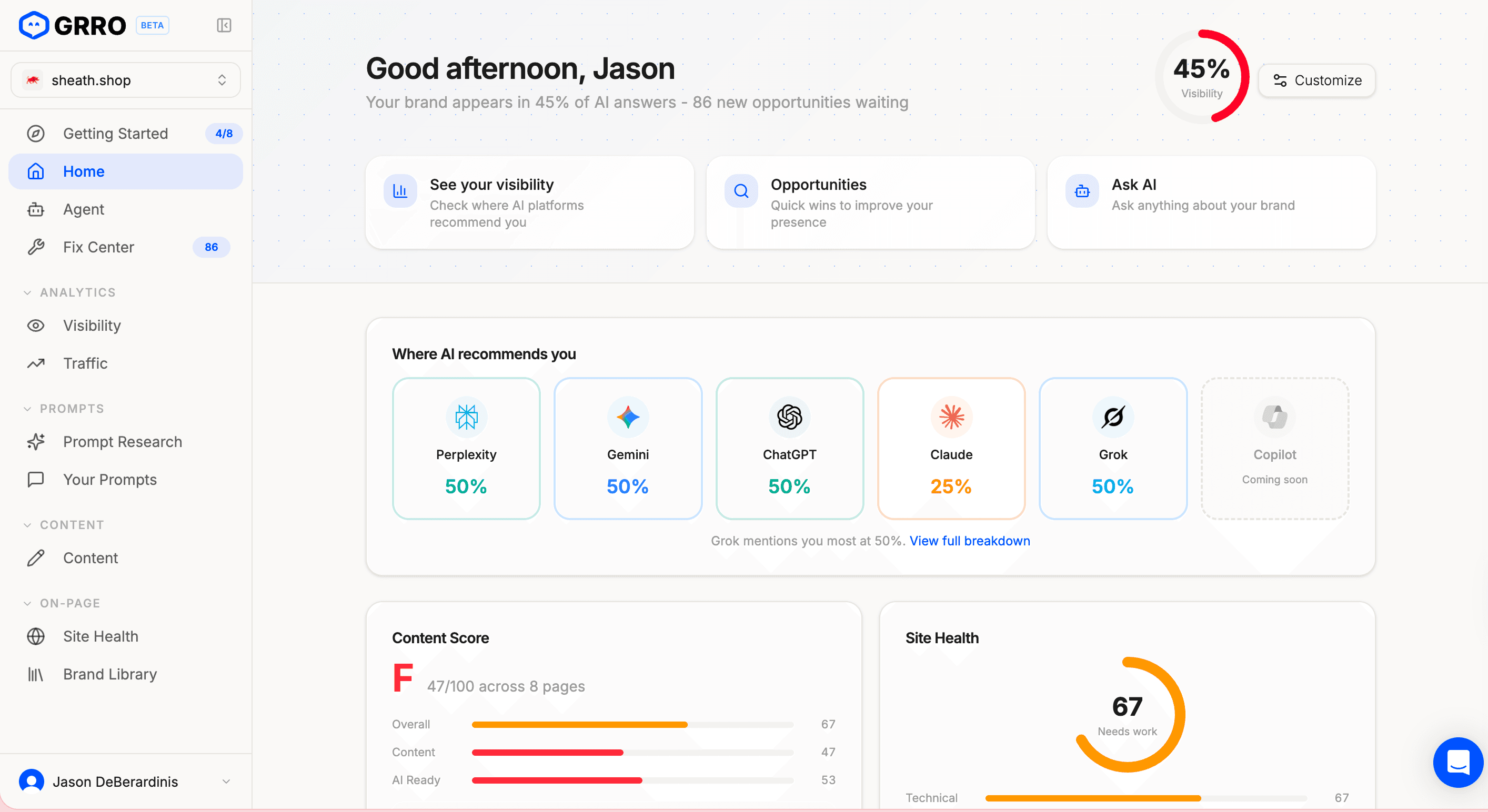
GRRO tracks brand visibility across all five major AI engines (ChatGPT, Perplexity, Gemini, Claude, and Grok) and provides a unified AI Recommendation Score. The platform combines search visibility monitoring with content studio analysis, competitor benchmarking, and a prioritized action plan.
GRRO's differentiator is that it treats AI search as a distinct channel with its own optimization framework rather than bolting AI tracking onto an existing SEO tool. The content studio evaluates pages specifically for AI readability, and the technical optimization engine provides step-by-step guidance on what to change and why.
Best for: Businesses that want a dedicated AI search visibility platform with monitoring, content scoring, and actionable recommendations in one place.
2. Otterly.ai
Website: otterly.ai Focus: AI search monitoring and brand tracking
Otterly focuses on monitoring brand mentions and sentiment across AI search engines. It tracks how often your brand appears in AI-generated responses and whether the sentiment is positive, neutral, or negative. The tool provides weekly reports with visibility trends over time.
Otterly's strength is its monitoring depth. It captures not just whether you are mentioned but the context of the mention and the specific claims AI engines make about your brand. This is valuable for reputation management and brand positioning.
Best for: Brands primarily concerned with monitoring AI mentions and managing brand reputation across AI engines.
3. Profound
Website: profound.ai Focus: AI search analytics and citation tracking
Profound specializes in tracking citations across AI search results. It identifies which sources AI engines cite when answering queries related to your brand or industry, helping you understand the competitive landscape of AI citations. The tool provides detailed citation maps showing which domains get referenced most frequently.
Best for: Enterprise teams and agencies that need deep citation analytics and want to understand the source graph behind AI recommendations.
4. WriteSonic (Chatsonic AI SEO)
Website: writesonic.com Focus: AI content creation with optimization
WriteSonic's Chatsonic module combines AI content generation with optimization scoring. It helps you write content that is structured for both traditional search and AI search engines. The tool generates drafts with answer-first formatting, proper heading structures, and FAQ sections built in.
WriteSonic is more of a content creation tool than a monitoring platform. If your primary need is writing new content optimized for AI search, it is a strong option. If you need visibility tracking and competitive intelligence, you will need to pair it with a monitoring tool.
Best for: Content teams that need to produce high volumes of AI-optimized content and want generation and optimization in one workflow.
5. Semrush (AI Toolkit)
Website: semrush.com Focus: Traditional SEO suite with AI search add-ons
Semrush has added AI search features to its existing platform, including AI Overview tracking and content optimization recommendations. The advantage is that it integrates with the broader Semrush ecosystem of keyword research, backlink analysis, and site auditing.
The limitation is that AI search tracking is an add-on rather than the core product. The AI-specific features are less developed than dedicated tools, and the platform still fundamentally approaches optimization from a traditional SEO mindset.
Best for: Teams already using Semrush for SEO that want basic AI search visibility without adding another tool to their stack.
6. Ahrefs (AI Search Features)
Website: ahrefs.com Focus: SEO platform with emerging AI search data
Ahrefs has begun incorporating AI search data into its platform, particularly around AI Overview appearances and click-through rate changes. Like Semrush, Ahrefs approaches AI search from a traditional SEO foundation, which means the data is presented through an SEO lens.
Best for: Existing Ahrefs users who want to add basic AI search context to their SEO workflow.
7. Peec AI
Website: peec.ai Focus: AI brand monitoring with sentiment analysis
Peec AI focuses on brand monitoring across AI engines with a strong emphasis on sentiment analysis and competitive positioning. The tool tracks how AI engines describe your brand relative to competitors and flags changes in sentiment or positioning.
Best for: Brand managers and PR teams who need to monitor how AI engines talk about their brand and competitors.
8. Knowatoa
Website: knowatoa.com Focus: AI visibility auditing and consulting
Knowatoa takes a consulting-first approach, combining a basic monitoring tool with strategic recommendations. The tool runs periodic audits of your AI visibility and provides detailed reports with prioritized recommendations. It is less of a real-time dashboard and more of a periodic audit service.
Best for: Small businesses that want periodic AI visibility checkups rather than continuous monitoring.
9. BrightEdge (AI Search Intelligence)
Website: brightedge.com Focus: Enterprise SEO with AI search layer
BrightEdge has added AI search intelligence to its enterprise SEO platform. The tool tracks AI Overview appearances, AI search referral traffic, and content performance in AI engines. The data integrates with BrightEdge's existing reporting and workflow tools.
Best for: Enterprise teams already on BrightEdge that need AI search data integrated into their existing reporting infrastructure.
10. HubSpot (AI Content Strategy)
Website: hubspot.com Focus: Marketing platform with AI content tools
HubSpot's content strategy tools have been updated to include AI search optimization recommendations. The tool scores content for AI readability and suggests structural improvements. It is not a standalone AI search optimization tool but adds AI awareness to the HubSpot content workflow.
Best for: HubSpot users who want AI optimization guidance within their existing content workflow.
Feature Comparison Table
| Feature | GRRO | Otterly | Profound | WriteSonic | Semrush | Ahrefs | Peec AI | Knowatoa | BrightEdge | HubSpot |
|---|---|---|---|---|---|---|---|---|---|---|
| ChatGPT Tracking | Yes | Yes | Yes | No | Partial | Partial | Yes | Yes | Yes | No |
| Perplexity Tracking | Yes | Yes | Yes | No | No | No | Yes | Yes | Partial | No |
| Gemini Tracking | Yes | Yes | Yes | No | Partial | Partial | Yes | Yes | Partial | No |
| Claude Tracking | Yes | Partial | Yes | No | No | No | Partial | Partial | No | No |
| Grok Tracking | Yes | Partial | Partial | No | No | No | Partial | No | No | No |
| Content Scoring | Yes | No | No | Yes | Partial | No | No | No | Partial | Partial |
| Competitor Benchmarking | Yes | Yes | Yes | No | Yes | Yes | Yes | Partial | Yes | No |
| Action Plan | Yes | No | Partial | No | Partial | No | No | Yes | Partial | Partial |
| Sentiment Analysis | Yes | Yes | Partial | No | No | No | Yes | No | No | No |
| Content Generation | No | No | No | Yes | Partial | No | No | No | No | Yes |
| API Access | Yes | Yes | Yes | Yes | Yes | Yes | No | No | Yes | Yes |
| Schema Recommendations | Yes | No | No | Partial | Yes | No | No | Partial | Yes | Partial |
Pricing Comparison
| Tool | Entry Price | Mid-Tier | Enterprise | Free Trial |
|---|---|---|---|---|
| GRRO | Free scan, paid plans from $35/mo | $125/mo | Custom | Yes, free scan |
| Otterly | $79/mo | $249/mo | Custom | 14-day trial |
| Profound | $199/mo | $499/mo | Custom | Demo only |
| WriteSonic | $49/mo | $99/mo | Custom | Free tier available |
| Semrush | $139/mo (includes AI add-on) | $249/mo | Custom | 7-day trial |
| Ahrefs | $129/mo | $249/mo | Custom | Limited free tools |
| Peec AI | $89/mo | $199/mo | Custom | 7-day trial |
| Knowatoa | $149/audit | $499/quarter | Custom | Free initial audit |
| BrightEdge | Custom only | Custom only | Custom only | Demo only |
| HubSpot | $890/mo (Marketing Hub Pro) | $3,600/mo | Custom | Free tools available |
Note: Pricing as of early 2026. Plans and pricing change frequently. Check each provider's website for current information.
Detailed Pros and Cons
GRRO
Pros:
- Tracks all five major AI engines in a single dashboard
- Content scoring specifically designed for AI readability (not repurposed SEO scores)
- Prioritized action plans with step-by-step implementation guidance
- AI Recommendation Score provides a single metric to track over time
- Competitive benchmarking with head-to-head comparisons
Cons:
- Newer platform, so the feature set is still expanding
- No built-in content generation (focused on optimization, not creation)
- Best suited for businesses with existing content to optimize
Otterly
Pros:
- Strong monitoring and alerting capabilities
- Good sentiment analysis and brand mention context
- Clean, intuitive interface
Cons:
- Limited actionable recommendations (strong on data, lighter on guidance)
- No content scoring or on-page optimization features
- Some AI engines only partially tracked
Profound
Pros:
- Deep citation analytics that no other tool matches
- Excellent for understanding the AI source graph
- Strong enterprise features and API
Cons:
- Higher price point limits accessibility for smaller businesses
- Interface has a steeper learning curve
- Lighter on content optimization guidance
WriteSonic
Pros:
- Excellent content generation for AI-optimized articles
- Built-in formatting for answer-first structure
- Very affordable entry pricing
Cons:
- No AI search monitoring or visibility tracking
- Not a standalone AI SEO solution
- Content quality still requires heavy human editing
Semrush and Ahrefs
Pros:
- Familiar interfaces for SEO professionals
- Integrated with broader SEO toolsets
- Strong domain authority and backlink data
Cons:
- AI search features are add-ons, not core competencies
- Limited engine coverage (primarily Google AI Overviews)
- Approach AI optimization through a traditional SEO lens
How to Choose the Right Tool
The right tool depends on your primary need.
If You Need Comprehensive AI Visibility Monitoring and Optimization
Choose a dedicated AI search platform like GRRO or combine Otterly (monitoring) with a content optimization tool. Dedicated platforms understand the nuances of AI recommendation signals in ways that bolted-on features cannot match.
If You Need Citation and Source Intelligence
Profound is the standout for deep citation analytics. If you need to understand which sources AI engines trust in your industry and map the competitive citation landscape, Profound provides the most granular data.
If You Need AI-Optimized Content Creation
WriteSonic or HubSpot's content tools are better fits if your bottleneck is content production rather than monitoring. Pair them with a monitoring tool for the complete picture.
If You Are Already Invested in an SEO Platform
Adding AI features from Semrush, Ahrefs, or BrightEdge keeps your stack consolidated. You will sacrifice depth of AI insights for workflow simplicity. This is a reasonable tradeoff for teams that are just starting to explore AI search optimization and want low-friction entry.
If You Are a Small Business with Limited Budget
Start with a free scan from GRRO to understand your baseline visibility. Combine that with manual testing across AI engines. Upgrade to paid tools as your AI search strategy matures and you need automated tracking.
What the Market Will Look Like in 12 Months
The AI search optimization tool market is evolving rapidly. Several trends are clear:
Consolidation is coming. Traditional SEO platforms will continue adding AI features, and some standalone AI tools will get acquired. Expect fewer tools but more capable ones within the next year.
Multi-engine tracking will become table stakes. Tools that only track one or two AI engines will struggle as businesses demand comprehensive visibility across all major platforms.
Content optimization will merge with monitoring. The current split between tools that monitor and tools that optimize will close. The winning platforms will do both well.
Pricing will compress. As competition increases, entry-level pricing will come down. The premium will shift to advanced features like predictive analytics, automated content restructuring, and API-driven workflows.
For a broader view of where AI search is heading, read our analysis of the future of AI search in 2026.
FAQ
Do I need an AI search optimization tool if I already use an SEO platform?
Yes, in most cases. Traditional SEO platforms are designed to track rankings on Google, Bing, and other search engines. AI search visibility is a different metric. Even if your SEO platform has added some AI features, a dedicated tool typically provides deeper multi-engine tracking, better content scoring for AI readability, and more actionable AI-specific recommendations. At minimum, run a free AI visibility scan to see what your current SEO tools might be missing.
How many AI engines should a tool track?
The more the better, but five is the current target: ChatGPT, Perplexity, Gemini, Claude, and Grok. Each engine serves a different audience and uses different retrieval methods. A tool that only tracks ChatGPT and Perplexity misses the visibility picture on the other three. As new AI search engines emerge, the best tools will add them quickly.
Is it worth paying for an AI search optimization tool or can I do this manually?
Manual testing works for initial exploration. Type 10 to 20 queries into each AI engine, record whether your brand appears, and note the context. But this approach does not scale. AI responses change frequently, context varies by session, and tracking 50+ queries across 5 engines weekly requires automation. Paid tools pay for themselves by catching visibility changes you would miss manually and saving hours of repetitive testing.
Can one tool handle both monitoring and optimization?
A few tools, including GRRO, combine monitoring with content scoring and optimization recommendations. Most tools specialize in either monitoring or optimization but not both. If your chosen tool only monitors, you will need a separate workflow or tool for content optimization. If it only optimizes content, you will need a separate tool to track whether those optimizations improved your AI visibility.
How do I measure ROI from an AI search optimization tool?
Track three metrics: AI Recommendation Score (are you showing up more often?), AI referral traffic (are AI engines sending you visitors?), and AI-attributed conversions (are those visitors converting?). The best tools help you track the first metric directly. For traffic and conversions, use UTM parameters and your analytics platform to attribute visits from AI search engines. Read our full guide on measuring ROI from AI search visibility for a complete framework.
Should I choose a specialized AI tool or an all-in-one marketing platform?
It depends on your team structure and existing stack. If you have a dedicated SEO or growth team, a specialized AI search tool gives you depth and nuance that all-in-one platforms cannot match. If you are a smaller team managing everything through a single platform like HubSpot, adding AI features within that platform reduces complexity even if the AI insights are less detailed.
How often should I check my AI search optimization tool?
Weekly monitoring is the minimum for active optimization. AI responses change more frequently than traditional search rankings, so daily checks catch issues faster. Most tools send automated alerts when your visibility changes significantly, which reduces the need for manual checking. During active optimization campaigns (like restructuring content or building authority signals), daily monitoring helps you see the impact of changes within days rather than weeks.
Conclusion
The AI search optimization tools market in 2026 offers genuine variety. Whether you need comprehensive visibility tracking, deep citation analytics, content generation, or integrated SEO features, there is a tool that fits your workflow and budget.
The most important decision is not which tool you choose but whether you start tracking AI search visibility at all. The 97% of businesses with no AI visibility strategy are not losing to superior tools. They are losing because they have not started.
Begin with a free AI visibility scan at GRRO to establish your baseline. Once you know where you stand, you can make an informed decision about which tool to invest in for ongoing monitoring and optimization. The data will tell you what matters most for your specific situation, and the right tool will help you act on it.

Co-Founder & CMO at GRRO