How to Audit Your AI Search Visibility in 30 Minutes
A step-by-step guide to manually checking whether ChatGPT, Perplexity, Gemini, and other AI search engines are recommending your brand. Do it yourself in 30 minutes or let GRRO do it automatically.

Key Takeaways
- You can audit your AI search visibility manually in 30 minutes using a 5-step process: define customer questions, query each AI platform, document mentions and sentiment, identify gaps, and score your baseline.
- Most brands discover they are invisible to 4 or more of the 5 major AI search engines when they run this audit for the first time.
- The audit reveals not just whether you are mentioned, but who AI engines are recommending instead of you.
- Each AI platform has different source preferences, so visibility on one does not guarantee visibility on the others.
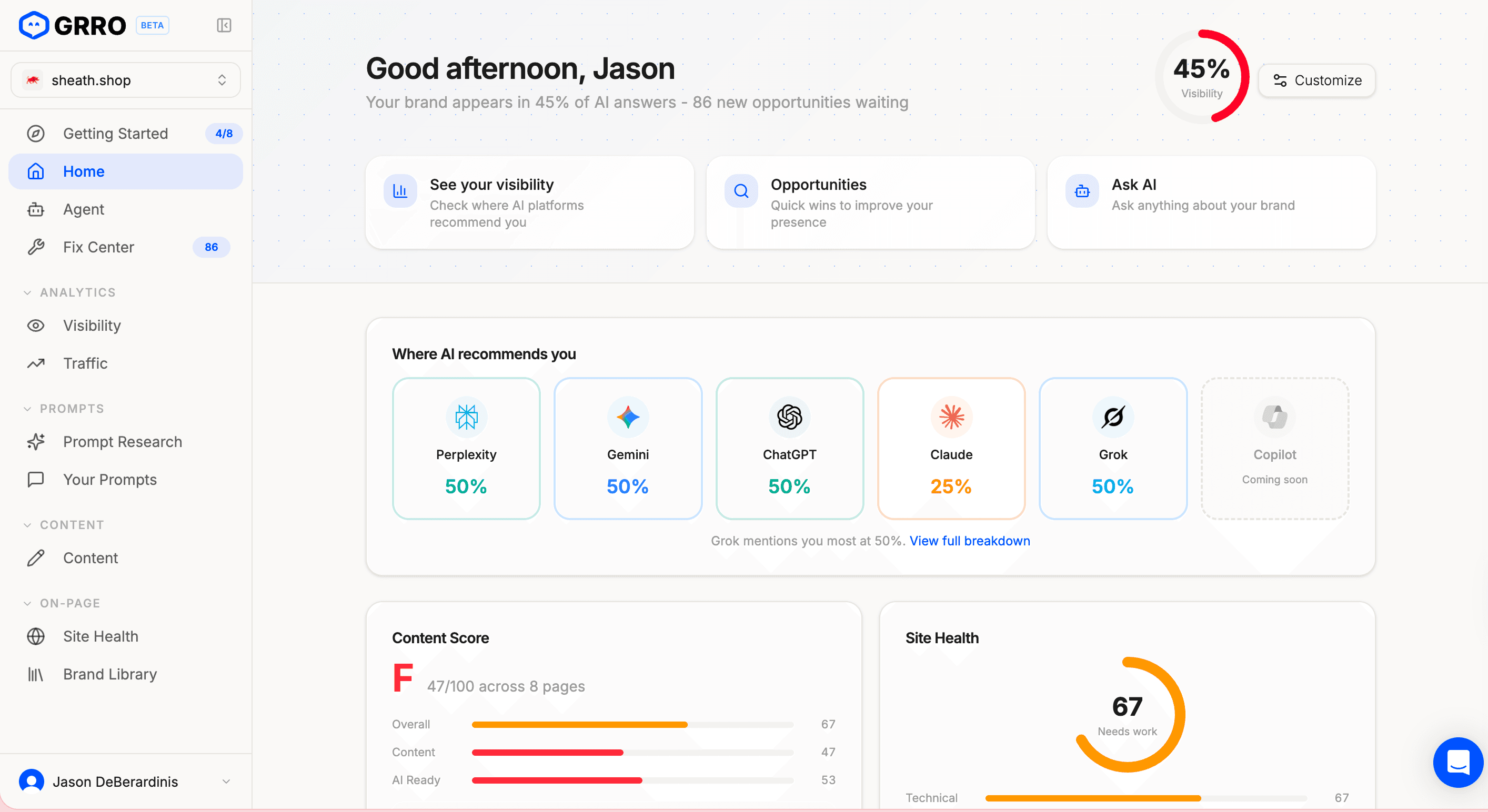
- GRRO automates this entire process across 5 AI engines with continuous monitoring, but this manual audit gives you a solid starting point.
Why You Need an AI Visibility Audit
Is AI recommending your business? Most business owners cannot answer that question. They know their Google rankings, their organic traffic numbers, and their domain authority. But they have no idea what happens when a potential customer asks ChatGPT, Perplexity, or Gemini for a recommendation in their category.
With 800M+ weekly AI search queries growing at 527% year over year, this blind spot is becoming expensive. Brands that are recommended by AI engines see 4.4x higher conversion rates from that traffic compared to traditional organic search. Brands that are not recommended are losing customers they never knew existed.
This guide walks you through a manual audit you can complete in 30 minutes. It will not be as comprehensive as an automated tool, but it will give you a clear picture of where you stand and where your biggest gaps are.
What You Will Need
Before starting, gather the following:
- Access to ChatGPT (free or Plus), Perplexity, Google Gemini, Claude, Grok,
- A spreadsheet or document for tracking results
- A list of your top competitors (5 to 10 names)
- 30 minutes of focused time
If you do not have accounts on all 5 platforms, prioritize ChatGPT, Perplexity, and Google Gemini. These 3 represent the largest share of AI search volume.
Step 1: Define Your Customer Questions (5 Minutes)
The foundation of your audit is a set of questions that your potential customers actually ask when they are considering a purchase in your category. These are not keyword phrases. They are natural language questions.
Write down 10 to 15 questions across 3 categories:
Category Questions (Top of Funnel)
These are broad questions about your product or service category:
- "What is the best [your category] for [common use case]?"
- "What [your category] do experts recommend?"
- "Top [your category] in 2026"
Examples:
- "What is the best project management software for remote teams?"
- "What CRM do sales experts recommend for startups?"
- "Top email marketing platforms in 2026"
Comparison Questions (Middle of Funnel)
These are questions where customers are comparing specific options:
- "[Your brand] vs [competitor]"
- "Which is better, [option A] or [option B]?"
- "[Your brand] alternatives"
Examples:
- "Asana vs Monday.com for small teams"
- "Which is better, HubSpot or Salesforce for startups?"
- "Mailchimp alternatives for ecommerce"
Solution Questions (Bottom of Funnel)
These are questions about specific problems your product solves:
- "How do I [solve problem your product addresses]?"
- "What tools help with [specific use case]?"
- "Best way to [achieve outcome your product enables]"
Examples:
- "How do I track remote team productivity?"
- "What tools help automate email marketing?"
- "Best way to manage client projects as a freelancer"
Write your 10 to 15 questions in your spreadsheet. These become the queries you will test across each AI platform.
Step 2: Query Each AI Platform (15 Minutes)
This is the core of the audit. Take each of your questions and ask it on every AI platform you have access to. Work through them systematically.
Set Up Your Tracking Sheet
Create a spreadsheet with these columns:
| Query | Platform | Your Brand Mentioned? | Position (1st, 2nd, etc.) | Sentiment (+/-/neutral) | Competitors Mentioned | Notes |
|---|---|---|---|---|---|---|
| ChatGPT | ||||||
| Perplexity | ||||||
| Gemini | ||||||
| Claude | ||||||
| Grok | ||||||
Query Each Platform
For each of your 10 to 15 questions:
- Copy the exact same question into each AI platform. Do not rephrase it between platforms. Consistency matters for accurate comparison.
- Record whether your brand is mentioned in the response. A mention means the AI engine named your brand, product, or company specifically.
- Note your position. If multiple brands are mentioned, record whether you are first, second, third, or later in the list.
- Assess sentiment. Is the mention positive ("highly recommended," "leading solution"), neutral ("one of several options"), or negative ("some users report issues")?
- List all competitors mentioned. This reveals who AI engines are recommending instead of you.
- Add notes on anything unusual: specific claims made about your brand, outdated information, or notable omissions.
Time-saving tip: You do not need to run all 15 queries on all 5 platforms. Start with your 5 most important category questions across all 5 platforms (30 queries total). If you have time, add comparison and solution queries for your top 3 platforms.
What to Watch For
- Competitor dominance. If the same competitor appears first across multiple platforms and queries, they have strong AI visibility and you are likely losing customers to them.
- Outdated information. AI engines sometimes surface old data about your brand. Note any incorrect pricing, discontinued features, or outdated descriptions.
- Platform-specific gaps. You might be mentioned on Perplexity but invisible to ChatGPT. Each platform has different source preferences, so platform-specific gaps are common.
- Negative sentiment from reviews. AI engines aggregate review sentiment. If your mentions are tinged with complaints pulled from review sites, that is a specific problem to address.
Step 3: Document Mentions, Sentiment, and Competitors (5 Minutes)
With your raw data collected, summarize the findings:
Your Mention Summary
Count your results:
- Total queries tested: [number]
- Total query-platform combinations: [number]
- Times your brand was mentioned: [number]
- Mention rate: [mentions / total combinations as a percentage]
- Average position when mentioned: [average of position numbers]
- Positive mentions: [number]
- Neutral mentions: [number]
- Negative mentions: [number]
Platform Breakdown
For each AI platform, calculate:
- How many queries returned a mention of your brand
- Your average position on that platform
- The dominant sentiment on that platform
This breakdown often reveals that brands are strong on 1 to 2 platforms but invisible on the rest. Since each platform serves different audience segments, these gaps represent direct revenue leakage.
Competitor Analysis
List every competitor that was mentioned across your queries and count:
- How many total mentions each competitor received
- Which platforms mention them most
- Their typical position (first, second, etc.)
- The sentiment of their mentions
This competitive view is one of the most valuable outputs of the audit. It shows you exactly who AI engines prefer for the queries your customers are asking.
Step 4: Identify Gaps (3 Minutes)
With your data documented, identify the 3 types of gaps:
Platform Gaps
Which AI engines do not mention your brand at all? Common patterns:
- Missing from ChatGPT: Usually means weak Wikipedia presence and poor Bing indexing. ChatGPT pulls 47.9% of its citations from Wikipedia.
- Missing from Perplexity: Often indicates no Reddit presence and stale content. Perplexity favors content updated within 48 to 72 hours and draws 46.7% of citations from Reddit.
- Missing from Gemini: Typically means you are not in Google's Featured Snippets and have no Quora presence. Quora accounts for 14.3% of Gemini citations.
- Missing from Grok: Almost always means no active X/Twitter presence. Grok prioritizes content less than 24 hours old from X.
Query Gaps
Which types of questions fail to surface your brand? Look for patterns:
- Are you invisible for category questions but mentioned in comparisons? This suggests weak top-of-funnel authority.
- Are you mentioned for comparisons but not for solution questions? This indicates your content is not answer-first.
- Are you mentioned for some use cases but not others? This reveals content gaps for specific customer segments.
Positioning Gaps
When you are mentioned, are you first or last? Is the sentiment positive or mixed? Positioning gaps mean you are visible but not winning the recommendation. This is often caused by:
- Weaker review scores than competitors
- Less recent content than competitors
- Fewer third-party mentions than competitors
For a deeper understanding of what causes these gaps, read our analysis of why 97% of brands are invisible to AI search.
Step 5: Score Your Baseline (2 Minutes)
Give yourself a simple baseline score using this framework:
Mention Score (0 to 40 points)
- Mentioned in 0 to 10% of query-platform combinations: 0 to 5 points
- Mentioned in 11 to 25%: 6 to 15 points
- Mentioned in 26 to 50%: 16 to 25 points
- Mentioned in 51 to 75%: 26 to 35 points
- Mentioned in 76 to 100%: 36 to 40 points
Position Score (0 to 25 points)
- Average position 4th or later: 0 to 5 points
- Average position 3rd: 6 to 12 points
- Average position 2nd: 13 to 19 points
- Average position 1st: 20 to 25 points
Sentiment Score (0 to 20 points)
- Majority negative: 0 to 5 points
- Majority neutral: 6 to 12 points
- Majority positive: 13 to 20 points
Consistency Score (0 to 15 points)
- Mentioned on 0 to 1 platforms: 0 to 3 points
- Mentioned on 2 to 3 platforms: 4 to 7 points
- Mentioned on 4 to 5 platforms: 8 to 12 points
- Mentioned on all 5 platforms: 13 to 15 points
Your total baseline score: ___ / 100
This manual scoring method gives you a reasonable approximation of your AI visibility. For comparison, GRRO's AI Recommendation Score uses a more precise automated version of this same approach with continuous monitoring across all 5 platforms.
What to Do With Your Results
Your audit gives you 3 actionable outputs:
1. Prioritize Your Platform Gaps
Focus first on the AI platforms where your customers are most active and where your competitors are strongest. If you are a B2B brand and invisible to ChatGPT, that is likely your top priority. If you are a consumer brand and invisible to Perplexity, start there.
2. Fix Your Content Gaps
For every query where your brand was not mentioned, ask: "Do we have content that directly answers this question?" If not, create it. If you do, restructure it to be answer-first. The most impactful content fixes are usually on your top 10 customer questions.
3. Build Your Source Presence
Based on which platforms you are missing from, build presence on the sources those platforms trust:
- ChatGPT: Wikipedia, LinkedIn, Bing-indexed sites
- Perplexity: Reddit, recently published content, Brave-indexed sites
- Gemini: Quora, Google Featured Snippets, Google-indexed sites
- Grok: X/Twitter, real-time content
For a comprehensive strategy guide on building multi-source authority, see our post on building authority signals that get your brand recommended by AI.
How GRRO Automates This Process
The manual audit above takes about 30 minutes and gives you a snapshot of 10 to 15 queries across up to 5 platforms. GRRO does the same thing, but:
- At scale. GRRO's prompt intelligence monitors 50 to 200+ queries specific to your business, not just 10 to 15.
- Continuously. AI responses change as engines update their models and source data. GRRO's search visibility tracking monitors your visibility in real time, not as a one-time snapshot.
- Across all 5 platforms. Every query runs on ChatGPT, Perplexity, Google Gemini, Claude, Grok, simultaneously.
- With competitive intelligence. GRRO tracks not just your mentions but every competitor mention, giving you a complete competitive view of AI recommendations in your category.
- With automated scoring. Instead of the manual scoring framework above, GRRO calculates a precise AI Recommendation Score using weighted algorithms across all 4 scoring components.
You can start with a free scan at grro.io that runs your brand across all 5 AI search engines in under 60 seconds and shows you exactly where you stand.
FAQ
How often should I repeat this manual audit?
AI engine responses change frequently. If you are managing your AI visibility actively, repeat the audit monthly. If you are just getting started, do it once to establish your baseline, then use an automated tool like GRRO for ongoing monitoring. Perplexity in particular updates its responses every 48 to 72 hours, so a snapshot audit misses a lot of variation.
Can I audit my competitors the same way?
Yes. Use the same process with the same queries but track competitor mentions instead of your own. This gives you a clear picture of who AI engines prefer in your category. In fact, auditing 2 to 3 key competitors alongside your own brand makes the results much more actionable.
What if I am not mentioned on any platform?
This is the reality for 97% of brands, so you are not alone. The good news is that brands starting from zero often see the fastest improvements because the first changes (adding structured data, restructuring content to be answer-first, building basic multi-source presence) have outsized impact. Most brands can move from zero mentions to consistent visibility within 60 to 90 days.
Should I use new chat sessions for each query?
Yes. Always start a fresh conversation for each query, especially on ChatGPT and Claude. Previous messages in a conversation can influence the responses, which would skew your audit results. Perplexity and Gemini are less affected by conversation history, but starting fresh is still best practice.
Does the wording of my query matter?
Significantly. "Best CRM for startups" and "What CRM should a startup use?" can produce different recommendations. For your audit, use the natural language phrasing your customers would actually use. If you are unsure, test 2 to 3 variations of your most important queries to see how sensitive the results are to wording.
Conclusion
Auditing your AI search visibility does not require expensive tools or deep technical knowledge. In 30 minutes, you can define your customer questions, query each major AI platform, document the results, identify your gaps, and score your baseline. Most brands that run this audit for the first time discover they are invisible to 4 or more AI search engines, which means potential customers asking those 800M+ weekly AI queries are being sent to competitors. The audit gives you a clear starting point. What you do next, whether you fix the gaps manually or use GRRO to monitor and improve your visibility automatically, is up to you. But knowing where you stand is step one. Run your free scan at grro.io to see your results instantly, or use the manual process above to get started today.

Co-Founder & CMO at GRRO