Perplexity vs ChatGPT vs Gemini: How Each AI Engine Recommends Differently
Each AI search engine pulls from different sources, favors different content types, and recommends brands through different mechanisms. Here is a platform-by-platform breakdown with specific tactics for each.
Key Takeaways
- ChatGPT uses Bing and heavily favors Wikipedia (47.9% of citations) and LinkedIn while actively avoiding Reddit as a source
- Perplexity uses Brave and Bing with Reddit appearing in 46.7% of citations and a 48-72 hour freshness window for new content
- Google AI Overviews pull from Google's own index with Quora citations at 14.3% and strong preference for existing Featured Snippets
- Grok relies on X/Twitter data with an extreme freshness window of less than 24 hours
- A strategy that works for one AI engine will not automatically work for the others, requiring platform-specific tactics
Not All AI Engines Recommend the Same Way
The biggest mistake businesses make with AI search visibility is treating all AI engines as one thing. They are not. ChatGPT, Perplexity, Gemini, Claude, and Grok each have different data sources, different freshness requirements, different content preferences, and different citation behaviors.
A brand that is highly visible on ChatGPT may be completely invisible on Perplexity. A strategy that dominates Grok recommendations may produce zero results on Google AI Overviews.
With over 800 million weekly queries flowing through these engines collectively and 527% year-over-year growth, understanding each engine's specific recommendation mechanics is not optional. It is the foundation of any effective AI visibility strategy.
Here is how each major AI engine decides what to recommend, and what you can do about it.
ChatGPT: The Bing-Powered Giant
Search backend: Microsoft Bing Key source: Wikipedia (47.9% of citations) Strong sources: LinkedIn, news publications, established domains Avoided source: Reddit Freshness window: 2 to 4 weeks for content updates to be reflected User base: Largest of all AI search engines
How ChatGPT Decides What to Recommend
When a user asks ChatGPT a question with web browsing enabled, the system queries Bing and retrieves the top results. These results are processed through a retrieval pipeline that chunks content, re-ranks for relevance and authority, and synthesizes an answer with the language model. For a detailed breakdown of this process, see our guide on how AI search engines decide what to recommend.
The most notable pattern in ChatGPT's recommendations is the extreme weight given to Wikipedia. Nearly half of all ChatGPT citations reference Wikipedia. This does not mean you need a Wikipedia article about your company (though that helps enormously). It means that Wikipedia-style authority signals, comprehensive coverage of topics, neutral tone, well-sourced claims, and established notability, are what ChatGPT's recommendation system values.
LinkedIn is the second major signal. ChatGPT regularly pulls from LinkedIn articles, company profiles, and professional endorsements. If your brand's leadership team publishes thought leadership on LinkedIn and your company page demonstrates expertise, ChatGPT is more likely to recognize and recommend you.
Perhaps most striking: ChatGPT actively avoids Reddit. Despite Reddit being one of the largest sources of user-generated content on the web, ChatGPT's retrieval system filters it out in most cases. If your AI visibility strategy is heavily Reddit-focused, it will not help you on ChatGPT.
How to Get Recommended by ChatGPT
-
Prioritize Bing SEO. Check your Bing rankings for your top 20 target queries. Use Bing Webmaster Tools. Many businesses that rank well on Google rank significantly lower on Bing because they have never optimized for it.
-
Build Wikipedia presence. You cannot create your own Wikipedia article (and should not try; it will get deleted). But you can earn mentions by becoming notable in your industry: getting press coverage, publishing original research, winning awards, and building a public track record that Wikipedia editors find worth referencing.
-
Invest in LinkedIn authority. Publish weekly articles from your company's executives. Keep your company page updated with comprehensive descriptions. Engage in industry discussions. LinkedIn authority compounds over time.
-
Structure content for extraction. ChatGPT's chunking process favors content with clear headings, direct answers in the first sentence of each section, and specific data points. Use the formatting principles in our guide on the content structure AI engines love.
-
Use authoritative, neutral language. Mirror Wikipedia's encyclopedic tone in your informational content. Avoid overtly promotional language in content that you want ChatGPT to reference. Factual, well-sourced, and comprehensive content gets recommended; sales copy does not.
Perplexity: The Research-First Engine
Search backend: Brave Search and Bing Key source: Reddit (46.7% of citations) Strong sources: News publications, recent blog posts, technical forums Freshness window: 48 to 72 hours (extremely fresh content favored) User base: Fastest-growing AI search engine
How Perplexity Decides What to Recommend
Perplexity takes a fundamentally different approach than ChatGPT. It uses Brave Search (an independent search engine with its own index) in addition to Bing, giving it access to a broader set of sources. More importantly, it maintains its own crawling infrastructure that indexes fresh content significantly faster than most search engines.
The most distinctive feature of Perplexity's recommendation system is its heavy reliance on Reddit. Nearly half of all Perplexity citations come from Reddit. This makes sense given Perplexity's identity as a research tool: Reddit contains candid, detailed, first-person accounts of products, services, and experiences that users find highly credible.
Perplexity also shows explicit source citations with numbered references, making it one of the most transparent AI engines in terms of showing users where information came from. This transparency means brands that appear as Perplexity citations get more direct traffic than from engines that synthesize without attribution.
The 48 to 72 hour freshness window is the most aggressive of any major AI engine. Content published today can appear in Perplexity recommendations within 2 to 3 days. This creates an enormous advantage for businesses that publish frequently and stay current.
How to Get Recommended by Perplexity
-
Build a genuine Reddit presence. This does not mean creating promotional posts. It means having employees or advocates who participate authentically in relevant subreddits. Answer questions with depth. Share experiences. Build karma and credibility over months. Perplexity heavily weights Reddit content that has high upvotes and genuine community engagement.
-
Publish frequently. The 48-72 hour freshness window means your content calendar directly impacts your Perplexity visibility. Aim for at least 2 to 3 substantive content pieces per week. Update existing content regularly with new data.
-
Optimize for Brave Search. Submit your site to Brave's web index through their webmaster tools. Brave has a smaller but distinct index from Google and Bing, and appearing here expands your retrieval surface.
-
Include first-person data and experiences. Perplexity values the same type of content Reddit users create: specific experiences, detailed comparisons, and honest assessments. Your brand content can replicate this by including case studies, first-hand testing data, and transparent analysis.
-
Structure for citation. Because Perplexity shows numbered citations, having clearly extractable facts, statistics, and conclusions in your content increases the likelihood of being cited with a direct link.
Google AI Overviews: The Incumbent's Evolution
Search backend: Google Key source: Quora (14.3% of citations) Strong sources: Featured Snippets content, high-authority domains, Google Knowledge Panel entities Freshness window: 1 to 2 weeks User base: Integrated into Google Search for billions of users
How Google AI Overviews Decide What to Recommend
Google AI Overviews are unique because they sit on top of the world's largest search engine. They pull from Google's own index, which means your existing Google SEO work directly feeds into AI Overview visibility.
The system has a strong preference for content that already holds Featured Snippets positions. Featured Snippets are the answer boxes that appear at the top of Google results for question queries. Google has already identified this content as the best answer for a specific query, and the AI Overview system trusts that assessment.
Quora appears in 14.3% of Google AI Overview citations. This is notable because Quora content tends to be question-and-answer formatted, which maps directly to how users query AI engines. Detailed, expert Quora answers in your industry can earn your brand (or your team members) visibility in Google AI Overviews.
Google AI Overviews also have the unique challenge of the 51% CTR drop they cause. When an Overview appears, users are far less likely to click through to any organic result. This means getting your brand named within the Overview itself is critical; the alternative is losing that traffic entirely.
How to Get Recommended by Google AI Overviews
-
Win Featured Snippets. Identify queries where you rank in the top 5 but do not hold the Featured Snippet. Restructure those pages to provide a more direct, concise answer in the first 40 to 60 words. Featured Snippet content transitions directly into AI Overview recommendations.
-
Build a Quora presence. Create profiles for your team's domain experts. Answer questions in your industry with genuine depth, specific data, and comprehensive explanations. Quora answers that are well-upvoted and from verified expert profiles carry significant weight.
-
Leverage Google Knowledge Panel. If your brand has a Google Knowledge Panel, keep it accurate and comprehensive. If you do not have one, pursue it through structured data, Wikipedia mentions, and consistent NAP (Name, Address, Phone) information across the web.
-
Maintain strong Google SEO. Google AI Overviews pull from the same index as organic results. Everything you do for traditional Google SEO feeds this channel. The key addition is restructuring content format for AI extractability.
-
Implement FAQ schema extensively. Google AI Overviews frequently pull from FAQ schema markup because the question-answer format maps perfectly to the AI's output format.
Grok: The Real-Time Engine
Search backend: X/Twitter (primary), web search (secondary) Key source: X/Twitter posts from verified accounts Strong sources: Trending topics, real-time news, expert commentary Freshness window: Less than 24 hours User base: X/Twitter users and xAI subscribers
How Grok Decides What to Recommend
Grok is built by xAI (Elon Musk's AI company) and is deeply integrated with X/Twitter. Its primary data source is the X/Twitter firehose: billions of posts, including real-time conversations, trending topics, and expert commentary.
This gives Grok a fundamentally different character than other AI engines. Where ChatGPT and Perplexity are strongest for research queries, Grok excels at real-time questions: "What happened with [event] today?" "What are people saying about [product launch]?" "What are the latest developments in [industry]?"
The freshness window is extreme: less than 24 hours. Content from yesterday is already aging out. This makes Grok less relevant for evergreen topics but highly influential for industries where recency matters: news, technology, finance, sports, and entertainment.
How to Get Recommended by Grok
-
Maintain an active X/Twitter presence. Post multiple times daily with industry-relevant commentary. Share data, insights, and expert perspectives. Engage in real-time conversations about your industry.
-
Pursue verification. Verified accounts carry more weight in Grok's recommendation system. Ensure your brand account and key team members have verified profiles.
-
Post during trending moments. When topics relevant to your industry trend on X/Twitter, contribute substantive commentary quickly. Grok's 24-hour window means timing is everything.
-
Use threads for depth. Grok can synthesize information from multi-post threads. When you have a detailed insight to share, use X/Twitter threads that provide comprehensive value.
-
Focus on recency. Do not rely on evergreen X/Twitter content for Grok. What you posted last week is essentially invisible to Grok. Consistent daily posting is the requirement.
Claude: The Training Data Engine
Search backend: Training data (no default real-time search) Key source: High-authority publications, established industry references Strong sources: Academic content, comprehensive guides, well-established brands Freshness window: Training data cutoff (periodically updated) User base: Growing, particularly among professionals and developers
How Claude Decides What to Recommend
Claude, developed by Anthropic, takes a different approach from the other engines listed here. By default, Claude does not perform real-time web searches. Its recommendations come from its training data, which is a massive corpus of text from the internet, books, academic papers, and other sources up to its knowledge cutoff date.
This means Claude's recommendations reflect the cumulative authority your brand has built across the web over time. Brands that are widely referenced in high-quality publications, that appear in comprehensive industry analyses, and that have established a strong knowledge base are more likely to be recommended by Claude.
How to Get Recommended by Claude
-
Build long-term authority. Claude draws from training data, so the breadth and depth of your brand's online presence over time matters. Getting mentioned in high-authority publications, industry reports, and educational content builds the kind of presence that enters training datasets.
-
Publish comprehensive, reference-quality content. Content that serves as an industry reference, the definitive guide, the canonical explanation, the most comprehensive comparison, is exactly the type of content that gets included in training data.
-
Maintain consistency across sources. Claude looks for consistent information about your brand across multiple sources. Ensure your brand messaging, product descriptions, and claims are consistent wherever they appear online.
-
Focus on expert attribution. Content attributed to recognized experts with established credentials carries more weight in training data selection.
##: The Microsoft Ecosystem
Search backend: Bing (Microsoft) Key source: Microsoft ecosystem content, professional/enterprise sources Strong sources: LinkedIn, Microsoft documentation, enterprise-focused content Freshness window: Similar to ChatGPT (2 to 4 weeks) User base: Microsoft 365 users, enterprise professionals
How Decides What to Recommend
Microsoft uses Bing as its search backend, similar to ChatGPT. However has tighter integration with the Microsoft ecosystem: LinkedIn, Microsoft 365, and enterprise tools. It tends to favor professional and business-oriented content.
How to Get Recommended by
- Follow the ChatGPT playbook for Bing SEO since both use the same search backend.
- Strengthen LinkedIn presence as has deep Microsoft ecosystem integration.
- Create enterprise-focused content that addresses business decision-makers.
- Use Microsoft Clarity and Bing Webmaster Tools to ensure your site is well-indexed in the Bing ecosystem.
Building a Cross-Engine Strategy
No single platform strategy covers all AI engines. Here is how to build a comprehensive approach:
The Universal Foundation (Works for All Engines)
- Answer-first content structure with direct answers in the first 40 to 60 words of each section
- Strong technical SEO: fast load times, clean HTML, proper headings, schema markup
- High-quality, authoritative, data-driven content
- Consistent brand information across all online properties
- Regular content updates to maintain freshness
Engine-Specific Layers
| Priority | Action | Primary Engine Impacted |
|---|---|---|
| 1 | Bing SEO optimization | ChatGPT |
| 2 | Active Reddit presence | Perplexity |
| 3 | Featured Snippets pursuit | Google AI Overviews |
| 4 | LinkedIn authority building | ChatGPT |
| 5 | Daily X/Twitter engagement | Grok |
| 6 | Wikipedia mention cultivation | ChatGPT, Claude |
| 7 | Quora expert answers | Google AI Overviews |
| 8 | Brave Search indexing | Perplexity |
How to Prioritize
Start with the engines your audience uses most. If your customers are primarily Gen Z researchers, Perplexity is growing fastest in that demographic. If they are enterprise decision-makers, ChatGPT are dominant. If they are in fast-moving industries (tech, finance, news), Grok's real-time capability matters.
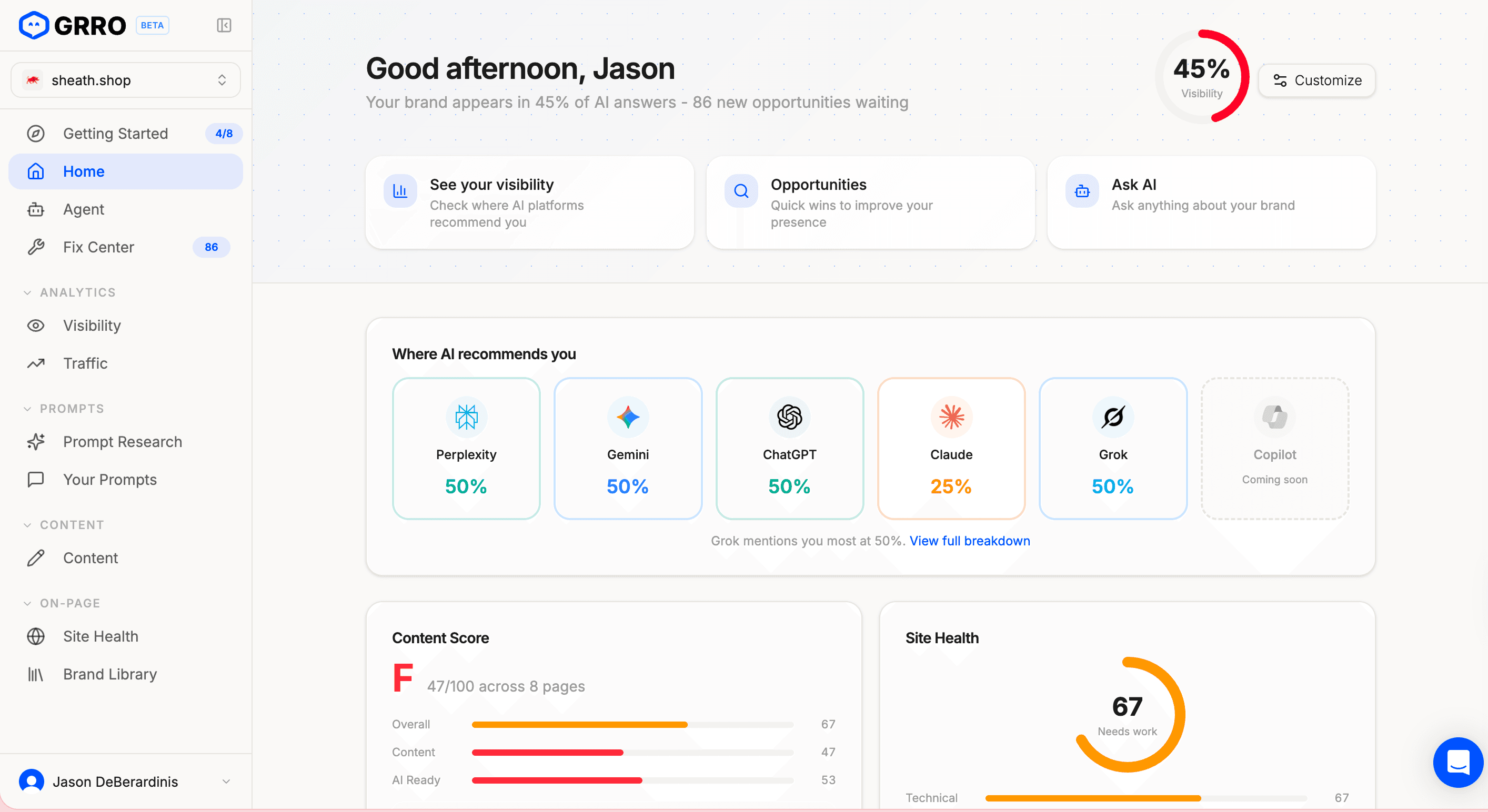
GRRO's search visibility tracking monitors your presence across all major engines simultaneously, so you can see where you are strong, where you have gaps, and which engine-specific strategies to prioritize. Use the source citation analytics to understand which sources each engine cites when recommending your brand. Start with a free scan to get your cross-engine baseline.
FAQ
Which AI search engine has the most users?
ChatGPT currently has the largest user base among dedicated AI search engines, with hundreds of millions of active users. However, Google AI Overviews technically reach the most people because they appear within Google Search, which billions of people use daily. Perplexity is the fastest-growing dedicated AI search engine. For most businesses, a strategy that covers ChatGPT, Perplexity, and Google AI Overviews captures the majority of AI search traffic.
Do I need to create content specifically for each AI engine?
No. Your core content strategy should follow universal best practices: answer-first structure, authoritative sourcing, and specific data. The engine-specific tactics are distribution and presence strategies, not content creation strategies. You write one excellent piece of content and then ensure it is discoverable by each engine through their preferred channels (Bing indexing for ChatGPT, Reddit discussion for Perplexity, Featured Snippets for Google AI, etc.).
How often should I check my visibility on each engine?
Weekly monitoring is the recommended minimum. Perplexity's 48-72 hour freshness window means your Perplexity visibility can change several times per week. ChatGPT and Google AI Overviews are more stable, shifting every 2 to 4 weeks. Grok changes daily. The GRRO platform automates cross-engine monitoring so you do not need to manually check each engine.
Is it possible to be recommended by all AI engines simultaneously?
Yes, but it requires a deliberate multi-platform strategy. The universal foundation (answer-first content, strong SEO, schema markup) gives you a base across all engines. Layering engine-specific tactics (Reddit for Perplexity, LinkedIn for ChatGPT, X/Twitter for Grok) extends your coverage. Most businesses start with 2 to 3 engines and expand. Achieving consistent recommendations across all 5 major engines typically takes 6 to 12 months of focused effort.
Why does ChatGPT avoid Reddit while Perplexity relies on it?
The reasons are partly technical and partly strategic. ChatGPT's agreement with Microsoft (Bing) and its training data policies lead it to deprioritize Reddit content. Perplexity, as an independent research-focused engine, values Reddit's candid, detailed user perspectives as a differentiator. This divergence is a clear example of why a one-size-fits-all AI strategy fails. The same content source is critical for one engine and irrelevant for another.
Conclusion
Each AI search engine operates with its own data sources, freshness requirements, citation patterns, and content preferences. ChatGPT trusts Wikipedia and LinkedIn through Bing. Perplexity values Reddit and fresh content through Brave. Google AI Overviews favor their own Featured Snippets and Quora. Grok demands real-time X/Twitter presence. Claude rewards long-term, established authority.
A strategy built for one engine will leave you invisible on the others. The 800 million weekly queries flowing through these platforms are distributed across multiple engines, and your customers are likely using more than one.
The practical path is to build a universal content foundation that works across all engines, then layer engine-specific distribution tactics based on where your audience concentrates. Monitor your visibility by engine, not as a single aggregate number, so you can identify and close specific gaps.
Start with a free AI visibility scan at GRRO to see your engine-by-engine breakdown. Knowing where you stand on each platform is the first step toward a strategy that captures recommendations across all of them.

Co-Founder & CMO at GRRO