What Is AI Search Optimization? The Complete Guide for 2026
AI search optimization is the practice of positioning your brand to get recommended by AI engines like ChatGPT, Perplexity, and Gemini. This complete guide covers how it works, how it differs from traditional SEO, and how to start.
Key Takeaways
- AI search optimization is the practice of making your brand the one AI engines recommend when users ask relevant questions
- It differs from traditional SEO in one fundamental way: you are optimizing to be recommended, not to be ranked
- AI engines use a Retrieval-Augmented Generation (RAG) pipeline that searches the web, retrieves top sources, and synthesizes an answer with recommendations
- The four core signals AI engines evaluate are authority, content structure, freshness, and multi-source presence
- With 800M+ weekly AI queries and 97% of businesses having no strategy, the opportunity window is wide open but closing fast
AI Search Optimization, Defined
AI search optimization is the process of positioning your content, your brand, and your online presence so that AI search engines recommend you when users ask relevant questions.
That is the simplest definition. When someone asks ChatGPT "What is the best project management tool for remote teams?" or asks Perplexity "How do I choose a CRM for my small business?" AI search optimization is what determines whether your brand appears in that answer or gets left out entirely.
It is not a rebrand of traditional SEO. It is not keyword stuffing with a new label. It is a fundamentally different discipline built around the way AI engines find, evaluate, and present information.
Traditional SEO gets you ranked on a results page. AI search optimization gets you recommended in a conversation.
How AI Search Optimization Differs from Traditional SEO
Traditional SEO and AI search optimization share DNA but produce different outcomes through different mechanisms.
The Output Is Different
Traditional SEO produces a ranked position on a search results page. Position 1 gets approximately 27.6% of clicks. Position 10 gets roughly 2.4%. Every position has some visibility.
AI search optimization produces a recommendation within an AI-generated answer. Your brand is either mentioned or it is not. There is no "page two." There is no partial visibility. You are recommended, or you are invisible.
The Evaluation Is Different
Google ranks pages based on over 200 factors including backlinks, domain authority, page speed, keyword relevance, and user engagement signals. These factors produce a numerical ranking.
AI engines evaluate whether your content provides the best answer to a specific question. They consider authority (who wrote this and who references it), structure (can the AI extract a clear answer), freshness (how current is this information), and multi-source validation (do other trusted sources confirm this). For a technical deep dive into this process, see our explanation of how AI search engines decide what to recommend.
The Content Format Is Different
SEO content is designed to satisfy search intent and earn clicks. It can afford to tease answers, use long introductions, and optimize for engagement metrics like time on page.
AI-optimized content must lead with direct answers. AI engines extract information from the first 40 to 60 words of relevant sections. If your answer is buried in paragraph four, the AI will find it from a competitor who leads with it. Content structure becomes a technical requirement, not a stylistic choice.
The Distribution Is Different
In traditional SEO, your website is the primary asset. Backlinks point to it. Content lives on it. Everything revolves around your domain.
In AI search optimization, your multi-source presence matters as much as your website. AI engines cross-reference information across Wikipedia, LinkedIn, Reddit, industry publications, and social platforms before making a recommendation. A brand that only exists on its own website will struggle to earn AI trust regardless of how good the on-site content is.
Where They Overlap
Both disciplines require strong technical foundations: fast page speeds, clean HTML, proper heading structure, XML sitemaps, and mobile optimization. Both benefit from high-quality, authoritative content. And critically, ranking in the top 20 results on traditional search engines is often a prerequisite for being included in AI recommendation pools, because AI engines use search engine results as their starting data source.
The smart approach is not to choose between SEO and AI search optimization. It is to do both, with your content structured to serve AI readability while maintaining traditional ranking signals. A structured AEO strategy helps you build both disciplines in parallel.
How AI Engines Decide What to Recommend
Understanding the recommendation process is essential to optimizing for it. Every major AI search engine uses some version of a Retrieval-Augmented Generation (RAG) pipeline.
Here is how it works at a high level:
Step 1: The user asks a question. "What is the best email marketing platform for e-commerce?"
Step 2: The AI queries a search engine. ChatGPT queries Bing. Perplexity queries Brave and Bing. Google AI queries Google. The AI is not answering from memory alone. It is actively searching the web.
Step 3: The search engine returns results. The top 10 to 20 URLs for that query are retrieved.
Step 4: Content is chunked. The retrieved pages are broken into 200 to 500 word segments. Each segment is evaluated independently.
Step 5: Chunks are re-ranked. An AI model scores each chunk for relevance, authority, and answer quality. The top 5 to 10 chunks advance.
Step 6: The LLM synthesizes an answer. Using the top chunks as context, the large language model generates a natural language answer that includes specific recommendations and citations.
This means your content needs to survive every stage of this pipeline. It needs to rank well enough in traditional search to be in the initial retrieval pool. It needs to be structured so that individual chunks are independently meaningful. And it needs to contain clear, authoritative answers that score well in the re-ranking step.
For the full technical breakdown including platform-specific routing, read our deep dive on the RAG pipeline explained.
The Four Core Signals
AI engines weigh four primary signals when deciding which content to recommend.
1. Authority
Who created this content, and do other sources trust it?
Authority in AI search comes from two places: the content creator's credentials and external validation from other sources. A piece written by a recognized industry expert and referenced by Wikipedia, LinkedIn thought leadership posts, and industry publications carries significantly more authority than an anonymous blog post.
AI engines measure authority through entity recognition (does the AI know who you are?), citation frequency (do other sources reference your content?), and domain expertise signals (does your site consistently produce authoritative content in this topic area?).
2. Content Structure
Can the AI extract a clear, useful answer from this content?
This is where most businesses fail. Their content may be excellent for human readers but poorly structured for AI extraction. AI engines need direct answers in the first 40 to 60 words of a section, question-format headings that match user queries, logical heading hierarchy, lists and tables for comparative information, and FAQ sections that mirror common questions.
A page that buries its best answer in the fourth paragraph will lose to a competitor whose answer sits in the opening sentence. Learn the specific formatting that drives recommendations in our guide on the content structure AI engines love.
3. Freshness
How current is this information?
Different AI engines weight freshness differently. Grok prioritizes content from the last 24 hours. Perplexity favors content published within 48 to 72 hours. ChatGPT and Gemini have longer windows but still factor recency into their trust calculations.
For businesses, this means regular content updates matter. Not just publishing new content, but also updating existing content with current data, removing outdated information, and signaling freshness through updated timestamps and schema markup.
4. Multi-Source Presence
Do multiple independent sources confirm this information?
AI engines are designed to cross-reference. If your brand is mentioned only on your own website, the AI has one data point. If your brand is mentioned on your website, referenced in a Wikipedia article, discussed in LinkedIn posts, cited in industry publications, and mentioned on Reddit, the AI has multiple independent confirmations.
Multi-source presence is the signal that most businesses underinvest in. Building this presence requires a deliberate strategy across the platforms each AI engine trusts. See our platform-by-platform breakdown in how each AI engine recommends differently.
How to Start: A Practical Framework
Knowing the theory matters. Executing on it matters more. Here is a practical framework for starting your AI search optimization work.
Phase 1: Measure (Week 1)
Run a free AI visibility scan to get your current AI Recommendation Score. Use search visibility tracking to monitor your brand across all major AI engines. Test 15 to 20 queries manually across ChatGPT, Perplexity, and Gemini to understand your qualitative position. Document which queries return your brand, which return competitors, and which return no relevant recommendations.
Phase 2: Audit Content (Weeks 2 to 3)
Review your top 20 pages by traffic. For each page, evaluate:
- Does it lead with a direct answer in the first 40 to 60 words?
- Are headings phrased as questions users actually ask?
- Does it include structured data (schema markup)?
- Is the information current and well-sourced?
- Are there FAQ sections that match common user queries?
The GRRO content scoring tool automates this analysis and gives each page a readiness score.
Phase 3: Restructure (Weeks 3 to 6)
Rewrite your top pages to follow answer-first formatting. This does not mean gutting your content. It means reorganizing it so AI engines can extract answers efficiently. Move direct answers to the top of each section. Add question-format H2s. Include FAQ schema. Update publication dates.
Phase 4: Build Authority (Weeks 4 to 12)
Expand your presence across the sources AI engines trust:
- Ensure your LinkedIn company page and executive profiles are current and active
- Contribute guest articles to industry publications
- Participate genuinely in Reddit communities relevant to your expertise
- Answer questions on Quora with depth and data
- Pursue Wikipedia mentions through legitimate notability
- Maintain an active X/Twitter presence for Grok visibility
Phase 5: Monitor and Iterate (Ongoing)
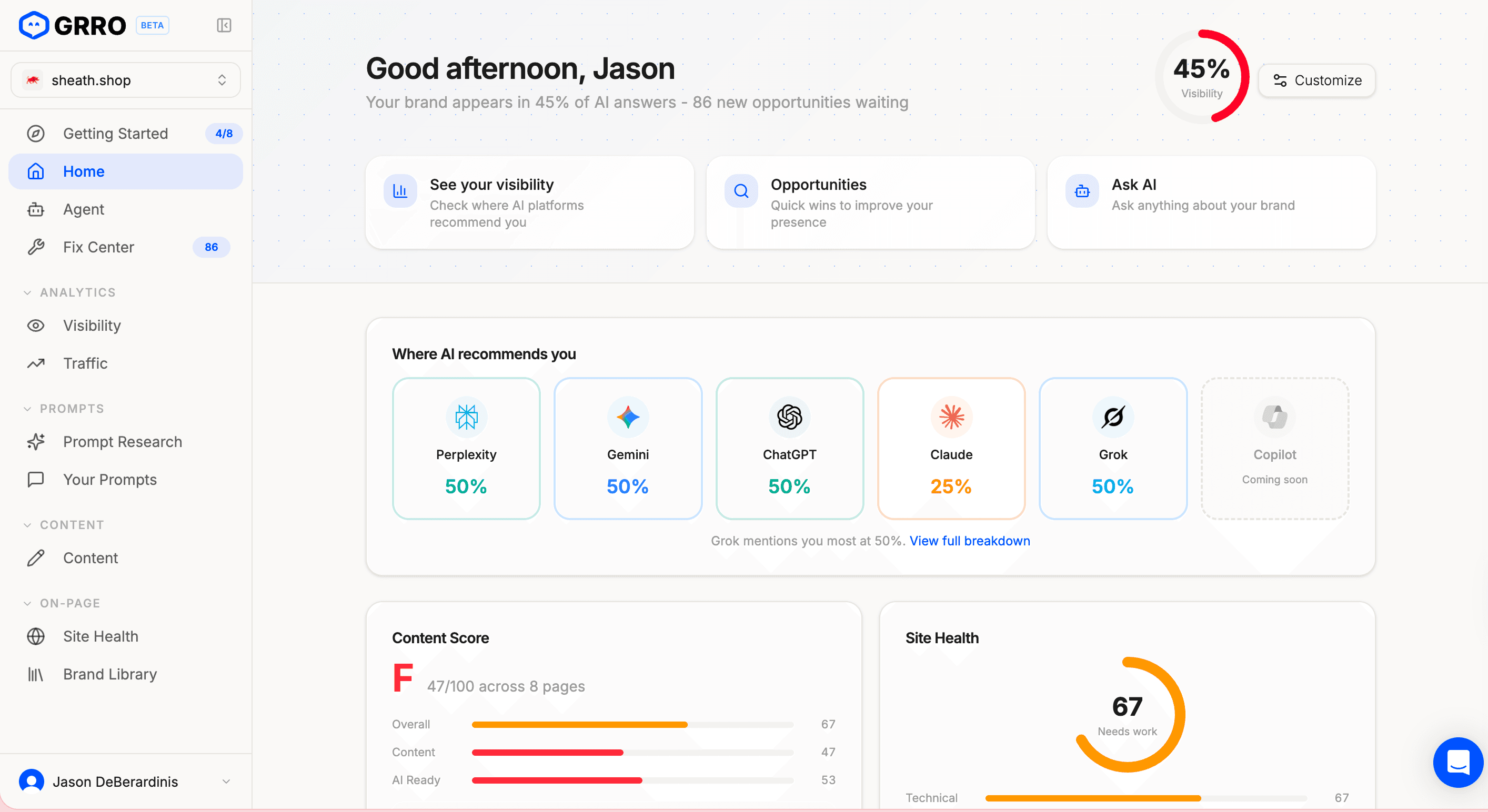
Track your AI Recommendation Score weekly. Compare against competitors. Identify new queries entering your space. Update content that falls below recommendation thresholds. The GRRO platform provides continuous monitoring, competitor benchmarking, and actionable recommendations.
The Scale of the Opportunity
The numbers define the urgency:
- 800 million weekly AI search queries
- 527% year-over-year growth in AI search
- 4.4x higher conversion from AI referral traffic
- 97% of businesses with no AI visibility strategy
- 3% of brands positioned for AI recommendations
- 40% of Gen Z using AI search first
These are not projections. These are current figures. And they are all accelerating.
For businesses that invest in AI search optimization now, the return is disproportionate. Low competition (3% of brands are doing this), high-value traffic (4.4x conversion), and a rapidly growing channel (527% YoY). This combination will not last forever.
Read our industry analysis of what 800 million weekly queries mean for your business for the full market context.
FAQ
Is AI search optimization the same as GEO (Generative Engine Optimization)?
They address the same challenge but differ in philosophy. GEO typically focuses on technical optimization, treating AI engines as another set of algorithms to game. AI search optimization, as practiced at GRRO, focuses on earning genuine recommendations through authoritative content, multi-source presence, and structured information. The outcomes overlap, but the approaches lead to different long-term results. Optimization tactics can be disrupted by algorithm changes. Genuine authority is durable.
Do I need special tools for AI search optimization?
You can start with manual testing by asking AI engines about your brand and monitoring the results. However, scaling beyond a handful of queries requires automated monitoring. The GRRO platform tracks your AI Recommendation Score across all major engines, scores your content for AI readability, and provides a prioritized action plan. Start with a free scan to see what automated tracking reveals.
How does AI search optimization affect my existing content strategy?
It primarily changes the format, not the substance. Your existing topic research, keyword strategy, and content calendar remain valuable. What changes is how you structure each piece of content. Leading with answers, using question-format headings, including FAQ sections, and implementing schema markup are format changes that improve AI readability without reducing the content's value for human readers or traditional search.
Can AI search optimization hurt my traditional SEO rankings?
No. The structural changes that improve AI readability (direct answers, clear headings, FAQ schema, structured data) also improve traditional SEO. Google has consistently rewarded content that directly answers user questions. Making your content better for AI engines makes it better for Google at the same time. The two strategies are complementary, not competitive.
How quickly will AI search optimization show results?
Initial improvements in AI visibility typically appear within 4 to 8 weeks. Perplexity reflects content changes in 48 to 72 hours. ChatGPT and Gemini usually take 2 to 4 weeks. Building comprehensive multi-source authority takes 3 to 6 months. The full competitive positioning, where your brand consistently appears in recommendations for your core topics, usually takes 6 to 12 months of sustained effort.
Conclusion
AI search optimization is the discipline of getting your brand recommended by AI engines instead of just ranked on traditional search pages. It requires answer-first content, multi-source authority, proper structured data, and continuous monitoring.
The fundamental shift is straightforward: search is moving from "here are 10 links, you decide" to "here is my recommendation." Businesses that understand this shift and act on it now have a structural advantage. The 97% visibility gap means the competitive field is nearly empty.
The four signals that matter are authority, structure, freshness, and multi-source presence. Strengthening all four positions your brand as the one AI engines trust enough to recommend.
Start by measuring where you stand with a free scan at GRRO. You cannot optimize what you have not measured, and most businesses are genuinely surprised by how little AI visibility they have. That surprise is the starting point for a strategy that will define your competitive position for years to come.

Co-Founder & CMO at GRRO