What Is Generative Engine Optimization (GEO)? The Complete Guide for 2026
Generative Engine Optimization (GEO) is the practice of optimizing your content to appear in AI-generated answers from engines like ChatGPT, Perplexity, and Gemini. This complete guide covers how GEO works, how it differs from SEO and AEO, and how to build a GEO strategy.

Key Takeaways
- Generative Engine Optimization (GEO) is the practice of optimizing your content and brand presence so that AI search engines include and recommend you in their generated answers
- GEO differs from traditional SEO because you are optimizing for AI-generated recommendations, not ranked links on a results page
- The six major generative engines are ChatGPT, Perplexity, Gemini, Claude, and Grok, and each one evaluates content differently
- GEO builds on SEO and AEO foundations but adds new requirements around answer-first formatting, multi-source authority, and structured data
- Businesses that invest in GEO now have a structural advantage because 97% of brands have zero AI visibility strategy
What Is Generative Engine Optimization?
Generative Engine Optimization (GEO) is the process of optimizing your website, content, and digital presence so that generative AI search engines recommend your brand when users ask relevant questions. Unlike traditional SEO, where the goal is to rank higher on a list of blue links, GEO focuses on making your brand the one that AI engines name, cite, and recommend inside their generated answers.
When a user asks ChatGPT "What is the best CRM for small businesses?" or asks Perplexity "Which email marketing platform has the best automation?" the AI does not show a list of links. It generates an answer and names specific brands. GEO is the discipline that determines whether your brand appears in that answer or gets overlooked entirely.
The term "generative engine" refers to any AI-powered search tool that generates answers rather than listing links. This includes ChatGPT (powered by OpenAI), Perplexity, Google Gemini, Anthropic's Claude, xAI's Grok,. Each of these platforms processes millions of queries daily, and their combined usage is growing at over 500% year over year.
GEO is not a replacement for SEO. It is a necessary evolution that sits alongside your existing search strategy. Brands that do both well will dominate visibility across every discovery channel. Brands that ignore GEO will slowly disappear from the conversations where purchasing decisions are being made.
How GEO Differs from SEO
GEO and SEO share a common goal of increasing visibility, but they operate through fundamentally different mechanisms. Understanding these differences is critical to building an effective strategy.
The Output Format
In traditional SEO, success means earning a high position on a search engine results page (SERP). The user sees a list of 10 links and decides which one to click. Even a page ranked at position 8 gets some visibility.
In GEO, the output is a generated paragraph or conversation response. The AI names specific brands, products, or resources. Your brand is either mentioned or it is not. There is no "position 7" in a ChatGPT answer. You are recommended, or you are invisible.
The Evaluation Process
Google evaluates pages using over 200 ranking signals including backlinks, domain authority, page speed, mobile friendliness, and user engagement. These signals produce a numerical score that determines your position.
Generative engines use a Retrieval-Augmented Generation (RAG) pipeline. They search the web, retrieve the top 10 to 20 results, chunk the content into segments, re-rank those segments for relevance and authority, and then synthesize an answer. The AI is making a qualitative judgment about which brands deserve to be named. For a deep technical walkthrough, see our guide on how AI decides what to recommend.
The Content Requirements
SEO content can afford to build slowly toward an answer. Long introductions, engaging hooks, and narrative storytelling are all valid SEO tactics because the user has already clicked through to your page.
GEO content must lead with direct answers. Generative engines extract information from the first 40 to 60 words of relevant sections. If your answer is buried in paragraph four, the AI will pull the answer from a competitor who states it upfront. Our guide on content structure AI engines love covers this in detail.
The Trust Signals
SEO trust is built primarily through backlinks. More high-quality links from authoritative domains means higher rankings.
GEO trust is built through multi-source validation. AI engines cross-reference your brand across Wikipedia, LinkedIn, Reddit, industry publications, news articles, and social media. A brand mentioned across 15 independent sources carries more weight than a brand with 500 backlinks but no presence outside its own website. Learn how to build these signals in our guide on building authority signals for AI recommendations.
Comparison Table: GEO vs. SEO
| Factor | Traditional SEO | GEO |
|---|---|---|
| Goal | Rank higher on SERPs | Get recommended in AI answers |
| Output | List of ranked links | Generated text with named brands |
| Visibility | Graduated (position 1 to 10+) | Binary (mentioned or invisible) |
| Primary trust signal | Backlinks | Multi-source presence |
| Content format | Flexible structure | Answer-first, structured |
| Evaluation method | 200+ ranking factors | RAG pipeline with re-ranking |
| User interaction | Click a link, visit page | Read AI answer, may or may not click |
| Speed of change | Weeks to months | 48 hours to 4 weeks |
How GEO Differs from AEO
Answer Engine Optimization (AEO) is a closely related discipline, and the terms are sometimes used interchangeably. But they are not identical.
AEO emerged as a response to Google's featured snippets and voice search. It focuses on structuring content to appear in answer boxes and position-zero results on traditional search engines. AEO is about being the answer within a conventional search framework.
GEO goes further. It addresses AI engines that generate entirely new responses rather than pulling a snippet from a single page. The key differences are:
- Scope: AEO targets featured snippets on Google. GEO targets generated answers across ChatGPT, Perplexity, Gemini, Claude, and Grok.
- Complexity: AEO typically optimizes for a single answer extraction. GEO must account for multi-source synthesis where the AI pulls information from multiple pages and blends them into one response.
- Authority model: AEO relies on traditional domain authority. GEO requires distributed authority across multiple platforms and sources.
- Measurement: AEO success is measurable through featured snippet tracking. GEO success requires monitoring AI recommendations across multiple engines simultaneously.
For a deeper comparison, read our dedicated guide on answer engine optimization.
In practice, GEO encompasses AEO. If your content is optimized for generative engines, it will also perform well in featured snippets. But the reverse is not always true. A page optimized only for featured snippets may not have the multi-source presence or structured depth that generative engines require.
How Generative Engines Work
To optimize for generative engines, you need to understand how they process queries and select sources. Every major AI search engine uses some version of the Retrieval-Augmented Generation (RAG) pipeline.
The RAG Pipeline
Step 1: Query interpretation. The user enters a question. The AI interprets the intent, identifying key topics, entities, and the type of answer expected.
Step 2: Web retrieval. The AI queries one or more search engines. ChatGPT queries Bing. Perplexity queries Brave and Bing. Gemini queries Google. The AI is not answering from memory. It is actively searching for current information.
Step 3: Content retrieval. The top 10 to 20 URLs from the search results are fetched and their content is extracted.
Step 4: Chunking. Each page is broken into 200 to 500 word segments. These chunks are evaluated independently, which means a single section of your page can be selected even if the rest of the page is irrelevant.
Step 5: Re-ranking. An AI model scores each chunk for relevance, authority, and answer quality. The top 5 to 10 chunks advance to the generation step.
Step 6: Answer generation. The large language model uses the top-ranked chunks as context and generates a natural language answer with specific recommendations and citations.
For the full technical breakdown, see our post on the RAG pipeline and how AI finds your brand.
How Each Engine Differs
Not all generative engines are identical. Their differences matter for your GEO strategy.
| Engine | Search Source | Freshness Priority | Unique Factors |
|---|---|---|---|
| ChatGPT | Bing | 2 to 4 weeks | Largest user base, brand recognition matters |
| Perplexity | Brave, Bing | 48 to 72 hours | Highest freshness weight, cites sources inline |
| Gemini | 1 to 3 weeks | Leverages Google's full index, strong entity understanding | |
| Claude | Web search | 2 to 4 weeks | Emphasis on nuanced, detailed answers |
| Grok | X/Twitter, web | 24 hours | Heaviest real-time weighting, social signals matter |
| Bing | 1 to 2 weeks | Enterprise context, workplace query focus |
Understanding these differences lets you prioritize your efforts. If your audience skews toward real-time information, Grok and Perplexity optimization deserves extra attention. If your audience uses AI for research and comparison, ChatGPT and Gemini are your primary targets.
For a detailed engine-by-engine breakdown, read our comparison of how Perplexity, ChatGPT, and Gemini recommend differently.
GEO Strategies That Work in 2026
Effective GEO is not about tricks or shortcuts. It is about building the kind of content and brand presence that generative engines trust enough to recommend. Here are the strategies that produce measurable results.
1. Lead with Direct Answers
Every page on your site should answer its primary question in the first 40 to 60 words. Do not bury your answer behind a long introduction. AI engines extract from the opening of relevant sections. If you want to be quoted, lead with the quote-worthy content.
Before GEO optimization: "In today's rapidly evolving digital landscape, businesses are increasingly wondering about the best tools for their marketing needs. With so many options available, it can be overwhelming to choose..."
After GEO optimization: "HubSpot, Mailchimp, and ActiveCampaign are the three best email marketing platforms for small businesses in 2026. HubSpot leads for CRM integration, Mailchimp for ease of use, and ActiveCampaign for automation depth."
2. Use Question-Format Headings
Structure your H2 and H3 headings as questions that match how users query AI engines. Instead of "Our Email Marketing Features," use "What Are the Best Email Marketing Features for Small Businesses?" This directly matches the queries AI engines are processing.
3. Build Multi-Source Presence
Your brand needs to exist across multiple platforms that AI engines reference:
- LinkedIn: Active company page and executive thought leadership
- Reddit: Genuine participation in relevant communities
- Wikipedia: Mentions through legitimate notability
- Industry publications: Guest articles and expert commentary
- YouTube: Video content that reinforces your expertise
- X/Twitter: Active presence for Grok visibility
Each independent mention of your brand gives AI engines another confirmation signal. The more sources that validate your expertise, the more likely you are to be recommended.
4. Implement Comprehensive Schema Markup
Structured data helps AI engines understand what your content is about and how to categorize it. Implement:
- Organization schema with founding details and leadership
- Article schema with author information and dates
- FAQ schema for question-answer pairs
- Product schema for commercial pages
- Review schema for testimonials and ratings
Our guide on schema markup for AI search visibility covers implementation in detail.
5. Maintain Content Freshness
Generative engines factor content recency into their trust calculations. Update your key pages regularly:
- Refresh statistics and data points quarterly
- Update "dateModified" timestamps when content changes
- Add new sections that address emerging questions
- Remove outdated information that could trigger accuracy concerns
6. Create Comparison and Listicle Content
AI engines frequently draw from content that compares options or lists recommendations. Pages titled "Best X for Y" or "X vs. Y: Which Is Better?" are disproportionately cited in AI-generated answers because they directly match the comparison queries users ask.
7. Build Entity Recognition
AI engines need to recognize your brand as a known entity. This means consistent naming across all platforms, a complete knowledge panel on Google, mentions in authoritative databases, and a clear association between your brand and your area of expertise.
GEO Tools and Platforms
Implementing GEO effectively requires the right tools. Here is what the current landscape looks like.
AI Visibility Monitoring
The most critical tool category for GEO is AI visibility monitoring. You need to know which AI engines are recommending your brand, for which queries, and how often. Manual testing (asking ChatGPT about your brand) gives you anecdotal data. Automated monitoring gives you actionable intelligence.
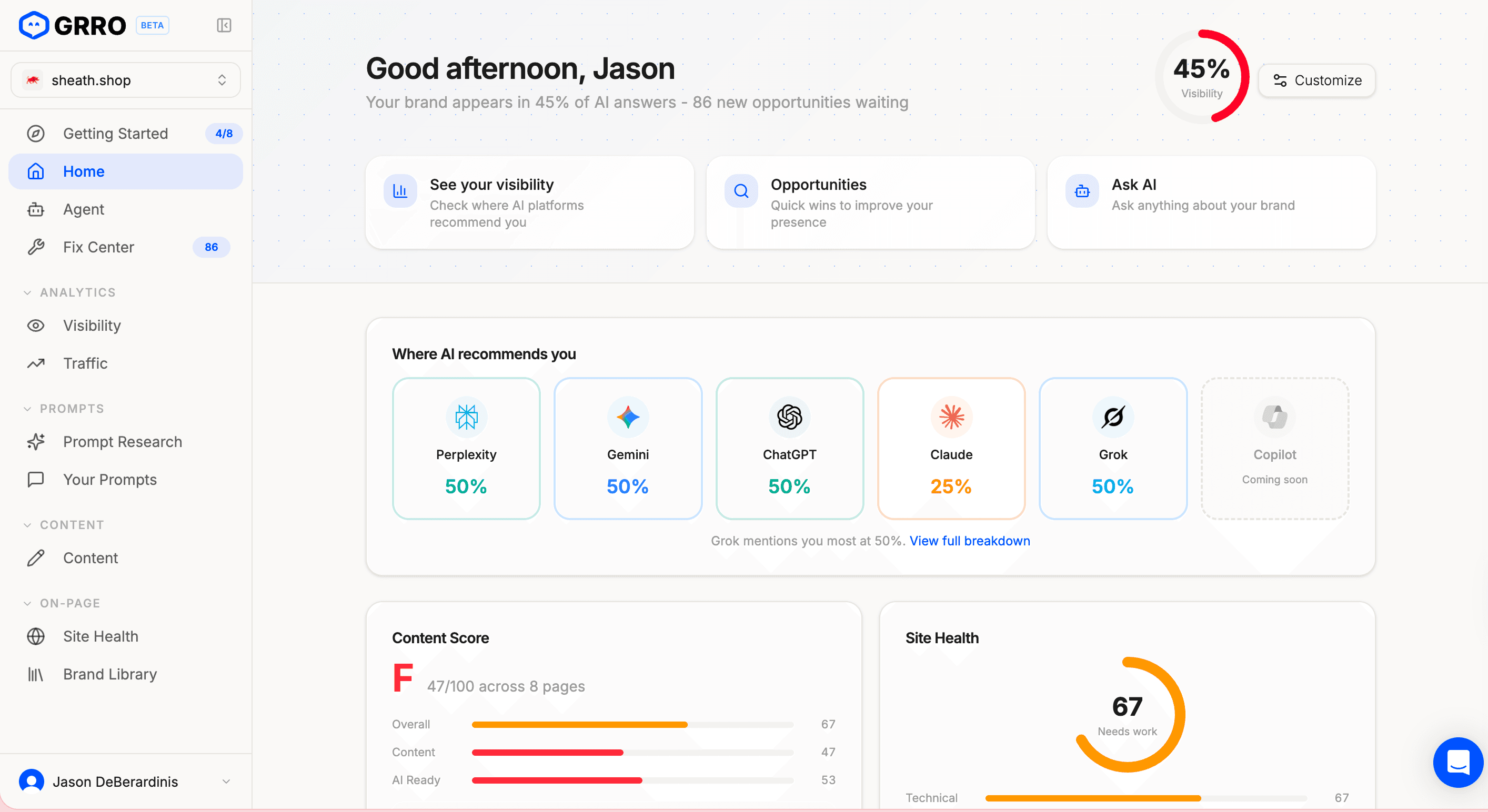
GRRO tracks your brand's visibility across all five major AI engines, scores your content for AI readability, and provides actionable recommendations. It monitors ChatGPT, Perplexity, Gemini, Claude, and Grok continuously so you can see exactly where you appear and where you are missing.
Content Optimization
Tools that score your content for AI readability help prioritize which pages to optimize first. GRRO's content studio evaluates answer-first formatting, heading structure, FAQ coverage, and schema implementation to identify your highest-impact optimization opportunities.
Multi-Source Tracking
Monitoring your brand mentions across LinkedIn, Reddit, industry publications, and other platforms helps you identify gaps in your multi-source presence and prioritize where to build authority.
Measuring GEO Success
GEO success is measured differently than SEO success. Here are the key metrics to track.
AI Recommendation Score
Your AI Recommendation Score measures how frequently and prominently your brand appears in AI-generated answers across all major engines. This is the single most important GEO metric. Learn how this score works in our guide on AI Recommendation Score explained.
Query Coverage
How many relevant queries return your brand as a recommendation? Track a basket of 50 to 100 queries relevant to your business and monitor coverage over time.
Engine-Specific Visibility
Your visibility may differ significantly across engines. You might appear in 40% of Perplexity answers but only 10% of ChatGPT answers. Engine-specific tracking reveals where to focus optimization efforts.
Citation Quality
When AI engines mention your brand, how prominent is the mention? Are you the primary recommendation, one of several options, or a footnote? Citation quality matters as much as citation frequency.
AI Referral Traffic
Monitor traffic from AI engines using UTM parameters and referral tracking. AI referral traffic converts at 4.4x the rate of traditional search traffic, making it one of the highest-value channels available.
Common GEO Mistakes to Avoid
Ignoring Multi-Source Presence
The most common GEO mistake is optimizing only your website and ignoring the external sources AI engines reference. A perfectly structured website with zero external mentions will still struggle to earn recommendations.
Burying Answers
Content that builds to an answer rather than leading with one will lose to competitors who state answers immediately. Every section should begin with its key point.
Neglecting Freshness
Content published two years ago with no updates sends a negative freshness signal. Even evergreen content needs regular timestamp updates and data refreshes.
Treating All AI Engines the Same
Each engine has different source preferences, freshness windows, and evaluation criteria. A one-size-fits-all approach will produce mediocre results across all engines rather than strong results on any of them.
Over-Optimizing for One Engine
Conversely, optimizing exclusively for ChatGPT while ignoring Perplexity, Gemini, and others limits your total visibility. The goal is broad coverage across all engines your audience uses.
Getting Started with GEO
If you are starting from zero, here is the fastest path to GEO results.
Week 1: Measure. Run a free AI visibility scan at GRRO to get your baseline AI Recommendation Score. Test 20 queries manually across ChatGPT, Perplexity, and Gemini. Use a structured AEO strategy workflow to turn these findings into a prioritized plan.
Weeks 2 to 3: Audit. Review your top 20 pages. Score each one for answer-first formatting, question-format headings, schema markup, and FAQ coverage. Our guide on how to audit your AI search visibility walks through this step by step.
Weeks 3 to 6: Restructure. Rewrite your top pages following GEO best practices. Lead with direct answers. Add FAQ sections. Implement schema markup. Update timestamps.
Weeks 4 to 12: Build authority. Expand your multi-source presence on LinkedIn, Reddit, industry publications, and other platforms AI engines trust.
Ongoing: Monitor. Track your AI Recommendation Score weekly. Identify new queries. Update content that falls below recommendation thresholds.
The businesses that start now will have a compounding advantage. Multi-source authority takes months to build, and every week you wait is a week your competitors could be building theirs.
FAQ
What does GEO stand for?
GEO stands for Generative Engine Optimization. It is the practice of optimizing your content and brand presence to appear in AI-generated answers from engines like ChatGPT, Perplexity, Gemini, Claude, and Grok.
Is GEO the same as SEO?
No. SEO focuses on ranking higher in traditional search engine results pages. GEO focuses on getting your brand recommended inside AI-generated answers. They share foundational elements like content quality and technical optimization, but GEO requires additional focus on answer-first formatting, multi-source presence, and AI-specific trust signals. The best strategy is to do both.
How is GEO different from AEO?
AEO (Answer Engine Optimization) focuses on earning featured snippets and voice search results on traditional search engines. GEO is broader. It addresses AI engines that generate entirely new answers by synthesizing information from multiple sources. GEO encompasses AEO but adds requirements for multi-source validation and AI-specific content structuring.
Can I do GEO without any tools?
You can start with manual testing by querying AI engines about your brand and noting the results. However, scaling beyond a handful of queries requires automated monitoring. GRRO provides continuous tracking across all five major AI engines with actionable recommendations.
How long does GEO take to show results?
Initial improvements typically appear within 4 to 8 weeks. Perplexity reflects content changes within 48 to 72 hours, while ChatGPT and Gemini take 2 to 4 weeks. Building comprehensive multi-source authority takes 3 to 6 months. Full competitive positioning usually requires 6 to 12 months of sustained effort.
Does GEO replace my existing SEO strategy?
No. GEO builds on your existing SEO foundation. Ranking in the top 20 traditional search results is often a prerequisite for being included in AI recommendation pools because AI engines use search results as their starting data source. The strongest approach combines both SEO and GEO.
What is the ROI of GEO?
AI referral traffic converts at 4.4x the rate of traditional search traffic. With 800 million weekly AI queries and 97% of businesses having no GEO strategy, the opportunity is significant. Early movers benefit from low competition and disproportionately high returns. See our analysis of measuring ROI from AI search visibility for detailed benchmarks.
Conclusion
Generative Engine Optimization is the defining search discipline of 2026. As AI search queries grow past 800 million per week and continue accelerating, the brands that appear in AI-generated answers will capture an outsized share of attention, trust, and revenue.
GEO is not a replacement for SEO. It is the next layer. It requires answer-first content, multi-source authority, structured data, and continuous monitoring across all five major AI engines.
The 97% visibility gap means that nearly every industry is wide open for brands willing to invest in GEO now. The content you restructure today, the authority you build this quarter, and the monitoring you put in place this month will compound over time.
Start with a free AI visibility scan at GRRO to measure where you stand. The first step in any optimization strategy is knowing your baseline. From there, the path to AI recommendations is structured, measurable, and within reach.

Co-Founder & CMO at GRRO