What Is Answer Engine Optimization (AEO)? The 2026 Guide
Answer Engine Optimization (AEO) is the practice of structuring your content to appear as the direct answer in search engines, voice assistants, and AI-powered answer tools. This guide covers how AEO works, how it compares to SEO and GEO, and how to build an AEO strategy.

Key Takeaways
- Answer Engine Optimization (AEO) is the practice of structuring your content so it gets selected as the direct answer by search engines, voice assistants, and AI-powered platforms
- AEO bridges the gap between traditional SEO and Generative Engine Optimization (GEO) by focusing on being the definitive answer to specific questions
- Answer engines include Google Featured Snippets, voice assistants (Siri, Alexa, Google Assistant), and AI search tools like ChatGPT and Perplexity
- The core of AEO is answer-first content formatting, schema markup, and entity authority
- AEO and GEO are complementary strategies, and the strongest brands invest in both
What Is Answer Engine Optimization?
Answer Engine Optimization (AEO) is the practice of optimizing your content to be selected as the direct answer when users ask questions through search engines, voice assistants, and AI-powered platforms. Instead of competing for one of ten link positions on a results page, AEO positions your content as the single best answer to a specific question.
AEO originally emerged in response to Google's Featured Snippets, the answer boxes that appear at the top of search results. When a user asks Google "What is the best CRM for startups?" and a paragraph of text appears above all other results, that text was pulled from a website that practiced effective AEO. The same principle applies to voice search. When Siri, Alexa, or Google Assistant reads a single answer aloud, it is selecting that answer from the web using similar evaluation criteria.
In 2026, AEO has expanded well beyond featured snippets. AI search engines like ChatGPT, Perplexity, Gemini, Claude, and Grok are all answer engines. They do not show a list of links. They generate a direct answer, often naming specific brands, products, and resources. AEO is the foundational discipline for being selected by any of these platforms.
The simplest way to think about AEO: traditional SEO gets you on the results page. AEO gets you into the answer itself.
How Answer Engines Work
Understanding the mechanics of answer engines is essential for optimizing your content to be selected by them. The three main categories of answer engines operate differently, but they share common evaluation criteria.
Google Featured Snippets
Google's featured snippet algorithm scans top-ranking pages for the most concise, direct answer to a query. It evaluates the first 40 to 60 words of relevant paragraphs, the structure of the content (headings, lists, tables), and whether the content directly addresses the query's intent.
Featured snippets come in four formats:
- Paragraph snippets: A brief text answer (40 to 60 words)
- List snippets: Numbered or bulleted lists
- Table snippets: Structured data in table format
- Video snippets: YouTube clips with timestamps
Pages that earn featured snippets typically rank in the top 10 for the target query, use the query or a close variant as a heading, and provide a clear, direct answer immediately after that heading.
Voice Assistants
Siri, Alexa, and Google Assistant pull from featured snippets and similar answer databases. Voice search adds another constraint: the answer must be concise enough to read aloud naturally. This means 30 to 50 words, conversational phrasing, and a self-contained answer that makes sense without visual context.
Voice search is growing steadily, with over 1 billion voice searches conducted monthly. Optimizing for voice means optimizing for natural language queries ("What is the best..." rather than "best...") and providing answers that sound natural when spoken.
AI Search Engines
AI search engines like ChatGPT, Perplexity, and Gemini represent the most advanced category of answer engines. They use Retrieval-Augmented Generation (RAG) pipelines to search the web, retrieve top results, chunk content into segments, re-rank those segments, and synthesize a new answer. This process is more complex than featured snippet selection because the AI may pull from multiple sources and generate an entirely new response.
For a technical deep dive into how this pipeline works, read our guide on how AI decides what to recommend.
AEO vs. SEO: Key Differences
AEO and SEO are complementary but distinct disciplines. Here is how they compare.
The Goal
SEO aims to rank your page as high as possible in a list of search results. The user then chooses which link to click.
AEO aims to have your content selected as the definitive answer. The user may not click anything at all because they got their answer directly from the search engine or AI.
The Content Approach
SEO content can use various structures: long narratives, engaging hooks, multimedia, and progressive disclosure. The user has already clicked your link, so you have time to build toward your point.
AEO content must lead with the answer. The search engine or AI is scanning your content to extract the most relevant passage. If your answer is in paragraph six, it will not be extracted. A competitor whose answer is in sentence one wins.
The Measurement
SEO success is measured by keyword rankings, organic traffic, and click-through rates.
AEO success is measured by featured snippet ownership, voice search appearances, and AI recommendation frequency. These require different tracking tools and methodologies, including prompt intelligence to understand which queries drive recommendations. Our guide on measuring ROI from AI search visibility covers the metrics that matter.
Comparison Table: AEO vs. SEO
| Factor | Traditional SEO | AEO |
|---|---|---|
| Primary goal | Rank on results page | Be selected as the answer |
| User interaction | User clicks a link | User reads/hears the answer directly |
| Content structure | Flexible | Answer-first, question-format headings |
| Key format | Long-form pages | Concise, direct answer passages |
| Measurement | Rankings, traffic, CTR | Snippet ownership, AI mentions, voice results |
| Schema importance | Helpful | Critical |
| Competitive dynamic | Position 1 to 10+ | Winner-take-most |
AEO vs. GEO: Understanding the Relationship
AEO and GEO (Generative Engine Optimization) are closely related, and the terms are sometimes used interchangeably. But they differ in scope and complexity.
AEO Is the Foundation
AEO focuses on being the best answer to a specific question. It is about formatting, structure, and directness. These are foundational skills that apply to every type of answer engine, from Google's featured snippets to AI-generated responses.
GEO Is the Evolution
GEO builds on AEO's foundation and adds the requirements specific to generative AI engines. These include multi-source validation (AI engines cross-reference your brand across multiple platforms), entity recognition (AI engines need to identify your brand as a known entity), and multi-engine optimization (each AI engine has different source preferences and evaluation criteria).
For a comprehensive guide to GEO, see our post on Generative Engine Optimization.
Where They Overlap
Both AEO and GEO require:
- Answer-first content formatting
- Question-format headings that match user queries
- Schema markup implementation
- Concise, factual, well-structured content
- Regular content updates for freshness
Where They Diverge
| Factor | AEO | GEO |
|---|---|---|
| Scope | Featured snippets, voice, AI answers | AI-generated answers specifically |
| Source evaluation | Single-source extraction | Multi-source synthesis |
| Authority model | Domain authority, backlinks | Multi-platform presence |
| Engine targets | Google, Siri, Alexa | ChatGPT, Perplexity, Gemini, Claude, Grok |
| Complexity | Moderate | High |
| Measurement | Snippet tracking | AI Recommendation Score across engines |
The practical recommendation is to build AEO as your foundation and layer GEO on top. Every GEO strategy benefits from strong AEO fundamentals.
AEO Optimization Strategies
Here are the proven strategies for optimizing your content to win answer engine selections.
1. Structure Content Around Questions
The most effective AEO structure is a question-based heading followed immediately by a direct answer.
Weak structure:
Email Marketing Features
Email marketing has evolved significantly over the past decade...
Strong AEO structure:
What Are the Best Email Marketing Features for Small Businesses?
The best email marketing features for small businesses are automated drip campaigns, audience segmentation, A/B testing, and detailed analytics. These four capabilities drive the highest ROI...
The heading matches the user's query. The first sentence provides the direct answer. The rest of the section expands with supporting detail.
2. Implement FAQ Schema
FAQ schema is one of the most powerful AEO tools available. It tells search engines and AI platforms that your page contains specific question-answer pairs. Pages with FAQ schema are significantly more likely to earn featured snippets and AI citations.
Each FAQ item should:
- Use the exact phrasing users search for
- Provide a complete answer in 40 to 80 words
- Include specific details, numbers, or recommendations
- Stand alone as a self-contained answer
For implementation details, see our guide on schema markup for AI search visibility.
3. Create Answer Passages
An answer passage is a self-contained paragraph that directly answers a specific question. It should be 40 to 60 words, factually precise, and structured so it reads naturally when extracted.
Think of answer passages as the building blocks of AEO content. Each section of your page should contain at least one answer passage that an engine could extract and present as a standalone response.
4. Use Comparison Tables
Answer engines frequently select table content for comparison queries. When users ask "What is better, X or Y?" or "How does X compare to Y?" tables are the most likely format to be extracted.
Build tables that:
- Have clear column headers
- Compare 3 to 5 options
- Include specific data points
- Cover the criteria users care about most
5. Optimize for Voice Search
Voice queries tend to be longer and more conversational than typed queries. Optimize for voice by:
- Using natural language in headings
- Providing answers that sound natural when read aloud
- Keeping answer passages concise (30 to 50 words)
- Targeting question words (who, what, when, where, why, how)
6. Build Topical Authority
Answer engines prefer to select answers from sites that demonstrate deep expertise on a topic. A single page about email marketing on a general business blog is less likely to be selected than a page from a site with 50 articles about email marketing.
Build topic clusters: a comprehensive pillar page supported by 10 to 20 related articles that interlink and reinforce your authority on the subject.
7. Maintain Content Freshness
Answer engines prioritize current information. A guide published in 2024 with no updates will lose to a guide published last month. Update your key content regularly:
- Refresh statistics quarterly
- Update timestamps when you make changes
- Add new sections addressing emerging questions
- Remove outdated recommendations
Measuring AEO Success
AEO requires different metrics than traditional SEO. Here are the measurements that matter.
Featured Snippet Ownership
Track how many featured snippets you own for your target queries. Monitor this weekly and note any gains or losses. Snippet ownership is volatile, so consistent tracking is essential.
AI Recommendation Frequency
How often do AI engines mention your brand when answering relevant queries? This is the AEO metric that matters most in 2026. Your AI Recommendation Score measures this across all major engines.
Voice Search Appearances
Use voice search testing (ask Siri, Alexa, and Google Assistant your target queries) to monitor whether your content is being selected for voice answers.
Zero-Click Impression Share
Track the percentage of impressions where users see your content in a featured snippet or AI answer without clicking through to your site. This measures your visibility in the answer layer.
Conversion from AI Referral Traffic
Monitor traffic that arrives from AI engines and compare its conversion rate to other channels. AI referral traffic typically converts at 4.4x the rate of traditional organic search, making it one of the highest-value traffic sources available.
The AEO Tech Stack
Building an effective AEO strategy requires the right technical foundation.
Schema Markup
Implement Organization, Article, FAQ, HowTo, and Product schema across your site. Schema markup is the primary technical signal that helps answer engines understand and categorize your content.
Structured Data Testing
Regularly validate your structured data using Google's Rich Results Test and Schema.org validators. Broken schema is worse than no schema because it signals technical unreliability.
AI Visibility Monitoring
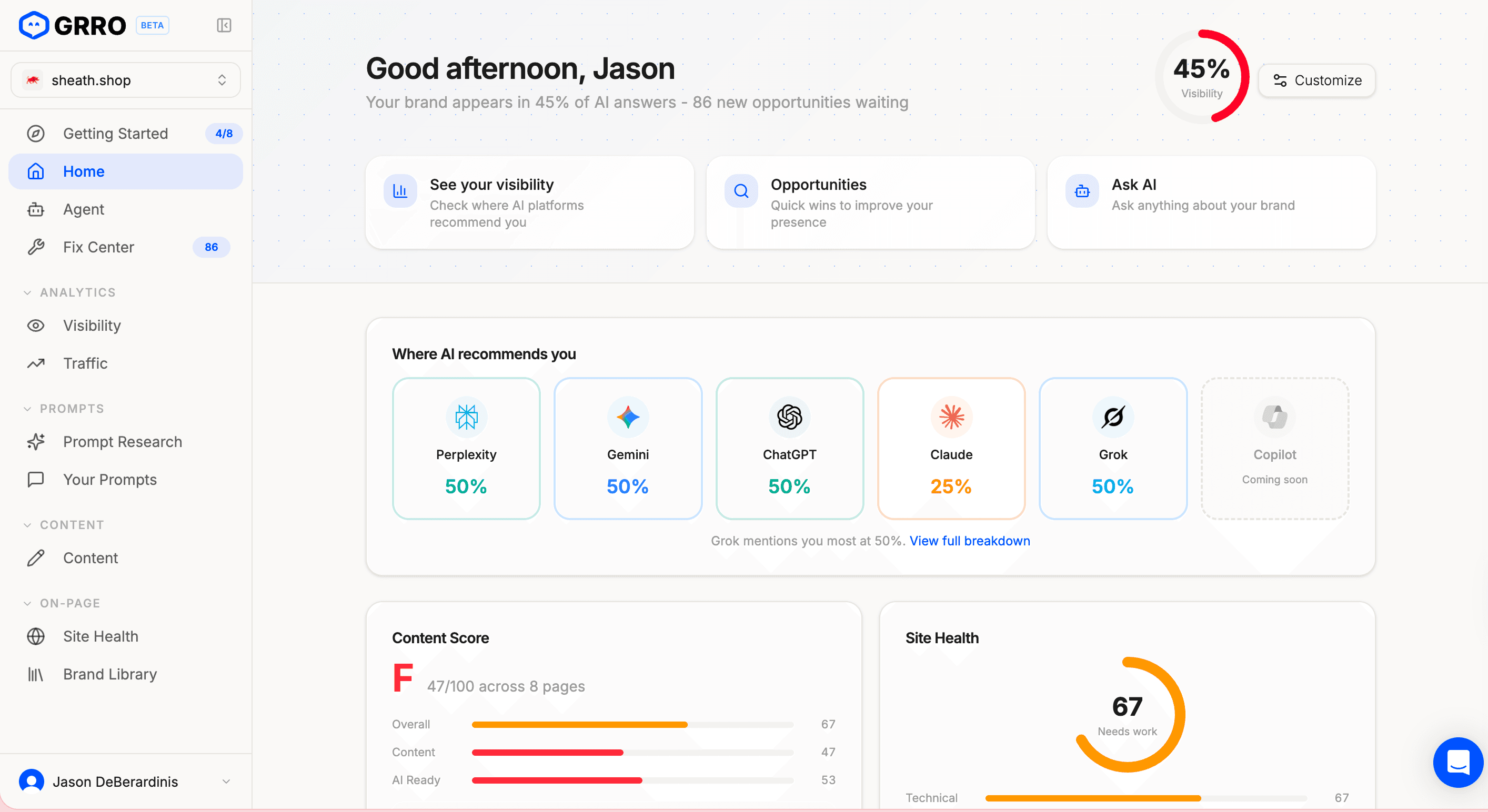
GRRO provides continuous monitoring of your brand's visibility across all 5 major AI engines. It tracks your AI Recommendation Score, identifies gaps in your coverage, and provides prioritized actions to improve your answer engine performance.
Content Scoring
Use tools that score your content for answer readiness. Evaluate each page for answer-first formatting, question-format headings, FAQ coverage, schema implementation, and information freshness.
Common AEO Mistakes
Writing for Humans Only
Content written purely for human engagement often buries answers behind narrative hooks and storytelling. AEO does not mean making content robotic. It means structuring it so the key answer is immediately accessible while the narrative depth follows.
Ignoring Schema Markup
Schema is not optional in AEO. It is the primary way you communicate content structure to answer engines. Sites without schema are competing with one hand tied behind their back.
Targeting the Wrong Questions
Optimizing for questions nobody asks wastes resources. Use search query data, People Also Ask boxes, and AI engine testing to identify the actual questions your audience asks. Then optimize for those specific phrasings.
Neglecting Multi-Source Presence
Even for AEO specifically, answer engines increasingly cross-reference information before selecting an answer. A brand with strong presence across LinkedIn, industry publications, and community forums will be selected over a brand that exists only on its own website. For strategies on building this presence, see our guide on building authority signals for AI recommendations.
Forgetting to Update
The fastest way to lose a featured snippet or AI recommendation is to let your content go stale. Set a calendar reminder to review and update your top AEO content quarterly.
FAQ
What does AEO stand for?
AEO stands for Answer Engine Optimization. It is the practice of structuring your content to be selected as the direct answer by search engines, voice assistants, and AI-powered platforms like ChatGPT and Perplexity.
Is AEO replacing SEO?
No. AEO is an extension of SEO, not a replacement. Strong SEO fundamentals (technical health, quality content, backlinks) are prerequisites for AEO success. Pages typically need to rank in the top 10 for a query before being considered for featured snippet or AI answer selection. The best strategy is to practice both.
What is the difference between AEO and GEO?
AEO focuses on being the direct answer to specific questions across all answer engines, including Google Featured Snippets and voice assistants. GEO (Generative Engine Optimization) specifically targets AI-generated answers from platforms like ChatGPT, Perplexity, and Gemini. GEO requires additional focus on multi-source validation and entity recognition. AEO is the foundation; GEO is the evolution.
How do I know if my content is AEO-optimized?
Check these five criteria: (1) Does each section lead with a direct answer in the first 40 to 60 words? (2) Are headings phrased as questions users actually ask? (3) Is FAQ schema implemented? (4) Can each answer passage stand alone without surrounding context? (5) Is the content current with an updated timestamp? If you can answer yes to all five, your content is AEO-ready.
How quickly does AEO produce results?
Featured snippet changes can happen within days of content updates. Voice search results typically follow within 1 to 2 weeks. AI engine recommendations take 2 to 8 weeks depending on the platform. Perplexity reflects changes in 48 to 72 hours, while ChatGPT and Gemini take 2 to 4 weeks. Building sustained answer engine dominance requires 3 to 6 months of consistent effort.
What tools do I need for AEO?
At minimum, you need schema markup implementation, a featured snippet tracking tool, and AI visibility monitoring. GRRO provides comprehensive AI visibility tracking across ChatGPT, Perplexity, Gemini, Claude, and Grok. For schema, use Google's Rich Results Test to validate your markup.
Does AEO work for local businesses?
Yes. AEO is particularly effective for local businesses because local queries ("best plumber near me," "top-rated dentist in Austin") are among the most common answer engine queries. Optimizing your Google Business Profile, building local schema markup, and structuring your content around local questions can significantly improve your answer engine visibility. See our local business AI search case study for a real-world example.
Conclusion
Answer Engine Optimization is the bridge between traditional SEO and the AI-driven future of search. It takes the ranking foundations of SEO and applies them to the new reality where search engines, voice assistants, and AI platforms deliver direct answers instead of link lists.
The core principles are straightforward: lead with direct answers, structure content around the questions your audience asks, implement schema markup, and maintain freshness. These are not revolutionary changes to your content strategy. They are structural adjustments that make your existing content work harder across every answer platform. Building a repeatable AEO strategy workflow ensures these adjustments compound over time.
In 2026, with AI search queries exceeding 800 million per week and the majority of businesses having no answer engine strategy, the opportunity for early movers is substantial. The brands that structure their content for answer engines today will own the answer layer tomorrow.
Start by measuring your current answer engine visibility with a free scan at GRRO. Understand where you stand across all 5 major AI engines. Then apply the strategies in this guide to systematically increase your presence in the answers your customers are reading.

Co-Founder & CMO at GRRO