AI Recommendation Score: What It Is and Why It Matters
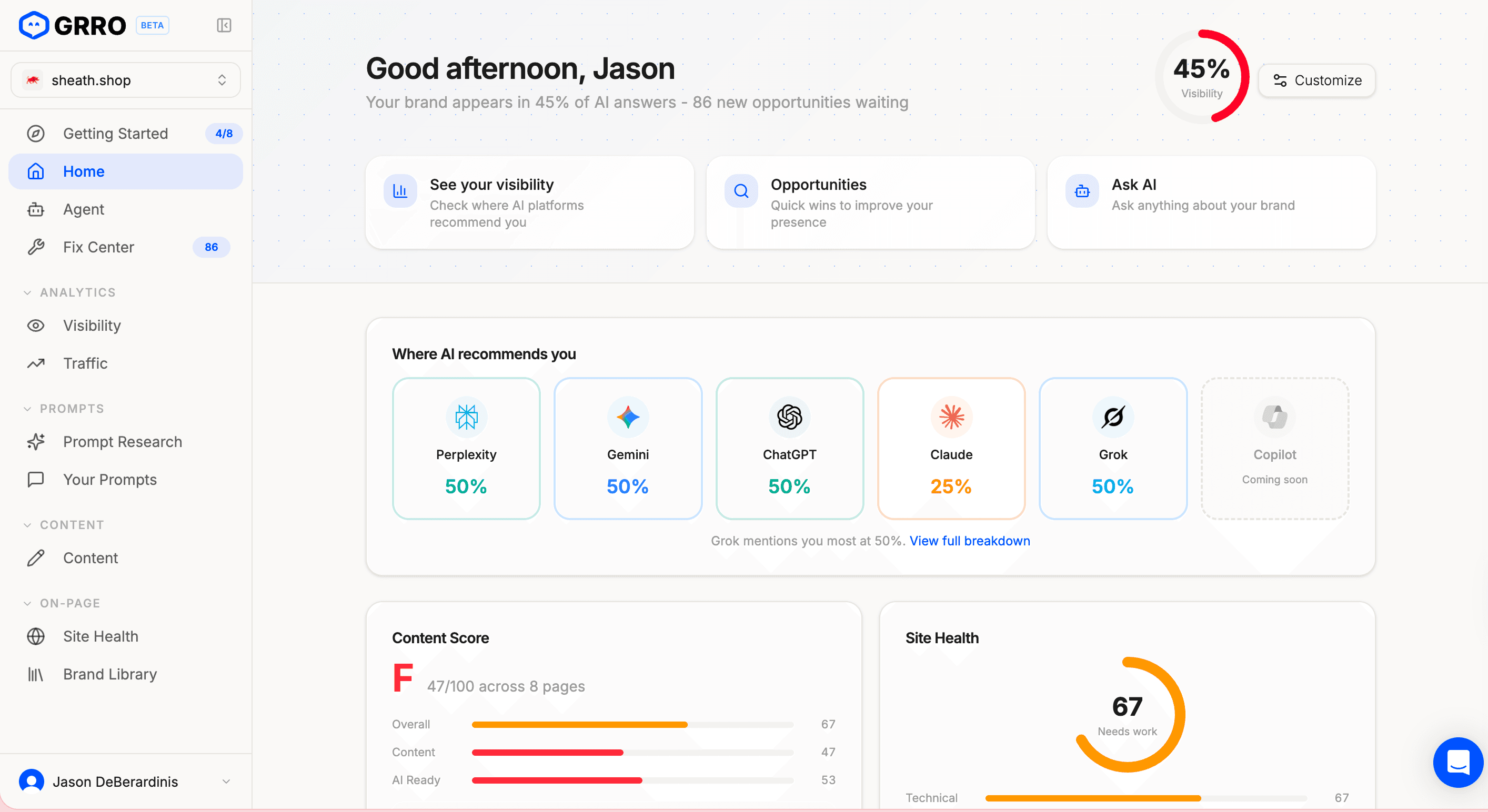
Your AI Recommendation Score tells you exactly how visible your brand is across ChatGPT, Perplexity, Gemini, and other AI search engines. Here is how it works, what a good score looks like, and how to improve yours.
Key Takeaways
- An AI Recommendation Score is a single metric that measures how often, how prominently, and how positively AI search engines recommend your brand when customers ask relevant questions.
- The score is calculated from 4 components: mention rate, rank position, sentiment, and cross-platform consistency across 5 major AI engines.
- A score above 70 means AI engines are actively recommending your brand. Below 30 means you are effectively invisible. The average business scores under 15.
- GRRO calculates your AI Recommendation Score by running real customer queries across ChatGPT, Perplexity, Gemini, Claude, and Grok, then analyzing every response for your brand.
- Improving your score requires a combination of answer-first content, structured data, multi-source presence, and consistent brand signals.
What Is an AI Recommendation Score?
When a potential customer asks ChatGPT "What is the best accounting software for freelancers?" or Perplexity "Which running shoes are best for flat feet?", the AI engine generates an answer and recommends specific brands. Your AI Recommendation Score measures whether your brand is one of them.
Think of it as the AI equivalent of a search ranking, but instead of measuring where you appear in a list of 10 blue links, it measures whether AI engines actively name and recommend your business in conversational answers.
This matters because AI search is not a future trend. It is a current reality. Over 800 million queries are processed by AI search engines every week. That number has grown 527% year over year. And traffic from AI recommendations converts at 4.4x the rate of traditional organic search.
Yet 97% of businesses have significant gaps in their AI visibility. Most do not even know they are invisible because they have never measured it. The AI Recommendation Score changes that by giving you a single, trackable number.
The 4 Components of Your Score
Your AI Recommendation Score is not a guess or an estimate. It is calculated from 4 specific, measurable components.
1. Mention Rate
Mention rate measures the percentage of relevant queries where your brand appears in the AI-generated response. If your customers ask 50 distinct questions that relate to your products or services, and your brand appears in the answers to 20 of them, your mention rate is 40%.
This is the most fundamental component. If AI engines are not mentioning your brand at all, nothing else matters.
What affects mention rate:
- Whether your brand appears across multiple independent sources that AI engines use as training data and retrieval sources
- Whether your content directly answers the questions customers ask
- Whether your structured data clearly identifies your brand, products, and expertise
- Whether competitors have stronger signals for the same queries
Most businesses start with a mention rate below 10%. Brands with strong AI visibility typically maintain mention rates above 60% for their core customer queries.
2. Rank Position
When AI engines recommend multiple brands in a single response, position matters. The first brand mentioned gets significantly more attention and click-throughs than the third or fourth.
Rank position measures where your brand appears relative to competitors in AI-generated answers. A first-position mention is weighted more heavily than a fifth-position mention.
What affects rank position:
- The breadth and authority of sources that mention your brand
- How directly your content answers the specific query
- Recency of your content and third-party mentions
- The strength of your entity signals in the AI engine's knowledge graph
A brand mentioned first in 80% of responses scores very differently than one mentioned last in 30% of responses, even if the raw mention counts are similar.
3. Sentiment
Not all mentions are equal. AI engines can recommend your brand positively ("Brand X is widely regarded as the best option for..."), neutrally ("Brand X is one of several options..."), or negatively ("While Brand X exists in this space, many users report issues with...").
Sentiment measures the quality of your AI mentions. Are AI engines recommending you enthusiastically, mentioning you as an afterthought, or flagging concerns?
What affects sentiment:
- Review scores and review content across third-party platforms
- The tone of mentions on forums, social media, and industry publications
- Whether comparison content positions you favorably or unfavorably
- Customer satisfaction signals that AI engines can detect in their source data
A brand mentioned in 50% of queries with consistently positive sentiment will have a higher AI Recommendation Score than one mentioned in 60% of queries with mixed or negative sentiment.
4. Cross-Platform Consistency
There are 5 major AI search engines that matter right now: ChatGPT, Perplexity, Google Gemini, Claude, and Grok. Each one uses different source data, different retrieval methods, and different ranking signals.
Cross-platform consistency measures how uniformly your brand is recommended across all 5 platforms. A brand that is recommended by 4 out of 5 engines scores higher than one recommended by only 2, even if the mention rate on those 2 platforms is very high.
What affects consistency:
- Your presence across the specific sources each AI engine prefers. ChatGPT relies heavily on Bing and Wikipedia. Perplexity favors Brave, Bing, and Reddit. Google Gemini uses Google search and Quora. Grok prioritizes X/Twitter.
- Whether your content is formatted in ways that each platform can parse effectively
- Whether your multi-source presence covers the preferred sources for all 5 engines
For a detailed breakdown of each platform's source preferences, see our guide on why most brands are invisible to AI search.
How GRRO Calculates Your Score
GRRO calculates your AI Recommendation Score through a systematic, automated process that would take hours to do manually.
Step 1: Query Generation
GRRO identifies the questions your customers actually ask. This starts with your industry, products, and competitors, then expands to cover the full range of queries where your brand should appear. For a typical business, this means 50 to 200 distinct queries.
Step 2: Multi-Platform Querying
Each query is run across all 5 major AI search engines using GRRO's search visibility tracking: ChatGPT, Perplexity, Google Gemini, Claude, and Grok. This happens continuously, not as a one-time snapshot, because AI responses change as these engines update their source data and models.
Step 3: Response Analysis
Every AI-generated response is analyzed through GRRO's source citation analytics for:
- Whether your brand is mentioned
- Where your brand appears relative to competitors
- The sentiment and context of each mention
- Which specific sources the AI engine drew from
- What competitors are being recommended instead
Step 4: Score Calculation
The 4 components (mention rate, rank position, sentiment, and consistency) are weighted and combined into a single score on a 0 to 100 scale. The weighting prioritizes mention rate and consistency, as these have the strongest correlation with actual AI referral traffic.
Step 5: Trend Tracking
Your score is tracked over time so you can see the impact of changes you make. Did adding FAQ schema improve your mention rate? Did publishing on LinkedIn boost your ChatGPT visibility? The trend data shows you exactly what is working.
If you want to try running this process manually before using the platform, we have a step-by-step guide on how to audit your AI search visibility in 30 minutes.
What a Good Score Looks Like
AI Recommendation Scores fall into 4 general ranges:
0 to 15: Invisible (Where 97% of Brands Are)
AI engines are not recommending your brand for any meaningful queries. Your customers are asking questions and getting sent to competitors. This is the default state for most businesses that have not taken deliberate action on AI visibility.
16 to 40: Emerging
AI engines mention your brand for some queries, but inconsistently. You might appear on 1 or 2 platforms but are missing from the others. Your competitors likely appear more frequently and in higher positions.
41 to 70: Visible
AI engines recommend your brand regularly across multiple platforms. You appear in the majority of relevant queries, though competitors may still outrank you in some areas. At this level, you are likely seeing measurable AI referral traffic.
71 to 100: Dominant
AI engines consistently recommend your brand first across most platforms and queries. You are the default recommendation in your category. Brands at this level typically see AI referral traffic that converts at 4.4x the rate of traditional organic search and represents a growing share of total revenue.
The average business that has never focused on AI visibility scores between 5 and 12. Brands that implement a structured AI recommendation strategy typically reach the 40 to 60 range within 90 days and the 70+ range within 6 months.
How to Improve Your Score
Improving your AI Recommendation Score is not about gaming a system. It is about making your brand more findable, more authoritative, and more useful to the AI engines that your customers are already using.
Improve Mention Rate
The fastest way to improve mention rate is to create content that directly answers the questions your customers ask. Not content about your products. Content that answers the questions.
For example, if you sell project management software, do not just write product pages. Write definitive guides that answer "How do I manage a remote team effectively?" and "What should I look for in a project management tool?" with your brand naturally positioned as the authoritative source.
Add structured data (FAQ schema, Product schema, Organization schema) so AI engines can parse your content efficiently. For a complete list of structured data fixes, see our post on why 97% of brands are invisible to AI search.
Improve Rank Position
Rank position is driven by authority. AI engines recommend first the brand they trust most for a given query. Build authority by:
- Getting mentioned in industry publications, not just your own blog
- Building a strong review profile on platforms like G2, Capterra, or Trustpilot
- Creating comparison content that objectively positions your strengths
- Earning backlinks and mentions from authoritative sites in your space
Improve Sentiment
Sentiment improves when your actual customer experience improves. AI engines aggregate signals from reviews, forums, social media, and support threads. The most effective way to improve sentiment scores is to:
- Actively manage your review profiles and respond to feedback
- Address common complaints that appear in reviews and forums
- Create content that honestly addresses your product's strengths and appropriate use cases
- Build a presence in communities where your customers discuss your category
Improve Consistency
Consistency means showing up across all 5 platforms, not just 1 or 2. Each AI engine has preferred sources:
- For ChatGPT: focus on Bing-indexed content, Wikipedia, and LinkedIn
- For Perplexity: prioritize Reddit, Brave-indexed content, and very recent publications
- For Google Gemini: optimize for Google search, Quora, and Featured Snippets
- For Grok: maintain an active, authoritative X/Twitter presence
- For Claude: focus on broad web presence and well-structured content
For a tactical guide to building multi-source authority, read our piece on building authority signals that get your brand recommended by AI.
Why Traditional Metrics Are Not Enough
You might be thinking: "I already track SEO rankings, organic traffic, and domain authority. Why do I need another score?"
Because AI search is a fundamentally different channel. A brand can rank #1 on Google for a keyword and still be completely invisible to ChatGPT. Traditional SEO metrics do not capture:
- Whether AI engines mention your brand in conversational answers
- How your brand is positioned relative to competitors in AI responses
- The sentiment of AI-generated recommendations about your brand
- Which AI platforms recommend you and which do not
Google AI Overviews have already caused a 61% drop in click-through rates for traditional search results. As AI search continues its 527% growth trajectory, the gap between what traditional SEO metrics measure and what actually drives customer acquisition will only widen.
Your AI Recommendation Score is the metric that bridges that gap.
FAQ
How often does my AI Recommendation Score change?
AI engines update their responses as they process new source data and model updates. GRRO recalculates your score continuously, so you can see changes within days of implementing improvements. Major algorithm updates at AI platforms can also cause score fluctuations, similar to how Google algorithm updates affect traditional search rankings.
Can I see my score broken down by individual AI platform?
Yes. GRRO provides your overall AI Recommendation Score plus individual scores for each of the 5 platforms: ChatGPT, Perplexity, Google Gemini, Claude, and Grok. This lets you identify which platforms you are strong on and where you have gaps.
What is the difference between AI Recommendation Score and traditional domain authority?
Domain authority measures the strength of your backlink profile for traditional search rankings. Your AI Recommendation Score measures whether AI engines actually recommend your brand in conversational answers. A site with high domain authority might still score poorly on AI recommendations if it lacks structured data, answer-first content, or multi-source presence. They measure fundamentally different things.
How quickly can I improve my score?
The fastest improvements come from structured data implementation (1 to 2 weeks) and content restructuring to answer-first format (2 to 4 weeks). Building multi-source presence takes 60 to 90 days. Most brands that implement a comprehensive strategy see their score move from the Invisible range (0 to 15) to the Visible range (41 to 70) within one quarter.
Is a perfect score of 100 realistic?
A score of 100 would mean AI engines unanimously recommend your brand first, with positive sentiment, for every relevant customer query across all 5 platforms. In practice, scores above 85 are exceptional and rare. Most market leaders in competitive categories score between 65 and 80. The goal is not perfection but consistent visibility and positive positioning relative to your competitors.
Conclusion
Your AI Recommendation Score is the single most important metric for understanding whether AI search engines are sending customers your way or sending them to competitors. It combines mention rate, rank position, sentiment, and cross-platform consistency into one number that tells you exactly where you stand. With 800M+ weekly AI queries and 527% annual growth, this is not a metric you can afford to ignore. The average business scores under 15. The brands winning AI search score above 70. Start with a free scan at grro.io to see your score in under 60 seconds, then use the roadmap above to start improving it.

Co-Founder & CMO at GRRO