Why Traditional SEO Is Not Enough in 2026
Traditional SEO alone cannot sustain organic growth in 2026. With AI search engines handling 800 million weekly queries and growing 527% year-over-year, brands need a dual strategy that combines SEO with AI search optimization.

Key Takeaways
- Traditional SEO is not dying, but relying on it exclusively in 2026 means ignoring a channel that delivers 4.4x higher conversion rates and is growing at 527% year-over-year
- AI search engines (ChatGPT, Perplexity, Gemini, Claude, Grok) are fundamentally changing how users find and choose products, services, and brands
- The shift from "10 blue links" to AI-generated recommendations means being ranked is no longer the same as being chosen
- 40% of Gen Z already uses AI search as their primary research tool, and adoption is accelerating across all demographics
- The optimal strategy is not SEO vs AI search optimization, it is both together, with content structured to serve AI readability while maintaining traditional ranking signals
The Landscape Has Changed
Traditional SEO is not enough in 2026 because the way people search has fundamentally changed. For two decades, SEO was the definitive strategy for organic growth: rank on Google, get clicks, convert traffic. That model still works, but it is no longer the complete picture.
AI search engines now handle over 800 million queries per week, growing at 527% year-over-year. When someone asks ChatGPT "What is the best CRM for my small business?" they do not receive 10 blue links to evaluate. They receive a direct recommendation. Your brand is either in that recommendation or it is not. There is no page 2. There is no "we ranked #7 but still got some traffic."
This is not a prediction about the future. This is the present reality. And the businesses that treat AI search as an afterthought are watching a growing share of their potential customers make decisions without ever seeing their brand.
What Traditional SEO Still Does Well
Before explaining what has changed, it is important to acknowledge what traditional SEO continues to do effectively:
Drives High-Volume Traffic
Google processes over 8.5 billion searches per day. Even with AI search growing rapidly, Google remains the largest single source of organic traffic. A strong organic ranking still delivers meaningful traffic volume.
Provides a Technical Foundation
The technical elements of SEO (site speed, mobile optimization, clean HTML, XML sitemaps, proper heading structure) are foundational to all digital visibility, including AI search. These investments are not wasted. They support both traditional and AI channels.
Builds Domain Authority
Backlinks, domain authority, and established rankings create a compounding asset. High-domain-authority sites are more likely to be included in AI engine retrieval pools, which means traditional SEO authority feeds directly into AI search visibility.
Supports Local Discovery
Google Maps, local pack results, and local SEO remain the primary discovery mechanism for local businesses. AI engines are entering this space, but Google's local infrastructure is still dominant.
The issue is not that traditional SEO has stopped working. The issue is that it no longer captures the full universe of how people discover and choose brands.
Five Reasons Traditional SEO Is No Longer Sufficient
Reason 1: The Zero-Click Shift Has Accelerated
Zero-click searches (searches where the user gets their answer without clicking any result) have been growing for years. Google's featured snippets started the trend. AI Overviews have accelerated it dramatically.
In 2026, an estimated 60 to 65% of Google searches result in zero clicks. For informational and advisory queries, the figure is even higher. Users get their answer directly from the AI Overview or, increasingly, skip Google entirely and ask an AI engine.
This means:
- A page ranked #1 for an informational query may get 50% fewer clicks than the same ranking delivered in 2023
- The value of organic rankings for informational queries is declining while the effort to maintain them remains constant
- Traffic from traditional organic search is plateauing or declining for many businesses even as total search volume grows
Reason 2: AI Engines Are Replacing Research Behavior
The behavior change is the most important factor. Users are not just adding AI search to their research process. They are replacing parts of it.
A B2B buyer who previously conducted 8 to 12 Google searches to evaluate software options now asks ChatGPT or Perplexity 2 to 3 questions and gets a synthesized answer. That is 8 to 12 potential organic touchpoints reduced to 2 to 3 AI interactions where your brand either appears or does not.
The data supports this shift:
- 40% of Gen Z uses AI search as their primary research tool
- AI search query volume has grown 527% year-over-year
- Users who start research on AI engines complete purchases 4.4x more often than those who start on traditional search
These are not fringe users. Gen Z is entering the workforce and making business purchasing decisions. Their default research behavior is asking AI, not searching Google.
Reason 3: Being Ranked Is Not the Same as Being Recommended
This is the conceptual shift that traditional SEO has not addressed: there is a fundamental difference between being ranked on a results page and being recommended in a conversation.
Traditional search: Google returns 10 results. Each result gets some visibility. Even position 10 gets approximately 2.4% of clicks. The user sees multiple options and makes their own evaluation.
AI search: The AI engine recommends 1 to 3 brands. Every other brand is invisible. The user receives a curated recommendation from a trusted AI, not a list to browse. Being absent from this recommendation is not like being on page 2. It is like not existing.
Traditional SEO optimizes for ranking. AI search optimization optimizes for being the brand the AI recommends. These are related but different objectives requiring different strategies.
For a detailed comparison, see our comprehensive guide on what AI search optimization is and how it differs from SEO.
Reason 4: Multi-Source Presence Is Now Required
Traditional SEO is website-centric. You optimize your website, build links to your website, and measure traffic to your website. Your website is the center of your strategy.
AI search optimization requires a multi-source strategy. AI engines cross-reference information across:
- Your website
- LinkedIn (company page and executive profiles)
- Reddit (community discussions and brand mentions)
- Wikipedia (entity validation)
- Industry publications (authority signals)
- Review platforms (G2, Trustpilot, Google Reviews)
- Social media (X/Twitter for Grok, YouTube for Gemini)
A brand with a perfectly optimized website but no presence on these platforms will struggle in AI search. AI engines validate brands through multi-source presence, and a single-source brand lacks the trust signals needed to earn recommendations.
Traditional SEO has no framework for this multi-source requirement. Link building addresses some of it, but building a Reddit presence, maintaining active LinkedIn thought leadership, and earning platform-specific reviews go beyond anything in the traditional SEO playbook.
Reason 5: Content Format Requirements Have Changed
Traditional SEO content has evolved through clear phases: keyword-stuffed content in the early days, long-form comprehensive content in the 2010s, and user-intent-matched content in recent years. Each phase was driven by Google's algorithm updates.
AI search requires a new content format that traditional SEO has not adapted to:
Traditional SEO content optimizes for:
- Engagement metrics (time on page, scroll depth)
- Click-through rate (compelling title tags and meta descriptions)
- Comprehensive coverage (longer content tends to rank better)
- Internal and external linking
AI-optimized content additionally requires:
- Answer-first formatting (direct answer in the first 40 to 60 words of each section)
- Question-format headings that match AI query patterns
- Structured data that gives AI engines machine-readable context
- FAQ sections that mirror the questions users ask AI engines
- Content chunks that are independently meaningful (because AI engines evaluate 200 to 500 word segments independently)
These format requirements do not conflict with traditional SEO. In fact, they enhance it. But traditional SEO strategies do not explicitly address them, leaving businesses optimized for Google's ranking algorithm but poorly formatted for AI extraction.
The Convergence Strategy: SEO Plus AI Search Optimization
The answer is not to abandon traditional SEO. It is to evolve it into a dual strategy that serves both channels.
Layer 1: Maintain Your SEO Foundation
Continue investing in:
- Technical SEO (site speed, mobile optimization, crawlability)
- Domain authority building through quality backlinks
- Keyword research and content planning
- Local SEO (for local businesses)
- Organic ranking tracking
These investments support both traditional and AI search visibility. A strong organic ranking is a prerequisite for AI visibility because AI engines use search engine results as their initial retrieval pool.
Layer 2: Restructure Content for AI Readability
Update your existing content to serve both channels:
- Add direct answers to the opening of each section
- Restructure headings as question-format H2s
- Add FAQ sections with schema markup
- Implement comprehensive structured data (Organization, Article, FAQ, Product, Person)
- Ensure each content section is independently meaningful
This restructuring improves AI extraction without hurting organic rankings. Google rewards the same content clarity that AI engines prefer.
Layer 3: Build Multi-Source Authority
Expand beyond your website:
- Establish strong LinkedIn presence (company and executive profiles)
- Build genuine Reddit community engagement
- Pursue Wikipedia mentions through legitimate notability
- Collect reviews on relevant platforms (Google, G2, Trustpilot)
- Maintain an active presence on platforms each AI engine trusts
This is the layer that traditional SEO does not address. It requires dedicated effort and strategy beyond website optimization.
Layer 4: Monitor AI Visibility
Add AI-specific metrics to your reporting:
- AI Recommendation Score across all 5 major engines
- Query coverage (what percentage of relevant queries return your brand in AI responses)
- Competitor displacement (instances where your brand appeared instead of or alongside competitors)
- AI referral traffic and conversion rates
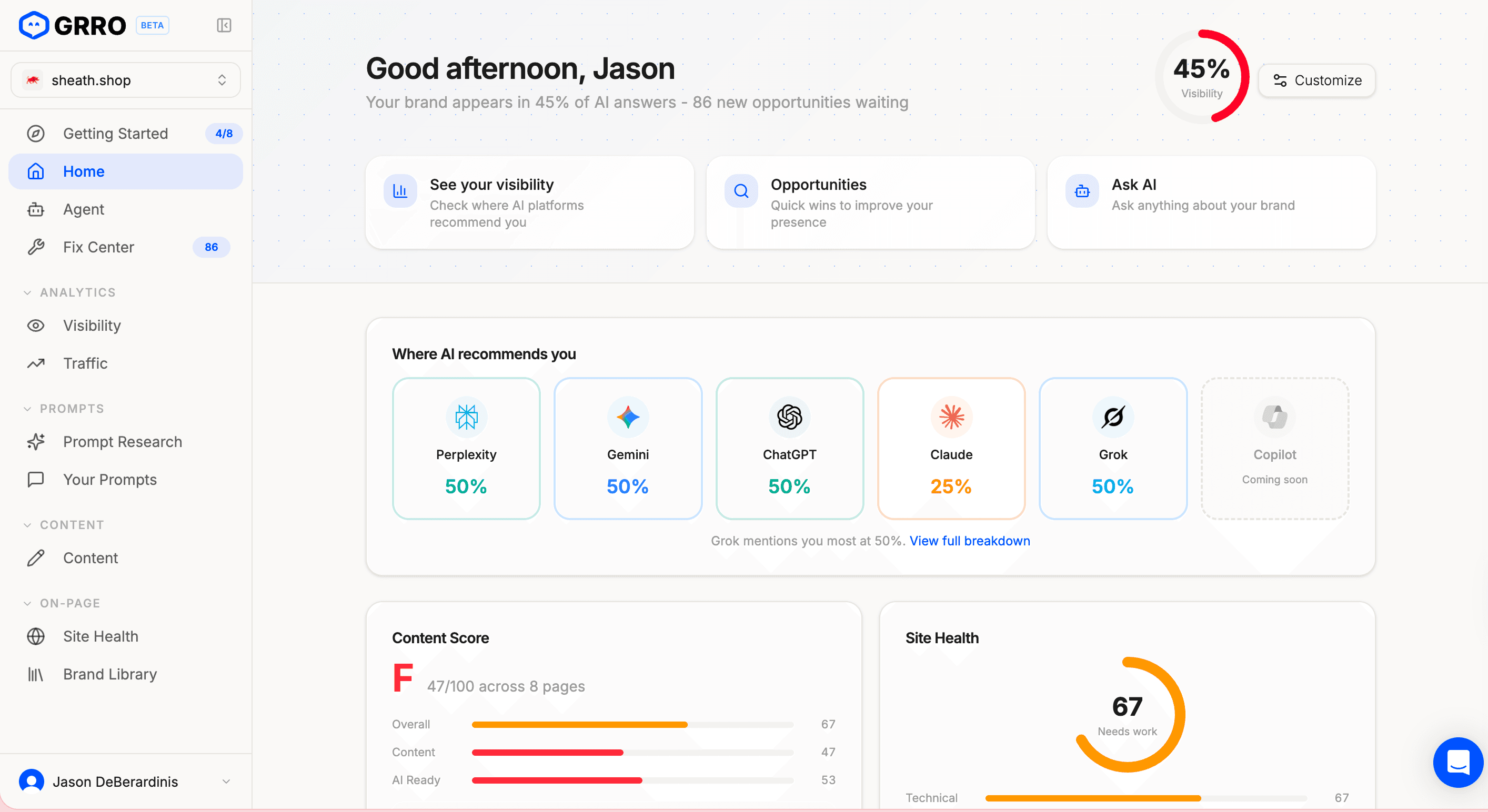
GRRO's search visibility tracking provides these metrics alongside traditional SEO data, giving you a unified view of your search presence.
What Happens If You Only Do SEO
A thought exercise: imagine two competitors in the same space. Both have equally strong SEO programs. Both rank on page 1 for their target keywords.
Competitor A maintains their SEO program and invests in AI search optimization: content restructuring, multi-source authority, structured data, and AI monitoring.
Competitor B maintains their SEO program but does nothing for AI search.
After 12 months:
- Both still rank similarly on Google (SEO parity is maintained)
- Competitor A appears in AI recommendations for 60% of target queries
- Competitor B appears in AI recommendations for 10% of target queries
- Competitor A captures the growing AI referral traffic at 4.4x conversion rates
- Competitor B misses 90% of AI-driven purchase decisions
The gap compounds. As more users shift to AI search (and the trend is accelerating), Competitor B falls further behind on a growing channel while maintaining parity on a plateauing one.
This is the real cost of relying exclusively on traditional SEO in 2026: you maintain your position on a channel that is flattening while missing the channel that is exploding.
The Transition Timeline
For businesses wondering when to start, the answer is now. But the transition does not need to happen overnight.
Month 1: Measure and Audit
- Run a free AI visibility scan to establish your baseline
- Test 20 to 30 target queries manually across ChatGPT, Perplexity, and Gemini
- Document where your brand appears and where competitors appear
- Audit your multi-source presence (LinkedIn, Reddit, review platforms)
- Assess your content format against AI extraction requirements
Months 2 to 3: Quick Wins
- Restructure your top 10 pages with answer-first formatting
- Add FAQ schema to all key pages
- Complete and optimize your LinkedIn company page and executive profiles
- Implement Organization and Author schema
- Begin systematic review collection on priority platforms
Months 3 to 6: Deep Optimization
- Restructure your full content library for AI readability
- Build a comprehensive structured data implementation across your site
- Start genuine Reddit engagement in relevant communities
- Create comparison content targeting key competitor queries
- Launch a multi-source authority building program
Months 6 to 12: Scale and Compete
- Monitor and iterate based on AI Recommendation Score trends
- Expand content coverage for emerging AI query patterns
- Build topical entity authority through deep content clusters
- Pursue press coverage and industry mentions for entity building
- Continuously update content for freshness signals
The Competitive Window
The most important statistic in AI search today is this: 97% of businesses have no AI visibility strategy. Only 3% of brands are actively positioned for AI recommendations.
This means the competitive field is nearly empty. The early movers have a structural advantage that will compound as AI search grows. Every month of delay narrows the window.
Within 2 to 3 years, AI search optimization will be as table-stakes as traditional SEO. The businesses that start now are building a head start that latecomers will struggle to close, because entity authority, multi-source presence, and content formatting advantages compound over time.
Traditional SEO took a decade to mature. Businesses that invested early in SEO built advantages that persist today. AI search optimization is at the same early stage, and the same first-mover dynamics apply.
FAQ
Is traditional SEO dying?
No. Traditional SEO is evolving, not dying. Google still processes billions of searches daily, and organic rankings still drive meaningful traffic. What is changing is the completeness of an SEO-only strategy. Traditional SEO is no longer sufficient as a standalone approach to organic growth because a growing share of user research and purchase decisions are happening through AI engines that traditional SEO does not address.
How much budget should I shift from SEO to AI search optimization?
For most businesses, 10 to 20% of your current SEO budget should be reallocated to AI search optimization in 2026. This is not a reduction in SEO investment but a rebalancing. Much of the work (content restructuring, structured data, freshness maintenance) benefits both channels. The incremental investment goes toward multi-source authority building and AI-specific monitoring.
Can small businesses compete in AI search?
Yes, and in many cases more effectively than large enterprises. AI engines evaluate topical authority within specific niches, not global brand size. A small business that is the clear authority in its niche can outperform a Fortune 500 company with shallow coverage of the same topic. The entity authority framework works regardless of business size.
Will AI search replace Google?
Not in the foreseeable future. More likely, AI search will coexist alongside traditional search, with each serving different query types and user preferences. Google itself is integrating AI into search through AI Overviews, blurring the line between traditional and AI search. The smart strategy optimizes for both rather than betting on one replacing the other.
What is the fastest way to see AI search results?
Content restructuring produces the fastest visible results. Reformatting your top pages with answer-first structure, adding FAQ schema, and updating publication dates can improve AI visibility within 4 to 8 weeks. Perplexity reflects changes in 48 to 72 hours. ChatGPT and Gemini typically respond within 2 to 4 weeks. Multi-source authority building takes longer (3 to 6 months) but produces the most durable results.
Do I need a new team for AI search optimization?
Not necessarily. Your existing SEO team can handle most AI search optimization work because the skills overlap significantly. The new areas that may require additional expertise are AI engine monitoring, multi-source authority strategy, and entity SEO. Many businesses start by upskilling their current team and adding AI visibility monitoring through GRRO's AEO strategy workflows to their stack.
How do I convince my leadership team to invest in AI search optimization?
Three data points make the case: (1) 800 million weekly AI queries growing at 527% year-over-year, meaning the channel is large and accelerating; (2) 4.4x higher conversion from AI referral traffic, meaning the traffic is more valuable; (3) 97% of businesses have no strategy, meaning the competitive window is open. Run a free AI visibility scan and present the gap between your brand and competitors to make the case concrete.
Conclusion
Traditional SEO is not dead, but treating it as a complete organic growth strategy in 2026 is leaving revenue on the table. The numbers are clear: 800 million weekly AI queries, 527% growth, 4.4x conversion rates, and 97% of brands with no strategy. The opportunity is enormous and the competition is minimal.
The businesses that thrive will be those that maintain their SEO foundation while building the AI search visibility layer on top: answer-first content, multi-source authority, comprehensive structured data, and continuous AI monitoring. This is not an either/or decision. It is an evolution.
The 3% of brands that have already started are building a compounding advantage. Every month you wait, the window narrows as more competitors recognize the shift and begin their own AI search strategies.
Start with measurement. Run a free AI visibility scan at GRRO to see where your brand stands across all 5 major AI engines. Compare that to your organic rankings. The gap between your SEO visibility and your AI visibility is the opportunity you are currently missing, and closing it is the most important strategic move you can make in 2026.

Co-Founder & CMO at GRRO