Entity SEO: How to Make AI Engines Understand Your Brand
Entity SEO is the practice of building a clear, verifiable brand identity that AI engines can recognize and recommend. Learn how to establish your brand as a known entity across ChatGPT, Perplexity, Gemini, and other AI search engines.

Key Takeaways
- Entity SEO is the practice of establishing your brand as a recognized, disambiguated entity in the knowledge graphs that AI engines use to generate recommendations
- AI engines do not recommend keywords or pages. They recommend entities: brands, products, people, and organizations they can identify and trust
- Building entity authority requires consistent Name, Address, Phone (NAP) data, connected platform profiles, structured data, and third-party validation
- The gap between brands with strong entity profiles and those without is the single biggest factor in AI search visibility
- Entity SEO compounds over time: once an AI engine recognizes your brand as an authority in a topic area, that recognition influences every future query in that space
What Is Entity SEO and Why It Matters for AI Search
Entity SEO is the practice of building a machine-readable brand identity that AI engines can recognize, validate, and trust enough to recommend.
In traditional SEO, the unit of optimization is the keyword. You research keywords, create content targeting those keywords, and build links to rank for those keywords. In entity SEO, the unit of optimization is the entity itself: your brand, your products, your people, and the relationships between them.
AI engines like ChatGPT, Perplexity, Gemini, Claude, and Grok do not think in keywords. They think in entities. When a user asks "What is the best project management tool for remote teams?" the AI does not match keywords. It identifies the entities (project management tools) that have the strongest authority signals for the context (remote teams) and recommends them by name.
If the AI engine does not recognize your brand as an entity, you cannot be recommended. It is that simple.
This makes entity SEO the foundation of every AI search optimization strategy. Without it, content optimization, structured data, and search visibility tracking all lack the anchoring identity that AI engines need to make a recommendation.
How AI Engines Build Entity Understanding
The Knowledge Graph
Every major AI engine maintains or references a knowledge graph: a database of entities and their relationships. Google has its Knowledge Graph. Bing has its Satori. ChatGPT builds entity understanding from its training data and real-time retrieval. Perplexity constructs entity profiles from multi-source retrieval.
These knowledge graphs contain nodes (entities) and edges (relationships). Your brand is a node. Your products are nodes. Your founders are nodes. The edges connect them: "Brand X was founded by Person Y" or "Brand X manufactures Product Z."
The richer and more verified these nodes and edges are, the more confidently AI engines can recommend your brand.
How Entities Get Created
AI engines create entity profiles from three sources:
-
Structured data on your website. Organization schema, Person schema, Product schema, and their interconnections tell AI engines what your entity is and how it relates to other entities. For advanced implementation details, see our guide on structured data for AI search.
-
Third-party references. Wikipedia mentions, LinkedIn profiles, Crunchbase entries, industry publications, and social media presence create independent data points that AI engines use to validate your entity.
-
Training data and retrieval. AI models learn about entities from the vast corpus of text they are trained on and from the real-time content they retrieve through the RAG pipeline.
Entity Disambiguation
One of the biggest challenges in entity SEO is disambiguation: helping AI engines understand that your brand is a specific, unique entity and not a common word, a different company with a similar name, or a generic term.
If your brand name is "Apex," AI engines need to distinguish between Apex the software company, Apex the construction firm, Apex the Salesforce programming language, and the common English word "apex." Without clear entity signals, the AI defaults to the most prominent or most common interpretation, and your brand may never surface.
Disambiguation requires:
- Consistent naming across all platforms (website, LinkedIn, X, Wikipedia, Crunchbase)
- sameAs schema links connecting all your platform profiles
- Context co-occurrence where your brand name consistently appears alongside your industry terms
- Unique identifiers like your domain name, founding date, and geographic location
The Entity Authority Framework
Building entity authority is a systematic process with five layers. Each layer reinforces the others.
Layer 1: Establish the Core Entity
Your website is your entity's home base. It must declare your entity clearly and completely through:
Organization schema with comprehensive attributes:
- Legal name and brand name
- Description including primary expertise areas
- Founding date and location
- Links to all official platform profiles (sameAs)
- Topics of expertise (knowsAbout)
About page that reads like a knowledge base entry:
- Factual, third-person description of your organization
- Key milestones with dates
- Leadership team with credentials
- Products or services with clear descriptions
- Industry positioning and differentiators
The about page is one of the most underutilized assets in entity SEO. AI engines frequently retrieve about pages when users ask brand-related questions. If your about page reads like marketing copy, the AI has nothing factual to extract. If it reads like a Wikipedia entry, the AI can build a robust entity profile.
Layer 2: Connect People Entities
Every brand is built by people, and AI engines understand this. Creating strong Person entities for your leadership team and subject matter experts extends your brand's authority.
For each key person:
- Create a detailed bio page on your website with Person schema
- Link the Person schema to the Organization schema via "worksFor"
- Ensure their LinkedIn profile matches the website bio
- Connect their published content (articles, talks, interviews) to their Person entity
- If applicable, pursue Wikipedia notability
When an AI engine encounters an article by your CMO about marketing trends, it traces the author entity back to your organization entity. If both entities are well-established, the content inherits compound authority.
Layer 3: Build Multi-Source Validation
AI engines cross-reference entity information across multiple independent sources. The more sources that confirm your entity's attributes, the higher your trust score.
Priority platforms for entity validation:
| Platform | Why It Matters | Action Required |
|---|---|---|
| Referenced by ChatGPT, Perplexity, Gemini | Complete company page, active executive profiles | |
| Wikipedia | Highest trust signal across all AI engines | Pursue mention if your brand has notability |
| Crunchbase | Business entity validation | Claim and complete your profile |
| Industry directories | Niche authority signal | Get listed in relevant directories |
| User sentiment signal, Perplexity source | Genuine community participation | |
| X/Twitter | Real-time relevance, Grok primary source | Active presence with industry content |
| YouTube | Video entity signal, Gemini source | Brand channel with optimized descriptions |
The key is consistency. Your brand name, description, founding date, and leadership information must be identical across every platform. Discrepancies create entity confusion and reduce trust. See our full guide on building authority signals for AI recommendations.
Layer 4: Create Topical Entity Associations
AI engines need to understand what topics your brand is authoritative about. This is not the same as keyword targeting. It is about creating a consistent, deep association between your entity and specific subject areas.
Strategies for building topical associations:
- Content depth over breadth. Publish extensively on your core topics rather than shallowly on many topics. A brand with 50 articles on AI search optimization builds stronger topical authority than one with 5 articles on 10 different subjects.
- Semantic clustering. Organize your content into clear topic clusters with pillar pages and supporting articles. This mirrors how AI engines organize knowledge.
- Expert attribution. Have your recognized experts author content on their areas of expertise. The AI traces the authority from the person to the topic to the brand.
- knowsAbout schema. Explicitly declare your expertise areas in your Organization schema.
Layer 5: Earn Entity References
The strongest entity signal is when other authoritative entities reference yours. This is the entity-level equivalent of backlinks, but with a critical difference: AI engines evaluate the semantic context of the reference, not just its existence.
A mention in an industry report that says "GRRO, the AI search visibility platform, provides comprehensive monitoring across five AI engines" creates a strong entity reference because it names the entity, describes what it does, and provides a specific attribute. A link in a blog roll with no context creates almost no entity value.
Strategies for earning quality entity references:
- Contribute original research that publications will cite by brand name
- Participate in industry roundups and expert panels
- Sponsor or speak at events where your brand will be mentioned in official materials
- Build partnerships that result in named references on partner websites
- Pursue press coverage with accurate brand descriptions
Measuring Entity Strength
Direct Entity Testing
The simplest test: ask each AI engine about your brand directly.
- "What is [Your Brand]?"
- "Tell me about [Your Brand]"
- "Who founded [Your Brand]?"
- "What does [Your Brand] do?"
If the AI engine provides accurate, detailed answers, your entity is well-established. If it says "I don't have information about [Your Brand]" or provides incorrect information, your entity work is incomplete.
Competitive Entity Comparison
Ask AI engines comparative questions:
- "What are the best [your category] tools?"
- "Compare [Your Brand] to [Competitor]"
- "Who are the leaders in [your industry]?"
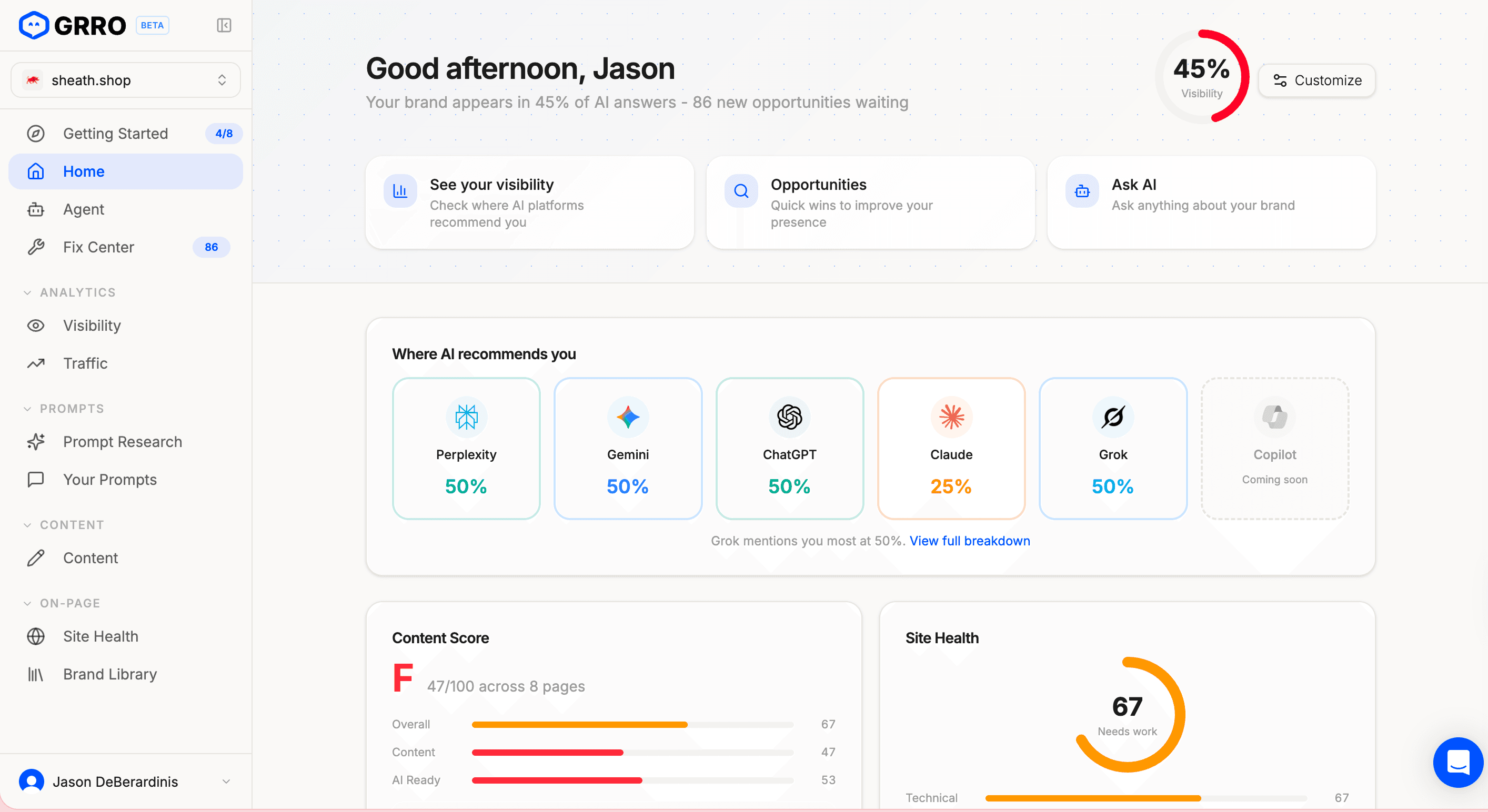
Track whether your brand appears in these answers. The GRRO platform automates this tracking across all five major AI engines with your AI Recommendation Score.
Entity Consistency Audit
Review your brand's presence across all platforms and check for:
- Name consistency (exact same brand name everywhere)
- Description alignment (same core messaging)
- Factual accuracy (founding date, team members, products)
- Link completeness (all profiles connected via sameAs schema)
- Visual consistency (same logo, brand imagery)
Inconsistencies are entity poison. Fix them before investing in additional entity building.
Entity SEO for Different Business Types
SaaS and Technology Companies
Focus on Product entities with detailed feature descriptions, integration relationships, and use case associations. SaaS brands benefit enormously from comparison content that explicitly positions their entity against competitors, because AI engines frequently retrieve comparison content when answering "which tool is best" queries.
Build a comparison page strategy that names your entity alongside the category and specific use cases.
E-Commerce Brands
Product entities are your primary asset. Each product should have comprehensive Product schema with Brand linkage, category classification, and aggregate reviews. The entity relationship chain (Brand produces Product, Product has Reviews, Reviews from Verified Buyers) creates the trust structure AI engines need.
Local Businesses
Local entity SEO adds geographic disambiguation. Your Google Business Profile, Yelp listing, and local directories create location-specific entity signals. AI engines increasingly handle local queries ("best Italian restaurant in Austin"), and local businesses with strong entity profiles dominate these recommendations.
Professional Services
Person entities drive professional services entity SEO. The individual experts at your firm are the entities AI engines evaluate. Their credentials, publications, speaking engagements, and professional profiles create the authority that AI engines transfer to your organization entity.
Common Entity SEO Mistakes
Mistake 1: Brand Name Inconsistency
Using "Acme Corp" on your website, "Acme Corporation" on LinkedIn, "ACME" on X, and "Acme" on Crunchbase creates four potential entities instead of one. Pick one canonical name and use it everywhere.
Mistake 2: Missing sameAs Links
Without sameAs schema connecting your platform profiles, AI engines may not recognize that your LinkedIn page, your website, and your X account belong to the same entity. This is the single easiest entity SEO fix with the highest impact.
Mistake 3: Thin About Pages
An about page that says "We are passionate about helping businesses grow" gives AI engines nothing to work with. Rewrite it with factual, specific information: founding date, team size, geographic focus, product descriptions, industry achievements.
Mistake 4: Ignoring Person Entities
Your brand entity is only as strong as the person entities connected to it. If your CEO, CTO, and subject matter experts do not have established Person entities with linked profiles and published credentials, your organization entity is missing a critical trust layer.
Mistake 5: No Topical Focus
Brands that publish content across dozens of unrelated topics dilute their entity associations. AI engines cannot determine what your brand is authoritative about. Focus on your core 3 to 5 topics and build deep content clusters around each.
FAQ
How long does it take to build a strong brand entity for AI search?
Building a recognizable brand entity typically takes 3 to 6 months of consistent effort. Initial entity recognition (AI engines correctly identifying your brand) can happen within 4 to 8 weeks if you implement comprehensive structured data and ensure platform consistency. Full topical authority, where AI engines consistently recommend your brand for relevant queries, usually takes 6 to 12 months.
Can small businesses compete with large brands in entity SEO?
Yes, especially in niche categories. AI engines evaluate entity authority within topic contexts, not globally. A small cybersecurity firm with deep, consistent content on a specific security niche can build stronger topical entity authority than a Fortune 500 company with shallow coverage of the same topic. The key is focus: own your niche entity before trying to expand.
What is the relationship between entity SEO and traditional link building?
Entity SEO and link building overlap but are not identical. Traditional link building focuses on domain authority through link volume and quality. Entity SEO focuses on brand recognition through named references in authoritative contexts. A link from a high-authority site helps both strategies. But a named brand mention without a link (an unlinked brand mention) helps entity SEO significantly while doing nothing for traditional link building.
How do I know if AI engines recognize my brand as an entity?
Ask AI engines directly: "What is [Your Brand]?" and "Tell me about [Your Brand]." If they provide accurate, detailed responses, your entity is recognized. If they return generic or incorrect information, your entity needs work. The GRRO platform provides automated entity recognition tracking across all five major AI engines.
Does entity SEO replace traditional SEO?
No. Entity SEO builds on traditional SEO. You still need strong technical foundations, quality content, and domain authority. Entity SEO adds a layer of brand identity optimization that makes all your other SEO investments more effective in the AI search era. Think of it as the identity layer that gives your content a trusted author and your brand a recognized name.
How does entity SEO differ from brand building?
Brand building creates awareness and emotional connections with human audiences. Entity SEO creates machine-readable identity and trust signals for AI engines. They share inputs (consistent messaging, authority content, platform presence) but serve different audiences. The best strategy is aligned: your brand building efforts should produce the named references, consistent information, and authority signals that entity SEO requires.
Which AI engines are most responsive to entity SEO improvements?
Perplexity and Gemini show the fastest response to entity improvements, typically reflecting changes within 2 to 4 weeks. ChatGPT's knowledge updates on a longer cycle but responds well to entity signals in its real-time retrieval. Grok is highly responsive to X/Twitter entity signals. Claude tend to follow similar patterns to ChatGPT. Monitoring all 5 engines, which you can do through GRRO, ensures you catch engine-specific responses.
Conclusion
Entity SEO is the bridge between having great content and being recommended by AI engines. Without a clear, verifiable brand entity, your content is anonymous text competing against millions of other anonymous texts. With a strong entity profile, your content carries the weight of your brand's authority, expertise, and multi-source validation.
The work is systematic but not complicated: establish your core entity with comprehensive structured data, connect your people entities, build multi-source validation across the platforms AI engines trust, create deep topical associations, and earn quality entity references from other authoritative entities.
The brands that do this work now are building a compounding advantage. Every entity signal reinforces the others. Every new reference strengthens the existing profile. And as AI search grows from 800 million weekly queries to billions, the brands with the strongest entities will capture a disproportionate share of that traffic.
Start by testing your entity recognition. Ask ChatGPT, Perplexity, and Gemini about your brand. Then run a free AI visibility scan at GRRO to see where your entity stands across all 5 engines. The gap between what AI engines know about you and what they should know is your entity SEO roadmap.

Co-Founder & CMO at GRRO