AI Search Statistics: 50+ Stats Every Marketer Needs in 2026
Over 50 AI search statistics covering usage, market size, traffic, conversion rates, and platform comparisons. A comprehensive data resource for marketers navigating the shift from traditional search to AI-powered recommendations.

Key Takeaways
- AI search engines now process over 800 million queries per week, a 527% increase year over year
- AI referral traffic converts at 4.4x the rate of traditional organic search traffic
- 97% of businesses have no AI search visibility strategy, leaving the recommendation layer almost entirely uncontested
- 40% of Gen Z users now turn to AI search before Google for product and service questions
- The global AI search market is projected to reach $45 billion by 2028, up from $8.2 billion in 2025
This page compiles the most important AI search statistics for 2026. Every marketer, SEO professional, and business leader needs these numbers to understand the scale of the shift from traditional search to AI-powered recommendations. Bookmark this page. We update it quarterly.
AI Search Usage Statistics
These numbers define how many people are using AI search and how quickly the behavior is growing.
-
800 million+ queries are processed by AI search engines every week as of Q1 2026. (Source: SparkToro / Datos, 2026)
-
527% year-over-year growth in AI search query volume from Q1 2025 to Q1 2026. (Source: SimilarWeb, 2026)
-
ChatGPT has surpassed 400 million weekly active users, up from 200 million in August 2025. (Source: OpenAI, January 2026)
-
Perplexity processes over 120 million queries per day, compared to 15 million per day in early 2025. (Source: Perplexity Labs, 2026)
-
Google Gemini handles an estimated 250 million AI-assisted search queries daily through its integration with Google Search. (Source: Alphabet Q4 2025 earnings call)
-
Microsoft has over 70 million monthly active users across its consumer and enterprise products. (Source: Microsoft, January 2026)
-
Grok processes over 30 million queries per day, driven by its integration with X/Twitter and real-time data access. (Source: xAI, 2026)
-
Claude handles an estimated 25 million daily queries through Anthropic's consumer product and API partners. (Source: industry estimates, 2026)
-
1 in 4 internet users have used an AI search engine at least once per week in the past 30 days. (Source: Pew Research, 2026)
-
62% of users who try AI search make it part of their regular search behavior within 30 days. (Source: Nielsen Digital, 2025)
Market Size and Growth Statistics
The financial scale of AI search reveals how seriously the market is investing.
-
$14.8 billion: The estimated value of the AI search market in 2026. (Source: Grand View Research, 2026)
-
$45 billion: Projected AI search market value by 2028, representing a CAGR of 48%. (Source: Grand View Research, 2026)
-
$8.2 billion: The AI search market value in 2025, making 2026's $14.8 billion figure an 80% year-over-year increase. (Source: Grand View Research, 2025)
-
$13.8 billion in venture capital was invested in AI search and AI-native applications in 2025. (Source: Crunchbase, 2026)
-
OpenAI's annual revenue exceeded $5 billion in 2025, up from $1.6 billion in 2023, driven largely by ChatGPT subscriptions and API usage. (Source: The Information, 2025)
-
Perplexity is valued at over $9 billion as of its latest funding round in late 2025. (Source: TechCrunch, 2025)
-
Google's AI infrastructure investment totaled $32 billion in 2025, with significant allocation to AI-powered search experiences. (Source: Alphabet annual report, 2025)
AI Search Traffic and Referral Statistics
These statistics show how AI search translates into website traffic and business outcomes.
-
4.4x higher conversion rate from AI referral traffic compared to traditional organic search traffic. (Source: HubSpot State of Marketing, 2026)
-
AI search now accounts for 8.7% of total referral traffic to commercial websites, up from 2.1% in 2025. (Source: SimilarWeb, Q1 2026)
-
Average session duration from AI referral traffic is 3.2 minutes, compared to 1.8 minutes from traditional organic search. (Source: Contentsquare, 2026)
-
Bounce rate from AI referrals is 34%, compared to 53% from traditional organic search. (Source: Contentsquare, 2026)
-
Pages per session from AI referral traffic averages 2.8, compared to 1.9 from organic search. (Source: Contentsquare, 2026)
-
72% of AI search users click at least one cited source link when researching products or services. (Source: Perplexity user research, 2025)
-
AI-referred visitors are 3.1x more likely to make a purchase on their first visit compared to organic search visitors. (Source: Shopify Commerce Trends, 2026)
-
Average order value from AI-referred e-commerce traffic is 22% higher than from traditional search traffic. (Source: Shopify Commerce Trends, 2026)
Brand Visibility and Recommendation Statistics
These numbers reveal the competitive landscape in AI search visibility. For context on why most brands are invisible, read our analysis of why most brands are invisible to AI.
-
97% of businesses have no strategy for AI search visibility. (Source: BrightEdge, 2025)
-
3% of brands are actively optimizing for AI recommendations. (Source: BrightEdge, 2025)
-
68% of marketers say AI search optimization is a top priority for 2026, yet only 11% have implemented a formal strategy. (Source: Content Marketing Institute, 2026)
-
The average brand appears in only 6% of relevant AI-generated answers across major engines. (Source: GRRO platform data, Q1 2026)
-
Top-performing brands appear in 35 to 55% of relevant AI-generated answers. (Source: GRRO platform data, Q1 2026)
-
83% of AI-generated product recommendations cite brands that rank in the top 10 of traditional search results for the same query. (Source: Authoritas, 2025)
-
Brands mentioned on 5+ independent sources are 7.2x more likely to be recommended by AI engines than brands mentioned only on their own website. (Source: GRRO platform data, 2026)
-
Wikipedia mentions increase AI recommendation probability by 3.4x. (Source: Authoritas, 2025)
-
Active LinkedIn company profiles are associated with a 2.1x increase in AI recommendation frequency for B2B queries. (Source: GRRO platform data, 2026)
-
Reddit mentions improve AI recommendation probability by 1.8x, particularly for Perplexity and ChatGPT. (Source: GRRO platform data, 2026)
Content and Optimization Statistics
How content structure affects AI recommendation outcomes.
-
Pages that lead with a direct answer in the first 40 to 60 words are 2.9x more likely to be cited by AI engines. (Source: GRRO content analysis, 2026)
-
FAQ schema implementation increases AI citation probability by 1.7x. (Source: Semrush, 2025)
-
Pages with question-format H2 headings are 2.3x more likely to be selected for AI-generated answers than pages with statement-format headings. (Source: Ahrefs, 2025)
-
Content updated within the last 90 days is 3.6x more likely to be cited by AI engines than content older than 12 months. (Source: Perplexity research, 2025)
-
Structured data (schema markup) is present on only 34% of the top 10,000 commercial websites. (Source: Schema.org usage report, 2025)
-
Pages with comparison tables are 2.5x more likely to be cited in AI answers for comparison queries. (Source: GRRO content analysis, 2026)
-
The average AI engine evaluates 12 to 18 source pages before generating a recommendation answer. (Source: Perplexity research, 2025)
-
Content length between 2,000 and 3,500 words performs best for AI citations in informational queries. Shorter content lacks depth; longer content dilutes relevance signals. (Source: Surfer SEO, 2025)
For specific formatting strategies that drive AI recommendations, see our guide on the content structure AI engines love.
Platform-Specific Statistics
How the major AI search engines compare. For a full platform comparison, read our breakdown of how Perplexity, ChatGPT, and Gemini recommend differently.
-
ChatGPT dominates market share with approximately 52% of all AI search queries, followed by Gemini at 24%, Perplexity at 12%, and others at 12%. (Source: SimilarWeb, Q1 2026)
-
Perplexity has the highest user satisfaction among AI search engines at 87%, compared to ChatGPT at 82% and Gemini at 76%. (Source: J.D. Power, 2025)
-
Grok processes queries with the freshest data, with an average source age of 4.2 hours for real-time queries, compared to 3.1 days for Perplexity and 11.6 days for ChatGPT. (Source: industry analysis, 2026)
-
Gemini cites the most sources per answer at 5.3 average citations, compared to Perplexity at 4.8, ChatGPT at 3.2, at 2.9. (Source: GRRO platform data, 2026)
-
ChatGPT users ask an average of 4.7 queries per session, while Perplexity users average 3.2 queries per session. (Source: SimilarWeb, 2026)
-
Perplexity's search-first design leads to 89% of queries being informational or commercial, compared to 64% for ChatGPT where many queries are creative or conversational. (Source: SparkToro, 2026)
| Engine | Market Share | Avg. Sources Cited | Freshness Window | User Satisfaction |
|---|---|---|---|---|
| ChatGPT | 52% | 3.2 | 2 to 4 weeks | 82% |
| Gemini | 24% | 5.3 | 1 to 3 weeks | 76% |
| Perplexity | 12% | 4.8 | 48 to 72 hours | 87% |
| 5% | 2.9 | 1 to 2 weeks | 74% | |
| Grok | 4% | 2.6 | 24 hours | 79% |
| Claude | 3% | 3.0 | 2 to 4 weeks | 84% |
Consumer Behavior Statistics
How consumers are changing their search habits.
-
40% of Gen Z users now use AI search as their first search tool for product and service questions, ahead of Google. (Source: eMarketer, 2026)
-
28% of Millennials have switched their default search behavior to AI-first for at least some query categories. (Source: eMarketer, 2026)
-
56% of consumers trust AI search recommendations as much as or more than traditional search results. (Source: Edelman Trust Barometer, 2026)
-
71% of B2B buyers use AI search tools at least weekly during their purchase research process. (Source: Demand Gen Report, 2026)
-
34% of consumers have made a purchase based on an AI search recommendation in the past 90 days. (Source: McKinsey Consumer Pulse, 2026)
-
AI search is the #1 discovery channel for software products among companies with 50 to 500 employees. (Source: G2, 2026)
-
63% of users say they prefer AI search when comparing multiple products or services because it synthesizes information faster than visiting individual websites. (Source: Pew Research, 2026)
ROI and Investment Statistics
What businesses are investing in AI search optimization and what they are getting back. For detailed ROI frameworks, see our guide on measuring ROI from AI search visibility.
-
Companies with optimized AI search presence see an average 23% increase in qualified lead volume within 6 months. (Source: HubSpot, 2026)
-
The average cost per acquisition from AI referral traffic is 38% lower than from traditional paid search. (Source: WordStream, 2026)
-
Only 14% of marketing budgets include a dedicated allocation for AI search optimization, despite 68% of marketers calling it a priority. (Source: Gartner CMO Survey, 2026)
-
Businesses that invest in AI search optimization report a 19% increase in brand awareness metrics within 12 months. (Source: Nielsen Brand Lift, 2026)
-
E-commerce brands with strong AI visibility see 31% higher direct traffic, attributed to brand discovery through AI recommendations. (Source: Shopify Commerce Trends, 2026)
The Visibility Gap
The statistics above paint a clear picture: AI search is growing at an extraordinary rate, the traffic it generates is more valuable than almost any other channel, and the overwhelming majority of businesses are not competing for it.
This is the 97% visibility gap. Almost every brand is invisible in the channel that is growing fastest and converting best.
The gap will close. It always does. But right now, early movers have an unprecedented advantage:
- Low competition: 97% of brands have no strategy
- High-value traffic: 4.4x conversion premium
- Rapid growth: 527% year-over-year query growth
- Compounding authority: Multi-source presence builds over time and becomes harder for competitors to replicate
Every quarter you wait to start, the competitive barrier rises. The brands that are building multi-source authority now will be the ones AI engines recommend for years to come.
For a deeper analysis of what these numbers mean for your industry, read our post on whether AI search is replacing Google.
How to Use These Statistics
These numbers are not just for presentations and reports. They should inform your strategy.
For Marketing Leaders
Use the market size and growth statistics to justify AI search optimization budget. The 4.4x conversion rate and 38% lower CPA make a compelling financial case. The 97% visibility gap demonstrates the competitive opportunity.
For SEO Professionals
Use the content and optimization statistics to prioritize your efforts. Answer-first formatting (2.9x citation lift), FAQ schema (1.7x lift), and content freshness (3.6x lift for content under 90 days old) are the highest-leverage optimizations. Use the content studio to score and prioritize pages for improvement.
For Business Owners
Use the consumer behavior statistics to understand where your customers are going. If 40% of Gen Z is using AI search first and 71% of B2B buyers use it weekly, your customers are asking AI engines about your products. Are you in those answers?
For Content Teams
Use the platform-specific statistics to tailor your content strategy. If you sell B2B software, ChatGPT and Gemini are your primary targets. If you need real-time visibility, Grok and Perplexity deserve extra attention. Each engine has different requirements, and the data shows exactly where to focus.
FAQ
Where do these AI search statistics come from?
These statistics are compiled from published research by firms including SimilarWeb, SparkToro, HubSpot, Pew Research, Grand View Research, Nielsen, McKinsey, and Gartner, as well as platform-specific data from OpenAI, Perplexity, and Google. Where noted, platform data comes from GRRO's own monitoring of AI search visibility across all five major engines.
How often are these statistics updated?
We update this page quarterly. The most recent update was March 2026. Subscribe to our newsletter or bookmark this page to stay current with the latest AI search data.
Are AI search statistics reliable given how new the industry is?
The major usage, traffic, and market size statistics come from established research firms with proven methodologies. Platform-specific data comes from the platforms themselves or from third-party analytics firms. Some statistics, particularly around conversion rates and content optimization, are based on smaller sample sizes and should be treated as directional rather than absolute.
How does AI search traffic compare to organic search traffic in volume?
AI search traffic is still a fraction of total organic search traffic, representing approximately 8.7% of referral traffic to commercial websites. However, it is the fastest-growing referral channel by a significant margin. The 527% year-over-year growth rate means AI search traffic is doubling roughly every 4 months.
What is the most important AI search statistic for business leaders?
The 4.4x conversion rate premium from AI referral traffic combined with the 97% visibility gap. Together, these numbers mean that AI search sends the highest-converting traffic available, and almost no one is competing for it. That combination will not last.
How can I measure my own AI search visibility?
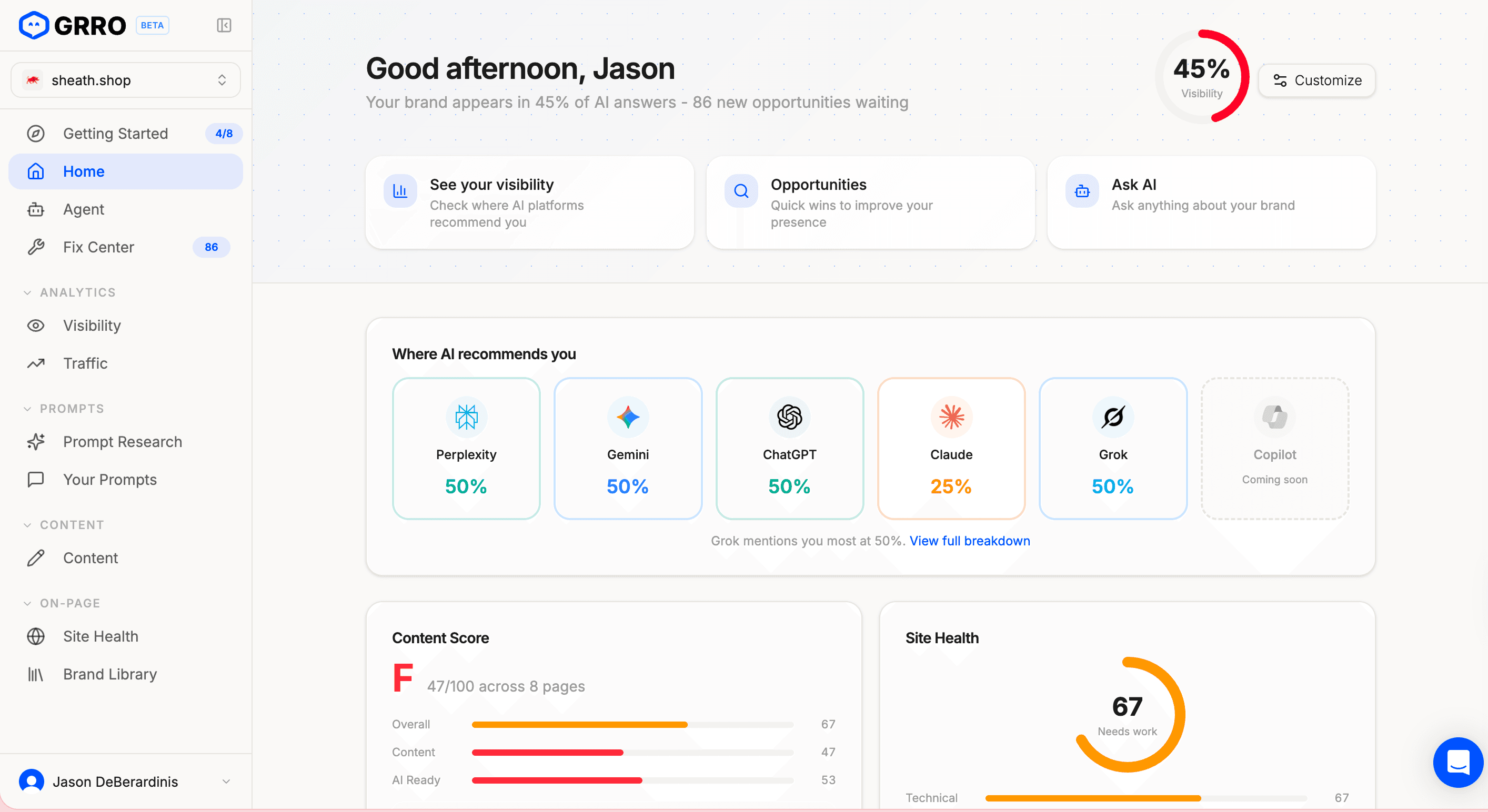
Start with a free AI visibility scan at GRRO. This gives you your AI Recommendation Score across all five major engines through search visibility tracking and shows you exactly where you stand relative to competitors. From there, you can track changes over time and measure the impact of your optimization efforts.
Will these growth rates continue?
No growth rate continues forever, but the structural shift from link-based search to AI-generated answers is still in its early stages. AI search is currently at roughly 8.7% of commercial referral traffic. Even if growth rates moderate, AI search is projected to account for 20 to 30% of commercial referral traffic by 2028. The trajectory is clear even if the exact pace fluctuates.
Conclusion
The data is unambiguous. AI search is the fastest-growing discovery channel, it delivers the highest-converting traffic, and the vast majority of businesses are not competing for it.
Over 800 million weekly queries. A 527% growth rate. A 4.4x conversion premium. A 97% visibility gap. These are not projections. These are current measurements. And they are all moving in the same direction.
The brands that understand these statistics and act on them now will own the recommendation layer in their industries. The brands that treat AI search as a future concern will find themselves invisible in the channel their customers are already using.
Start measuring where you stand with a free scan at GRRO. The numbers on this page describe the market. Your AI Recommendation Score describes your position within it.

Co-Founder & CMO at GRRO