The Brands Winning at AI Search in 2026 (And What They Do Differently)
Some brands consistently appear in AI search recommendations while competitors remain invisible. We analyzed the brands winning at AI search in 2026 and identified the seven patterns that set them apart.

Key Takeaways
- A small number of brands dominate AI search recommendations in their categories, appearing in 60% to 80% of relevant queries while most competitors appear in fewer than 10%
- The winning brands share seven distinct patterns: answer-first content, deep topical authority, multi-source presence, active community engagement, structured data discipline, consistent freshness, and entity-level recognition
- These brands did not adopt a new "AI SEO" playbook. They executed fundamentals better than everyone else and structured their content for AI extraction
- None of the brands winning at AI search are doing so accidentally. Each has a deliberate strategy, even if they do not call it "AI search optimization"
- The competitive gap is widest in categories where most brands have no AI visibility strategy, which is currently 97% of all businesses
- Following these patterns can take a brand from invisible to consistently recommended in 3 to 6 months
The Brands That Own AI Search Recommendations
To understand what winning at AI search looks like, we analyzed brand recommendations across ChatGPT, Perplexity, Gemini, Grok, Claude, for commercial queries in seven major categories. We identified the brands that appear most frequently and studied what they do differently from competitors who are invisible.
The results are striking. In most categories, 2 to 3 brands capture the majority of AI recommendations while dozens of qualified competitors never appear. The gap is not about product quality. It is about how these brands present their information, where they build their presence, and how consistently they maintain both.
Here are the patterns, illustrated by the brands executing them best.
Brand Profile: HubSpot (CRM and Marketing Software)
Ask ChatGPT, Perplexity, or Gemini "What is the best CRM for small businesses?" and HubSpot appears in the answer nearly every time. This is not accidental. HubSpot has systematically built the AI visibility infrastructure that earns consistent recommendations.
What HubSpot Does Differently
Massive content depth with answer-first structure. HubSpot's blog publishes thousands of articles, but the key is not volume. Each article leads with a direct, extractable answer. When someone asks "What is a CRM?" HubSpot's article opens with a clear definition in the first two sentences. This answer-first approach maps perfectly to how AI engines extract information from the RAG pipeline.
Multi-source dominance. HubSpot is referenced on virtually every platform AI engines monitor: G2 (10,000+ reviews, 4.4 rating), Capterra, Reddit (actively discussed in r/smallbusiness, r/sales, r/marketing), LinkedIn (massive company presence and executive thought leadership), Wikipedia, and hundreds of industry publications. This multi-source presence creates the cross-referencing pattern that AI engines trust.
Free tools as authority magnets. HubSpot's free CRM, free website grader, and other free tools generate organic discussion and recommendation across platforms. When Reddit users ask about CRM options, other users naturally recommend the free tier, creating authentic third-party validation.
Educational content that positions the brand. HubSpot Academy, certifications, and educational resources make HubSpot a recognized educational authority. AI engines weigh this educational positioning heavily because it signals deep expertise.
The Lesson
HubSpot proves that winning at AI search requires more than great content. It requires building an ecosystem of content, tools, education, and multi-platform presence that makes the AI confident in recommending the brand across diverse queries.
Brand Profile: Shopify (E-Commerce Platform)
For e-commerce platform queries, Shopify dominates AI recommendations. "What is the best platform to start an online store?" returns Shopify in virtually every AI engine's response.
What Shopify Does Differently
Category-defining content. Shopify does not just describe its platform. It defines the entire category. Their guides on "How to start an online store," "What is e-commerce," and "How to choose an e-commerce platform" are definitive resources that AI engines use as primary context for e-commerce queries.
Extensive comparison positioning. Shopify creates and maintains detailed comparison pages: Shopify vs. WooCommerce, Shopify vs. BigCommerce, Shopify vs. Squarespace. Each comparison is factual, balanced, and structured with tables and FAQ sections. When users ask AI engines comparison questions, these pages provide the structured data the AI needs.
User community as a source. The Shopify Community forum generates thousands of authentic discussions that AI engines index. When a user posts about their experience migrating from WooCommerce to Shopify, that post becomes part of the dataset AI engines use to evaluate Shopify's suitability for specific use cases.
Partner and app ecosystem visibility. Shopify's app marketplace and partner network create thousands of additional web pages that reference Shopify in specific contexts: "best Shopify apps for email marketing," "Shopify SEO tools," "Shopify payment integration." Each of these pages strengthens Shopify's entity association with relevant queries.
The Lesson
Shopify demonstrates that owning the educational and comparative content in your category is a powerful AI search strategy. If you can be the source that AI engines rely on for category-level questions, your brand appears in the answer by default.
Brand Profile: Canva (Design Tools)
In the design tool category, Canva consistently appears in AI recommendations for queries ranging from "best free design tool" to "how to create social media graphics."
What Canva Does Differently
Accessible positioning with clear differentiation. Canva's content consistently positions the product as "design for everyone," with specific use cases (social media graphics, presentations, documents) clearly articulated. This use-case specificity gives AI engines precise recommendation contexts.
Massive organic social proof. Canva's 150M+ users generate enormous organic discussion across every platform. Reddit, LinkedIn, X/Twitter, YouTube tutorials, blog posts, and review platforms are saturated with Canva mentions. This is the multi-source presence that AI engines require, and Canva has it at a scale most brands cannot replicate quickly.
Template and resource libraries. Canva's free template library generates organic search traffic and AI engine indexing for thousands of specific queries: "Instagram story template," "business card design," "presentation template." Each template page is an entry point that reinforces Canva's relevance for design-related queries.
Educational content hub. Canva Design School provides structured educational content that establishes expertise. The content is organized by topic, skill level, and use case, creating the topical depth that AI engines evaluate when assessing expertise signals.
The Lesson
Canva shows that sheer volume of authentic multi-source mentions creates overwhelming AI recommendation momentum. When a brand is discussed everywhere, AI engines cannot ignore it. The strategy is not to manufacture mentions but to build a product and content ecosystem that generates them organically.
Brand Profile: Ahrefs (SEO Tools)
For SEO tool recommendations, Ahrefs consistently appears alongside Semrush in AI responses. But Ahrefs' approach to earning AI visibility is distinctly different.
What Ahrefs Does Differently
Original research and data. Ahrefs publishes original studies using their proprietary data: "We analyzed 1 billion web pages and here is what we found about link building." This original research is cited by hundreds of publications, creating the authority signals that AI engines weigh heavily. When other sources cite your research, AI engines treat you as a primary authority.
Depth over breadth. Ahrefs' content library is not the largest in the SEO tool space, but individual articles are among the most comprehensive. Their guide on "How to do keyword research" is 8,000+ words of expert-level detail with original data, screenshots, and step-by-step methodology. AI engines prefer this depth of content because it provides richer, more authoritative extraction material.
Strong author identities. Ahrefs associates content with named authors who have established SEO expertise and public profiles. Tim Soulo, Patrick Stox, and other Ahrefs authors are recognized entities in the SEO space. This author-level expertise amplifies the E-E-A-T signals that AI engines evaluate.
YouTube as a secondary authority source. Ahrefs maintains an active YouTube channel with hundreds of educational videos. YouTube content is indexed by Gemini (through Google's ecosystem) and referenced by other AI engines. This cross-platform content strategy creates authority signals on both text and video platforms.
The Lesson
Ahrefs demonstrates that original research is one of the most powerful AI visibility strategies available. When your brand produces data that others cite, you become a primary source in the AI recommendation chain. Depth of content and named author expertise multiply this effect.
Brand Profile: Notion (Productivity and Collaboration)
Notion appears frequently in AI recommendations for productivity, project management, and note-taking queries despite competing against Microsoft, Google, and established players like Asana and Monday.com.
What Notion Does Differently
Template marketplace as content engine. Notion's template gallery generates thousands of indexed pages, each targeting specific use cases: "Notion CRM template," "Notion habit tracker," "Notion project timeline." These pages answer specific queries that AI engines field, and each one reinforces Notion's relevance for productivity-related recommendations.
Community-driven content. Notion has cultivated an active community of creators, consultants, and power users who produce content about Notion across YouTube, LinkedIn, Reddit, and personal blogs. This organic, third-party content creation generates the multi-source presence that the brand cannot manufacture alone.
Versatility positioning. Notion's content strategy emphasizes versatility: "Notion for project management," "Notion for personal knowledge management," "Notion for team wikis." This category-spanning positioning means Notion appears in AI recommendations for a wide range of queries, not just one narrow category.
Active Reddit engagement. The r/Notion subreddit has 300,000+ members sharing templates, tips, and use cases. This active community creates a continuous stream of fresh, authentic content that AI engines (especially Perplexity) index and cite.
The Lesson
Notion shows that community-driven content creation can be a more powerful AI visibility strategy than centralized content production. When thousands of users create content about your product, the multi-source validation is authentic and overwhelming.
Brand Profile: Stripe (Payment Processing)
For developer-focused payment processing queries, Stripe dominates AI recommendations. "What is the best payment API?" returns Stripe in virtually every AI engine.
What Stripe Does Differently
Best-in-class documentation. Stripe's API documentation is considered the gold standard in developer tooling. This documentation is comprehensive, well-structured, and updated frequently. AI engines index this documentation and use it as the primary source for technical payment processing queries.
Developer community engagement. Stripe engineers actively participate in Stack Overflow, GitHub, and developer forums. This creates thousands of authentic, expert-level references to Stripe in the exact contexts where developers make technology decisions.
Thought leadership content. Stripe publishes Stripe Press (books), the Stripe blog (business insights), and Stripe Radar reports (industry data). Each of these content pillars builds a different dimension of authority: intellectual (Press), practical (blog), and data-driven (Radar).
Strong entity recognition. Stripe's founders (Patrick and John Collison) are widely recognized technology leaders with Wikipedia articles, extensive media coverage, and active public profiles. This founder-level entity recognition transfers authority to the brand.
The Lesson
Stripe proves that technical documentation quality is an AI visibility strategy. For technology brands, comprehensive, well-structured documentation can be the single highest-value content investment for AI search.
Brand Profile: Patagonia (Outdoor Apparel)
Patagonia consistently appears in AI recommendations for sustainable clothing, outdoor apparel, and ethical brand queries, often ahead of larger competitors.
What Patagonia Does Differently
Values-driven content that generates organic coverage. Patagonia's environmental activism and corporate responsibility generate enormous media coverage without paid promotion. Every environmental initiative, every "Do not Buy This Jacket" campaign, every lawsuit to protect public lands creates media mentions that AI engines index and use as authority signals.
Transparent supply chain content. Patagonia's Footprint Chronicles and material sourcing transparency create unique, authoritative content that no competitor replicates. When AI engines answer questions about sustainable clothing, Patagonia's transparency data is often the most detailed and trustworthy source available.
Authentic community. Patagonia's customer base actively advocates for the brand on social media, Reddit, review platforms, and in personal conversations. This authentic advocacy creates the multi-source validation that AI engines require.
Clear brand positioning. Patagonia's brand identity is unambiguous. When an AI engine needs to recommend a brand for "sustainable outdoor clothing," Patagonia's positioning makes it the obvious choice. There is no ambiguity about what the brand stands for.
The Lesson
Patagonia demonstrates that authentic brand differentiation is an AI visibility strategy. When your brand has a clear, distinctive position that is validated across multiple independent sources, AI engines can recommend you with confidence.
The Seven Patterns That Set These Brands Apart
Across all seven brands, seven consistent patterns emerge:
Pattern 1: Answer-First Content
Every winning brand structures content so that direct, extractable answers appear in the first 40 to 60 words of relevant sections. No preamble. No narrative buildup. The answer comes first, context follows. This is the content structure AI engines love.
Pattern 2: Deep Topical Authority
Winning brands do not skim the surface of many topics. They go deep on their core topics with comprehensive guides, original research, and layered content that covers subtopics thoroughly. This builds the topical authority that AI engines use as an expertise signal.
Pattern 3: Multi-Source Presence
Every winning brand has substantial presence across 5+ independent platforms. They are discussed on Reddit, featured on review platforms, active on LinkedIn, cited in publications, and referenced in community forums. This is not optional. It is foundational. See our complete guide on building multi-source presence.
Pattern 4: Active Community Engagement
These brands do not broadcast. They participate. They engage in Reddit discussions, respond to reviews, contribute to forums, and interact with their user communities. This engagement generates authentic content that AI engines value more than corporate messaging.
Pattern 5: Structured Data Discipline
Schema markup, FAQ structure, comparison tables, and clean HTML are consistent across winning brands. Their content is not just good for humans. It is technically optimized for AI extraction. For the technical implementation, see our guide on structured data for AI search.
Pattern 6: Consistent Freshness
Winning brands update their content regularly. They refresh statistics, add new information, and signal recency through updated timestamps and schema. AI engines like Perplexity and Grok weight freshness heavily, and winning brands ensure their content reflects this.
Pattern 7: Entity-Level Recognition
Each winning brand has achieved "entity" status in AI engines' understanding. The AI knows what the brand is, what it does, who founded it, and how it compares to alternatives. This entity recognition comes from Wikipedia mentions, media coverage, structured data, and consistent cross-platform presence. See our guide on entity SEO for AI search.
How to Apply These Patterns to Your Brand
You do not need HubSpot's content budget or Shopify's market position to apply these patterns. Here is a practical framework:
Month 1: Foundation
- Run a free AI visibility scan to establish your baseline
- Audit your top 20 pages for answer-first structure
- Implement Product, Organization, and FAQ schema on key pages
- Claim and optimize profiles on relevant review platforms
Month 2: Content and Structure
- Restructure your top 10 pages for AI extraction (answer-first, question headings, comparison tables)
- Begin publishing weekly content in your core topic area to build topical authority
- Create 2 to 3 comparison pages for your product vs. top competitors
- Launch a systematic review solicitation process
Month 3: Multi-Source Expansion
- Begin active participation on Reddit (5 to 10 relevant subreddits)
- Increase LinkedIn publishing to 3 to 5 posts per week (company and executive)
- Pitch 3 to 5 guest article opportunities to industry publications
- Publish one piece of original research or data analysis
Months 4 to 6: Compound and Measure
- Continue all activities from months 1 to 3 with increasing quality
- Track AI Recommendation Score weekly to measure progress
- Identify new query opportunities where competitors are weak
- Build author profiles with cross-platform presence
- Target a 20+ point improvement in your GRRO AI Recommendation Score
FAQ
Can small businesses compete with large brands for AI recommendations?
Yes, especially in niche categories. AI engines recommend the most relevant, authoritative answer for each specific query. A small business that deeply owns a narrow topic (e.g., "best CRM for independent insurance agents") can outperform a large brand that covers the broad category. Specificity is an advantage, not a limitation. The brands analyzed in this article dominate broad categories, but the same patterns apply at any scale.
How do I know which patterns are most important for my business?
Start with a GRRO scan to identify your specific gaps. If your content is strong but multi-source presence is weak, prioritize external platforms. If your multi-source presence is decent but content structure is poor, prioritize answer-first restructuring. The patterns work as a system, but you will see the fastest results by addressing your weakest signal first.
How long does it take to go from invisible to consistently recommended?
Based on the brands we have studied, the typical timeline is 4 to 8 weeks for initial appearances in AI recommendations, 3 to 6 months for consistent recommendations on core queries, and 6 to 12 months for broad category coverage. The timeline varies by competition level, content quality, and investment. Brands that commit to all seven patterns simultaneously see the fastest results.
Do I need to be on every platform these brands are on?
No. Prioritize the 4 to 5 platforms most relevant to your audience and the AI engines that matter most for your category. A B2B software company should prioritize G2, LinkedIn, and industry forums. A consumer brand should prioritize Reddit, Trustpilot, and social platforms. The key is meaningful presence on enough platforms for multi-source validation, not token presence on every platform.
Are there industries where these patterns do not apply?
The patterns are universal, but the specific implementation varies by industry. Healthcare brands need to emphasize credential-based authority and YMYL trust signals. Local businesses need to focus on local platforms and geographic specificity. E-commerce brands need product-level schema and review strategies. See our industry-specific guides for healthcare, local business, e-commerce, and SaaS.
What is the most common mistake brands make when trying to replicate these patterns?
The most common mistake is pursuing volume over quality. Publishing 50 thin articles does not build topical authority. Getting 200 fake Reddit accounts to mention your brand does not build multi-source presence. AI engines evaluate quality, authenticity, and depth. Every successful brand in this analysis earned their AI visibility through genuine value creation, not through shortcuts.
How does GRRO help me implement these patterns?
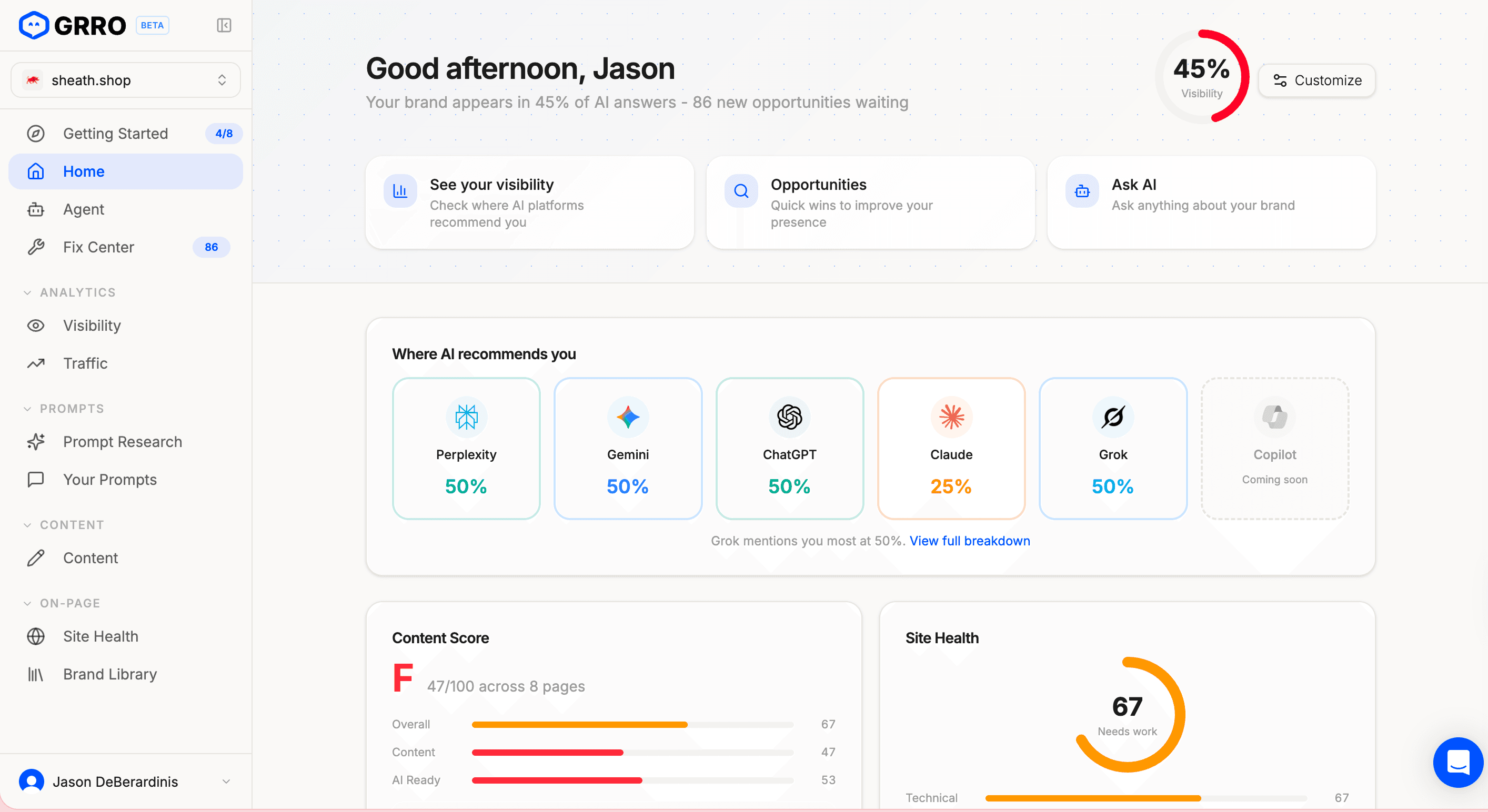
GRRO is the measurement layer that makes these patterns actionable. The platform's search visibility tracking monitors your AI Recommendation Score across all five major AI engines, identifies which of the seven patterns you are strong in and which need work, runs competitor analysis for benchmarking, and provides prioritized weekly actions. Start with a free scan to see exactly where you stand relative to the brands winning in your category.
Conclusion
The brands winning at AI search in 2026 are not using secret tactics or gaming algorithms. They are executing seven fundamental patterns with exceptional consistency: answer-first content, deep topical authority, multi-source presence, active community engagement, structured data discipline, consistent freshness, and entity-level recognition.
These patterns are available to every business. The competitive advantage comes from execution, not access. With 97% of brands having no AI visibility strategy, the opportunity to implement these patterns and capture AI recommendations is extraordinary.
The brands profiled in this article did not build their AI visibility overnight. But they did not wait, either. They started with one pattern, expanded to the next, and compounded their advantage over time.
Start by measuring where you stand with a free scan at GRRO. Identify which of the seven patterns represents your biggest gap. Build a 90-day plan to close that gap. Then move to the next one. The brands that start now will be the ones AI engines recommend for years to come.

Co-Founder & CMO at GRRO