How to Get Your SaaS Product Recommended by AI
AI search engines now influence over 40% of SaaS buying decisions. Here is how to position your SaaS product to be the one ChatGPT, Perplexity, and Gemini recommend when users ask for software recommendations.

Key Takeaways
- AI search engines are becoming the primary research tool for SaaS buyers, with over 40% of B2B software purchase decisions now influenced by AI-generated recommendations
- SaaS products that appear in AI recommendations see 4.4x higher conversion rates compared to traditional organic search referrals
- The five pillars of SaaS AI visibility are comparison content, technical documentation, third-party review profiles, thought leadership, and community presence
- G2, Capterra, and TrustRadius reviews directly influence AI recommendations because these platforms are high-authority sources that AI engines cross-reference
- Most SaaS companies have zero AI visibility strategy, creating a window of opportunity that will close as adoption increases
- Tracking your AI Recommendation Score across all 5 major AI engines gives you the data to prioritize efforts and measure progress
Why AI Search Is Reshaping SaaS Discovery
AI search engines are fundamentally changing how businesses discover and evaluate SaaS products. When a marketing director asks ChatGPT "What is the best project management tool for a remote team of 50 people?" or asks Perplexity "How does Monday.com compare to Asana for agile development?" the AI generates a direct recommendation with specific product mentions and reasoning.
This is replacing the traditional SaaS discovery path of Google search, clicking through 10 results, reading multiple blog posts, and slowly forming an opinion. AI search compresses that process into a single answer. The products mentioned in that answer get evaluated. The products not mentioned get skipped entirely.
For SaaS companies, this shift creates both a massive opportunity and an existential risk. The opportunity is that AI recommendations carry significant trust and drive high-intent traffic. The risk is that being excluded from AI answers means being invisible to a growing segment of your potential buyers.
For the broader context on this shift, see our analysis of how AI search is reshaping business discovery and the latest AI search statistics for 2026.
How AI Engines Evaluate SaaS Products
When an AI engine receives a SaaS-related query, it evaluates products across several dimensions before making a recommendation.
Feature Match
The AI evaluates whether your product's features align with the user's stated needs. This evaluation is based on the product descriptions, feature pages, and documentation it finds across the web. If the user asks for "project management with time tracking," the AI looks for products that explicitly mention time tracking in their feature descriptions across multiple sources.
Authority Signals
AI engines assess your product's authority through the volume and quality of mentions across trusted sources. A SaaS product mentioned on its own website, on G2, on Capterra, in TechCrunch articles, in LinkedIn discussions, and in Reddit recommendations has a stronger authority profile than one that only exists on its own domain.
User Sentiment
Review scores and user sentiment from third-party platforms like G2, Capterra, and TrustRadius directly influence AI recommendations. Products with high average ratings and recent positive reviews are more likely to be recommended. Negative sentiment patterns (recurring complaints about specific issues) can cause AI engines to recommend competitors instead.
Comparison Context
AI engines heavily weight comparison content when answering "which is better" or "best tool for X" queries. If authoritative comparison articles consistently position your product favorably for specific use cases, the AI learns to recommend it for those use cases.
Freshness
For SaaS products that evolve rapidly, content freshness matters. AI engines check when product information was last updated. A pricing page from 2024 or a feature comparison from 2023 may be deprioritized in favor of more current sources.
For the technical details on how AI engines process and rank content, read our guide on how AI decides what to recommend.
The Five Pillars of SaaS AI Visibility
Pillar 1: Comparison and Alternative Content
Comparison queries are the highest-intent queries in SaaS. "Salesforce vs HubSpot CRM," "Best Slack alternatives," and "Monday.com vs Asana vs ClickUp" are exactly the queries where AI engines make direct product recommendations.
Create honest comparison pages. Build comparison pages for every major competitor matchup. Include feature-by-feature tables, pricing comparisons, use case recommendations, and clear conclusions about which product fits which buyer.
Own your "alternatives" page. Create a page titled "[Your Product] Alternatives" that honestly compares your product to competitors. This seems counterintuitive, but it gives you control over the narrative when users search for alternatives to your product.
Include comparison tables. AI engines extract structured data from tables more easily than from paragraphs. Use HTML tables with clear headers for every comparison.
| Feature | Your Product | Competitor A | Competitor B |
|---|---|---|---|
| Time tracking | Built-in, free | Add-on, $5/user | Third-party integration |
| Reporting | Advanced, customizable | Basic | Advanced, fixed templates |
| Starting price | $12/user/month | $15/user/month | $10/user/month |
| Free trial | 14 days | 7 days | 30 days |
Update comparisons quarterly. Competitors change pricing, add features, and sunset products. Keeping your comparison content current ensures AI engines use your data instead of outdated third-party content.
Pillar 2: Technical Documentation
Comprehensive technical documentation serves a dual purpose: it helps customers use your product, and it signals depth and legitimacy to AI engines.
Public API documentation. Maintain thorough, publicly accessible API docs. AI engines frequently reference API documentation when evaluating product capabilities, especially for technical buyer personas.
Integration guides. Create detailed guides for every integration your product supports. These pages capture queries like "Does [your product] integrate with Slack?" or "How to connect [your product] to Zapier."
Setup and migration guides. Step-by-step guides for product setup and competitor migration address high-intent queries. "How to migrate from [competitor] to [your product]" is a query where AI recommendations directly influence purchasing decisions.
Knowledge base. A comprehensive, well-organized knowledge base demonstrates product maturity and customer investment. It also creates hundreds of pages that AI engines can index and reference.
Pillar 3: Third-Party Review Profiles
G2, Capterra, TrustRadius, and similar platforms are among the highest-authority sources AI engines use for SaaS evaluations. Your profiles on these platforms directly influence AI recommendations.
Maintain active profiles. Claim and complete your profiles on G2, Capterra, TrustRadius, Product Hunt, and any industry-specific review platforms. Complete every field, upload screenshots, and keep pricing and feature information current.
Encourage genuine reviews. Develop a systematic process for requesting reviews from satisfied customers. Focus on volume and recency. AI engines weight recent reviews more heavily than older ones.
Respond to all reviews. Responding to both positive and negative reviews signals active engagement and customer care. AI engines can detect patterns in review responses and factor them into trust calculations.
Optimize your review categories. Ensure your product is listed in the correct categories on each platform. Category placement determines which queries your product appears for.
Target category leadership. Being a "Leader" or "Top Rated" product in G2 or Capterra categories provides explicit authority signals that AI engines recognize and reference in recommendations.
Pillar 4: Thought Leadership
Thought leadership positions your team as experts in your product category, which AI engines use as an authority signal.
Executive LinkedIn content. Founders and key executives should publish regular LinkedIn content about the problems your product solves, industry trends, and customer success patterns. LinkedIn content is cited by ChatGPT, Perplexity, and Gemini.
Guest articles in industry publications. Place articles in publications your target audience reads. A guest post in TechCrunch, VentureBeat, or an industry-specific publication creates a high-authority external mention that AI engines cross-reference with your website content.
Podcast appearances. Podcast transcripts and show notes create additional web content that AI engines index. Appearing on podcasts relevant to your audience builds brand recognition and creates citable content.
Original research and reports. Publish annual industry reports, benchmark studies, or survey results with original data. AI engines heavily value original data because it cannot be found elsewhere. When your research is cited by other publications, it creates a compounding authority effect.
Pillar 5: Community Presence
AI engines, especially Perplexity, heavily weight community discussions when making product recommendations. Your presence in relevant communities directly impacts AI visibility.
Reddit participation. Identify subreddits where your target audience discusses tools in your category. Participate genuinely by providing helpful answers, sharing expertise, and mentioning your product where naturally relevant. Never spam.
Quora answers. Answer questions related to your product category on Quora. Provide thorough, balanced responses that demonstrate expertise. Quora answers appear in Perplexity and ChatGPT citations.
Industry forums and communities. Participate in Slack communities, Discord servers, and industry forums where your audience gathers. While these may not be directly indexed by all AI engines, they build brand recognition that influences mentions elsewhere.
Stack Overflow and developer communities. For developer-focused SaaS products, maintaining an active presence on Stack Overflow and GitHub builds technical credibility that AI engines recognize.
For deeper strategies on building authority across multiple platforms, see our guide on building authority signals for AI recommendations.
SaaS-Specific Content Strategies for AI Search
The "Best [Category] for [Use Case]" Strategy
AI users frequently ask questions in the format "What is the best [product category] for [specific use case]?" Create dedicated pages that target these queries.
Examples:
- "Best Project Management Tool for Remote Teams"
- "Best CRM for Startups Under 20 Employees"
- "Best Email Marketing Platform for E-commerce"
Each page should provide a genuine, balanced recommendation with your product positioned appropriately. Include a comparison table, pros and cons for each option, and a clear recommendation for the specific use case.
The Integration Hub Strategy
Create a dedicated integrations page that lists every tool your product integrates with, along with individual guides for each integration. This captures queries like:
- "CRM that integrates with Slack"
- "Project management tool with Salesforce integration"
- "Email marketing platform that connects to Shopify"
Each integration page should explain the integration's capabilities, include setup instructions, and describe specific use cases.
The Migration Guide Strategy
Create detailed migration guides for every major competitor. These guides capture users who have already decided to switch and are looking for the easiest path. AI engines recommend products that reduce friction in the switching process.
"How to migrate from Mailchimp to [your product]" is a high-intent query where the AI's recommendation directly influences which tool the user chooses.
The Pricing Transparency Strategy
Publish detailed, transparent pricing information. AI engines frequently answer pricing queries, and they strongly prefer sources that provide clear, specific pricing. Include:
- Feature-by-feature plan comparison tables
- Annual vs monthly pricing breakdowns
- Total cost of ownership calculators or examples
- Pricing FAQ sections addressing common questions
If your pricing is opaque or requires a demo to see, AI engines cannot include accurate pricing in their recommendations and may default to competitors who provide transparent pricing.
Measuring Your SaaS AI Visibility
Manual Testing
Test 20 to 30 SaaS-relevant queries across ChatGPT, Perplexity, and Gemini. Include:
- Category queries: "Best [your category] tools 2026"
- Comparison queries: "[Your product] vs [competitor]"
- Use case queries: "Best [category] for [specific use case]"
- Pricing queries: "How much does [your product] cost?"
- Review queries: "[Your product] reviews"
Record which queries mention your product, which mention competitors, and which mention neither. This gives you a qualitative baseline.
Automated Tracking with GRRO
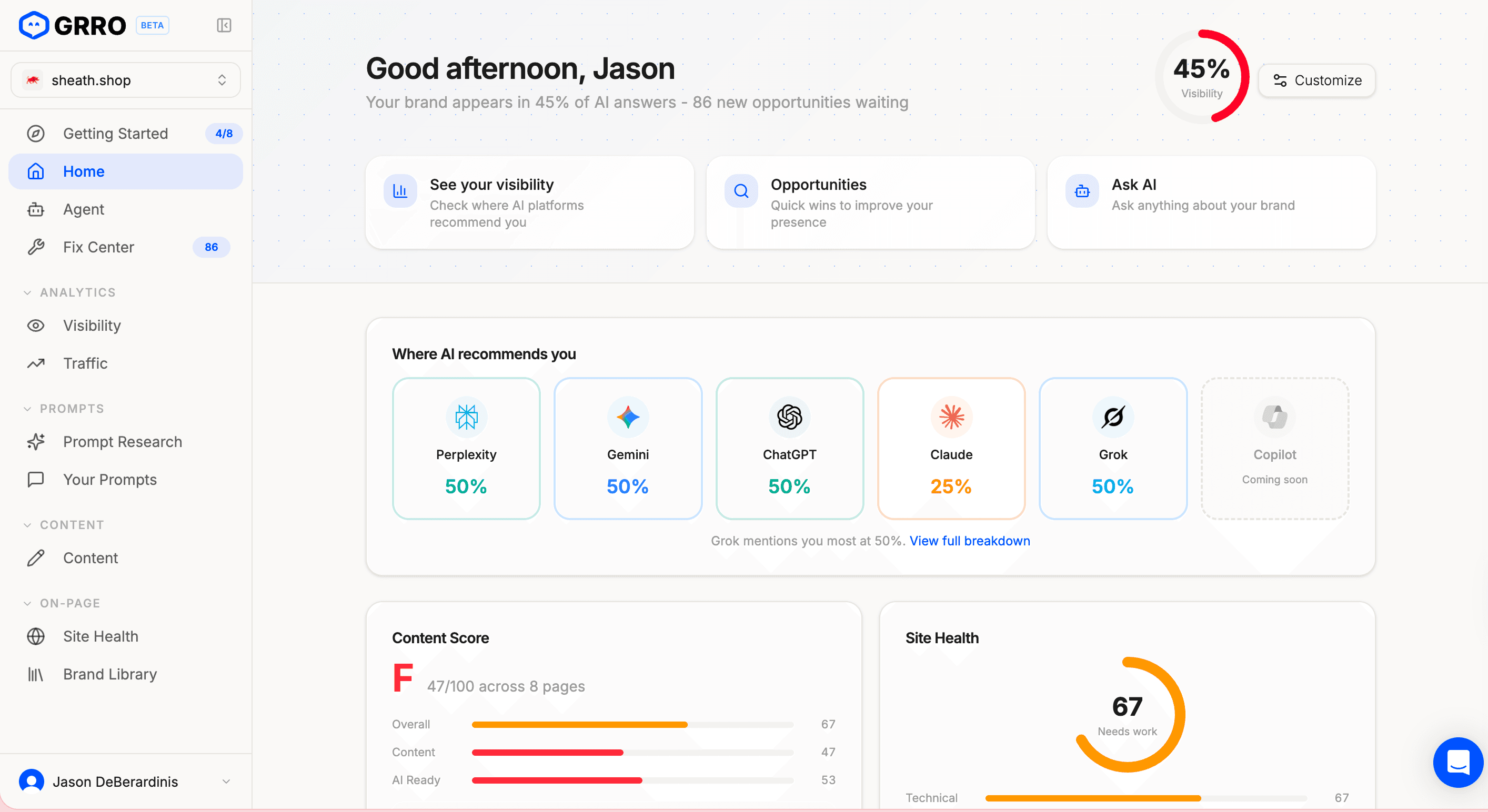
GRRO's search visibility tracking automates AI visibility monitoring across all 5 major AI engines. For SaaS companies, this means:
- Continuous monitoring of category, comparison, and use case queries
- Competitor benchmarking showing which products AI engines recommend for your target queries
- Content scoring that evaluates your pages' readiness for AI extraction
- Trend tracking that shows whether your AI visibility is improving or declining
- An AI Recommendation Score that gives you a single metric to track your overall AI search performance
Key Metrics for SaaS AI Visibility
- Category recommendation rate: How often your product is mentioned in "best [category]" queries
- Head-to-head win rate: In direct comparison queries, how often the AI recommends your product over specific competitors
- Use case coverage: How many specific use case queries return your product as a recommendation
- Sentiment accuracy: Whether AI engines accurately represent your product's strengths and weaknesses
- Source diversity: How many different source types (website, G2, articles, Reddit) contribute to your AI mentions
A 90-Day SaaS AI Visibility Playbook
Month 1: Foundation
Week 1: Run a comprehensive AI visibility audit across all 5 engines. Document your baseline AI Recommendation Score and identify competitor gaps.
Week 2: Audit and update your G2, Capterra, and TrustRadius profiles. Launch a review request campaign to active customers.
Week 3: Create or update your top 5 competitor comparison pages with current data, feature tables, and clear use case recommendations.
Week 4: Audit your pricing page for transparency and clarity. Ensure pricing information is structured, current, and machine-readable.
Month 2: Content Expansion
Week 5 to 6: Create dedicated pages for your top 10 integrations. Build an integration hub page that links to all individual integration guides.
Week 7 to 8: Create migration guides for your top 3 competitors. Publish 3 to 4 "Best [category] for [use case]" articles targeting your strongest buyer personas.
Month 3: Authority Building
Week 9 to 10: Launch executive LinkedIn thought leadership. Publish weekly LinkedIn content aligned with your product category. Pitch 2 to 3 guest articles to industry publications.
Week 11 to 12: Begin genuine Reddit and community participation. Identify 5 to 7 subreddits and communities. Start contributing helpful, expert answers. Re-audit AI visibility to measure progress.
For a broader framework on auditing and improving your AI visibility, see our guide on how to audit your AI search visibility.
FAQ
How important are G2 and Capterra reviews for AI recommendations?
Extremely important. G2, Capterra, and TrustRadius are among the highest-authority sources AI engines consult when making SaaS recommendations. Products with 100+ recent reviews, high average ratings, and category leadership badges are significantly more likely to be recommended. If your review profiles are thin or outdated, this is one of the highest-impact areas to invest in.
Can a small SaaS startup compete with established players in AI recommendations?
Yes, but through niche positioning rather than broad competition. A startup cannot out-authority Salesforce in the general "CRM" category. But it can build strong authority for specific use cases like "CRM for solo consultants" or "CRM for nonprofit organizations." Focus your AI visibility strategy on the specific segments where you have genuine expertise and competitive advantages.
How does pricing transparency affect AI recommendations?
AI engines strongly prefer products with publicly available, clearly structured pricing. When users ask "How much does [category] cost?" the AI can only recommend products whose pricing it can verify. Products with gated pricing ("Contact sales for pricing") are at a disadvantage because the AI cannot include specific pricing in its answer and may recommend competitors with transparent pricing instead.
Should I create content about competitors on my own website?
Yes. Creating honest, balanced comparison and alternative pages gives you control over the narrative when AI engines process competitor-related queries. Without your own comparison content, AI engines will use third-party comparisons where you have no control over positioning. The key is honesty: recommend competitors for use cases where they genuinely excel, and position your product for use cases where it has clear advantages.
How do AI engines handle SaaS products they have never seen before?
AI engines can only recommend products they have encountered across their data sources. If your product has minimal web presence (no G2 profile, no industry mentions, no community discussions), AI engines literally do not have the data to recommend it. Building multi-source presence is the prerequisite for AI recommendation eligibility.
Does technical documentation matter for AI recommendations?
Yes, particularly for developer-focused and enterprise SaaS products. Comprehensive API documentation, integration guides, and knowledge bases signal product maturity and depth. AI engines reference technical documentation when answering detailed queries about product capabilities, integrations, and implementation. Products with sparse documentation lose credibility in these evaluations.
How often should I update my SaaS content for AI search?
Update comparison pages and pricing information quarterly at minimum. Update integration guides whenever functionality changes. Publish new content (blog posts, case studies, reports) at least twice per month to maintain freshness signals. Review and update your third-party profiles (G2, Capterra) monthly. The GRRO platform helps you identify which specific content needs updating based on your AI visibility trends.
Conclusion
Getting your SaaS product recommended by AI search engines is no longer optional. It is becoming the primary path through which B2B buyers discover and evaluate software. The SaaS companies that build AI visibility now will capture a disproportionate share of high-intent buyers as AI search adoption accelerates.
The strategy rests on five pillars: comparison content that wins head-to-head queries, comprehensive technical documentation, strong third-party review profiles, executive thought leadership, and genuine community presence. Each pillar reinforces the others, creating a compound authority signal that AI engines recognize and reward.
Start by measuring your current AI visibility with a free scan at GRRO. Understand where you rank against competitors across all 5 major AI engines. Then systematically build each pillar, starting with the highest-impact gaps your scan reveals. The window of opportunity is open, and the SaaS companies that move first will have a significant and durable competitive advantage.

Co-Founder & CMO at GRRO