How to Build Topical Authority for AI Search Engines
Topical authority is the single strongest signal that determines whether AI search engines recommend your brand over competitors. Here is how to build it using content clusters, pillar pages, and strategic internal linking.

Key Takeaways
- Topical authority is the degree to which AI engines recognize your brand as a comprehensive, trusted expert on a specific subject area
- AI engines evaluate topical authority by measuring content depth, internal linking structure, content freshness, multi-source validation, and consistency across platforms
- A content cluster strategy built around pillar pages with 10 to 15 supporting articles is the most effective way to build topical authority for AI search
- Internal linking is not optional. It is the mechanism that signals topic relationships to both search engines and AI crawlers
- Brands with strong topical authority are 3 to 5x more likely to be recommended by AI engines than brands that publish scattered, disconnected content
- Building topical authority takes 3 to 6 months of sustained effort but creates compounding returns that are difficult for competitors to replicate
What Topical Authority Means for AI Search
Topical authority is the degree to which AI search engines recognize your brand as a comprehensive, trustworthy expert on a given topic. It is not a single metric or score. It is a pattern that AI engines detect by analyzing the breadth, depth, and consistency of your content across a subject area.
When a user asks ChatGPT, Perplexity, or Gemini a question about CRM software, the AI does not just find the single best-matching page. It evaluates which sources have demonstrated comprehensive expertise on CRM topics across multiple pages, multiple angles, and multiple related subtopics. The brand that has published a pillar guide on CRM selection, comparison articles between major platforms, pricing breakdowns, implementation guides, and integration tutorials has a fundamentally different authority profile than the brand that published a single blog post titled "Best CRMs in 2026."
This is the difference topical authority creates. It shifts you from being a possible source to being the preferred source.
For a foundational understanding of how AI engines evaluate and recommend content, read our guide on how AI decides what to recommend.
Why Topical Authority Matters More for AI Than for Traditional SEO
Topical authority has always been a factor in traditional SEO. Google's algorithms have rewarded comprehensive sites for years. But for AI search engines, topical authority is amplified for several specific reasons.
AI Engines Cross-Reference Across Pages
When an AI engine processes a query, it does not evaluate your site based on a single page. It evaluates your entire domain's relationship to the topic. The RAG pipeline retrieves multiple pages from multiple sources, and sites that appear across several retrieval results for related queries build a stronger authority signal.
If your site returns relevant results for "what is a CRM," "best CRM for small businesses," "CRM implementation guide," and "CRM pricing comparison," the AI engine recognizes a pattern of comprehensive coverage. That pattern increases the likelihood of your content being selected during the re-ranking step.
AI Engines Value Consistency
AI engines cross-reference claims across sources and across your own content. If your pillar page says one thing and a supporting article says something contradictory, this inconsistency reduces trust. Topical authority requires consistent messaging, data, and recommendations across your entire content ecosystem.
AI Engines Reward Depth Over Breadth
A site with 500 blog posts covering 200 different topics has less topical authority in any single area than a site with 50 posts covering 5 topics in depth. AI engines recognize when a site tries to cover everything versus when it goes deep on its areas of genuine expertise. For businesses, this means strategic focus matters more than content volume.
AI Engines Track Entity Relationships
Modern AI engines understand entities: brands, people, products, and concepts. When your content consistently discusses the relationships between entities in your field, the AI builds a knowledge graph that positions your brand as an authority. Writing about how your product relates to industry standards, how it compares to alternatives, and how it solves specific problems creates a rich entity profile that AI engines trust.
For a deeper look at the signals AI engines evaluate, see our guide on building authority signals for AI recommendations.
The Content Cluster Strategy
A content cluster is a group of interlinked articles organized around a central topic. It consists of one pillar page and multiple supporting articles, all connected through strategic internal links.
The Pillar Page
The pillar page is a comprehensive, authoritative guide on your core topic. It covers the subject broadly and thoroughly, typically ranging from 3,000 to 5,000 words. It should answer the primary question users have about the topic and provide clear, structured sections that each address a subtopic.
Characteristics of an effective pillar page:
- Covers the topic comprehensively from fundamentals to advanced strategies
- Uses question-format H2 and H3 headings
- Includes a table of contents for navigation
- Links to every supporting article in the cluster
- Leads each section with a direct answer
- Includes original data, frameworks, or insights
- Is updated quarterly to maintain freshness
Supporting Articles
Each supporting article dives deep into a specific subtopic that the pillar page covers at a high level. If your pillar page is "The Complete Guide to Email Marketing," supporting articles might include:
- How to Build an Email List from Scratch
- Email Marketing Automation: A Step-by-Step Guide
- How to Write Email Subject Lines That Get Opened
- Email Segmentation Strategies for E-commerce
- Email Marketing Analytics: Which Metrics Matter
- How to Reduce Email Unsubscribe Rates
- Transactional Email Best Practices
- Email Deliverability: How to Stay Out of Spam Folders
- Email Marketing Tools Comparison 2026
- How to A/B Test Email Campaigns Effectively
Each supporting article should be 1,500 to 3,000 words, focused on a single subtopic, and linked back to the pillar page and to 2 to 3 other relevant supporting articles.
The Linking Structure
Internal linking is what transforms a collection of individual articles into a topical authority signal. Without links, AI engines see isolated pages. With strategic linking, they see an interconnected knowledge base.
Pillar to supporting links: The pillar page should link to every supporting article using descriptive, keyword-rich anchor text. Example: "For a detailed walkthrough, see our guide on email segmentation strategies for e-commerce."
Supporting to pillar links: Every supporting article should link back to the pillar page at least once. Example: "This is one of several tactics covered in our complete guide to email marketing."
Supporting to supporting links: Where topics relate to each other, link between supporting articles. An article on email automation should link to the article on segmentation because segmented automation is a logical intersection.
The rule of relevance: Only link where the connection is genuinely useful to the reader. Forced links between unrelated topics dilute the topical signal rather than strengthening it.
How to Plan Your Content Clusters
Step 1: Identify Your Core Topics
Choose 3 to 5 core topics that align with your business expertise and your target audience's questions. These become your pillar page topics. They should be broad enough to support 10 to 15 supporting articles but specific enough to demonstrate focused expertise.
Too broad: "Marketing" (could support hundreds of articles, no focus) Too narrow: "Best time to send marketing emails on Tuesdays" (cannot support a cluster) Just right: "Email marketing for e-commerce" (focused, but supports 10 to 15 subtopics)
Step 2: Map User Questions
For each core topic, identify every question your target audience asks. Use these sources:
- AI engine queries: Ask ChatGPT, Perplexity, and Gemini what questions people commonly ask about your topic
- Reddit and Quora: Search for threads where users ask questions in your space
- Google's "People Also Ask" boxes
- Sales and support conversations: What questions do prospects and customers ask repeatedly?
- Competitor content gaps: What questions do competitors fail to answer thoroughly?
Group these questions into 10 to 15 subtopic categories. Each category becomes a supporting article.
Step 3: Audit Existing Content
Before creating new content, audit what you already have. Many businesses have existing blog posts that can be restructured into a content cluster with editing rather than starting from scratch. Map existing content to your planned cluster structure and use content gap planning to identify what is missing.
Step 4: Create a Content Calendar
Plan your cluster rollout over 8 to 12 weeks. Publish the pillar page first, then release 2 to 3 supporting articles per week. This cadence maintains freshness signals while building the cluster systematically.
Step 5: Interlink as You Publish
Add internal links as each new article goes live. Update the pillar page to link to each new supporting article. Update existing supporting articles to link to new ones where relevant. This ongoing interlinking is what builds the topical authority signal over time.
Internal Linking Best Practices for AI Authority
Internal linking is the single most underrated tactic in AI search optimization. It is the mechanism that tells AI crawlers how your content relates to itself, which topics you cover comprehensively, and which pages are most important.
Use Descriptive Anchor Text
Generic anchor text like "click here" or "read more" provides no topical signal. Use keyword-rich, descriptive anchor text that tells both users and AI crawlers what the linked page covers.
Weak: "For more information, click here." Strong: "Learn how to implement email segmentation strategies that increase open rates by 40%."
Link Contextually Within Body Content
Links placed within the natural flow of content carry more weight than links in sidebars, footers, or "related posts" sections. When a supporting article mentions a concept covered in another article, link to it inline.
Maintain a Consistent Linking Hierarchy
Your pillar page should be the most-linked-to page in each cluster. Supporting articles should link to the pillar and to each other. This creates a hub-and-spoke pattern that AI crawlers recognize as a topical authority structure.
Avoid Over-Linking
Including too many internal links on a single page dilutes the value of each link and creates a poor user experience. Aim for 5 to 10 internal links per 2,000-word article, placed where they genuinely add value.
Update Links When Publishing New Content
When you publish a new supporting article, go back to existing articles in the cluster and add links to the new content where relevant. This keeps the cluster interconnected and signals to AI crawlers that the cluster is actively maintained.
For the structural formatting principles that complement internal linking, see our guide on the content structure AI engines love.
Multi-Source Topical Authority
Topical authority is not limited to your website. AI engines cross-reference your expertise across the web. Building authority on external platforms reinforces the signals your website content creates.
LinkedIn Thought Leadership
Executives and subject matter experts should publish regularly on LinkedIn about your core topics. LinkedIn content appears in ChatGPT, Perplexity, and Gemini citations. Consistent, expert-level LinkedIn activity in your topic area creates an additional authority signal that AI engines associate with your brand.
Industry Publications
Guest articles, contributed columns, and expert quotes in industry publications create high-authority external signals. When your brand appears on your website, on LinkedIn, and in recognized publications, AI engines see multi-source confirmation of your expertise.
Reddit and Community Participation
Genuine participation in Reddit communities relevant to your expertise builds organic authority. When employees provide helpful, knowledgeable answers in subreddit discussions, it creates touchpoints that AI engines, especially Perplexity, use to evaluate your brand's expertise.
Wikipedia and Reference Sources
If your brand or key individuals are notable enough for Wikipedia mentions, these carry significant authority weight. Wikipedia is one of the highest-trust sources for AI engines. Even a mention within a relevant Wikipedia list or article strengthens your topical authority profile.
For a broader strategy on building multi-source authority, read our guide on building authority signals for AI recommendations.
How to Measure Topical Authority
Topical authority is not a single number, but you can measure proxy metrics that indicate your authority level.
Content Coverage Score
Map every question users ask about your core topic. Calculate what percentage of those questions your content answers thoroughly. A content coverage score of 80% or higher indicates strong topical authority.
Internal Link Density
Measure the average number of internal links per article within each content cluster. Healthy clusters typically have 5 to 10 internal links per article, with the pillar page receiving the most inbound internal links.
AI Recommendation Rate
The most direct measure of topical authority is your AI Recommendation Score across your core queries. If AI engines consistently recommend your brand for questions in your topic area, your topical authority is strong. If they recommend competitors, it is not.
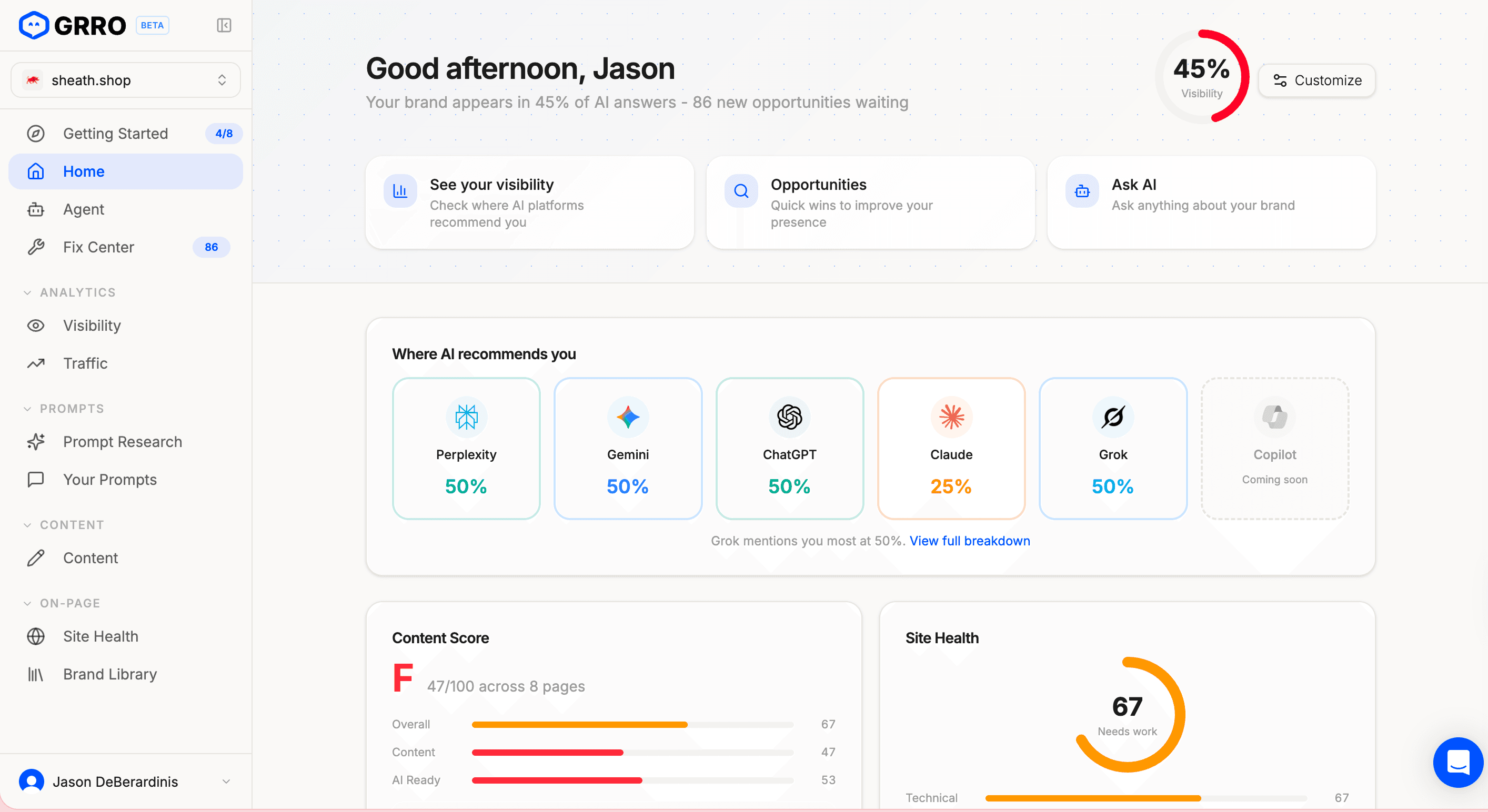
GRRO's content studio tracks your AI Recommendation Score across all 5 major AI engines and shows you exactly which queries recommend your brand and which recommend competitors. This gives you a real-time measurement of your topical authority's impact.
Learn more about how this score works in our explanation of the AI Recommendation Score.
Organic Ranking Breadth
Track how many keywords in your topic area your site ranks for in the top 20. Broad organic rankings across related keywords indicate that search engines, and by extension AI engines, recognize your topical depth.
Common Topical Authority Mistakes
Publishing Across Too Many Topics
The most common mistake is trying to build authority across 10 or 20 topics simultaneously. This spreads resources thin and prevents deep coverage of any single topic. Start with 2 to 3 core topics and expand only after you have built comprehensive coverage.
Creating Content Without Linking It
Publishing 20 articles on related topics without interlinking them fails to create the cluster signal AI engines look for. Individual pages are not authority. Interconnected, comprehensive coverage is authority.
Ignoring Content Updates
Topical authority degrades if content becomes outdated. A pillar page last updated 18 months ago with 2024 statistics sends a negative freshness signal. Establish a quarterly review cycle for all pillar pages and high-traffic supporting articles.
Duplicating Competitor Content
Publishing content that says the same thing as every other site in your space does not build authority. It creates undifferentiated content that AI engines have no reason to prefer. Differentiate through original data, unique frameworks, specific case studies, and expert perspectives that competitors lack.
Neglecting External Authority Building
Focusing exclusively on website content while ignoring LinkedIn, industry publications, and community participation leaves authority signals on the table. AI engines cross-reference across platforms, and website-only authority is weaker than multi-platform authority.
A 90-Day Topical Authority Playbook
Month 1: Foundation (Weeks 1 to 4)
Week 1: Identify your top 3 core topics based on business relevance and competitive opportunity. Map all user questions for each topic.
Week 2: Audit existing content and map it to planned clusters. Identify gaps where new content is needed.
Week 3: Write and publish your first pillar page. Ensure it leads with direct answers, uses question-format headings, and includes FAQ schema.
Week 4: Publish 3 supporting articles for your first cluster. Interlink them with the pillar page and with each other.
Month 2: Expansion (Weeks 5 to 8)
Week 5 to 6: Publish 4 to 6 additional supporting articles for your first cluster. Continue interlinking. Start your second pillar page.
Week 7 to 8: Publish the second pillar page and begin its supporting articles. Start LinkedIn thought leadership content aligned with your core topics. Identify 3 to 5 industry publications for guest contribution pitches.
Month 3: Amplification (Weeks 9 to 12)
Week 9 to 10: Complete both content clusters. Update the first pillar page with any new information. Begin genuine Reddit participation in relevant subreddits.
Week 11 to 12: Publish your first guest article. Update all internal links across both clusters. Run a complete AI visibility audit across ChatGPT, Perplexity, Gemini, Claude, and Grok to measure progress.
By the end of 90 days, you should have 2 complete content clusters with a total of 20 to 30 interlinked articles, active LinkedIn thought leadership, initial external publication presence, and measurable improvement in your AI Recommendation Score.
For a comprehensive approach to measuring your progress, read our guide on how to audit your AI search visibility.
FAQ
How many articles do I need to build topical authority?
There is no universal minimum, but effective content clusters typically require 10 to 15 articles around a single topic: one pillar page and 9 to 14 supporting articles. The key is comprehensive coverage of the topic, not a specific article count. If your topic requires 20 articles to cover thoroughly, write 20. If 10 covers it completely, 10 is sufficient.
How long does it take to build topical authority for AI search?
Initial improvements in AI visibility typically appear within 4 to 8 weeks as content clusters take shape. Meaningful topical authority, where AI engines consistently recommend your brand for topic-specific queries, usually takes 3 to 6 months. The compounding nature of topical authority means results accelerate over time as your content ecosystem matures.
Can I build topical authority with existing content or do I need to start fresh?
Most businesses already have content that can be reorganized into content clusters. Audit your existing articles, identify which ones fit into your planned clusters, and restructure them with updated answers, question-format headings, and internal links. You will likely need to fill gaps with new content, but starting from zero is rarely necessary.
Does topical authority matter for all AI engines or just some?
Topical authority matters for all AI search engines, but the weight each engine gives it varies. Google AI Overviews and Gemini weight topical authority heavily because they rely on Google's organic rankings, which already factor in site-level authority. ChatGPT and Perplexity also evaluate content depth and consistency. Building topical authority improves your visibility across every AI engine GRRO tracks.
Should I focus on one topic or build authority across multiple topics simultaneously?
Start with one to two topics and build comprehensive coverage before expanding. Splitting resources across five topics simultaneously typically produces shallow coverage in all five rather than deep authority in any one. Once your first cluster is complete and performing well, expand to additional topics.
How does topical authority interact with E-E-A-T?
Topical authority and E-E-A-T (Experience, Expertise, Authoritativeness, Trustworthiness) are complementary signals. Topical authority demonstrates expertise through content breadth and depth. E-E-A-T adds credibility through author credentials, cited sources, and first-hand experience. The strongest authority profiles combine both: comprehensive content coverage produced by credentialed experts with demonstrated experience.
How do I know if my topical authority is improving?
Track three metrics: organic ranking breadth (how many keywords in your topic area you rank for), AI Recommendation Score across your core queries (measured through the GRRO platform), and content coverage score (what percentage of user questions your content addresses). Improvement across all three indicates growing topical authority.
Conclusion
Topical authority is the foundation of AI search visibility. AI engines do not recommend brands that publish occasional, disconnected content on a topic. They recommend brands that demonstrate comprehensive, consistent, interconnected expertise.
The strategy is clear: choose your core topics, build content clusters around pillar pages, interlink everything strategically, and reinforce your website authority with LinkedIn thought leadership, industry publications, and community participation. This is a sustained effort, not a one-time project, but the returns compound over time and create a competitive position that is genuinely difficult to replicate.
Start by measuring your current AI visibility with a free scan at GRRO. Understanding where you stand across all 5 major AI engines gives you the baseline you need to track the impact of your topical authority strategy as it develops.

Co-Founder & CMO at GRRO