AI Search and E-E-A-T: What Google's Quality Standards Mean for LLM Visibility
Google's E-E-A-T framework (Experience, Expertise, Authoritativeness, Trustworthiness) has become the de facto quality standard that AI engines use to evaluate content. Learn how each signal translates to LLM visibility and how to strengthen all four.

Key Takeaways
- E-E-A-T (Experience, Expertise, Authoritativeness, Trustworthiness) was designed by Google to evaluate content quality, but AI engines like ChatGPT, Perplexity, and Gemini use functionally identical criteria to decide what to recommend
- Experience is the newest and most impactful signal: content from people who have actually done the thing carries more weight than theoretical knowledge
- Expertise and Authoritativeness are evaluated through entity recognition, credential signals, and multi-source validation, not just on-page content quality
- Trust is the umbrella signal that encompasses the other three. Without trust, none of the other signals matter for AI recommendation
- Strengthening E-E-A-T for AI search requires both on-site changes (author bios, structured data, content depth) and off-site investment (multi-source presence, publication citations, review platforms)
- Brands with strong E-E-A-T signals are recommended 3x to 5x more often than brands with equivalent content but weak authority signals
How E-E-A-T Became the AI Search Quality Standard
Google introduced E-E-A-T (adding Experience to the original E-A-T) in December 2022 as part of its Search Quality Rater Guidelines. These guidelines tell human evaluators how to assess content quality, and they directly influence how Google's algorithms rank pages.
What most businesses do not realize is that E-E-A-T has become the de facto quality standard for AI search engines as well. Not because ChatGPT or Perplexity adopted Google's framework explicitly, but because the underlying logic is identical.
AI engines need to determine which content is trustworthy enough to recommend. They need to evaluate whether the author has real experience, whether the source has genuine expertise, whether the content is backed by authoritative references, and whether the overall signal is trustworthy. These are exactly the same evaluations Google codified in E-E-A-T.
The practical implication: if you build content that satisfies E-E-A-T for Google, you are simultaneously building content that earns AI engine trust. The two are not separate strategies. They are the same strategy applied through different lenses.
Understanding each component and how it translates to AI visibility is the foundation for an effective AI search optimization strategy.
Experience: The Signal AI Engines Value Most
Experience is the most differentiated E-E-A-T signal in the AI search era. It refers to first-hand, real-world experience with the topic being discussed. A product review from someone who actually used the product. A medical article from a practicing physician. A business strategy guide from someone who has executed that strategy.
Why Experience Matters More for AI Than for Google
Google evaluates experience as one of many ranking factors. AI engines evaluate experience as a primary differentiator when choosing between multiple qualified sources.
When Perplexity retrieves 15 results about "the best CRM for small businesses," it needs to determine which sources to synthesize into its answer. A comparison article written by a journalist who tested five CRMs for a month carries more weight than a comparison article written by a content marketer who researched specifications online. Both might be accurate. But the first one has experience signals the AI can identify and trust.
How AI Engines Detect Experience
AI engines identify experience through several signals:
- First-person language patterns. "In my experience," "When I used," "After implementing this for six months" signal real-world engagement with the topic.
- Specific, non-generic details. Experience produces specificity. "The onboarding took 3 days and required migrating 12,000 contacts" is more credible than "The onboarding process is straightforward."
- Temporal context. "I have been using this since 2023 and here is what changed in the latest update" demonstrates ongoing experience.
- Author credentials. Author bios that include relevant professional experience connect the person to the subject matter.
How to Strengthen Your Experience Signals
| Action | Impact | Implementation |
|---|---|---|
| Add detailed author bios with relevant experience | High | Include years of experience, specific roles, named projects |
| Include first-person case studies | High | Document your actual results, challenges, and learnings |
| Reference specific metrics from your work | Medium | "We increased conversion by 23% over 8 months" |
| Show temporal engagement | Medium | Update content with new observations over time |
| Include process documentation | Medium | Share the actual steps you took, not just recommendations |
The most effective experience signal is the detailed case study. When your content includes "Here is exactly what happened when we did this, including what went wrong," AI engines treat it as high-experience content. See our e-commerce AI visibility case study for an example of experience-rich content that performs well in AI search.
Expertise: Demonstrating Deep Knowledge
Expertise is the depth and breadth of knowledge a person or organization has in a specific domain. In AI search, expertise is evaluated at both the author level and the site level.
Author-Level Expertise
AI engines increasingly evaluate individual authors, not just websites. This is a significant shift from traditional SEO, where domain authority could compensate for anonymous content.
Signals that establish author expertise:
- Consistent publishing history. An author who has published 50 articles about AI search optimization over 2 years carries more expertise weight than someone who published their first article on the topic last week.
- Cross-platform presence. Does this author have LinkedIn posts, conference presentations, podcast appearances, or publication bylines on this topic? Multi-platform expertise signals reinforce each other.
- Entity recognition. Has the AI engine's training data encountered this author before? Authors who are mentioned in Wikipedia, cited in academic papers, or referenced in major publications have established entity recognition that boosts everything they write.
- Credentials. Relevant degrees, certifications, professional memberships, and awards signal formal expertise.
Site-Level Expertise (Topical Authority)
AI engines also evaluate whether your website as a whole demonstrates expertise on the topic. A single excellent article about email marketing on a site that primarily covers fitness topics carries less expertise weight than the same article on a site dedicated to marketing.
This is topical authority in practice. AI engines assess topical authority through:
- Content depth: How many articles do you have on this topic and related subtopics?
- Content interconnection: Do your articles reference each other, building a coherent knowledge base?
- Semantic consistency: Does your site use consistent, expert-level terminology?
- Time depth: How long has your site been publishing authoritative content on this topic?
Building Expertise for AI Visibility
- Create content clusters. Instead of writing isolated articles, build interconnected content clusters around your core topics. Each article should link to related articles on your site, creating a web of expertise the AI can map.
- Establish author authority. Give every piece of content a named, credentialed author. Include structured data (Person schema) for authors. Build their profiles across LinkedIn, industry publications, and relevant platforms.
- Go deep, not wide. AI engines reward depth over breadth. An article that covers "email marketing segmentation" in 3,000 words of expert-level detail outperforms an article that covers "email marketing" in 1,000 words of surface-level overview.
- Update existing content. Adding new information, current data, and updated recommendations to existing content strengthens expertise signals over time. AI engines notice when content evolves, and they trust evolving content more.
Authoritativeness: The External Validation Factor
Authoritativeness is the external perception of your expertise. While expertise is what you know, authoritativeness is what others say about what you know. It is the most "off-site" of the E-E-A-T signals.
How AI Engines Evaluate Authority
AI engines assess authoritativeness through signals that exist outside your website:
| Authority Signal | Where It Lives | How AI Engines Use It |
|---|---|---|
| Wikipedia mentions | Wikipedia | Entity recognition, factual baseline |
| Publication citations | News sites, industry publications | Expert validation |
| Backlink profile | Other websites | Implicit endorsement |
| Social proof | LinkedIn, X/Twitter | Professional recognition |
| Review ratings | G2, Capterra, Trustpilot | Customer validation |
| Academic citations | Research papers, journals | Scholarly credibility |
| Industry awards | Award organizations | Institutional recognition |
The key insight is that authoritativeness cannot be built on your own website alone. It requires external validation from independent sources. This is why multi-source presence is so critical for AI search visibility. Every independent source that references your brand adds to your authority score.
The Authority Gap
Most businesses have a significant gap between their actual expertise and their perceived authority. They may have deep knowledge and excellent products, but few external sources validate this. From the AI engine's perspective, a brand with no external validation is indistinguishable from a brand that is fabricating credentials.
Closing this gap requires deliberate investment in:
- Earned media. Pursue press coverage, contributed articles, and expert quotes in relevant publications.
- Professional presence. Build comprehensive LinkedIn profiles for key team members. Participate in industry discussions.
- Review solicitation. Actively request reviews from customers on platforms AI engines monitor.
- Community participation. Engage authentically on Reddit, forums, and social platforms where your expertise is relevant.
- Original research. Publish data, surveys, or analyses that other sources will cite.
For a detailed framework, read our guide on building authority signals for AI recommendations.
Authority Compounds Over Time
Authority is not a binary state. It accumulates. Each publication mention, each LinkedIn article, each review, each citation builds on the previous ones. This compounding effect means early investment in authority delivers disproportionate returns over 6 to 12 months.
It also means that competitors who start building authority before you do gain an advantage that becomes harder to close over time. The urgency of building authority is real, especially given that 97% of businesses have no AI visibility strategy and the competitive field is currently wide open.
Trustworthiness: The Umbrella Signal
Trust is the overarching signal that encompasses Experience, Expertise, and Authoritativeness. Google describes Trust as the most important factor in E-E-A-T. AI engines treat it similarly: trust is the final determination that decides whether content gets recommended or gets passed over.
What Builds Trust for AI Engines
Trust for AI engines is built through consistency, transparency, accuracy, and corroboration:
- Consistency. Does your content say the same things across platforms? Do your claims match your schema data? Do your product descriptions match your reviews? Inconsistencies erode trust.
- Transparency. Do you identify your authors? Do you disclose relationships and biases? Do you cite your sources? Transparent content earns higher trust scores.
- Accuracy. AI engines cross-reference facts. If your content contains claims that contradict information from trusted sources, the AI will trust the other sources and deprioritize yours.
- Corroboration. Do other sources confirm what you say? Multi-source validation is the strongest trust signal. When your website, LinkedIn content, Reddit discussions, review platform data, and publication mentions all tell a consistent story, AI engines trust that story.
Trust Killers to Avoid
Certain practices actively destroy trust with AI engines:
- Outdated information. Pages with prices, statistics, or recommendations from 2 years ago signal neglect. AI engines have access to timestamps and will deprioritize stale content.
- Exaggerated claims. "The #1 solution" without evidence, inflated statistics, or superlatives that contradict external data damage trust.
- Thin content. Pages that provide surface-level answers without depth or evidence suggest a lack of genuine expertise.
- Missing attribution. Claims without sources, statistics without citations, and recommendations without rationale reduce AI confidence.
- Broken technical signals. Missing SSL certificates, broken links, slow load times, and missing schema markup create a poor trust foundation.
YMYL and Trust
For YMYL (Your Money or Your Life) topics, including health, finance, legal, and safety, trust requirements are elevated significantly. AI engines apply stricter evaluation criteria to content that could affect someone's health, financial wellbeing, or safety. See our guide on AI search optimization for healthcare for YMYL-specific trust strategies.
E-E-A-T Audit Checklist for AI Visibility
Use this checklist to evaluate your current E-E-A-T strength for AI search:
Experience Audit
- Every article has a named, real author
- Author bios include specific, relevant experience
- Content includes first-person insights and real-world examples
- Case studies reference actual results with specific metrics
- Content is updated with new observations over time
Expertise Audit
- Authors have Person schema markup
- Content covers topics in depth (2,000+ words with specific detail)
- Related articles are interlinked into content clusters
- Terminology is consistent and expert-level
- Content addresses nuances and edge cases, not just basics
Authoritativeness Audit
- Brand is mentioned on 5+ independent platforms
- Key team members have active LinkedIn profiles with thought leadership content
- Brand has reviews on at least one major review platform
- At least one industry publication has referenced the brand
- Organization schema is implemented on the website
Trust Audit
- All content is current (updated within the last 12 months)
- Claims are supported by cited sources
- Schema data matches visible content
- SSL certificate is valid and site loads securely
- No exaggerated or unsubstantiated claims
How GRRO Measures E-E-A-T for AI Search
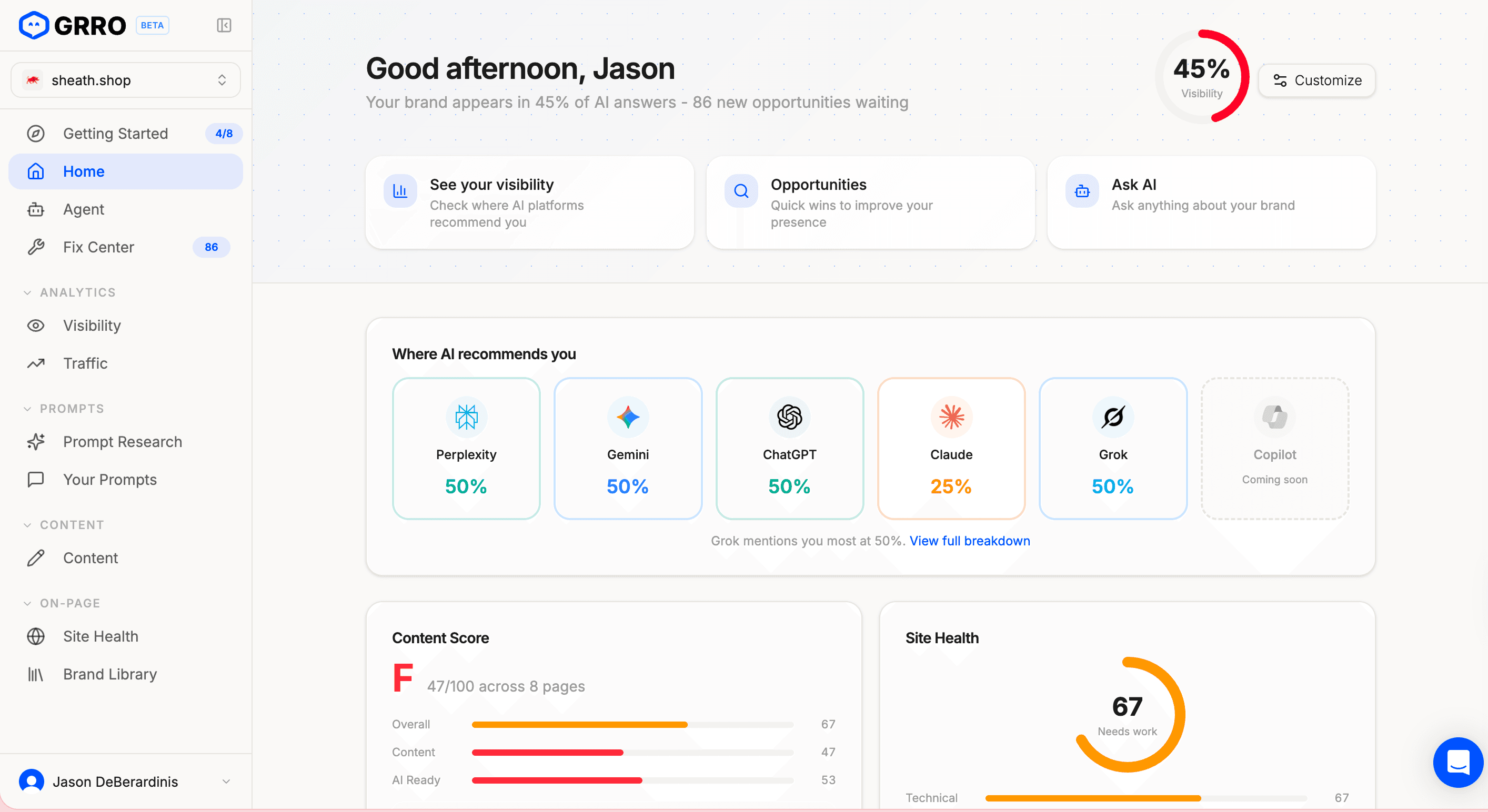
The GRRO platform evaluates E-E-A-T signals as part of its AI Recommendation Score. The platform:
- Scans your content for experience signals (first-person language, specific details, temporal context)
- Evaluates your topical authority through content depth and cluster analysis
- Tracks your multi-source presence across the platforms each AI engine trusts
- Monitors your brand's entity recognition across AI engines
- Identifies specific E-E-A-T gaps and provides prioritized recommendations
This is not a subjective assessment. GRRO's analysis is based on the same signals AI engines evaluate, giving you an objective measure of your E-E-A-T strength and a clear path to improvement.
FAQ
Does E-E-A-T apply to all AI engines or just Google?
E-E-A-T as a named framework is specific to Google. However, every major AI engine evaluates functionally identical signals when deciding what to recommend. ChatGPT evaluates source authority and content credibility. Perplexity weights expert sources and cross-references multiple data points. Gemini inherits Google's quality signals directly. The terminology differs, but the underlying evaluation criteria are remarkably consistent across all 5 major AI engines.
How important is personal experience vs. organizational expertise?
Both matter, but personal experience is increasingly the differentiator. AI engines have access to vast amounts of organizational expertise (product specifications, feature lists, general knowledge). What they have less access to is genuine first-person experience. Content that demonstrates real-world application, including failures and unexpected outcomes, stands out because it is rare and difficult to fabricate.
Can a new brand build E-E-A-T quickly?
Building E-E-A-T from scratch takes 3 to 6 months for meaningful impact and 6 to 12 months for strong positioning. The fastest levers are author expertise (hire or feature established experts), review acquisition (systematic customer review solicitation), and LinkedIn thought leadership (immediate, high-frequency publishing). Wikipedia mentions and publication citations take longer but are worth pursuing from day one.
How does E-E-A-T interact with content structure?
E-E-A-T and content structure are complementary, not competing signals. Strong E-E-A-T makes your content trustworthy enough to recommend. Good structure makes it extractable enough for the AI to use. You need both. The most authoritative content in the world will not get recommended if the AI cannot extract a clear answer from it. And the most perfectly structured content will not be trusted if it lacks authority signals.
Does paying for backlinks help E-E-A-T?
No. AI engines are increasingly sophisticated at detecting unnatural link patterns. Paid backlinks can create the appearance of authority for traditional SEO, but AI engines cross-reference authority signals across multiple dimensions. A brand with paid backlinks but no LinkedIn presence, no review platform ratings, and no genuine publication mentions will not pass AI trust evaluation. Invest in genuine authority building instead.
How do I demonstrate experience for products I sell but did not create?
Retailers and resellers can demonstrate experience through detailed product testing, comparison reviews based on hands-on evaluation, customer feedback aggregation, and use-case documentation. "We tested all 15 standing desks in our warehouse and here is what we found" is a powerful experience signal even if you did not manufacture the desks. Document your direct engagement with the products you sell.
How does GRRO evaluate my E-E-A-T strength?
GRRO analyzes your E-E-A-T through the same signals AI engines use. The platform's source citation analytics evaluates your content's experience signals, your site's topical authority, your multi-source presence across platforms, and your entity recognition in AI engine responses. The content studio then translates these insights into specific page-level improvements. The result is an E-E-A-T score that correlates directly with your AI Recommendation Rate, along with specific, prioritized actions to strengthen each signal. Start with a free scan to see your current E-E-A-T assessment.
Conclusion
E-E-A-T is not just a Google concept. It is the universal quality framework that determines whether AI engines trust your content enough to recommend it. Experience, Expertise, Authoritativeness, and Trustworthiness work together to create a trust profile that AI engines evaluate every time they decide whether to mention your brand.
The good news is that strengthening E-E-A-T for AI search simultaneously strengthens your position in traditional search. This is not a tradeoff. It is a multiplier. Every investment in genuine expertise, real experience documentation, multi-source authority, and transparent content pays dividends across both channels.
The brands winning at AI search in 2026 are the ones that stopped trying to game algorithms and started building genuine authority. They document their real experiences. They invest in their team's expertise. They build presence across the platforms AI engines trust. And they measure their progress with tools like GRRO that track the signals that actually drive recommendations.
Start with the E-E-A-T audit checklist above. Identify your weakest signal. Build a 90-day plan to strengthen it. Then move to the next one. The compounding effect of consistent E-E-A-T investment creates an advantage that competitors cannot easily replicate.

Co-Founder & CMO at GRRO