The Complete AI Search Optimization Checklist for 2026
A step-by-step AI search optimization checklist covering content structure, technical setup, schema markup, multi-source presence, and monitoring. Bookmark this and work through it systematically.

Key Takeaways
- This checklist covers every action required to optimize your brand's visibility across AI search engines like ChatGPT, Perplexity, Gemini, Claude, and Grok
- The checklist is organized into five categories: Content Structure, Technical Foundation, Schema Markup, Multi-Source Presence, and Monitoring and Measurement
- Each item is specific and actionable, so you can work through the list systematically without guessing what "optimize your content" actually means
- Completing the full checklist typically takes 4 to 12 weeks depending on your starting point and team size
- Bookmark this page and return to it regularly as you work through each phase of your AI search optimization strategy
How to Use This Checklist
This checklist is designed to be worked through sequentially. The categories build on each other: Content Structure and Technical Foundation come first because they address your on-site presence. Schema Markup enhances what you have already built. Multi-Source Presence extends your strategy beyond your website. Monitoring and Measurement lets you track progress and iterate.
For each item, check it off when completed. Some items are one-time tasks. Others are recurring tasks that should become part of your regular workflow. Recurring items are marked with (Recurring) so you know to revisit them.
If you are new to AI search optimization, start with our complete guide to what AI search optimization is before working through this checklist. Understanding the principles will make each action item clearer.
Section 1: Content Structure
Content structure determines whether AI engines can extract clear answers from your pages. This is where most businesses have the biggest gaps and the most to gain.
Audit and Answer-First Formatting
- Identify your top 20 pages by traffic and business value
- For each page, check whether the first 40 to 60 words contain a direct answer to the primary question the page addresses
- Rewrite opening paragraphs of all key pages to lead with a direct answer before providing context or background
- Ensure every H2 section opens with a clear answer statement in its first one to two sentences
- Eliminate introductory filler like "In today's digital landscape" or "As we all know" from the opening of pages and sections
- Verify that each 200 to 500 word section can stand alone as a coherent answer without requiring context from other sections
Heading Optimization
- Audit all pages for proper heading hierarchy (one H1, then H2s, then H3s under each H2, with no skipped levels)
- Rewrite H2 headings as questions or keyword-rich phrases that match user queries (e.g., "How Much Does CRM Software Cost?" instead of "Pricing")
- Rewrite H3 headings to be specific and descriptive enough that a reader can understand the subsection's content from the heading alone
- Ensure no page has more than one H1 tag
- Check that heading text is not duplicated across sections on the same page
Content Completeness
- For each key topic, verify that your page covers the topic comprehensively enough to be the single best source an AI engine could cite
- Add comparison tables wherever your content involves product, feature, pricing, or approach comparisons
- Include specific data points, named examples, and concrete recommendations rather than vague generalities
- Add step-by-step instructions for any process-oriented content
- Include year-specific references (e.g., "in 2026") for time-sensitive content so AI engines recognize currency
- (Recurring) Review and update all statistics and data points quarterly to maintain accuracy
FAQ Sections
- Add an FAQ section with 5 to 7 questions to every key page
- Write FAQ questions using the exact phrasing real users would type into an AI engine
- Keep FAQ answers concise (2 to 4 sentences) and direct, leading with the answer
- Include cross-links to other relevant pages within FAQ answers where natural
- (Recurring) Update FAQ sections monthly with new questions from customer interactions, search console data, and AI engine testing
Internal Linking
- Build internal links between related content using descriptive anchor text
- Ensure every key page is reachable within three clicks from your homepage
- Link from high-authority pages to pages you want to boost in AI visibility
- Use topic clusters: pillar pages linking to detailed subtopic pages and vice versa
- Audit for and fix broken internal links
For a deep dive on content formatting for AI engines, see our guide on the content structure AI engines love.
Section 2: Technical Foundation
Technical SEO is the floor your content stands on. If your site is not crawlable, fast, and properly indexed, your content will never enter an AI engine's retrieval pool. GRRO's technical optimization tools can identify gaps in your technical foundation and prioritize fixes.
Crawlability and Indexing
- Submit your XML sitemap to Google Search Console
- Submit your XML sitemap to Bing Webmaster Tools (critical for ChatGPT visibility, since both use Bing for retrieval)
- Verify that your robots.txt does not block important pages from search engine crawlers
- Check that all key pages return a 200 status code (not 301, 404, or 500)
- Verify that no important pages have a "noindex" meta tag or X-Robots-Tag header
- (Recurring) Check Google Search Console and Bing Webmaster Tools weekly for crawl errors and indexing issues
Page Speed
- Test all key pages with Google PageSpeed Insights and aim for a performance score above 80
- Ensure Largest Contentful Paint (LCP) is under 2.5 seconds on all key pages
- Optimize images with modern formats (WebP, AVIF) and lazy loading
- Minimize render-blocking JavaScript and CSS
- Enable browser caching and compression (gzip or Brotli)
Mobile Optimization
- Verify all key pages render correctly on mobile devices using Google's Mobile-Friendly Test
- Ensure text is readable without zooming on mobile
- Check that buttons and links have adequate tap targets
- Verify that no horizontal scrolling is required on mobile
- Confirm mobile and desktop versions serve the same content (no hidden content on mobile)
Security and Trust
- Ensure your entire site runs on HTTPS with a valid SSL certificate
- Verify that HTTP URLs redirect to HTTPS
- Check for mixed content warnings (HTTP resources loaded on HTTPS pages)
- Implement security headers (X-Content-Type-Options, X-Frame-Options, Content-Security-Policy)
Bing-Specific Optimization
- Create and verify your Bing Webmaster Tools account
- Submit your sitemap directly to Bing (do not rely on Google indexing to cascade)
- Check your Bing rankings for top target keywords (they may differ significantly from Google rankings)
- Optimize for Bing-specific signals: social media mentions, exact keyword matching, and multimedia content
- (Recurring) Monitor Bing Webmaster Tools monthly for indexing status and keyword performance
Section 3: Schema Markup
Schema markup helps search engines (and by extension, AI engines) understand your content's structure, purpose, and context. Proper schema implementation improves your chances of entering the AI retrieval pool and being correctly categorized.
Essential Schema Types
- Implement Article schema on all blog posts, guides, and long-form content
- Include: headline, author, datePublished, dateModified, publisher, image
- Ensure author includes name and url (linking to an author page or LinkedIn)
- Implement FAQ schema on all pages that include FAQ sections
- Each question-answer pair must match the visible content exactly
- Do not include FAQ schema for questions not visible on the page
- Implement Organization schema on your homepage
- Include: name, url, logo, sameAs (linking to social profiles), description
- Implement WebSite schema with a SearchAction if your site has internal search
- Implement BreadcrumbList schema for navigation path context
Conditional Schema Types
- Implement Product schema on product or service pages (if applicable)
- Include: name, description, offers with price and currency, review aggregation
- Implement HowTo schema on step-by-step tutorial content (if applicable)
- Implement LocalBusiness schema if your business serves a specific geographic area
- Implement Person schema for author pages with credentials and professional information
- Implement Review schema for pages that contain reviews or testimonials
Schema Validation
- Test all schema implementation with Google's Rich Results Test
- Test with Schema.org's Validator for broader compliance
- Verify no errors or warnings in Google Search Console's Enhancements reports
- Ensure schema data matches visible page content exactly (no hidden or misleading schema)
- (Recurring) Re-validate schema quarterly and after any major content or template changes
For complete implementation guidance, see our schema markup for AI search visibility guide.
Section 4: Multi-Source Presence
AI engines cross-reference information across multiple sources before making recommendations. A brand that only exists on its own website will struggle to earn AI trust regardless of how good the on-site content is. This section builds your presence across the platforms AI engines rely on.
- Ensure your company LinkedIn page is complete with description, logo, website URL, industry, and company size
- (Recurring) Publish 2 to 3 thought leadership posts per week from key team members
- (Recurring) Comment meaningfully on industry conversations to increase visibility
- Ensure team members' personal LinkedIn profiles mention the company and their roles
- Add links to key content on your website from LinkedIn posts where relevant
- Optimize LinkedIn profiles with relevant keywords in headlines and About sections
- Identify 3 to 5 subreddits where your target audience discusses topics related to your product or service
- (Recurring) Participate genuinely by providing helpful, detailed answers to questions in those subreddits
- Build karma and reputation before mentioning your own product (Reddit communities penalize self-promotion from new accounts)
- When mentioning your product, do so naturally and in context, not as the sole purpose of a comment
- (Recurring) Monitor mentions of your brand and competitors on Reddit weekly
Industry Publications and Media
- Identify 5 to 10 industry publications that cover topics related to your business
- (Recurring) Pitch guest articles or expert commentary monthly
- (Recurring) Respond to journalist queries through platforms like HARO, Qwoted, or Connectively
- Maintain a media page on your website with logos of publications you have been featured in
- Ensure all published guest articles include a bio with your name, company, and website link
Review and Directory Platforms
- Claim and complete your profiles on relevant review platforms (G2, Capterra, Trustpilot, or industry-specific platforms)
- (Recurring) Encourage satisfied customers to leave genuine reviews
- (Recurring) Respond to all reviews, positive and negative, promptly and professionally
- Ensure your company information is consistent across all directory listings (name, address, website, description)
- List your product on relevant software directories and comparison sites
Wikipedia and Knowledge Bases
- Assess whether your company meets Wikipedia's notability criteria
- If notable, ensure your Wikipedia presence is accurate and properly sourced (do not edit your own page; provide sources that independent editors can use)
- Maintain accurate entries on Wikidata and other knowledge bases
- Ensure your Crunchbase profile is current (if applicable)
X (Twitter) and Social Platforms
- Maintain an active X account (Grok heavily indexes X content)
- (Recurring) Post industry insights and commentary regularly on X
- Ensure your X profile includes your company name, website, and a clear description
- Maintain presence on YouTube if video content is part of your strategy
- (Recurring) Share content across all active social platforms when published
Quora and Q&A Platforms
- Create expert profiles on Quora and relevant Q&A platforms
- (Recurring) Answer questions in your area of expertise with detailed, helpful responses
- Include relevant credentials in your profile to establish authority
- Link to your content as a source when it genuinely adds value to an answer
For a deeper strategy on multi-source authority, read our guide on building authority signals for AI recommendations.
Section 5: Monitoring and Measurement
You cannot optimize what you do not measure. This section establishes the monitoring framework that turns your optimization efforts into a feedback loop.
Baseline Measurement
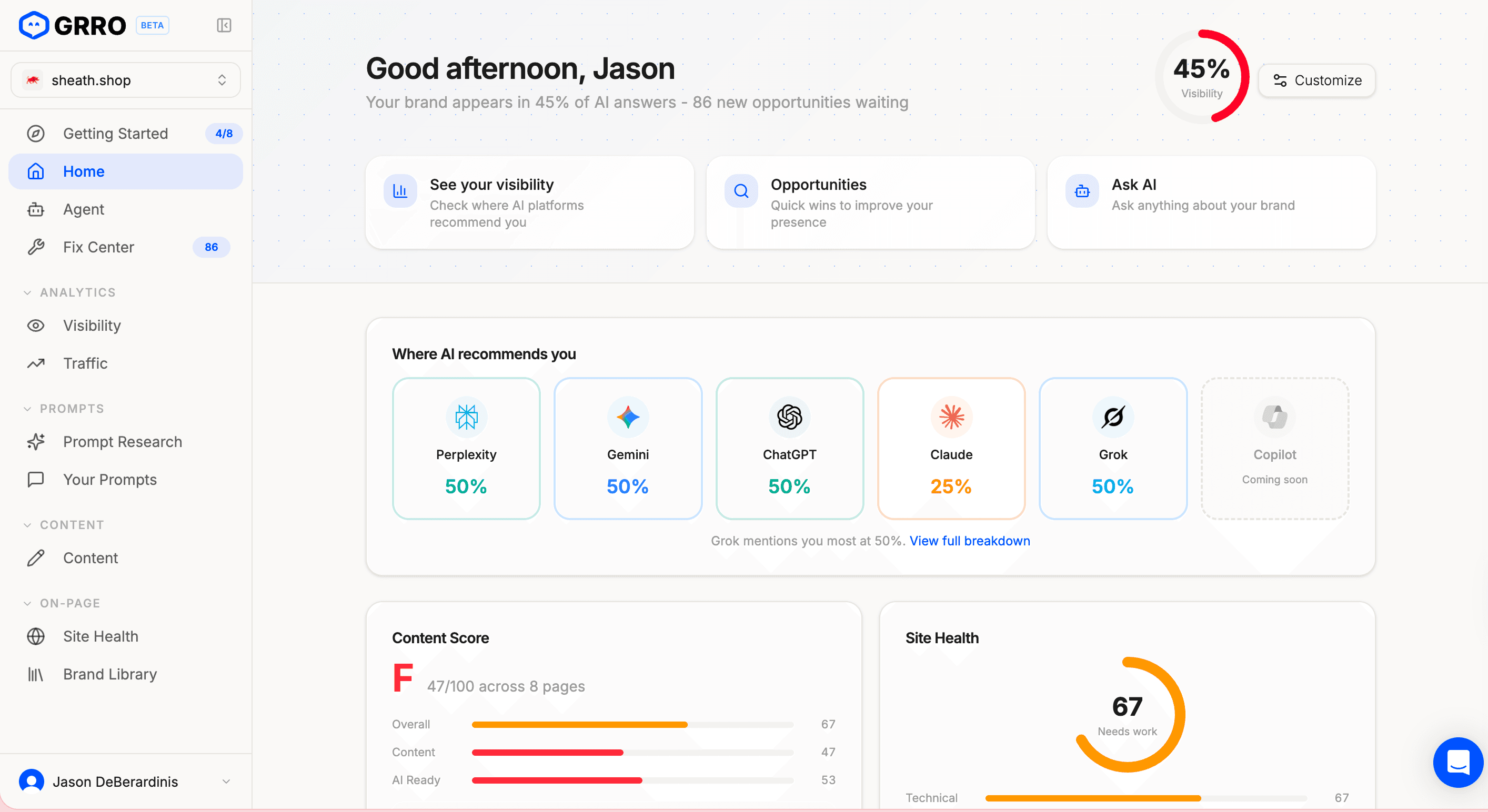
- Run a free AI visibility scan at GRRO to get your baseline AI Recommendation Score using search visibility tracking
- Test 20 to 30 queries manually across ChatGPT, Perplexity, and Gemini and document the results in a spreadsheet
- Record which queries return your brand, which return competitors, and which return no relevant recommendation
- Document the specific language AI engines use when describing your brand (positive, neutral, negative, or absent)
- Identify your top 5 competitor brands that appear in AI recommendations for your target queries
Ongoing Tracking
- (Recurring) Track your AI Recommendation Score weekly using an automated tool
- (Recurring) Test your top 10 to 15 queries manually across AI engines weekly
- (Recurring) Monitor AI referral traffic in your analytics platform (look for referrals from chat.openai.com, chatgpt.com, perplexity.ai, gemini.google.com)
- (Recurring) Compare AI referral traffic conversion rates against organic search conversion rates
- (Recurring) Track competitor visibility changes monthly
Content Performance
- (Recurring) Score all new content for AI readability before publishing (check answer-first format, heading structure, FAQ presence, schema)
- (Recurring) Identify which pages are being cited by AI engines and analyze what makes them successful
- (Recurring) Identify which pages are not appearing in AI recommendations despite targeting relevant queries, and diagnose the gap
- (Recurring) Update the content on your top 10 pages monthly with current data and examples
Reporting
- Create a monthly AI visibility report that tracks: AI Recommendation Score trend, query coverage, competitor comparison, AI referral traffic, and AI-attributed conversions
- Share the report with stakeholders to maintain organizational buy-in for AI search optimization
- (Recurring) Review the report monthly and adjust strategy based on what is improving and what is not
For a complete measurement framework, see our guide on measuring ROI from AI search visibility.
Priority Order: Where to Start
If the full checklist feels overwhelming, here is the priority order. Complete each tier before moving to the next.
Tier 1: Quick Wins (Week 1 to 2)
- Run your baseline AI visibility scan
- Rewrite the opening paragraphs of your top 5 pages to lead with direct answers
- Add FAQ sections with 5 to 7 questions to your top 5 pages
- Submit your sitemap to Bing Webmaster Tools
- Implement Article and FAQ schema on your top 5 pages
Tier 2: Foundation (Weeks 2 to 4)
- Restructure headings on your top 20 pages
- Add comparison tables to relevant content
- Fix all crawl errors in Google Search Console and Bing Webmaster Tools
- Optimize page speed on all key pages
- Implement Organization schema on your homepage
Tier 3: Authority (Weeks 4 to 8)
- Establish a weekly LinkedIn posting cadence
- Identify and begin participating in relevant Reddit communities
- Pitch your first guest article to an industry publication
- Claim profiles on relevant review platforms
- Set up weekly AI visibility monitoring
Tier 4: Scale (Weeks 8 to 12)
- Expand content restructuring to all pages
- Implement all relevant schema types
- Build out multi-source presence across all platforms
- Establish monthly reporting cadence
- Begin tracking AI-attributed conversions
Maintaining Your AI Search Optimization
AI search optimization is not a one-time project. Building a repeatable AEO strategy is essential because AI engines update their models, change their retrieval methods, and shift their recommendation patterns regularly. The checklist items marked (Recurring) are the ongoing work that maintains and improves your visibility over time.
Build these recurring tasks into your team's workflow:
Weekly: Track AI Recommendation Score, test top queries manually, post on LinkedIn and X, participate on Reddit.
Monthly: Update top content with current data, review monitoring reports, pitch guest articles, respond to reviews, adjust strategy based on data.
Quarterly: Full content audit for freshness, re-validate all schema markup, review multi-source presence across all platforms, update the query landscape map.
FAQ
How long does it take to complete this entire checklist?
Most businesses can complete the full checklist in 4 to 12 weeks depending on team size, existing content quality, and technical readiness. Tier 1 (quick wins) can be done in one to two weeks. Tiers 2 and 3 take two to four weeks each. Tier 4 scales into ongoing work. The recurring items are permanent additions to your marketing workflow.
Do I need to complete every item on the checklist to see results?
No. The checklist is comprehensive by design, but the items in Tier 1 alone can produce measurable improvements in AI visibility within 4 to 8 weeks. Each subsequent tier compounds the gains. However, businesses that complete all five sections build the strongest long-term positioning.
Should I hire someone to do this or can my team handle it?
Most marketing teams can handle the content structure and multi-source presence sections in-house. The technical foundation and schema markup sections may require developer support, especially if your site uses a custom CMS or has complex architecture. Many businesses work through the checklist internally and bring in specialized help for technical implementation only.
Which section is the most impactful?
Content Structure (Section 1) typically produces the fastest and most visible improvements because it directly affects how AI engines extract and evaluate your content. However, Multi-Source Presence (Section 4) is the most impactful long-term because it builds the authority signals that differentiate your brand from competitors in AI recommendations.
How often should I revisit the checklist?
Monthly for recurring items. Quarterly for a full reassessment of all sections. The AI search landscape evolves quickly, and what worked three months ago may need adjustment. Use your monitoring data (Section 5) to identify which areas need attention each quarter.
Can I use this checklist for local businesses?
Yes. The entire checklist applies to local businesses with a few additions: implement LocalBusiness schema, ensure Google Business Profile and Bing Places are complete and current, target location-specific queries in your content, and build local citations on directories and local news publications. The core principles of answer-first content, technical foundation, and multi-source presence apply regardless of business size or type. See our local business AI search case study for a practical example.
What tools do I need to work through this checklist?
At minimum: Google Search Console, Bing Webmaster Tools, Google PageSpeed Insights, a schema validation tool, and an AI search monitoring tool. For monitoring, start with a free scan from GRRO to establish your baseline. For content scoring, the GRRO platform provides per-page AI readiness analysis. For a full tool comparison, see our AI search optimization tools comparison.
Conclusion
This checklist covers every actionable step required to optimize your brand's visibility across AI search engines in 2026. From content structure to technical foundation, schema markup to multi-source presence, and monitoring to measurement, each item moves you closer to being the brand that AI engines recommend.
The key is to start. Most businesses never begin because the scope feels large. But the Tier 1 quick wins take one to two weeks and produce measurable results. Every item you complete improves your position in a channel where 97% of your competitors have done nothing.
Start with a free AI visibility scan at GRRO to see your baseline score. Then work through this checklist tier by tier. Bookmark this page, come back to it weekly, and check items off as you complete them. Consistent execution of this checklist will position your brand ahead of the vast majority of competitors who have not started.

Co-Founder & CMO at GRRO