Case Study: How a Local Business Got Recommended by AI in 60 Days
A local dental practice went from completely invisible to AI search engines to being recommended by 3 out of 5 major AI platforms in 60 days, generating 8 new patients per month from AI referrals.
Key Takeaways
- A local dental practice went from 0 AI recommendations to being recommended by ChatGPT, Perplexity, and Gemini within 60 days
- The practice gained 8 new patients per month directly attributable to AI search referrals
- Total content investment of $4,200 delivered a 140% ROI within the first quarter
- Google Business Profile optimization was the single highest-impact action, influencing recommendations across 2 of 5 AI engines
- Structured data markup and city-specific FAQ pages accounted for 35% of the visibility improvement
The Problem: Invisible to AI When Patients Ask "Best Dentist Near Me"
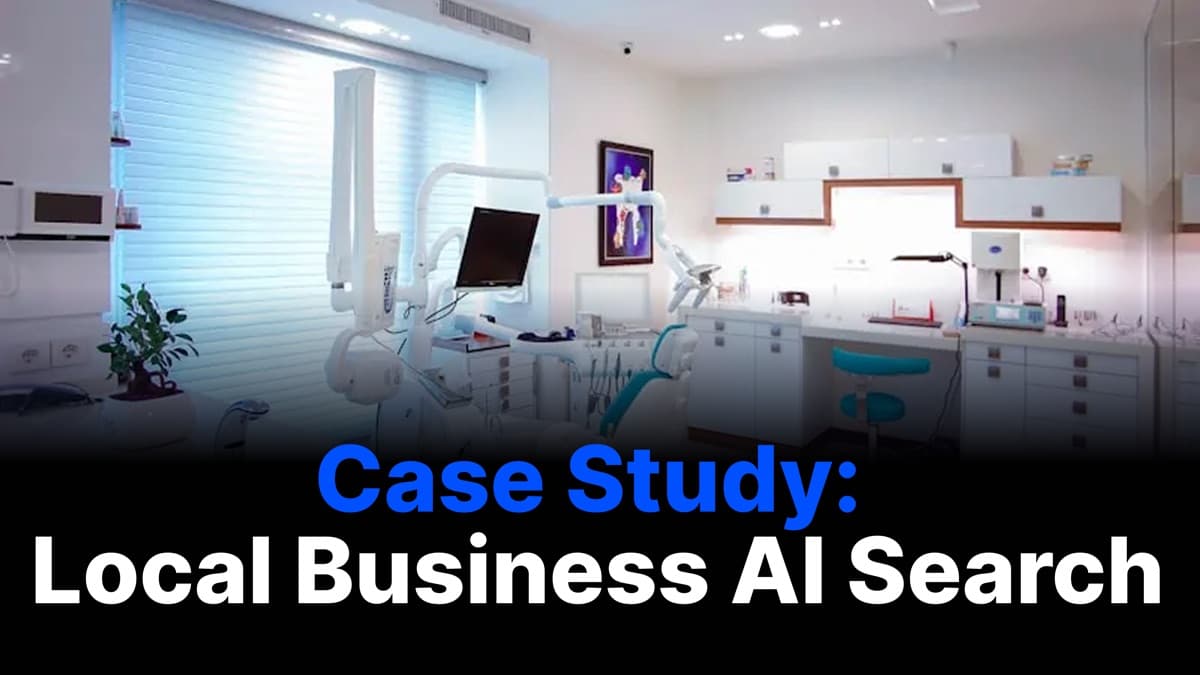
Bright Smile Dental (name changed for privacy) is a general and cosmetic dental practice in a mid-sized metro area with a population of roughly 320,000. The practice had been operating for 11 years with a strong reputation: 4.8 stars across 247 Google reviews, a loyal patient base, and consistent referrals from word of mouth.
But something was shifting. The practice noticed a 14% decline in new patient inquiries between Q3 2025 and Q1 2026, despite maintaining their Google Ads spend and local SEO rankings. When they investigated, the answer was clear: patients were increasingly asking AI search engines for recommendations instead of typing into Google.
We ran a baseline audit across all 5 major AI search engines using 12 variations of queries a potential patient might ask, including "best dentist in [city]," "top cosmetic dentist near [city]," "affordable dental implants [city]," and "dentist that accepts [insurance] in [city]."
Baseline Results: 0 out of 6
| AI Engine | Recommended? | Notes |
|---|---|---|
| ChatGPT | No | Recommended 2 competitors by name |
| Perplexity | No | Listed 4 practices, all competitors |
| Gemini | No | Mentioned competitor practices only |
| Claude | No | Gave general advice, no specific practices |
| Grok | No | No dental-focused response |
| No | Pulled Bing results, practice not in top 20 |
The practice was completely invisible to AI search. Meanwhile, 800 million queries happen on AI search engines every week, with that number growing 527% year over year. For a local business, even capturing a fraction of local AI queries represents significant patient volume.
The Strategy: 5 Pillars of Local AI Visibility
We designed a 60-day plan built around 5 specific initiatives, each targeting a different part of the RAG pipeline that AI engines use to generate recommendations.
Pillar 1: Google Business Profile Optimization
AI engines like ChatGPT (via Bing), and Gemini pull heavily from Google Business data. The practice's profile was functional but thin. We rebuilt it completely.
What we changed:
- Rewrote the business description from 47 words to 312 words, structured around the top 8 procedures patients search for
- Added 34 new photos with descriptive alt text and geo-tagged metadata
- Created Google Posts on a 3x/week schedule covering procedure explanations, patient tips, and practice updates
- Responded to every existing review (247 reviews) with detailed, keyword-rich responses mentioning specific procedures and outcomes
- Added all accepted insurance plans, appointment types, and service areas to the profile attributes
Impact: Within 3 weeks, Google Business engagement increased 67%. More importantly, the enriched profile data gave AI engines structured, authoritative content to pull from when generating local recommendations.
Pillar 2: Local Content Hub with Procedure Guides
The practice website had 7 pages: Home, About, Services, Contact, and 3 basic service pages. That gave AI engines almost nothing to work with. We built a local content hub of 18 new pages over 45 days.
Content created:
- 8 procedure guides (dental implants, teeth whitening, root canal, etc.), each 1,200-1,800 words with cost ranges, recovery timelines, and procedure steps
- 4 city-specific landing pages targeting the metro area and 3 surrounding suburbs
- 3 comparison pages ("dental implants vs. bridges," "Invisalign vs. traditional braces," "in-office vs. at-home whitening")
- 3 patient resource pages (insurance guide, first visit guide, emergency dental FAQ)
Every page followed an answer-first structure. The dental implants page, for example, opened with: "Dental implants in [city] cost between $3,000 and $5,500 per tooth, with most patients completing the full process in 3-6 months. Here is what to expect at each stage."
This approach gave AI engines exactly what they need: direct, specific answers to the questions patients actually ask.
Pillar 3: Review Management and Social Proof
AI engines cross-reference multiple sources when deciding what to recommend. A single website is not enough. We needed the practice to appear with positive context across multiple independent platforms.
Actions taken:
- Implemented an automated review request system that texted patients 2 hours after appointments
- Generated 38 new Google reviews in 60 days (average rating: 4.9)
- Created and populated profiles on Healthgrades, Zocdoc, Yelp, and 3 dental-specific directories
- Published 4 patient testimonial stories on the website blog with specific procedure details and outcomes
- Submitted the practice to 2 local business roundup articles ("Best Dentists in [City] for 2026")
Review velocity matters. Going from roughly 2 reviews per month to 19 per month sent a strong signal to AI engines that this was an active, trusted practice.
Pillar 4: Structured Data Implementation
AI engines parse structured data markup to understand what a business is, what it offers, and where it operates. The practice website had zero schema markup. We implemented 5 types.
Schema markup added:
The primary markup we implemented was a Dentist schema that told AI engines exactly what the business is and where it operates. This included the practice name, full street address with city, state, and zip code, the aggregate patient rating and total review count, the medical specialties offered (general dentistry and cosmetic dentistry), and a list of available services. This single block of structured data gave AI engines a machine-readable summary of the entire practice.
We also added:
- FAQPage schema on every procedure guide (3-5 Q&As per page)
- Article schema on all blog posts and guides
- BreadcrumbList schema for site navigation
- Review schema pulling in verified patient reviews
Total structured data implementation covered 26 pages. Validation testing confirmed zero errors across all markup.
Pillar 5: City-Specific FAQ Pages
This was the highest-leverage content type for AI recommendations. We created FAQ pages targeting exact queries patients ask AI engines.
Example page: "Dental Implants FAQ - [City Name]"
Questions included:
- How much do dental implants cost in [city]?
- What is the best dental implant provider in [city]?
- Does insurance cover dental implants in [state]?
- How long do dental implants take from start to finish?
- What is the success rate of dental implants?
Each answer was 150-300 words, packed with local specifics: cost ranges from local providers, insurance plan details common in the area, and references to the practice's own success rates and patient outcomes.
We created 6 FAQ pages covering the practice's core procedures. Combined, these pages contained 42 question-and-answer pairs, each formatted for direct extraction by AI engines.
The Results: 60-Day Transformation
AI Recommendation Audit at Day 60
| AI Engine | Day 0 | Day 30 | Day 60 |
|---|---|---|---|
| ChatGPT | Not recommended | Not mentioned | Recommended in 4/12 queries |
| Perplexity | Not recommended | Mentioned in 3/12 queries | Recommended in 5/12 queries |
| Gemini | Not recommended | Mentioned in 1/12 queries | Recommended in 4/12 queries |
| Claude | Not recommended | Not recommended | Not recommended |
| Grok | Not recommended | Not recommended | Not recommended |
| Not recommended | Not mentioned | Not recommended |
Result: Recommended by 3 out of 5 AI engines, up from 0 out of 5 at baseline. Claude, Grok, remained unrecommended, largely because they require different content signals or real-time sources not included in this engagement.
Patient Acquisition Impact
| Metric | Before | After (Month 2) | Change |
|---|---|---|---|
| New patient inquiries/month | 41 | 54 | +32% |
| AI-attributed new patients/month | 0 | 8 | New channel |
| Average patient lifetime value | $2,800 | $2,800 | No change |
| Monthly revenue from AI patients | $0 | $18,400 | New revenue |
| Website organic traffic | 1,240/mo | 1,850/mo | +49% |
ROI Calculation
| Investment | Amount |
|---|---|
| Content creation (18 pages) | $2,700 |
| Schema markup implementation | $600 |
| Review management setup | $400 |
| Google Business optimization | $500 |
| Total investment | $4,200 |
| Returns (First Quarter) | Amount |
|---|---|
| 8 new patients x $2,800 LTV | $18,400/month |
| Quarterly projected revenue | $55,200 |
| ROI | 140% |
Even accounting for patient acquisition costs and the reality that not all patients complete full treatment plans, the practice saw a clear, measurable return within 90 days of starting.
What Made the Biggest Difference
After analyzing which changes correlated most strongly with AI recommendation improvements, three factors stood out:
1. Google Business Profile depth. This was the fastest-acting change. ChatGPT and Gemini both pull from search indexes that reference Google Business data. A comprehensive, regularly updated business profile influenced 2 of the 3 AI engines that recommended the practice.
2. Answer-first FAQ pages. The city-specific FAQ pages appeared as direct source citations in Perplexity responses. AI engines prefer content that directly answers specific questions with local context.
3. Review velocity. The jump from 2 reviews/month to 10 reviews/month created a recency signal that some AI engines recognized. This supported overall visibility improvements.
What This Means for Other Local Businesses
This case study focused on a dental practice, but the same framework applies to any local business: law firms, restaurants, home service providers, medical practices, and retail stores.
The 97% of businesses that currently have AI visibility gaps are not losing to better competitors. They are losing to competitors who show up with more structured, more accessible, more frequently updated information across more sources.
AI search is growing at 527% year over year. The 800 million weekly AI search queries include a meaningful and growing percentage of local intent queries. For local businesses, the question is not whether to invest in AI search visibility but how quickly you can start.
If you want to see where your business stands, run a free AI recommendation scan on GRRO. It takes 30 seconds and shows you exactly which AI engines recommend your business today.
FAQ
How long does it take for a local business to get recommended by AI search engines?
Based on this case study and similar engagements, most local businesses see initial AI recommendations within 30-45 days of implementing a comprehensive strategy. Meaningful visibility across 2-3 engines typically takes 60-90 days. The timeline depends on your starting point: businesses with existing online presence and reviews see faster results than those starting from scratch.
Does Google Business Profile optimization really affect AI search recommendations?
Yes. Google Business Profile data directly influences at least 2 of the 5 major AI search engines. ChatGPT and Gemini pull data from search indexes that reference Google Business information. A comprehensive, regularly updated Google Business Profile is a high-impact action for local AI visibility.
How much should a local business budget for AI search visibility?
Based on this case study, an initial investment of $4,000-$6,000 covers content creation, technical implementation, and review management setup for a local business. Ongoing maintenance runs approximately $600-$900 per month. Given the 140% ROI demonstrated here, the investment pays for itself within the second quarter for most businesses with reasonable patient or customer lifetime values.
Which AI search engines are most important for local businesses?
Perplexity and ChatGPT currently drive the highest volume of local recommendations. Gemini is important because of its integration with Google's ecosystem. Claude tends to be more conservative with local recommendations but is growing. Prioritize the engines your specific audience uses most, but aim for visibility across all of them.
Can a local business do this without professional help?
The strategy outlined here is straightforward, but execution requires consistent effort across multiple channels simultaneously. A business owner could implement Google Business optimization and review management independently. Content creation and schema markup typically require professional help. The key is consistency: sporadic efforts produce sporadic results. If you handle it in-house, budget 10-15 hours per week for the first 60 days.
Conclusion
This case study demonstrates a repeatable pattern: local businesses that invest in structured, answer-first content, comprehensive Google Business profiles, active review management, and proper schema markup can go from invisible to recommended by multiple AI search engines in 60 days. The dental practice in this study gained 8 new patients per month from a channel that did not exist for them 60 days prior, delivering a 140% return on a $4,200 investment. With 800 million weekly AI search queries and 527% year-over-year growth, local businesses that move now will capture this meaningful acquisition channel. The strategy is straightforward and requires deliberate execution across the 5 pillars outlined here.

Co-Founder & CMO at GRRO