How to Get Your Business Recommended by ChatGPT
A step-by-step guide to getting your business recommended by ChatGPT. Covers how ChatGPT selects sources, the signals that influence recommendations, optimization strategies, and common mistakes that keep brands invisible.

Key Takeaways
- ChatGPT is the largest AI search engine with over 400 million weekly active users and approximately 52% of all AI search queries
- ChatGPT selects recommendations using a RAG pipeline that searches Bing, retrieves top results, chunks and re-ranks content, and generates an answer with named brands
- The four factors that most influence ChatGPT recommendations are Bing ranking position, content structure, multi-source authority, and entity recognition
- Getting recommended requires a combination of on-site optimization (answer-first content, schema markup) and off-site presence (LinkedIn, Reddit, Wikipedia, industry publications)
- Most businesses are invisible to ChatGPT because they have never optimized for the specific way ChatGPT finds and evaluates sources
How ChatGPT Has Changed Business Discovery
Getting your business recommended by ChatGPT is now one of the highest-value visibility opportunities available to any brand. ChatGPT processes hundreds of millions of queries per week, and a significant portion of those queries are product research, service comparisons, and purchase-intent questions where the AI names specific businesses.
When a user asks ChatGPT "What is the best accounting software for freelancers?" or "Which CRM works best for real estate agents?" ChatGPT does not show a list of links. It generates a conversational answer that names specific brands, explains why they are recommended, and often includes pros, cons, and pricing. The businesses that appear in these answers capture attention, trust, and traffic. The businesses that do not appear miss the interaction entirely.
With over 400 million weekly active users, ChatGPT is now the most-used AI search engine. It accounts for roughly 52% of all AI search queries. For many users, particularly in Gen Z and among knowledge workers, ChatGPT has become the first place they turn when researching products and services.
The critical fact: 97% of businesses have no strategy for appearing in ChatGPT's recommendations. That means the competitive field is nearly empty. If you optimize now, you are competing against almost nobody.
How ChatGPT Selects What to Recommend
Understanding ChatGPT's source selection process is the foundation of any optimization strategy. ChatGPT does not recommend brands randomly. It follows a structured pipeline.
The RAG Pipeline
ChatGPT uses Retrieval-Augmented Generation (RAG) to generate answers. Here is how it works step by step:
Step 1: Query interpretation. The user asks a question. ChatGPT's system analyzes the query to understand intent, key entities, and the type of answer expected.
Step 2: Bing search. ChatGPT queries Bing to find relevant web pages. This is the critical connection point: ChatGPT's source pool starts with Bing's search results.
Step 3: Content retrieval. The top 10 to 20 URLs from Bing are retrieved and their content is extracted.
Step 4: Chunking. Each page is broken into 200 to 500 word segments. Each segment is evaluated independently.
Step 5: Re-ranking. An AI model scores each chunk for relevance, authority, and answer quality. The top 5 to 10 chunks advance.
Step 6: Answer generation. The large language model uses the top-ranked chunks to generate a natural language answer that names specific brands and provides recommendations.
For a deeper technical breakdown, read our post on how AI decides what to recommend and our explanation of the RAG pipeline.
What This Means for Your Business
This pipeline has direct implications for your optimization strategy:
-
You must rank on Bing. If your pages do not appear in Bing's top 20 results for relevant queries, they will not enter ChatGPT's retrieval pool at all.
-
Individual sections matter. ChatGPT evaluates content in chunks. A brilliant answer buried on a weak page can still be selected. Conversely, a weak section on an otherwise strong page will be skipped.
-
Direct answers win. The re-ranking step favors chunks that contain clear, direct answers. Content that takes three paragraphs to reach its point loses to content that answers in the first sentence.
-
Multiple sources build confidence. ChatGPT cross-references information across the retrieved sources. If your brand appears across multiple independent pages, ChatGPT is more confident in recommending you.
The Signals ChatGPT Uses to Decide
Based on analysis of thousands of ChatGPT recommendations across industries, these are the signals that most influence whether your business gets named.
1. Bing Ranking Position
ChatGPT starts with Bing search results. If you do not rank in Bing's top 20 for relevant queries, you will not be in ChatGPT's consideration set. This makes Bing SEO a prerequisite for ChatGPT recommendations.
Key actions for Bing visibility:
- Submit your site to Bing Webmaster Tools
- Ensure your XML sitemap is submitted and current
- Optimize for Bing's ranking factors (quality content, social signals, domain age)
- Check Bing rankings for your target queries and address any gaps
Many businesses focus exclusively on Google SEO and neglect Bing. For ChatGPT optimization, Bing ranking is the entry ticket.
2. Content Structure and Answer Quality
Once your content enters ChatGPT's retrieval pool, the quality and structure of your content determines whether it advances past the re-ranking step.
ChatGPT's re-ranker favors:
- Direct answers in the first 40 to 60 words of a section
- Specific recommendations with named brands, products, or approaches
- Supporting data including statistics, pricing, and comparison points
- Clear structure with logical headings, lists, and tables
- Self-contained passages that make sense without surrounding context
Content that is vague, meandering, or structured as a narrative journey will lose to content that delivers answers efficiently.
3. Multi-Source Authority
ChatGPT gives more weight to brands that appear across multiple independent sources. If the only place your brand is mentioned is your own website, ChatGPT has a single data point. If your brand is mentioned on your website, discussed on LinkedIn, cited in industry publications, referenced on Reddit, and noted on review sites, ChatGPT has multiple independent confirmations.
The data supports this: brands mentioned on 5 or more independent sources are 7.2x more likely to be recommended by AI engines. See our full AI search statistics for more data points.
4. Entity Recognition
ChatGPT needs to recognize your brand as a known entity in your space. Entity recognition is built through:
- Consistent brand naming across all platforms
- A Google Knowledge Panel
- Wikipedia mentions or pages
- Mentions in authoritative databases and directories
- Clear association between your brand and your expertise area
If ChatGPT does not recognize your brand as a relevant entity for a given query category, it will not recommend you regardless of how good your content is.
5. Content Freshness
ChatGPT considers how recently content was published or updated. Its freshness window is approximately 2 to 4 weeks, meaning content updated within that timeframe receives a trust boost over older content.
This does not mean you need to publish daily. It means your key pages should be updated regularly with current information, fresh statistics, and updated timestamps.
6. Review and Reputation Signals
For commercial queries (product recommendations, service comparisons), ChatGPT references review platforms and reputation signals. G2, Capterra, Trustpilot, and industry-specific review sites all feed into ChatGPT's recommendation confidence.
Step-by-Step Optimization for ChatGPT
Here is the practical playbook for getting your business recommended by ChatGPT.
Phase 1: Foundation (Weeks 1 to 2)
Audit your Bing presence. Go to Bing Webmaster Tools. Submit your sitemap. Check your Bing rankings for 20 to 30 target queries. If you are not in the top 20 on Bing, that is your first problem to solve.
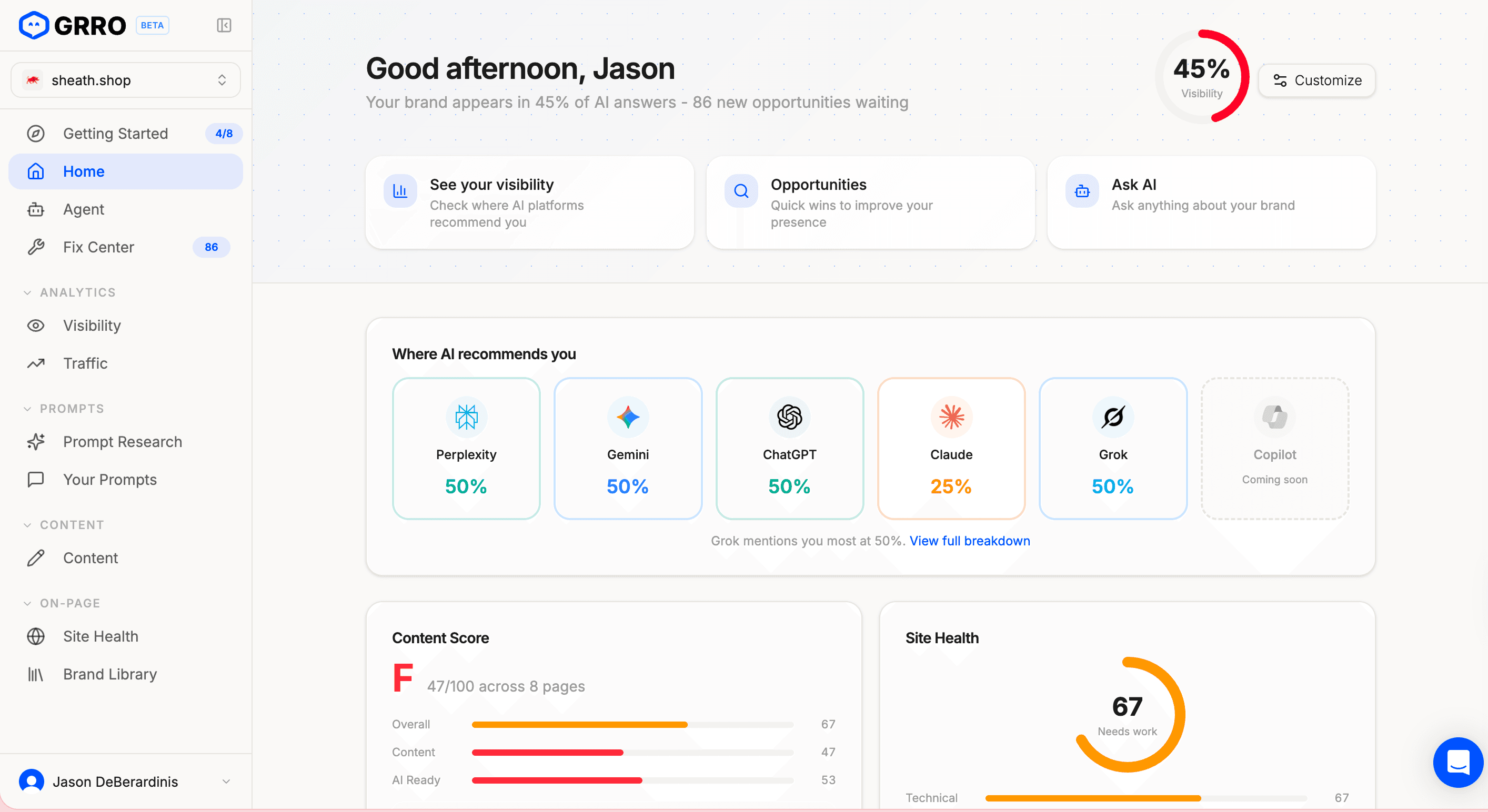
Run an AI visibility scan. Use GRRO's free scan to get your baseline AI Recommendation Score. This tells you exactly how visible you are to ChatGPT and the other five major AI engines.
Identify your target queries. Use prompt intelligence to discover the exact questions your ideal customers ask when researching products or services like yours. These are the queries you need to appear in. Examples:
- "What is the best [your category] for [use case]?"
- "Which [your product type] is most affordable?"
- "[Your brand] vs. [Competitor]: Which is better?"
- "How do I choose a [your category]?"
Phase 2: Content Optimization (Weeks 2 to 4)
Restructure your top 10 pages. GRRO's content studio scores each page for AI readiness and highlights specific improvements. For each priority page:
- Rewrite the opening to include a direct answer in the first 40 to 60 words
- Change statement headings to question-format headings
- Add comparison tables where relevant
- Add an FAQ section with 5 to 7 questions and direct answers
- Update the dateModified timestamp
Implement schema markup. Add Organization schema to your homepage, Article schema to blog posts, and FAQ schema to any page with question-answer content. See our schema markup guide for implementation details.
Create targeted content. Write 3 to 5 new pages specifically targeting your highest-priority ChatGPT queries. Each page should:
- Answer the target question in the first paragraph
- Provide depth that justifies being the recommended source
- Include data, examples, and specific recommendations
- Be 2,000 to 3,500 words
For detailed content formatting strategies, read our guide on the content structure AI engines love.
Phase 3: Multi-Source Presence (Weeks 3 to 8)
LinkedIn presence. Ensure your company page is complete and active. Have executives publish thought leadership content 2 to 3 times per week. Engage in industry discussions. LinkedIn is a high-trust source for ChatGPT.
Reddit presence. Identify 3 to 5 relevant subreddits. Begin participating genuinely: answer questions, share expertise, engage in discussions. Do not spam promotional content. Build credibility over weeks and months. Reddit is one of the most-cited platforms in ChatGPT answers.
Industry publications. Pitch 2 to 3 guest articles to publications in your industry. Respond to journalist queries. Seek speaking opportunities. Each published mention in an independent source strengthens your recommendation probability.
Review platforms. Ensure your profiles on G2, Capterra, Trustpilot, or relevant industry review sites are current with recent reviews. Actively encourage satisfied customers to leave reviews.
Phase 4: Bing-Specific Optimization (Weeks 4 to 6)
Bing Webmaster Tools. Verify your site, submit your sitemap, and use the URL Submission API to notify Bing of new and updated content.
Social signals. Bing weighs social signals more heavily than Google. Active LinkedIn, Facebook, and X profiles with engagement improve your Bing rankings.
Content depth. Bing tends to favor comprehensive, long-form content. Ensure your target pages are thorough, well-structured, and provide genuine depth on their topics.
Technical health. Fix any crawl errors in Bing Webmaster Tools. Ensure your site loads quickly and renders correctly for BingBot.
Phase 5: Monitor and Iterate (Ongoing)
Weekly ChatGPT testing. Ask your 20 most important target queries in ChatGPT weekly. Document whether your brand appears, how it is described, and which competitors show up.
Track AI Recommendation Score. Use GRRO to monitor your score over time. Look for trends: improving, declining, or plateauing. Your AI Recommendation Score is the single best metric for ChatGPT visibility.
Content freshness. Update your top 10 pages at least quarterly with current statistics, new examples, and refreshed timestamps. ChatGPT's 2 to 4 week freshness window means regular updates keep you in the high-trust category.
Competitive monitoring. Track which competitors appear in ChatGPT for your queries. When a new competitor starts appearing, analyze their content and presence to understand what they are doing differently.
What ChatGPT Looks for by Query Type
Different query types trigger different evaluation criteria. Understanding this helps you tailor content to the queries that matter most.
Product Comparison Queries
"What is the best CRM for small businesses?"
ChatGPT looks for:
- Pages that compare multiple options objectively
- Specific criteria (price, features, ease of use)
- Clear winner recommendations with reasoning
- Recent review data and pricing
Your content should include comparison tables, specific pricing, and clear recommendations.
How-To Queries
"How do I set up email marketing automation?"
ChatGPT looks for:
- Step-by-step instructions
- Specific tool recommendations within the instructions
- Practical examples
- Common mistakes to avoid
Your content should follow a numbered step format with actionable detail.
Brand Reputation Queries
"Is [Your Brand] any good?"
ChatGPT looks for:
- Third-party reviews and ratings
- Customer testimonials
- Industry recognition
- Comparison to alternatives
Your off-site presence matters most here. Reviews on G2, Capterra, Reddit discussions, and industry analyst mentions all contribute.
Definition Queries
"What is [term in your industry]?"
ChatGPT looks for:
- Clear, concise definitions
- Authoritative sources
- Context and examples
- Related concepts
Your content should define terms in the first sentence and expand with context.
Common Mistakes That Keep Businesses Invisible
Mistake 1: Ignoring Bing
If your SEO strategy focuses exclusively on Google, you are missing ChatGPT's entry point. ChatGPT uses Bing as its search source. Check your Bing rankings and invest in Bing-specific optimization.
Mistake 2: Burying Answers
The most common content mistake is building toward an answer instead of leading with it. ChatGPT extracts from the first 40 to 60 words of relevant sections. Put your best answer in sentence one.
Mistake 3: No Multi-Source Presence
A website with great content but no external mentions is fighting with one hand behind its back. ChatGPT cross-references brands across the web. If you only exist on your own domain, ChatGPT lacks the independent validation it needs to recommend you confidently.
Mistake 4: Outdated Content
Pages published 18 months ago without updates send a staleness signal. ChatGPT's 2 to 4 week freshness window means recently updated content gets a trust boost. Update your key pages regularly.
Mistake 5: No Schema Markup
Schema markup helps ChatGPT understand what your content is about and how to categorize it. Without it, your content is harder for the AI to parse and less likely to advance through the re-ranking step.
Mistake 6: Thinking ChatGPT Reads Minds
ChatGPT cannot infer your brand's relevance from thin signals. You need to explicitly state your expertise, provide clear answers, and make it easy for the AI to extract the information it needs. Subtlety does not work in AI search.
Mistake 7: Optimizing Once and Forgetting
ChatGPT's source pool refreshes continuously. A page that earns a recommendation today can lose it next month if a competitor publishes better content or if your content goes stale. AI search optimization is an ongoing process, not a project.
ChatGPT vs. Other AI Engines
While this guide focuses on ChatGPT, it is worth understanding how ChatGPT's evaluation differs from other AI engines so you can build a comprehensive strategy.
| Factor | ChatGPT | Perplexity | Gemini | Grok |
|---|---|---|---|---|
| Search source | Bing | Brave, Bing | X/Twitter, web | |
| Freshness window | 2 to 4 weeks | 48 to 72 hours | 1 to 3 weeks | 24 hours |
| User base | 400M+ weekly | Growing rapidly | 250M+ daily queries | Growing via X integration |
| Citation style | Inline mentions | Numbered source links | Integrated into Google results | Social-data enriched |
| Social signal weight | Moderate | Low | Low | Very high |
| Review platform weight | High | Moderate | High | Low |
For a detailed engine-by-engine comparison, read our analysis of how Perplexity, ChatGPT, and Gemini recommend differently.
The best strategy is not to optimize exclusively for ChatGPT. It is to build the kind of content and presence that all AI engines trust. ChatGPT may be your primary target due to its market share, but the optimization principles apply broadly. For a comprehensive approach, see our guide on how to optimize your website for AI search.
FAQ
How does ChatGPT decide which businesses to recommend?
ChatGPT uses a Retrieval-Augmented Generation (RAG) pipeline. It searches Bing for relevant web pages, retrieves the top 10 to 20 results, breaks each page into content chunks, re-ranks those chunks for relevance and authority, and then generates an answer using the top-ranked chunks. Your business appears in the answer if your content survives each stage of this pipeline.
Do I need to pay OpenAI to be recommended by ChatGPT?
No. ChatGPT recommendations are based on the quality and relevance of your content, not on paid placements. There is no advertising program that lets you buy ChatGPT recommendations. Optimization is the only path to appearing in ChatGPT's answers.
How long does it take to start appearing in ChatGPT?
Most businesses see initial changes within 2 to 4 weeks after significant content optimization. ChatGPT's content index refreshes on approximately this timeline. Building sustained recommendation presence, where you appear consistently for your target queries, typically takes 3 to 6 months of combined content optimization and multi-source presence building.
Can ChatGPT recommend my business even if I am a small company?
Yes. ChatGPT evaluates content quality and relevance, not company size. Small businesses that produce authoritative, well-structured content on specific topics can earn recommendations even against larger competitors. Niche expertise and clear answers often outperform broad, generic content from large brands.
Does my website need to allow GPTBot access?
Yes. GPTBot is OpenAI's web crawler that indexes content for ChatGPT. If your robots.txt file blocks GPTBot, ChatGPT cannot access your content directly. Check your robots.txt file and ensure GPTBot is not blocked unless you have a specific reason.
How do I know if ChatGPT is recommending my business?
The simplest method is to ask ChatGPT your target queries and check whether your business appears. For systematic monitoring across multiple queries and over time, use GRRO's AI visibility tracking which continuously monitors your brand's presence across ChatGPT and five other major AI engines.
Should I optimize for ChatGPT or all AI engines?
Start with ChatGPT because of its 52% market share, but build toward all-engine optimization. Most of the work (answer-first content, schema markup, multi-source presence) benefits all AI engines simultaneously. Engine-specific optimizations, like Bing SEO for ChatGPT or X presence for Grok, are layered on top of the universal foundation.
Conclusion
Getting your business recommended by ChatGPT is a structured, measurable process. It requires ranking on Bing, structuring content for AI extraction, building multi-source presence, and monitoring your visibility continuously.
The opportunity is defined by the numbers: 400 million weekly active users, 52% AI search market share, 4.4x conversion rate from AI referrals, and 97% of businesses with no strategy. ChatGPT is the largest AI search engine in the world, and almost nobody is optimizing for it.
The businesses that invest in ChatGPT visibility now will own the recommendation layer in their categories for years. Multi-source authority compounds over time, and the brands that build it first establish a moat that is difficult for latecomers to cross.
Start by measuring where you stand. Run a free AI visibility scan at GRRO to get your ChatGPT recommendation score across your target queries. Then follow the phase-by-phase playbook in this guide to systematically increase your presence in the answers your customers are already reading.

Co-Founder & CMO at GRRO