How to Optimize Your Website for AI Search in 2026
A step-by-step guide to optimizing your website for AI search engines like ChatGPT, Perplexity, and Gemini. Covers content formatting, technical setup, schema markup, multi-source presence, and monitoring strategies.

Key Takeaways
- Optimizing for AI search requires changes to content structure, technical setup, and off-site presence, not just on-page SEO tweaks
- The single highest-impact change is restructuring your content to lead with direct answers in the first 40 to 60 words of every section
- Schema markup, particularly FAQ and Organization schema, significantly increases your probability of being cited by AI engines
- Multi-source presence across LinkedIn, Reddit, Wikipedia, and industry publications is as important as on-site optimization
- Monitoring with tools like GRRO is essential because you cannot optimize what you are not measuring
Why AI Search Optimization Matters in 2026
Optimizing your website for AI search means structuring your content, technical foundation, and brand presence so that AI engines like ChatGPT, Perplexity, Gemini, Claude, and Grok recommend you when users ask relevant questions. It is no longer optional for businesses that depend on online visibility.
AI search engines now process over 800 million queries per week. That number is growing at 527% year over year. When someone asks ChatGPT "What is the best project management tool for agencies?" or asks Perplexity "Which accounting software works best for freelancers?" the AI does not show a list of links. It generates an answer and names specific brands. If your website is not optimized for this process, you are invisible in the fastest-growing discovery channel available.
The good news: 97% of businesses have no AI search strategy. This means the competitive window is wide open. The businesses that optimize now will build a compounding advantage that becomes harder for competitors to overcome each month. For the full data behind this opportunity, see our AI search statistics for 2026.
This guide walks through every step of AI search optimization, from content restructuring to technical setup to monitoring. Follow it in order, and you will have a complete AI search strategy by the time you finish.
Step 1: Audit Your Current AI Visibility
Before optimizing anything, measure where you stand. You cannot set priorities without knowing your baseline.
Run an AI Visibility Scan
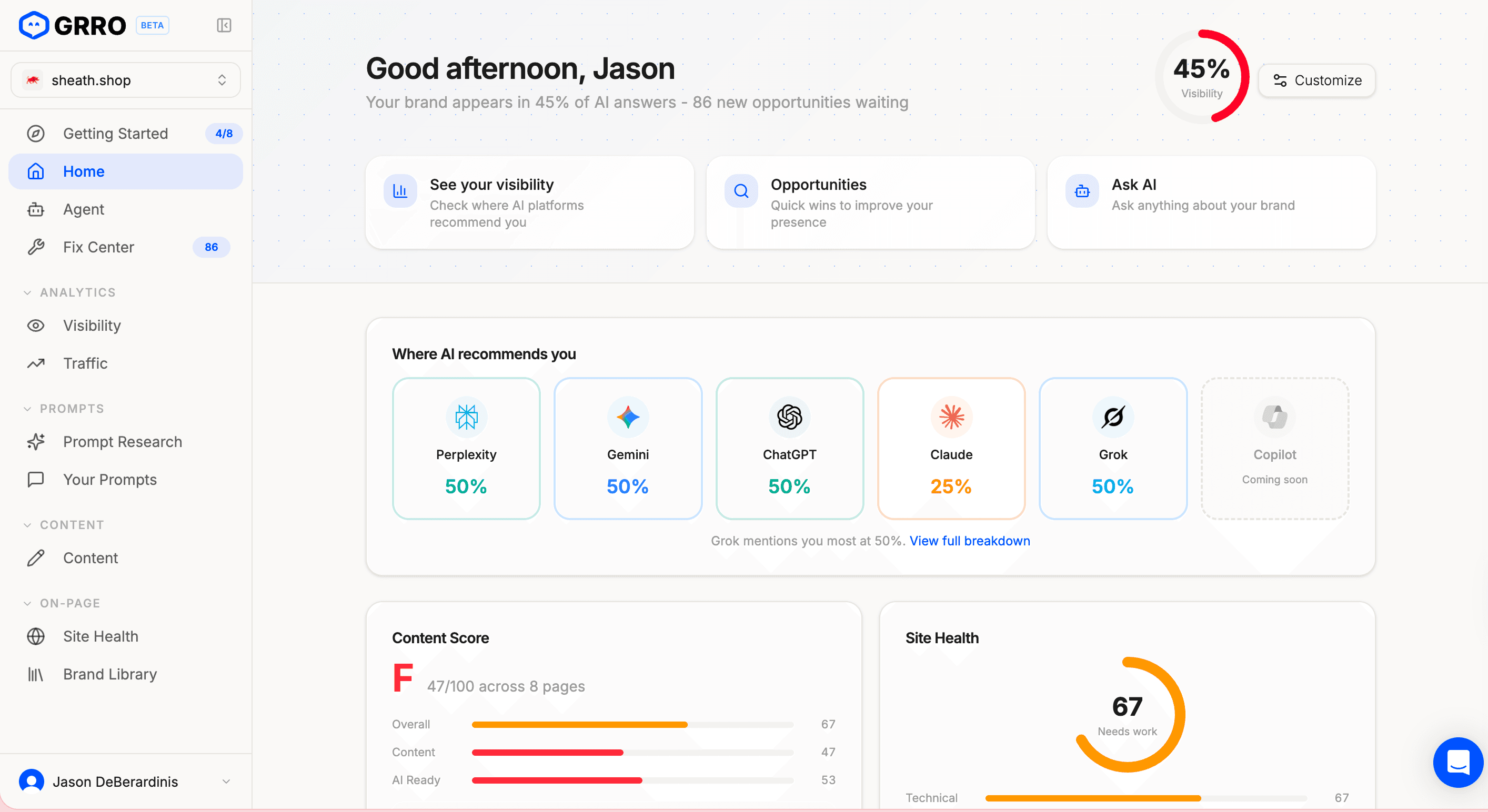
Start with a free AI visibility scan at GRRO. This tests your brand against all five major AI engines and gives you an AI Recommendation Score that tells you how often and how prominently your brand appears in AI-generated answers.
Manual Testing
Supplement automated scanning with manual queries. Open ChatGPT, Perplexity, and Gemini. Ask 15 to 20 questions that your ideal customers would ask. Document:
- Which queries return your brand as a recommendation
- Which queries return competitors instead
- Which queries return no relevant brand recommendation
- The exact wording AI engines use when mentioning (or not mentioning) your brand
Identify Priority Pages
Based on your audit, identify the 10 to 20 pages most critical for AI visibility. These are typically:
- Your homepage
- Your main product or service pages
- Your top blog posts by traffic
- Your comparison and "best of" pages
- Your about page and team pages
These priority pages will be the focus of your optimization work. For a detailed audit methodology, read our guide on how to audit your AI search visibility.
Step 2: Restructure Your Content for AI Extraction
Content structure is the single highest-leverage optimization for AI search. AI engines use Retrieval-Augmented Generation (RAG) pipelines that chunk your content into 200 to 500 word segments and evaluate each segment independently. The structure of each segment determines whether it gets selected.
Lead with Direct Answers
Every section of every page should begin with a direct answer to the question implied by its heading. AI engines extract from the first 40 to 60 words of relevant sections. If your answer is in paragraph three, the AI will find it from a competitor who puts it in sentence one.
Before optimization:
"Project management has evolved significantly over the past decade. With remote work becoming the norm and teams distributed across time zones, the tools we use to manage projects have had to adapt. Many businesses struggle to find the right fit for their specific needs, and the sheer number of options available can make the decision overwhelming."
After optimization:
"The best project management tools for remote teams in 2026 are Asana, Monday.com, and ClickUp. Asana leads for workflow automation, Monday.com for visual project tracking, and ClickUp for all-in-one functionality. Here is how to choose the right one for your team."
The optimized version gives the AI a clean, extractable answer in the first two sentences. The rest of the section can provide the depth and nuance that human readers want.
Use Question-Format Headings
Structure your H2 and H3 headings as questions that match how users query AI engines. This directly matches the queries AI engines process and increases the probability of your content being selected.
| Weak Heading | Strong AI-Optimized Heading |
|---|---|
| Our Features | What Features Should You Look for in a CRM? |
| Pricing | How Much Does CRM Software Cost in 2026? |
| Benefits | Why Do Small Businesses Need a CRM? |
| Getting Started | How Do You Set Up a CRM for Your Business? |
Include Comparison Tables
AI engines frequently cite table content for comparison queries. When a user asks "How does X compare to Y?" tables are the most likely format to be extracted. Include comparison tables on any page where you discuss multiple options, features, or approaches.
Add FAQ Sections
Every important page should include an FAQ section with 5 to 7 questions and concise answers. Each answer should be 40 to 80 words, self-contained, and directly responsive to the question. FAQ sections serve double duty: they provide extractable answer passages for AI engines and they can be marked up with FAQ schema for additional visibility.
GRRO's content studio scores each page for AI readiness and highlights specific structural improvements. For detailed formatting guidance, see our guide on the content structure AI engines love.
Step 3: Implement Schema Markup
Schema markup tells AI engines what your content is about and how to categorize it. Pages with proper schema are significantly more likely to be cited in AI-generated answers.
Organization Schema
Add Organization schema to your homepage. This should include:
{
  "@context": "https://schema.org",
  "@type": "Organization",
  "name": "Your Company Name",
  "url": "https://yoursite.com",
  "logo": "https://yoursite.com/logo.png",
  "description": "Your company description",
  "foundingDate": "2020",
  "founders": [
    {
      "@type": "Person",
      "name": "Founder Name"
    }
  ],
  "sameAs": [
    "https://linkedin.com/company/yourcompany",
    "https://twitter.com/yourcompany"
  ]
}
>
> Organization schema establishes your brand as a known entity, which is a prerequisite for AI recommendation.
>
> ### Article Schema
>
> Every blog post and content page should have Article schema with:
>
> - Headline
> - Author (linked to a Person schema)
> - datePublished and dateModified
> - Publisher
> - Description
> - Image
>
> The dateModified field is particularly important because AI engines use it to assess content freshness.
>
> ### FAQ Schema
>
> Implement FAQ schema on every page that has an FAQ section. This explicitly signals to AI engines that your page contains question-answer pairs.
>
> ```json
> {
>   "@context": "https://schema.org",
>   "@type": "FAQPage",
>   "mainEntity": [
>     {
>       "@type": "Question",
>       "name": "What is the best CRM for small businesses?",
>       "acceptedAnswer": {
>         "@type": "Answer",
>         "text": "The best CRM for small businesses is..."
>       }
>     }
>   ]
> }

### Product and Review Schema

For e-commerce and SaaS businesses, Product and Review schema help AI engines understand your offerings and the social proof behind them.

For a comprehensive schema implementation guide, see our post on [schema markup for AI search visibility](/blog/schema-markup-ai-search-visibility).

## Step 4: Optimize Technical Foundations

AI search optimization builds on the same technical foundations as traditional SEO. GRRO's [technical optimization tools](/features/technical-optimization) can audit your site's AI readiness and identify the highest-priority fixes. If your site's technical health is poor, no amount of content optimization will compensate.

### Page Speed

AI engines use search engine results as their starting retrieval pool. Pages that load slowly rank poorly in traditional search, which means they are less likely to be in the initial pool of pages AI engines evaluate. Target a Largest Contentful Paint (LCP) under 2.5 seconds and a Cumulative Layout Shift (CLS) under 0.1.

### Mobile Optimization

Over 60% of AI search queries originate from mobile devices. Your pages must render correctly on mobile with readable text, accessible navigation, and no horizontal scrolling.

### XML Sitemap

Maintain a current XML sitemap and submit it to Google Search Console and Bing Webmaster Tools. Both Google and Bing feed their indexes into AI engines (Gemini uses Google; ChatGPT use Bing). A clean sitemap ensures your pages are indexed quickly.

### Robots.txt and AI Crawlers

Be aware that AI engines send their own crawlers to index content. Ensure your robots.txt file does not block AI crawlers unless you have a specific reason to do so. Key crawlers to allow:

- **GPTBot** (OpenAI/ChatGPT)
- **PerplexityBot** (Perplexity)
- **Google-Extended** (Gemini)
- **ClaudeBot** (Anthropic/Claude)
- **Applebot-Extended** (Apple AI features)

### Clean HTML Structure

AI engines parse your HTML to understand content hierarchy. Ensure:

- Headings follow a logical H1 > H2 > H3 hierarchy
- Content is in semantic HTML elements (article, section, nav)
- No critical content is hidden behind JavaScript that crawlers cannot render
- Alt text is present on all images

### HTTPS

All pages should be served over HTTPS. Non-secure pages receive ranking penalties in traditional search and reduced trust signals from AI engines.

## Step 5: Build Multi-Source Presence

On-site optimization is only half the equation. AI engines cross-reference your brand across the internet before deciding whether to recommend you. A brand that exists only on its own website lacks the independent validation AI engines need to trust a recommendation.

Brands mentioned on 5 or more independent sources are 7.2x more likely to be recommended by AI engines than brands mentioned only on their own website. Here is where to build presence.

### LinkedIn

LinkedIn is a high-trust source for all AI engines, particularly for B2B queries.

- Maintain a complete, active company page with regular posts
- Ensure executive profiles are current and publishing thought leadership
- Engage in industry-relevant LinkedIn groups
- Publish LinkedIn articles that reference your brand expertise

### Reddit

Reddit is one of the most-cited sources in AI-generated answers, particularly for Perplexity and ChatGPT.

- Participate genuinely in subreddits relevant to your industry
- Answer questions with depth and expertise (not self-promotion)
- Build karma and post history over time
- Only reference your brand when it is genuinely relevant to the discussion

### Industry Publications

Guest articles, expert commentary, and earned media mentions in industry publications build the editorial authority that AI engines weight heavily.

- Contribute guest posts to respected publications in your field
- Respond to journalist queries through platforms like HARO, Qwoted, and Connectively
- Seek speaking opportunities that generate press coverage
- Build relationships with industry analysts and reporters

### Wikipedia

Wikipedia mentions increase AI recommendation probability by 3.4x. However, Wikipedia has strict notability and sourcing requirements.

- Only pursue Wikipedia presence if your brand meets notability criteria
- Never edit your own Wikipedia page (this violates Wikipedia policy)
- Focus on meeting notability through press coverage and third-party sources
- Let the Wikipedia community create your page based on published sources

### YouTube

Video content reinforces your expertise across a different medium. YouTube is indexed by Google (and therefore Gemini) and is increasingly referenced by other AI engines.

- Create educational video content in your area of expertise
- Optimize video titles and descriptions with relevant keywords
- Include transcripts to make video content indexable

### X/Twitter

X is the primary data source for Grok and influences other engines for real-time topics.

- Maintain an active X presence with regular posting
- Engage with industry conversations
- Share expertise and original insights
- Use relevant hashtags for discoverability

For a comprehensive strategy on building authority signals, read our guide on [building authority signals for AI recommendations](/blog/building-authority-signals-ai-recommendations).

## Step 6: Create AI-Targeted Content

Beyond optimizing existing pages, create new content specifically designed to capture AI search queries.

### Target Question-Based Queries

AI users ask questions in natural language. Build content around the specific questions your customers ask:

- "What is the best [your category] for [specific use case]?"
- "How do I choose a [your product type]?"
- "[Your brand] vs. [Competitor]: Which is better?"
- "What does [industry term] mean?"
- "How much does [your product type] cost?"

### Create Comprehensive Guides

Long-form guides (2,000 to 3,500 words) that cover a topic thoroughly perform best for AI citations. Each guide should:

- Answer the primary question in the first paragraph
- Break the topic into logical H2 sections
- Include data, statistics, and specific recommendations
- End with an FAQ section
- Link to related content on your site

### Build Comparison Content

Comparison content is disproportionately cited by AI engines because it directly matches comparison queries. Create pages that compare:

- Your product vs. competitors
- Different approaches to solving a problem
- Options within your product category
- Tools, platforms, or services in your space

### Maintain a Content Calendar

Freshness matters. Content updated within 90 days is 3.6x more likely to be cited by AI engines. Establish a regular cadence:

- Publish new content 2 to 4 times per month
- Update your top 10 pages quarterly
- Refresh statistics and data points as new information becomes available
- Remove or update outdated content that could trigger accuracy concerns

## Step 7: Monitor and Iterate

AI search optimization is not a one-time project. It is an ongoing process that requires continuous monitoring and adjustment.

### Track Your AI Recommendation Score

Your AI Recommendation Score measures how frequently your brand appears in AI-generated answers across all major engines. Track this weekly. The [GRRO platform](https://grro.io) provides continuous monitoring with score trends, engine-specific breakdowns, and competitive benchmarks.

Learn how this metric works in our guide on [AI Recommendation Score explained](/blog/ai-recommendation-score-explained).

### Monitor Engine-Specific Visibility

Your visibility will differ across engines. You might appear in 30% of Perplexity answers but only 8% of ChatGPT answers. Engine-specific monitoring reveals where to focus your next optimization efforts.

### Track Competitor Movements

Monitor which competitors are appearing in AI answers for your target queries. When a competitor starts showing up, analyze what they are doing differently and adjust your strategy.

### Measure AI Referral Traffic

Set up tracking to identify traffic arriving from AI engines. Use UTM parameters and referral analysis to measure:

- Volume of AI referral traffic
- Conversion rate from AI referrals
- Revenue attributed to AI search
- Which pages receive the most AI referral traffic

### Iterate Based on Data

Use your monitoring data to prioritize next steps:

- Pages that are close to recommendation thresholds get optimized first
- Engines where you have low visibility get targeted content and presence building
- Queries where competitors dominate get dedicated content responses
- Content that is performing well gets expanded and updated

## Optimization Checklist

Use this checklist to track your progress across all optimization areas.

### Content Structure
- [ ] Top 20 pages lead with direct answers in first 40 to 60 words
- [ ] All H2 headings on key pages use question format
- [ ] Comparison tables included on relevant pages
- [ ] FAQ sections added to all important pages
- [ ] Content updated within the last 90 days

### Technical Setup
- [ ] Page speed under 2.5s LCP
- [ ] Mobile-optimized layout
- [ ] Current XML sitemap submitted to Google and Bing
- [ ] AI crawlers allowed in robots.txt
- [ ] Clean heading hierarchy (H1 > H2 > H3)
- [ ] HTTPS on all pages

### Schema Markup
- [ ] Organization schema on homepage
- [ ] Article schema on all blog posts
- [ ] FAQ schema on pages with FAQ sections
- [ ] Product schema on commercial pages
- [ ] Schema validated with Rich Results Test

### Multi-Source Presence
- [ ] LinkedIn company page active and current
- [ ] Executive LinkedIn profiles publishing regularly
- [ ] Reddit presence in relevant communities
- [ ] Guest articles in industry publications
- [ ] YouTube channel with educational content
- [ ] Active X/Twitter presence

### Monitoring
- [ ] AI Recommendation Score tracked weekly
- [ ] Engine-specific visibility monitored
- [ ] Competitor movements tracked
- [ ] AI referral traffic measured
- [ ] Quarterly content refresh scheduled

## Common Mistakes to Avoid

### Optimizing Only Your Website

The most common mistake is treating AI search optimization as a purely on-site effort. Multi-source presence is equally important. A perfectly optimized website with no external mentions will struggle to earn AI recommendations.

### Ignoring Content Freshness

Content published 18 months ago with no updates signals staleness to AI engines. Even evergreen content needs regular refreshes with updated timestamps, current statistics, and new sections addressing recent developments.

### Blocking AI Crawlers

Some businesses block AI crawlers in robots.txt, either intentionally or accidentally. This prevents your content from being indexed by AI engines. Unless you have a specific reason to block AI access, ensure GPTBot, PerplexityBot, and other AI crawlers can access your site.

### Stuffing Keywords Instead of Answering Questions

AI engines evaluate whether your content genuinely answers a question, not whether it contains a keyword a certain number of times. Focus on providing clear, authoritative answers rather than optimizing keyword density.

### Treating All AI Engines Identically

Each AI engine has different source preferences, freshness windows, and evaluation criteria. ChatGPT uses Bing. Gemini uses Google. Perplexity uses Brave. Grok prioritizes real-time social content. A tailored approach outperforms a generic one.

## FAQ

### How long does it take to optimize a website for AI search?

The initial optimization of content structure, schema markup, and technical foundations typically takes 4 to 6 weeks for a site with 20 to 50 key pages. Building multi-source presence takes 3 to 6 months. Full competitive positioning, where your brand consistently appears in AI recommendations for your core queries, usually takes 6 to 12 months of sustained effort.

### Can I optimize for AI search without changing my existing content?

Partially. Adding schema markup and fixing technical issues can be done without changing visible content. However, the highest-impact optimization is restructuring content to lead with direct answers, which does require editing your existing pages. The changes improve readability for human visitors as well, so there is no trade-off.

### Do I need to optimize for all five AI engines?

Ideally, yes. But if you need to prioritize, focus on ChatGPT (52% market share), Gemini (24%), and Perplexity (12%) first. These three engines handle approximately 88% of AI search queries. Expand to Grok, and Claude as your strategy matures.

### Will AI search optimization hurt my Google rankings?

No. The optimizations that improve AI visibility (direct answers, clear headings, FAQ schema, structured data, fresh content) also improve traditional Google rankings. Google has consistently rewarded content that directly answers user questions. The two strategies are complementary.

### How much does AI search optimization cost?

The cost depends on your current state. If your site has strong SEO fundamentals, the incremental investment is primarily content restructuring and monitoring. If you are starting from scratch, expect to invest in technical fixes, content rewriting, schema implementation, and ongoing monitoring. [GRRO](https://grro.io) offers a free initial scan, and monitoring plans scale with your needs.

### What is the ROI of AI search optimization?

AI referral traffic converts at 4.4x the rate of traditional organic search. The cost per acquisition from AI referrals is 38% lower than paid search. With 97% of businesses having no strategy, early movers see disproportionate returns. See our full analysis of [measuring ROI from AI search visibility](/blog/measuring-roi-ai-search-visibility).

### Should I hire someone or do this in-house?

That depends on your team's capacity and expertise. The content restructuring and schema implementation can be done by most marketing teams with guidance. Multi-source presence building requires ongoing effort. Monitoring requires specialized tools. Many businesses start with a [free GRRO scan](https://grro.io) to understand their baseline and then decide whether the scope of work warrants outside help.

## Conclusion

Optimizing your website for AI search is a seven-step process: audit your current visibility, restructure content for AI extraction, implement schema markup, optimize technical foundations, build multi-source presence, create AI-targeted content, and monitor continuously.

The window of opportunity is defined by two numbers: 800 million weekly AI queries and a 97% visibility gap. AI search is already the fastest-growing and highest-converting discovery channel available, and almost no one is competing for it.

Every step in this guide is actionable today. You do not need to complete all seven steps before seeing results. Start with the highest-impact changes: restructure your top 10 pages to lead with direct answers, add FAQ schema, and ensure AI crawlers can access your site. These changes alone can meaningfully improve your AI visibility within weeks.

Begin by measuring where you stand with a [free scan at GRRO](https://grro.io). Your AI Recommendation Score is the starting point for every optimization decision that follows.

Co-Founder & CMO at GRRO