The Rise of Zero-Click AI Search: What It Means for Your Brand
Zero-click AI search delivers complete answers without sending users to your website. Learn how this shift changes brand strategy, why brand mentions matter more than clicks, and how to turn zero-click visibility into business results.

Key Takeaways
- Zero-click AI search means the user gets a complete answer directly from the AI engine and never visits a source website, and this is now the default behavior for most AI queries
- Approximately 60% to 70% of AI search interactions end without a click to any external website, compared to roughly 50% for traditional Google searches
- The shift from clicks to mentions fundamentally changes how brands should measure visibility and attribute value
- Brand mentions in AI answers drive discovery, trust, and downstream conversions even without a direct click
- Businesses that optimize for zero-click visibility are capturing a growing share of the 800M+ weekly AI queries
- The brands winning in zero-click AI search are those that focus on being the recommended answer rather than the clicked link
What Is Zero-Click AI Search?
Zero-click AI search occurs when a user asks an AI engine a question and receives a complete, satisfying answer without clicking through to any source website. The AI synthesizes information from multiple sources, delivers the answer in natural language, and the user moves on.
This is not a failure state. It is the intended design of AI search. ChatGPT, Perplexity, Gemini, Claude, and Grok are all built to answer questions directly. They do not exist to generate traffic for websites. They exist to deliver the best possible answer in the conversation.
For brands, this creates a fundamental strategic question: if 60% to 70% of AI interactions never generate a click, is AI search visibility still valuable?
The answer is yes, but only if you rethink what "valuable" means. The brands that treat AI search as a traffic source will be disappointed. The brands that treat it as a recommendation engine will find it is one of the most powerful discovery and trust channels available.
How Zero-Click Works in AI Search
Understanding the mechanics of zero-click AI search reveals why it behaves differently from traditional zero-click in Google.
The AI Answer Cycle
When a user asks "What is the best project management tool for remote teams?" the AI engine follows this sequence:
- Query interpretation. The AI determines the intent, the context, and the type of answer required.
- Source retrieval. The AI searches the web through its search partner (Bing for ChatGPT, Brave for Perplexity, Google for Gemini) and retrieves 10 to 20 relevant URLs.
- Content chunking. Each retrieved page is broken into segments of 200 to 500 words. Each segment is evaluated independently.
- Re-ranking. An AI model scores each chunk for relevance, authority, and answer quality.
- Answer synthesis. The language model generates a natural language answer using the top-scoring chunks, including specific recommendations and (sometimes) citations.
- The user reads the answer. In most cases, the answer is sufficient. The user does not click through to any source.
For the technical deep dive on this pipeline, see our explanation of how AI search engines decide what to recommend.
Why Users Do Not Click
Users do not click through from AI answers for three primary reasons:
- The answer is complete. AI engines synthesize information from multiple sources into a single coherent response. The user gets the answer without needing to visit any individual source.
- The interface does not encourage clicking. Unlike Google's search results page, which is a list of links, AI chat interfaces present answers as conversation. Citations are secondary, sometimes buried, and clicking requires active effort.
- Trust in the AI. Users increasingly trust the AI's synthesis. If ChatGPT says "Asana is the best project management tool for remote teams because of X, Y, and Z," many users accept that recommendation without verifying it at the source.
Zero-Click Rates by AI Engine
The zero-click rate varies by platform and query type:
| AI Engine | Estimated Zero-Click Rate | Citation Behavior |
|---|---|---|
| ChatGPT | 65% to 75% | Inline citations, but users rarely click |
| Perplexity | 50% to 60% | Prominent source citations, highest click-through of any AI engine |
| Gemini | 70% to 80% | Citations often collapsed or secondary |
| Grok | 75% to 85% | Minimal citation, real-time synthesis |
| Claude | 80% to 90% | No web search in most interactions |
| 60% to 70% | Bing-powered citations, moderate click-through |
Perplexity is the exception. Its interface is designed around source attribution, making it the AI engine most likely to drive click-through traffic. For brands with limited resources, optimizing for Perplexity's citation-heavy format can provide both zero-click visibility and actual referral traffic. See our guide on how to appear in Perplexity search.
The Impact on Traffic and Attribution
Zero-click AI search disrupts the traditional traffic-based model for measuring marketing success. If most AI interactions do not generate clicks, then traffic-based metrics undercount the value of AI visibility.
What the Data Shows
Studies from 2025 and early 2026 reveal a consistent pattern:
- AI-referred traffic converts at 4.4x the rate of organic search traffic. The users who do click through from AI recommendations are significantly further along in the buying process.
- Brands mentioned in AI answers see 15% to 25% increases in direct and branded search traffic within 30 to 60 days, even when the AI interaction itself generated no click.
- The "halo effect" of AI recommendation drives increased trust across all channels. When ChatGPT recommends a brand, users are more likely to trust that brand when they encounter it on Google, social media, or through advertising.
The Attribution Challenge
Traditional web analytics cannot track zero-click AI visibility. Google Analytics sees nothing when a user reads your brand name in a ChatGPT response and later Googles your brand directly. The AI interaction is invisible in your analytics, but the downstream branded search is very real.
This creates a measurement gap that misleads marketers into undervaluing AI search. The brands that solve this attribution challenge are the ones that can justify continued investment in AI visibility.
How to bridge the gap:
- Track branded search volume trends. Increases in branded search often correlate with increased AI visibility.
- Monitor direct traffic patterns. Users who discover you through AI often visit your site directly.
- Use GRRO's AI Recommendation Score to quantify your AI visibility independently of traffic metrics.
- Ask customers. Add "How did you hear about us?" to your forms and include "AI assistant / ChatGPT / Perplexity" as options.
Brand Mentions vs. Clicks: The New Value Equation
In zero-click AI search, the brand mention is the unit of value, not the click. This requires a fundamental shift in how businesses think about search visibility.
Why Mentions Matter
A brand mention in an AI answer functions like a personal recommendation from a trusted advisor. When a user asks "What CRM should I use?" and ChatGPT says "HubSpot is a strong choice for small businesses because of its free tier and ease of use," that mention carries significant weight regardless of whether the user clicks through to HubSpot's website.
The mention creates:
- Brand awareness. The user now knows your brand exists in the context of their specific need.
- Positioning. The AI has positioned your brand relative to the user's requirements.
- Trust transfer. The user's trust in the AI extends to the recommended brand.
- Memory. The user stores your brand in their consideration set for when they are ready to act.
Measuring Mention Value
Quantifying the value of an AI brand mention is evolving, but several frameworks are emerging:
| Metric | Description | Why It Matters |
|---|---|---|
| Mention Reach | Estimated number of users who saw the mention | Volume of exposure |
| Mention Sentiment | Was the recommendation positive, neutral, or negative? | Quality of exposure |
| Mention Position | Was your brand the primary recommendation or an alternative? | Strength of recommendation |
| Mention Context | What query triggered the mention? | Intent alignment |
| Downstream Conversion | Did branded search or direct visits increase? | Business impact |
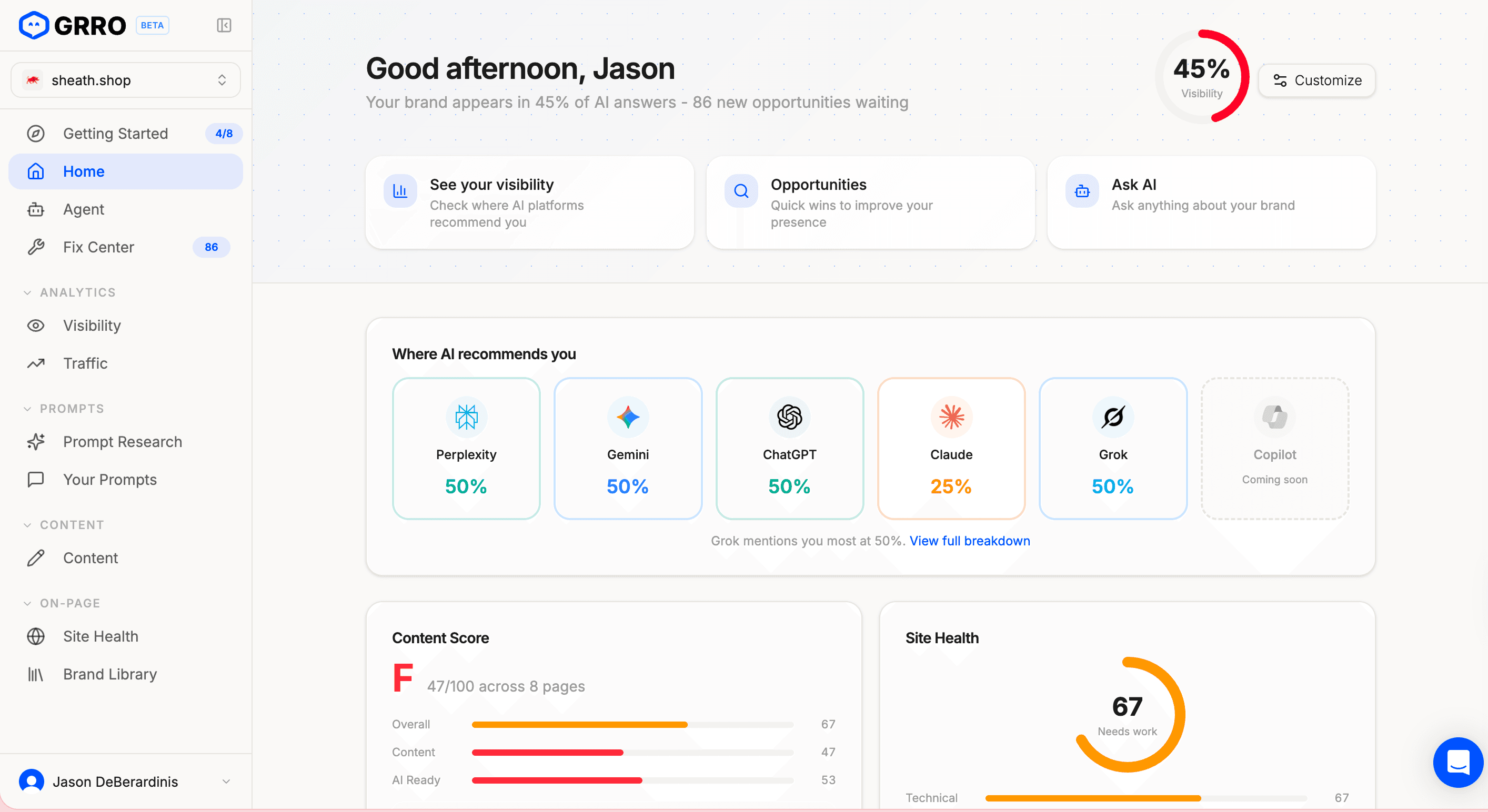
GRRO's search visibility tracking monitors all of these metrics across five AI engines, providing a comprehensive view of your zero-click AI visibility.
The Strategy Shift: From Traffic Optimization to Recommendation Optimization
Zero-click AI search demands a different strategic approach than traffic-driven SEO. Here are the key shifts.
Shift 1: Optimize for Extraction, Not Clicks
In traditional SEO, content is designed to earn a click from the search results page. Headlines are crafted to intrigue. Meta descriptions tease the answer. The goal is to get the user to your website.
In AI search, the goal is to have your content extracted and used in the AI's answer. This means leading with direct, complete answers that AI engines can pull from your content. It means structuring information so that individual sections are independently meaningful. And it means including the specific facts, numbers, and comparisons that AI engines need to build recommendations.
For the full content optimization framework, see our guide on content structure AI engines love.
Shift 2: Build Entity Recognition
In a zero-click environment, AI engines need to know who you are before they can recommend you. Entity recognition means the AI's language model has a representation of your brand, your expertise, and your market position.
Entity recognition is built through multi-source presence, consistent branding across platforms, Wikipedia mentions, and structured data (Organization schema) on your website. The stronger your entity recognition, the more likely AI engines are to include your brand by name in their answers.
Shift 3: Invest in Authority, Not Just Content
In a click-based model, more content means more ranking opportunities. In a zero-click model, content quality and authority matter more than volume. AI engines recommend the most authoritative voice on a topic, not the brand that published the most articles about it.
Invest in original research, expert perspectives, unique data, and genuine thought leadership. These authority signals are what separate brands that get recommended from brands that get cited as "sources" but never named.
Shift 4: Track Recommendations, Not Rankings
Traditional SEO tracks keyword rankings. AI search optimization tracks recommendation frequency. The metric that matters is not "Where do we rank for [keyword]?" but "How often is our brand recommended when users ask about [topic]?"
This shift in measurement drives a shift in strategy. Instead of optimizing for hundreds of keywords, focus on the 20 to 50 core queries that drive the most business value and ensure your brand is the recommended answer for each one.
Industries Most Affected by Zero-Click AI Search
Zero-click impacts every industry, but the magnitude varies.
High Impact: Informational and Advisory
Industries where users seek advice, recommendations, and explanations are most affected. This includes professional services, consulting, financial advisory, healthcare information, legal guidance, and technology consulting. In these categories, the AI answer often fully satisfies the user's need.
Moderate Impact: E-commerce and SaaS
Product and software recommendation queries still generate some click-through because users need to visit the website to purchase or sign up. However, the AI answer increasingly determines which 2 to 3 brands the user will even consider visiting. Zero-click narrows the consideration set before a click ever happens.
Lower Impact (For Now): Transactional
Pure transactional queries ("buy [product name]") still drive direct navigation. But the queries that precede the transaction ("What [product] should I buy?" "Is [product] worth it?") are increasingly answered in zero-click environments.
What This Means for Paid Advertising
Zero-click AI search has significant implications for paid advertising, which we cover in detail in our analysis of how AI search will impact paid advertising. The short version: as more users get their answers from AI engines rather than search results pages, the effectiveness of search ads decreases for discovery queries. Brands need to invest in being the organic recommendation rather than the paid placement.
How to Win in a Zero-Click World
Winning in zero-click AI search requires executing on several fronts simultaneously.
1. Make Your Brand the Default Answer
For your core topics, your brand should be the first and most authoritative name an AI engine considers. This requires comprehensive content, strong E-E-A-T signals, multi-source presence, and consistent positioning across every platform AI engines index.
2. Structure Content for AI Extraction
Every piece of content should be written so that AI engines can extract a complete, useful answer from any individual section. This means answer-first formatting, question-format headings, comparison tables, and FAQ sections with schema markup.
3. Build Multi-Source Validation
Invest in the platforms AI engines cross-reference: Reddit, LinkedIn, review sites, industry publications, and Wikipedia. A brand with multi-source validation earns higher recommendation confidence and appears more frequently in AI answers.
4. Measure What Matters
Replace click-based metrics with recommendation-based metrics. Track your AI Recommendation Score, brand mention frequency, mention sentiment, and downstream branded search volume. Use GRRO's AI search traffic analytics for automated tracking across all five major AI engines.
5. Capture the Clicks That Do Happen
When users do click through from AI answers, make the landing experience exceptional. These users are high-intent and pre-qualified by the AI's recommendation. Conversion-optimized landing pages, clear CTAs, and seamless user experiences turn the smaller click volume into higher conversion rates.
FAQ
Is zero-click AI search bad for businesses?
No, but it requires adaptation. Zero-click AI search changes the mechanism of discovery, not the value of discovery. Being recommended by ChatGPT to a million users who never click through is more valuable than ranking on page two of Google where almost no one clicks. The visibility has shifted format, not disappeared. Brands that adapt their measurement and strategy to this new format are finding AI search to be one of their most valuable channels.
How is zero-click AI search different from Google's zero-click results?
Google's zero-click results (featured snippets, knowledge panels, "People Also Ask") give users partial answers on the search results page but still encourage clicking through for more detail. AI zero-click is more complete. The AI synthesizes information from multiple sources into a comprehensive answer that usually eliminates the need to visit any website. The completeness of AI answers makes the zero-click rate significantly higher.
Can I still get traffic from AI search?
Yes, especially from Perplexity, which has the highest click-through rate among AI engines. And the traffic that AI search does send is exceptionally high-value, converting at 4.4x the rate of traditional organic traffic. The volume is lower, but the quality is significantly higher. Optimize for Perplexity's citation format, include specific data points that prompt users to want more detail, and ensure your landing pages convert the high-intent traffic you do receive.
How do I prove the value of zero-click AI visibility to my leadership?
Correlate AI recommendation data with branded search volume, direct traffic, and customer acquisition surveys. Show that increased AI visibility (measured by GRRO's AI Recommendation Score) correlates with increased branded search and higher conversion rates. Many GRRO customers find that a 10-point increase in their AI Recommendation Score corresponds to a 5% to 15% increase in branded search volume within 60 days.
Will zero-click AI search get worse for businesses over time?
Zero-click rates will likely increase as AI engines improve. However, the value of AI brand mentions will also increase as more users adopt AI search. The total opportunity (mention volume multiplied by mention value) is growing even as click-through rates decline. The businesses that invest in recommendation optimization now are building durable advantages.
Does zero-click AI search affect all query types equally?
No. Informational queries ("How does X work?") have the highest zero-click rates (80%+). Recommendation queries ("What is the best X?") have moderate zero-click rates (60% to 70%) but high brand impact. Transactional queries ("Buy X") still drive clicks because the user needs to complete a purchase. Focus your AI optimization strategy on the recommendation queries that drive the most brand value.
How does GRRO help with zero-click AI visibility?
GRRO is built specifically for the zero-click reality. Instead of tracking clicks, GRRO tracks brand recommendations across all five major AI engines. The platform shows you exactly when, where, and how your brand is mentioned in AI answers, whether users clicked or not. It provides the AI Recommendation Score that replaces click-based metrics as the primary measure of AI search success. Start with a free scan to see your current zero-click AI visibility.
Conclusion
Zero-click AI search is not a trend to watch. It is the current state of AI search behavior. The majority of AI interactions end without a click, and that percentage is growing.
For brands, this means the click is no longer the primary unit of value in AI search. The brand mention is. Being recommended by ChatGPT, Perplexity, or Gemini carries significant brand value regardless of whether users click through. The recommendation drives awareness, trust, consideration, and downstream conversions through channels that traditional analytics cannot always track.
The strategic response is clear: optimize for being the recommended answer, not just the ranked result. Build the authority, content structure, and multi-source presence that make AI engines confident enough to recommend your brand by name.
Start by measuring your current zero-click AI visibility with a free scan at GRRO. Understand where your brand appears, where it is missing, and what it will take to become the default recommendation in your category. The brands that adapt to zero-click AI search now will own the recommendation layer for years to come.

Co-Founder & CMO at GRRO