How AI Search Will Impact Paid Advertising in 2026
AI search is reshaping the paid advertising landscape by reducing ad clicks, shifting brand discovery to AI recommendations, and forcing marketers to rethink budget allocation. Learn what is changing, what still works, and how to adapt your paid strategy.

Key Takeaways
- AI search is reducing the effectiveness of traditional search ads by 15% to 25% for discovery and consideration queries as users get answers from AI engines instead of clicking search results
- Brand discovery is shifting from paid placements to AI recommendations, making organic AI visibility a complement (not replacement) for paid advertising
- Google Ads, Meta Ads, and programmatic display are each affected differently by AI search adoption, with search ads seeing the most disruption
- Cost per acquisition (CPA) on search ads is rising as click volumes decline but competition stays flat, squeezing ROI for traditional paid search
- Smart brands are reallocating 10% to 20% of search ad budgets toward AI visibility strategies that generate organic recommendations
- The brands that combine paid advertising with AI search optimization are outperforming brands that rely on either channel alone
The Advertising Landscape Before and After AI Search
Paid advertising has operated on a stable model for two decades: brands bid on keywords, users search, users see ads, users click, brands pay. The entire model depends on one behavior: users clicking links on a search results page.
AI search disrupts this model at its foundation. When a user asks ChatGPT "What CRM should I use for my small business?" the AI answers the question directly. The user does not see a search results page. There are no ads. There is no click to bid on. The user gets a recommendation, and that recommendation was earned through content quality, authority, and multi-source presence, not through ad spend.
This does not mean paid advertising is dying. It means the relationship between paid and organic is being rewritten, and the brands that understand this shift will have a significant competitive advantage through 2026 and beyond.
How AI Search Reduces Ad Effectiveness
The impact of AI search on paid advertising is measurable across several dimensions.
Declining Search Ad Click Volumes
As users migrate queries from Google Search to AI engines, the pool of searches that generate ad-clickable results shrinks. Current data shows:
| Metric | 2024 | 2025 | 2026 (Projected) |
|---|---|---|---|
| Weekly AI search queries | 150M | 500M | 800M+ |
| % of users trying AI search first | 12% | 28% | 40%+ |
| Google search ad click-through rate | 3.2% | 2.8% | 2.3% (est.) |
| Average CPC increase (YoY) | +8% | +12% | +15% (est.) |
The pattern is clear: as AI search adoption grows, the total addressable market for search ads contracts. Fewer searches happen on ad-supported platforms. The searches that remain become more competitive, driving up costs.
The Query Migration Pattern
Not all queries are migrating to AI search at the same rate. Understanding which queries are shifting helps you prioritize your response.
High migration (moving fast to AI search):
- Research and comparison queries: "What is the best X for Y?"
- How-to and informational queries: "How do I set up email automation?"
- Opinion and recommendation queries: "Is [product] worth it?"
- Explanation queries: "What is the difference between X and Y?"
Moderate migration:
- Local discovery queries: "Best restaurants near me" (Google still dominant due to Maps)
- Product comparison shopping: "X vs Y pricing" (shifting but still Google-heavy)
Low migration (staying on search):
- Navigational queries: "Login to [service]" (users know where they want to go)
- Transactional queries: "Buy [specific product]" (purchase intent keeps users on shopping platforms)
- Urgent local queries: "Emergency plumber near me" (immediate action required)
If your ad budget is concentrated on research, comparison, and informational queries, the impact of AI search is significant and accelerating. If your budget targets transactional and navigational queries, the near-term impact is smaller but still growing.
Rising Cost Per Acquisition
When click volumes decrease but advertiser competition stays constant, the math is straightforward: CPA rises. Businesses across industries are reporting 12% to 20% increases in search ad CPA compared to 2024, with the steepest increases in categories where AI search adoption is highest (technology, professional services, SaaS, and e-commerce).
This CPA inflation is not driven by worse ad creative or landing pages. It is a structural change in the market. The same ad budget buys fewer clicks because fewer people are clicking on search results.
Channel-by-Channel Impact Analysis
AI search does not affect all advertising channels equally.
Google Search Ads
Impact level: High
Google Search Ads face the most direct disruption because they depend on users clicking links on a search results page. Google's own AI Overviews (formerly SGE) are compounding the problem by answering queries directly within Google's interface, pushing organic and paid results further down the page.
Google is responding by integrating ads into AI Overviews and experimenting with conversational ad formats. These are early and their effectiveness is unproven, but they signal Google's awareness of the threat.
What to do:
- Shift budget from broad research keywords to high-intent transactional keywords
- Test Google's AI Overview ad placements as they become available
- Reduce spend on queries where AI search provides complete answers
- Increase investment in branded search terms (users who discover you through AI will search your brand name)
Google Shopping Ads
Impact level: Moderate
Product-specific shopping ads retain value because the user intent is transactional. However, AI engines are increasingly capable of comparing products and making purchase recommendations without the user ever visiting a shopping results page. Perplexity in particular provides detailed product comparisons with pricing that may reduce the need for Shopping ad clicks.
What to do:
- Maintain Shopping ad investment for high-intent, ready-to-buy queries
- Ensure product data feed is comprehensive (this data feeds both Shopping ads and AI engines)
- Invest in product page optimization for AI to capture users before they reach Shopping results
Meta Ads (Facebook and Instagram)
Impact level: Low to Moderate
Meta's advertising ecosystem is less directly affected because it operates on a different model: interruption-based advertising within social feeds rather than search-intent advertising. However, AI search indirectly impacts Meta ads by changing how users discover brands. If a user already received a recommendation from ChatGPT, they may not need the Meta ad that would have introduced them to the brand.
What to do:
- Shift creative toward brand reinforcement (for users who already encountered your brand via AI search) rather than cold discovery
- Use Meta ads to build the social proof and content engagement that strengthens your AI authority signals
- Test whether AI-recommended brands see higher Meta ad conversion rates (early data suggests yes)
LinkedIn Ads
Impact level: Low to Moderate
LinkedIn Ads serve a B2B audience that overlaps significantly with AI search users. The platform itself is valuable for AI visibility because LinkedIn content is indexed by most AI engines. This creates an interesting dynamic: LinkedIn Ads can simultaneously drive direct conversions and build the multi-source authority that improves AI recommendations.
What to do:
- Continue LinkedIn advertising for direct lead generation
- Use Thought Leader Ads to amplify executive content that also serves as AI authority signals
- View LinkedIn ad spend as partially an AI visibility investment
Programmatic Display
Impact level: Low
Programmatic display advertising operates on impression-based models (awareness, retargeting) that are less affected by AI search behavior. Users encounter these ads while browsing content, not while searching for answers.
What to do:
- Maintain programmatic budgets for awareness and retargeting
- Consider increasing retargeting investment to capture users who discover your brand through AI recommendations but have not yet converted
The New Budget Allocation Framework
The question every marketing leader is asking: "How should I reallocate my budget in response to AI search?"
Here is a practical framework:
Assess Your AI Search Exposure
Calculate what percentage of your current ad spend targets queries that are migrating to AI search. For most B2B and SaaS companies, this is 30% to 50% of search ad spend. For e-commerce, it is 20% to 35%.
The Reallocation Model
| Current Allocation | Recommended Shift | New Allocation |
|---|---|---|
| 100% Search Ads | Reduce by 15% to 20% | 80% to 85% Search Ads |
| Freed budget (15% to 20%) | Split between AI visibility and high-intent search | 10% to 15% AI visibility + 5% high-intent search |
The "AI visibility" allocation funds:
- Content creation optimized for AI extraction
- Multi-source presence building (LinkedIn, Reddit, review platforms)
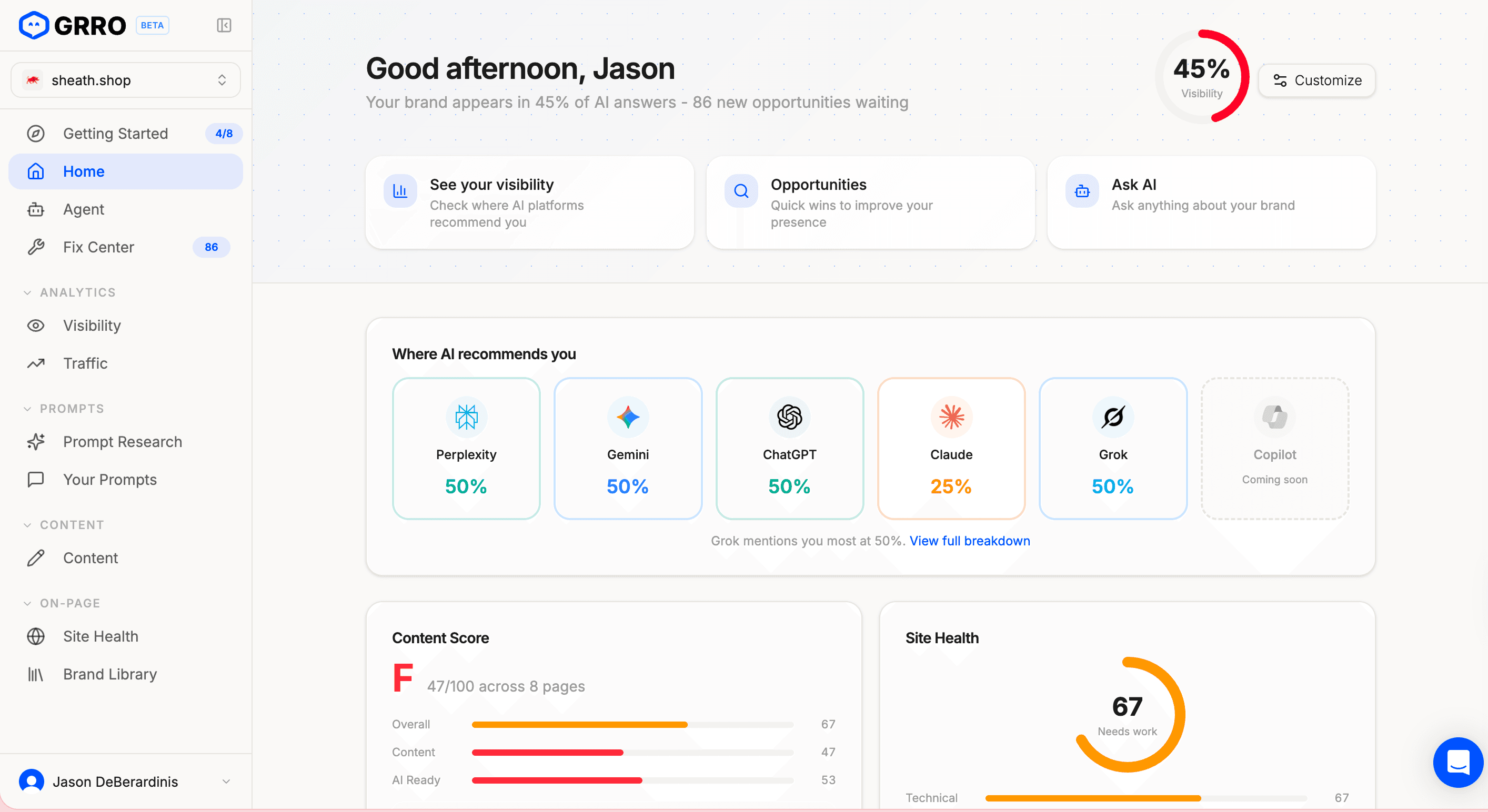
- AI search monitoring through tools like GRRO
- Author and entity authority building
- Schema markup and technical AI optimization
Why Not Cut More?
Search ads still work for high-intent, transactional queries. The users who do search on Google and click ads are increasingly high-intent (the casual browsers have moved to AI). This means search ads may actually become more efficient for conversion-stage targeting even as they become less effective for discovery-stage targeting.
The optimal strategy is not to abandon search ads. It is to reallocate discovery and consideration budget toward AI visibility while concentrating remaining search budget on high-intent conversion queries.
New Advertising Strategies for the AI Search Era
Beyond budget reallocation, AI search creates new strategic approaches to paid advertising.
Strategy 1: Brand Search Capture
When AI engines recommend your brand, users often follow up by searching your brand name on Google. This creates a "brand search surge" that you can capture with branded search ads at a low CPC. Instead of paying to introduce your brand (the expensive part of advertising), AI search does the introduction for free and you pay only to capture the user when they come looking for you.
How to implement:
- Increase branded keyword bids to ensure you own your brand name searches
- Create landing pages optimized for users who "heard about you from AI" with social proof and clear CTAs
- Track branded search volume trends as a proxy for AI visibility impact
Strategy 2: AI-Informed Audience Targeting
Use AI search query data to inform your paid advertising targeting. If GRRO shows that your brand is frequently recommended for "best CRM for remote teams" queries, build paid campaigns that target "remote team" audiences on LinkedIn and Meta with messaging that reinforces the same positioning.
This creates a unified brand experience: the user hears about you from AI, sees your ad on LinkedIn, and encounters a consistent message. The combined impact is greater than either channel alone.
Strategy 3: Content Amplification for AI Authority
Use paid promotion to amplify content that serves dual purposes: direct lead generation and AI authority building. A LinkedIn Thought Leader Ad promoting an expert analysis piece drives traffic and engagement while building the LinkedIn presence signals that AI engines evaluate.
This is not a new concept, but AI search gives it new justification. The ROI calculation for content amplification now includes both the direct conversion value and the long-term AI visibility value.
Strategy 4: Review and Social Proof Investment
Allocate budget toward generating the customer reviews, case studies, and social proof that strengthen your AI recommendation signals. This can take the form of:
- Post-purchase email campaigns requesting reviews on platforms AI engines monitor
- Customer video testimonial campaigns
- Case study development with named clients and specific metrics
- Incentivized review programs (where permitted by platform policies)
This "advertising" does not generate immediate clicks, but it builds the trust infrastructure that AI engines use to decide whether to recommend you.
Measuring the Combined Impact
The biggest challenge in the AI search advertising landscape is measurement. Traditional attribution models do not capture the AI visibility influence on paid advertising performance.
What to Track
| Metric | What It Shows | How to Track |
|---|---|---|
| AI Recommendation Score | Your organic AI visibility | GRRO |
| Branded search volume | AI-driven brand discovery | Google Search Console, Google Ads |
| Branded search CPA | Efficiency of AI-to-search pipeline | Google Ads |
| AI-referred traffic conversion rate | Quality of AI-driven visitors | Google Analytics (UTM tagging from AI sources) |
| Overall blended CPA | Combined efficiency of paid + AI organic | All channels aggregated |
The Correlation to Watch
Track the correlation between your AI Recommendation Score (measured by GRRO) and your branded search volume. Many businesses are discovering that a 10-point improvement in AI Recommendation Score corresponds to a 5% to 15% increase in branded search volume within 30 to 60 days. This relationship quantifies the advertising value of AI visibility.
What Google, Microsoft, and Meta Are Doing
The advertising platforms are not standing still. Each is adapting to the AI search reality.
Google is integrating ads into AI Overviews, testing conversational ad formats, and building AI-powered campaign tools. The company's incentive is to keep ad revenue flowing despite the shift to AI-delivered answers. Expect continued innovation in ad formats that work within AI answer interfaces.
Microsoft
Microsoft owns both Bing (the search partner for ChatGPT) and LinkedIn. This gives it a unique position to offer ad placements that influence AI recommendations. Microsoft's AI advertising strategy is still evolving, but the integration between Bing Ads recommendations is already being tested.
Meta
Meta is investing heavily in its own AI (Meta AI) and integrating AI features across Facebook, Instagram, and WhatsApp. As Meta's AI handles more user queries within its ecosystem, the company will likely develop ad formats that integrate with AI-delivered recommendations.
FAQ
Will AI search kill paid advertising?
No. AI search is restructuring paid advertising, not killing it. Paid advertising remains effective for high-intent transactional queries, retargeting, brand reinforcement, and audiences that have not yet adopted AI search. What is changing is the role of paid ads in the discovery and consideration phases of the buyer journey, where AI recommendations are replacing ad-driven discovery for a growing share of users.
Should I stop running Google Ads?
Absolutely not. Google Ads remain the most effective channel for capturing high-intent, ready-to-buy users. What you should do is evaluate which of your current keywords target queries that are migrating to AI search and reallocate that portion of budget. Keep and potentially increase investment in transactional and branded keywords. Reduce investment in broad research and comparison keywords where AI search provides complete answers.
How much budget should I shift from ads to AI visibility?
Start with 10% to 15% of your search ad budget allocated to AI visibility initiatives. This is enough to fund content optimization, multi-source presence building, and AI monitoring tools like GRRO without significantly impacting your paid channel performance. Adjust based on results: if your AI Recommendation Score improves and branded search volume increases, the reallocation is working and you can expand it.
Can I advertise directly on AI search platforms?
Not yet in any meaningful way. ChatGPT, Perplexity, and most AI engines do not currently offer traditional advertising. Perplexity has experimented with sponsored results, and Google is integrating ads into AI Overviews, but these are early stage. For now, the primary way to "advertise" on AI search is through organic AI optimization, which means making your content authoritative enough to be recommended.
How does AI search affect my customer acquisition cost?
AI search increases customer acquisition cost for search-based discovery (because fewer people are clicking ads for discovery queries) while potentially decreasing overall CAC (because AI recommendations generate high-converting organic traffic). The net effect depends on your AI visibility. Brands with strong AI recommendations see lower blended CAC. Brands invisible to AI see rising CAC as their search ad efficiency declines without an offsetting organic channel.
What metrics should I present to my board about AI search impact on advertising?
Focus on three metrics: (1) Branded search volume trend, showing the correlation between AI visibility and brand discovery. (2) Blended CPA across paid and AI-organic channels, showing overall efficiency. (3) AI Recommendation Score from GRRO, showing your competitive position in AI search. These three metrics tell the story of how AI search is affecting your business and what your strategy is doing about it.
How does GRRO help with advertising strategy?
GRRO provides the AI visibility data that informs your advertising strategy. The platform's prompt intelligence tracks which queries drive AI recommendations for your brand and your competitors, enabling you to identify where organic AI visibility can replace paid spend and where paid investment should increase. GRRO's AI search traffic analytics connect AI visibility to advertising efficiency through attribution data. Start with a free scan to see how AI search is affecting your competitive landscape.
Conclusion
AI search is not replacing paid advertising. It is changing the role paid advertising plays in the marketing mix. Discovery and consideration, which were historically driven by search ads, are increasingly powered by AI recommendations. Conversion and brand capture remain strong use cases for paid advertising, and may become more efficient as AI pre-qualifies users before they reach your ads.
The strategic response is not to panic or to gut your ad budget. It is to recognize the shift and adapt: reallocate discovery budget toward AI visibility, concentrate paid budget on high-intent conversion queries, build the authority signals that earn organic AI recommendations, and measure the combined performance of paid and AI-organic channels.
The brands that adapt fastest will enjoy a period of dual advantage: lower CAC from AI-generated organic recommendations and higher efficiency from concentrated paid advertising. The brands that ignore the shift will face rising CPAs, declining reach, and increasing invisibility to the growing share of users who ask AI for recommendations.
Start by measuring your AI visibility with a free scan at GRRO. Compare your AI Recommendation Score with your advertising metrics. The relationship between the two will tell you exactly how AI search is impacting your paid performance and where your budget should shift.

Co-Founder & CMO at GRRO