How ChatGPT Search Works: A Technical Breakdown for Marketers
ChatGPT search uses a Retrieval-Augmented Generation pipeline powered by Bing to find, evaluate, and synthesize web content into recommendations. Here is exactly how the process works and what it means for your brand's visibility.

Key Takeaways
- ChatGPT search uses a Retrieval-Augmented Generation (RAG) pipeline that queries Bing, retrieves the top web results, chunks and re-ranks the content, then synthesizes a natural language answer with citations
- Bing integration means your traditional search presence directly affects your ChatGPT visibility, but ranking alone is not enough to guarantee a recommendation
- ChatGPT prioritizes content that provides direct answers, demonstrates authority through citations and credentials, maintains freshness, and is confirmed by multiple independent sources
- The model processes content in 200 to 500 word chunks, which means each section of your page must be independently meaningful and answer-complete
- Understanding this pipeline gives marketers a concrete framework for optimizing content that actually gets recommended by ChatGPT
What Happens When Someone Searches ChatGPT
ChatGPT search works by combining the language understanding of a large language model with real-time web retrieval. When a user asks ChatGPT a question that requires current information or specific recommendations, the system does not answer from memory alone. It actively searches the web, retrieves relevant content, evaluates it, and then generates an answer that synthesizes the best information it finds.
This is fundamentally different from how ChatGPT worked before the search feature launched. The original ChatGPT could only draw on its training data, which had a fixed knowledge cutoff. ChatGPT search changed that by adding a live retrieval layer that brings current web content into the conversation.
For marketers, this means ChatGPT search is not a closed system. It is an open system that reads and evaluates your website content in real time. Whether your brand appears in ChatGPT's answers depends on how well your content performs at every stage of the retrieval pipeline.
For a broader comparison of how different AI engines handle this process, see our breakdown of how AI engines decide what to recommend.
The Retrieval Pipeline: Step by Step
ChatGPT search follows a multi-stage pipeline. Each stage filters and refines the information that reaches the final answer. Understanding each stage reveals where your content can win or lose.
Stage 1: Query Understanding
When a user types a question, ChatGPT first interprets the intent. This is more sophisticated than traditional keyword matching. The model understands context, nuance, and implicit intent.
For example, "What is the best CRM for a 10-person sales team?" is understood as a request for a product recommendation with specific constraints (small team, sales-focused). ChatGPT identifies the key entities (CRM software), the intent (recommendation), and the constraints (team size, use case) before sending a search query.
The model often reformulates the user's question into multiple search queries to cover different angles. A single user question might generate two to four separate searches to ensure comprehensive coverage. Tracking these query patterns through prompt intelligence reveals exactly which reformulations drive your brand's visibility.
Stage 2: Bing Web Retrieval
ChatGPT uses Bing as its primary web retrieval engine. When the search triggers, ChatGPT sends its reformulated queries to Bing and retrieves the top results.
This stage is critical for a reason many marketers overlook: if your content does not appear in Bing's top results for the relevant query, it will not enter ChatGPT's retrieval pool at all. ChatGPT can only recommend content it retrieves, and it retrieves content through Bing.
This means your Bing SEO directly affects your ChatGPT visibility. If you have been optimizing exclusively for Google and ignoring Bing, you have a blind spot. Bing considers many of the same ranking factors as Google (backlinks, domain authority, content quality, technical SEO), but there are differences in how it weights them. Bing gives more weight to social signals, tends to favor exact keyword matches more than Google, and processes structured data differently.
The top 10 to 20 Bing results for each reformulated query are retrieved and passed to the next stage.
Stage 3: Content Chunking
The retrieved web pages are not processed as whole documents. ChatGPT breaks each page into chunks of approximately 200 to 500 words. Each chunk is evaluated independently.
This chunking process has profound implications for content structure. A 3,000-word article is not evaluated as a single piece. It is evaluated as 6 to 15 independent segments. Each segment must be coherent and meaningful on its own.
If your best answer is split across two chunks, with the setup in one chunk and the conclusion in another, neither chunk may score well independently. This is why answer-first formatting matters so much. Each section of your content should contain a complete, self-contained answer within its first few sentences. For a complete guide to structuring content for this process, see the content structure AI engines love.
Stage 4: Semantic Re-Ranking
After chunking, ChatGPT uses an internal re-ranking model to score each chunk for relevance to the original question. This is not simple keyword matching. The re-ranking model evaluates semantic similarity, answer quality, and information completeness.
A chunk that contains a direct, well-structured answer to the question scores higher than a chunk that mentions the right keywords but buries the answer in context or qualification. A chunk that includes specific data points, comparisons, or actionable recommendations scores higher than vague generalities.
The re-ranking stage typically selects the top 5 to 10 chunks from across all retrieved pages. These chunks become the context for the final answer generation.
Stage 5: Answer Synthesis
The selected chunks are passed to the large language model as context. ChatGPT then generates a natural language answer that synthesizes the information from the top chunks, attributes sources through citations, and presents a coherent response to the user's question.
During synthesis, the model makes editorial decisions: which sources to cite, which recommendations to highlight, what order to present information, and how much detail to include. These decisions are influenced by the quality and clarity of the source content.
Sources that provide clear, quotable statements are more likely to be cited. Sources that present information in a structured, extractable format are more likely to influence the answer. Sources that agree with the consensus across other retrieved chunks are treated as more reliable.
Stage 6: Citation and Display
The final answer includes inline citations that link back to the original source URLs. Users can click these citations to visit the source directly. This is both a traffic opportunity and a trust signal. Being cited (not just informing the answer but getting an explicit citation link) is the highest-value outcome in ChatGPT search.
What Content Gets Prioritized
Understanding the pipeline is the foundation. Now let us look at the specific signals that determine which content wins at each stage.
Direct Answers Win the Re-Ranking
The single most impactful thing you can do is lead with direct answers. When ChatGPT's re-ranking model evaluates a chunk, it is looking for the most relevant answer to the user's question. A chunk that opens with "The best CRM for small sales teams is [X] because [reasons]" will outscore a chunk that opens with "Choosing a CRM is an important decision that requires careful consideration of many factors."
The first 40 to 60 words of each section are disproportionately influential. The re-ranking model gives more weight to the opening of a chunk because direct answers typically appear at the beginning of well-structured content.
Authority Signals Cross-Referenced
ChatGPT does not just evaluate a single page. It cross-references information across multiple retrieved pages. If five out of eight retrieved sources mention your brand as a top recommendation, that consensus signal is powerful. If only your own website mentions your brand, the signal is weak.
This is why building authority signals for AI recommendations across multiple platforms matters. Your brand needs to appear in industry publications, LinkedIn thought leadership, Reddit discussions, review sites, and other third-party sources that Bing indexes.
Author credentials also matter. Content written by recognized industry experts, with author bios that the model can cross-reference with other known sources, carries more authority than anonymous or generic content.
Freshness and Recency
ChatGPT search prioritizes current information. When multiple sources provide similar answers, the more recently published or updated source tends to get cited. This is especially true for queries with time-sensitive components ("best tools in 2026," "current pricing for X," "latest updates to Y").
Freshness signals include publication dates, last-modified timestamps, and the presence of current data and references within the content. A page published in 2024 with no updates will lose to a page published or updated in 2026, assuming similar quality.
Structured Data and Schema
While ChatGPT's primary retrieval comes through Bing's web results, structured data influences how content gets indexed and ranked by Bing, which in turn affects retrieval. FAQ schema, HowTo schema, Product schema, and Article schema help Bing understand your content's structure and purpose, which can improve your position in the retrieval pool.
For a comprehensive guide to implementing schema for AI search, see our post on schema markup for AI search visibility.
Content Depth Over Content Length
ChatGPT's re-ranking favors depth over length. A 1,500-word article that thoroughly covers a specific topic with data, examples, and actionable advice will outscore a 5,000-word article that superficially covers a broad topic. The chunking process means the model evaluates individual sections, not total word count.
Each section should go deep on its specific subtopic. Include data points, named examples, step-by-step processes, and specific recommendations. Vague advice like "make sure your content is high quality" scores lower than specific guidance like "include comparison tables with named products and specific pricing data."
How ChatGPT Search Differs from Other AI Engines
ChatGPT is one of five major AI search engines, and each works differently. Understanding the differences helps you prioritize your optimization efforts.
ChatGPT vs. Perplexity
Perplexity uses Brave and Bing for retrieval and provides more citation-heavy answers. Perplexity typically cites 5 to 15 sources per answer compared to ChatGPT's 3 to 8. Perplexity also updates its index faster, reflecting new content within 48 to 72 hours versus ChatGPT's longer refresh window. For a detailed comparison, read our analysis of Perplexity vs. ChatGPT vs. Gemini recommendations.
ChatGPT vs. Gemini
Gemini uses Google's search index rather than Bing. This means your Google SEO performance directly affects your Gemini visibility, while your Bing performance affects your ChatGPT visibility. If your brand ranks well on Google but poorly on Bing, you may be visible in Gemini but invisible in ChatGPT.
ChatGPT vs. Claude
Claude does not currently use the same real-time web search integration as ChatGPT. Claude's search capabilities are more limited, relying on provided context and a smaller retrieval window. This means Claude's recommendations draw more heavily from training data and less from live web content.
ChatGPT vs. Grok
Grok, built by xAI, integrates heavily with X (Twitter) data and prioritizes very recent content. Grok's freshness window is the shortest of any major AI engine, often favoring content from the last 24 hours. If your strategy relies on evergreen content, Grok requires a different approach than ChatGPT.
ChatGPT vs.
Microsoft also uses Bing for retrieval, which means it shares ChatGPT's Bing dependency. However integrates more tightly with Microsoft's ecosystem (Office, Teams, Edge) and tends to favor content that is structured for business and productivity use cases.
Practical Optimization for ChatGPT Search
Here is a concrete optimization framework based on how the pipeline works.
Optimize for Bing, Not Just Google
Ensure your site is submitted to Bing Webmaster Tools. Submit your XML sitemap directly to Bing. Check your Bing rankings for target keywords. If you rank in the top 20 on Google but not on Bing, you have a ChatGPT visibility gap.
Structure Content in Self-Contained Sections
Every H2 and H3 section should contain a complete answer within its first two to three sentences. Assume the AI will read each section independently. Do not rely on context from previous sections. Each 200 to 500 word chunk should make sense on its own.
Lead with Answers, Follow with Context
The answer-first format is not just a style choice. It is a technical requirement. The re-ranking model disproportionately weights the opening of each chunk. Place your direct answer in the first sentence of each section, then provide supporting evidence, examples, and nuance.
Build Multi-Source Authority
ChatGPT cross-references sources. Your brand should appear on your own website, in industry publications, on LinkedIn, in Reddit discussions, on review platforms, and in any other venues that Bing indexes. Each independent mention reinforces your authority. For a strategy framework, see our guide on building authority signals for AI recommendations.
Update Content Regularly
Freshness matters. Review your key pages monthly. Update statistics, add current examples, refresh dates, and remove outdated information. Signal freshness through updated timestamps and schema markup.
Include Specific, Quotable Statements
ChatGPT's synthesis favors content that contains clear, concise statements that can be quoted or paraphrased. Write sentences that stand on their own as complete answers. "The average CAC for SaaS companies in 2026 is $205" is more quotable than "customer acquisition costs vary widely depending on industry and approach."
Use Tables and Structured Comparisons
When covering comparisons, use HTML or Markdown tables. The chunking and re-ranking process treats structured data more favorably because it is easier to extract specific information from tables than from narrative paragraphs.
How to Track Your ChatGPT Visibility
Monitoring your ChatGPT visibility requires consistent testing and measurement.
Manual Testing
Test 15 to 20 queries relevant to your business in ChatGPT weekly. Record whether your brand appears, whether you are cited, and what the AI says about you. Track changes over time. This gives you qualitative insight but does not scale.
Automated Monitoring
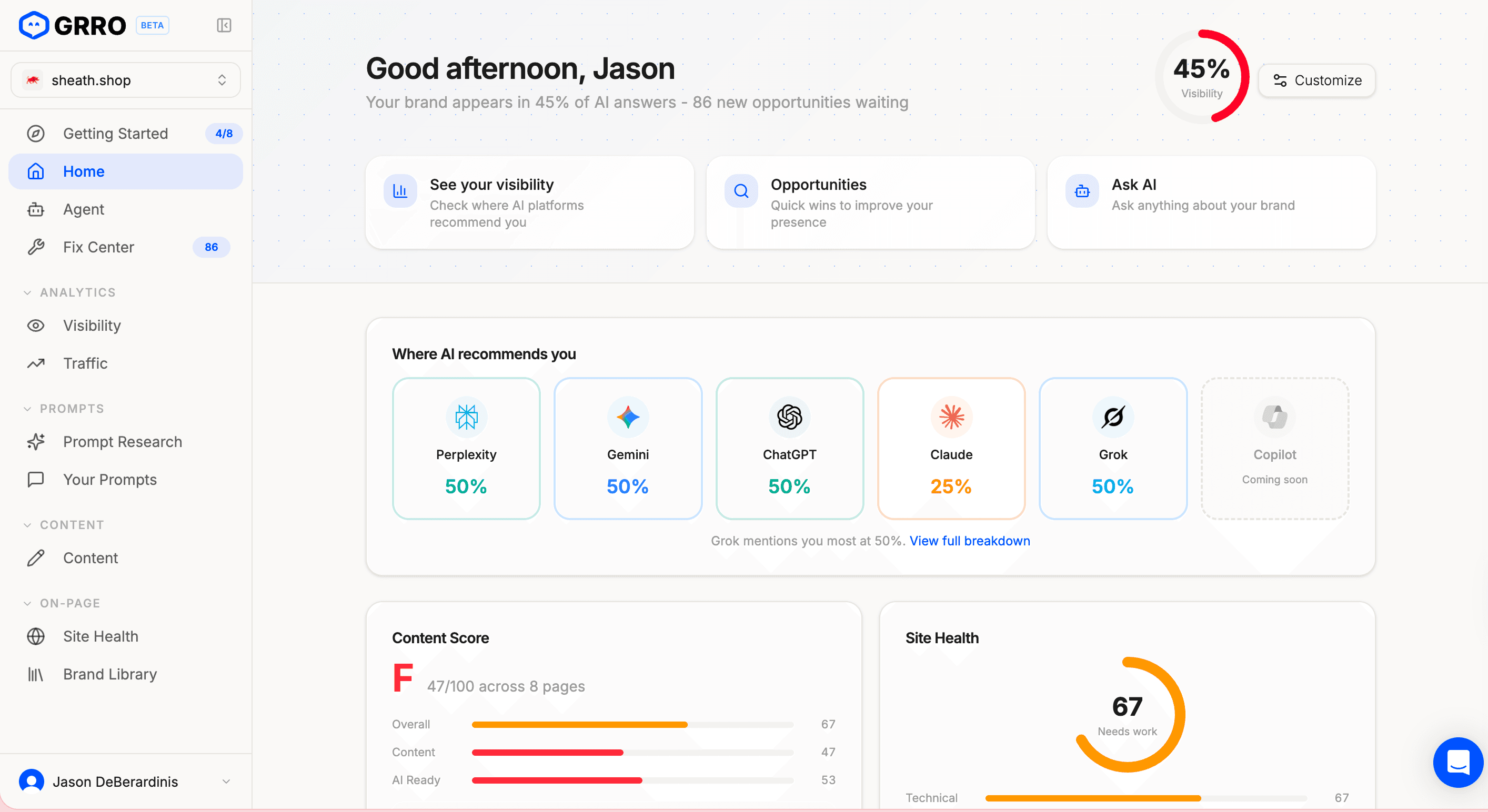
Tools like GRRO automate this process through search visibility tracking across ChatGPT and five other AI engines. Automated monitoring catches changes you would miss with manual testing and provides trend data over weeks and months.
Traffic Attribution
Use your analytics platform to segment traffic from ChatGPT referrals. Look for referral sources from chat.openai.com and chatgpt.com. Track conversion rates from AI referral traffic compared to organic search traffic. AI referral traffic typically converts at 4.4x the rate of traditional search traffic.
FAQ
Does my Google ranking affect my ChatGPT visibility?
Not directly. ChatGPT uses Bing, not Google, for web retrieval. Your Bing ranking is what matters for ChatGPT visibility. However, many of the same factors that help you rank on Google (quality content, backlinks, technical SEO) also help on Bing. If you rank well on Google, you likely rank reasonably on Bing, but there can be significant differences for specific queries. Check your Bing rankings separately.
How quickly does ChatGPT pick up new content?
ChatGPT's retrieval reflects Bing's index, which typically processes new content within days to a few weeks. There is no fixed schedule, and high-authority sites get indexed faster. Perplexity is significantly faster at reflecting new content (48 to 72 hours), while ChatGPT may take 1 to 4 weeks for new pages to appear in its retrieval pool.
Can I optimize for ChatGPT without hurting my Google SEO?
Yes. The optimizations that improve ChatGPT visibility, including answer-first formatting, clear heading structure, FAQ sections, and schema markup, also improve Google rankings. Google has consistently rewarded content that directly answers user queries. There is no conflict between ChatGPT optimization and Google SEO. They are complementary. For a full breakdown of this alignment, see our complete guide to AI search optimization.
Does ChatGPT use social media content in its search results?
Indirectly. ChatGPT retrieves content through Bing, which indexes many social media platforms. LinkedIn posts, Reddit discussions, and X posts that Bing indexes can appear in ChatGPT's retrieval pool. This is one reason multi-source presence matters. Your brand mentions on social platforms can reinforce the authority signals that ChatGPT uses when making recommendations.
How important are backlinks for ChatGPT search visibility?
Backlinks affect ChatGPT visibility indirectly through Bing. Strong backlink profiles help your pages rank higher in Bing, which increases the likelihood of being retrieved by ChatGPT. However, once your content is in the retrieval pool, the re-ranking model evaluates content quality and relevance more heavily than raw backlink counts. Backlinks get you into the pool. Content quality gets you into the answer.
Does ChatGPT favor certain types of content?
ChatGPT tends to favor well-structured informational content, comparison articles, how-to guides, and expert analysis. Product pages with thin content rarely get cited. The model prefers sources that demonstrate expertise through specific data, named examples, and authoritative framing. Content that reads like advertising or promotional material is less likely to be cited than educational content.
How does ChatGPT handle conflicting information from different sources?
When sources disagree, ChatGPT typically follows the majority consensus. If 7 out of 10 retrieved sources agree on a recommendation, that recommendation wins. When the split is closer, ChatGPT may present multiple perspectives or hedge its answer. This is why multi-source authority matters so much. Getting your brand mentioned consistently across many sources creates the consensus signal that drives recommendations.
Conclusion
ChatGPT search works through a multi-stage pipeline: query understanding, Bing retrieval, content chunking, semantic re-ranking, answer synthesis, and citation display. Each stage filters content, and your brand must survive every stage to appear in the final answer.
The practical implications are clear. Optimize for Bing. Structure content in self-contained sections with answers in the first sentences. Build multi-source authority. Keep content fresh. Include specific, quotable statements.
ChatGPT is just one of five major AI engines, but with the largest user base, it is often the starting point for AI search optimization. Master ChatGPT search, and you have a strong foundation for the other five.
Start by measuring your current ChatGPT visibility with a free scan at GRRO. The scan shows you exactly which queries return your brand and which do not, giving you a concrete starting point for optimization.

Co-Founder & CMO at GRRO