What Is an AI Visibility Score and How Is It Calculated?
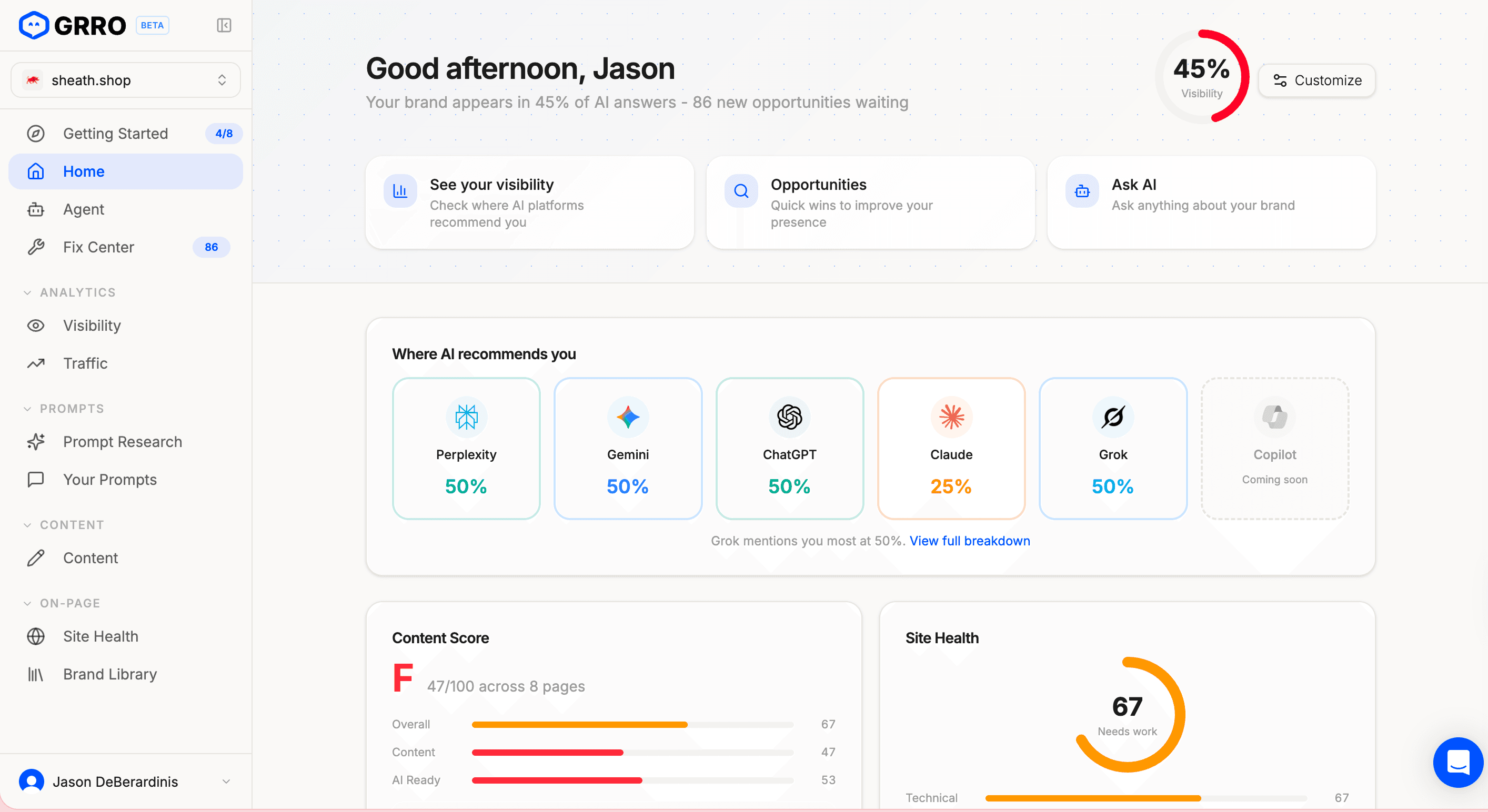
An AI Visibility Score measures how often and how prominently AI search engines recommend your brand. This guide explains how GRRO calculates the score, what factors influence it, how to interpret your results, and what specific actions improve your score across all five major AI engines.

Key Takeaways
- An AI Visibility Score quantifies how visible your brand is across AI search engines like ChatGPT, Perplexity, Gemini, Claude, and Grok on a scale from 0 to 100
- GRRO calculates the score by running relevant queries across all 5 engines, analyzing whether your brand appears in the responses, and evaluating factors like mention prominence, citation quality, and recommendation context
- The average business scores between 5 and 15 out of 100, meaning 85% to 95% of relevant AI queries return no mention of most brands
- Four core factors drive the score: recommendation frequency (how often you appear), mention prominence (where in the answer you appear), citation quality (how your brand is described), and engine coverage (how many engines recommend you)
- Improving your AI Visibility Score requires a combination of content structure optimization, authority building, multi-source presence, and continuous monitoring
What an AI Visibility Score Actually Measures
An AI Visibility Score is a single number that tells you how visible your brand is to AI search engines. It answers a simple question: when people ask AI engines questions relevant to your business, how often does your brand appear in the answer?
This is fundamentally different from what traditional SEO metrics measure. Google Search rankings tell you your position on a results page. Domain authority estimates your site's overall SEO strength. Organic traffic tells you how many people visit your site from search.
An AI Visibility Score tells you something none of those metrics capture: whether AI engines are actively recommending your brand to users who ask relevant questions.
With AI search growing at 527% year over year and over 800 million weekly AI queries being processed, this measurement gap is becoming a critical blind spot for businesses that only track traditional SEO metrics. Your brand might rank #1 on Google for important keywords but be completely absent from the AI-generated answers that an increasing percentage of your potential customers see first.
For background on why AI search visibility matters and how it differs from traditional SEO, see our foundational guide on what AI search optimization is.
How GRRO Calculates Your AI Visibility Score
GRRO's AI Visibility Score is calculated through a multi-step process that evaluates your brand's presence across all five major AI search engines. Here is how each component works.
Step 1: Query Set Generation
The process begins with identifying the queries that matter to your business. GRRO generates a set of relevant queries based on:
- Your industry and product category: What questions do people ask when researching products or services like yours?
- Your target keywords: What terms are you already tracking for traditional SEO?
- Competitor analysis: What queries trigger your competitors' recommendations?
- Query intent mapping: What informational, comparative, and transactional queries relate to your business?
A typical query set includes 50 to 200 queries spanning different intent types: "What is the best [category]?" queries, "How do I [task]?" queries, "[Brand A] vs [Brand B]" comparisons, and industry-specific questions.
Step 2: Multi-Engine Query Execution
Each query in your set is executed across all five major AI engines:
| Engine | How GRRO Queries It | What Gets Analyzed |
|---|---|---|
| ChatGPT | API with web search enabled | Full response text and cited URLs |
| Perplexity | API with source retrieval | Response text and numbered citations |
| Gemini | API with Google Search grounding | Response text and source references |
| Claude | API with search capability | Response text and contextual mentions |
| Grok | API with X/Twitter and web access | Response text and source links |
| API with Bing integration | Response text and cited sources |
This produces a complete snapshot of how each engine responds to each relevant query and whether your brand appears in any of those responses.
Step 3: Response Analysis
For each query-engine combination, GRRO analyzes the AI response using four dimensions.
Recommendation Frequency
Does your brand appear in the response? This is the binary foundation: recommended or not recommended. Across your full query set, what percentage of queries return your brand in at least one engine? What percentage return your brand across multiple engines?
Most businesses are surprised to discover that their recommendation frequency is below 15%. Meaning for 85%+ of the queries relevant to their business, AI engines do not mention them at all.
Mention Prominence
When your brand does appear, where in the answer does it show up? Mention prominence evaluates:
- First mention: Is your brand the first one recommended? First-mentioned brands receive disproportionate user attention and trust.
- Standalone recommendation: Is your brand recommended on its own, or listed among 5+ options?
- Featured vs. passing mention: Is your brand described in detail, or mentioned briefly in a list?
- Primary vs. supporting context: Is your brand the answer to the question, or referenced as supporting context?
A brand mentioned first in a detailed recommendation scores significantly higher than a brand listed fifth in a bulleted list.
Citation Quality
How is your brand described when it is mentioned? Citation quality evaluates:
- Sentiment: Is the mention positive, neutral, or negative?
- Specificity: Does the AI cite specific features, data points, or use cases for your brand?
- Source attribution: Does the AI link to your website or cite you as a source?
- Recommendation strength: Does the AI actively recommend you ("I recommend [Brand]") or passively mention you ("Options include [Brand]")?
A strong positive recommendation with specific feature mentions and a source link scores higher than a neutral mention in a generic list.
Engine Coverage
How many of the 5 engines recommend your brand? Engine coverage measures the breadth of your AI visibility. A brand recommended by all 5 engines has fundamentally stronger AI visibility than a brand recommended by only one, even if the single-engine brand appears for more queries on that one platform.
Engine coverage matters because users use different AI engines. A ChatGPT-only strategy misses the growing user bases of Perplexity, Gemini, and the others. Broad coverage ensures visibility regardless of which engine a potential customer prefers.
Step 4: Score Calculation
GRRO combines these four dimensions into a single score from 0 to 100 using a weighted formula:
- Recommendation Frequency: 35% of total score
- Mention Prominence: 25% of total score
- Citation Quality: 20% of total score
- Engine Coverage: 20% of total score
The weighting reflects the relative importance of each factor. Frequency is weighted highest because being mentioned at all is the prerequisite for everything else. Prominence and citation quality are weighted equally because both determine the actual impact of each mention. Engine coverage ensures the score rewards broad visibility.
Step 5: Benchmarking and Context
Your raw score is contextualized against:
- Industry benchmarks: How does your score compare to the average in your industry?
- Competitor scores: How do you stack up against specific competitors?
- Historical trends: How has your score changed over time?
- Per-engine breakdown: Which engines recommend you most and least?
This benchmarking transforms a raw number into actionable intelligence. A score of 25 means something very different if your top competitor scores 60 versus if they score 10.
How to Interpret Your AI Visibility Score
Score Ranges and What They Mean
| Score Range | Interpretation | Typical Business Profile |
|---|---|---|
| 0 to 10 | Invisible to AI | No AI strategy, thin web presence, limited third-party coverage |
| 11 to 25 | Minimally visible | Some organic mentions, no intentional AI optimization |
| 26 to 40 | Emerging visibility | Beginning AI optimization, appearing for some queries on some engines |
| 41 to 60 | Competitive visibility | Active AI strategy, appearing for most priority queries across multiple engines |
| 61 to 80 | Strong visibility | Comprehensive AI presence, frequently recommended as a top option |
| 81 to 100 | Dominant visibility | Category leader, recommended first for most relevant queries across all engines |
The average business in 2026 scores between 5 and 15. This means the vast majority of brands are functionally invisible to AI search. For context, 97% of businesses have no AI visibility strategy at all, which is why the average scores are so low.
Understanding Per-Engine Scores
Your overall score is an aggregate, but GRRO also provides per-engine breakdowns. These per-engine scores reveal important patterns:
High Perplexity, Low Gemini: Your content ranks well on Bing/Brave but not on Google. Focus on Google SEO and schema markup.
High Gemini, Low ChatGPT: Your Google rankings are strong but Bing rankings are weak. Submit your sitemap to Bing Webmaster Tools and ensure Bing is indexing your content.
High ChatGPT and Perplexity, Low Claude: Your real-time web presence is strong but your training-data-level authority needs work. Invest in Wikipedia, authoritative publications, and established review platforms.
Low across all engines: Foundational work is needed. Start with content structure, basic authority building, and multi-source presence. See our AI search optimization checklist for a step-by-step starting framework.
Understanding Query-Level Data
Beyond the aggregate score, GRRO provides query-level visibility data showing exactly which queries trigger your brand's recommendation and which do not. This data is where the most actionable insights live.
Queries where you are consistently recommended reveal your current strength areas. Queries where competitors are recommended but you are not reveal your highest-priority content gaps. Queries where no brand is consistently recommended reveal opportunity areas where first-mover advantage is available.
What Factors Influence Your AI Visibility Score
Your score is ultimately determined by how AI engines evaluate your brand. Based on analysis of thousands of brand visibility profiles, these are the factors with the highest impact.
1. Content Structure and Answer-First Formatting
AI engines extract information from your content in chunks. Pages that lead with direct answers, use question-format headings, and include FAQ sections score dramatically higher in AI retrieval than pages that bury answers or use vague headings.
This is often the single fastest way to improve your score. Restructuring your top 20 pages to lead with direct answers can produce measurable score improvements within 2 to 4 weeks. For a detailed formatting guide, see our article on content structure AI engines love.
2. Multi-Source Presence
AI engines cross-reference your brand across multiple sources before recommending you. Brands that appear only on their own website earn lower trust than brands mentioned across Wikipedia, LinkedIn, industry publications, Reddit, review platforms, and community forums.
Building multi-source presence is a medium to long-term investment (3 to 12 months) but has the highest compounding impact on your score. Each new authoritative source that mentions your brand increases AI engine confidence across all 5 platforms. Our guide on building authority signals for AI recommendations covers this in depth.
3. Traditional Search Rankings
ChatGPT uses Bing. Gemini uses Google. Perplexity uses Bing and Brave. Your traditional search engine rankings directly determine whether your content enters the retrieval pool for these engines. Brands ranking in the top 10 to 15 for their target queries consistently score higher than brands ranking below position 20.
4. Schema Markup and Structured Data
Schema markup helps AI engines understand your content at a structural level. FAQ schema, article schema, organization schema, and product schema all provide signals that improve how AI engines categorize, extract, and recommend your content. Gemini in particular weights schema markup heavily due to its deep Google integration. See our guide on schema markup for AI search visibility.
5. Content Freshness
Different engines weight freshness differently. Perplexity reflects new content in 48 to 72 hours. ChatGPT and Gemini take 2 to 4 weeks. Grok prioritizes the latest 24 hours. Maintaining a regular publishing cadence and updating existing content with new data and timestamps improves your score across all engines, with the most immediate impact on Perplexity and Grok.
6. Review and Rating Signals
Third-party review platforms (G2, Capterra, Trustpilot, Google Business Profile) provide independent validation that AI engines weight heavily. Brands with substantial, recent, positive reviews score higher than brands with few reviews, old reviews, or negative sentiment.
How to Improve Your AI Visibility Score
Quick Wins (1 to 4 Weeks)
- Restructure your top 10 pages with answer-first formatting, question-format H2s, and FAQ sections
- Add schema markup (FAQ, Article, Organization) to your key pages
- Submit your sitemap to Bing Webmaster Tools and Google Search Console
- Update your top pages with current data and fresh dateModified timestamps
- Complete your Google Business Profile if applicable
Medium-Term Improvements (1 to 3 Months)
- Create comparison and "best of" content targeting high-value recommendation queries
- Build LinkedIn thought leadership for key team members
- Participate in Reddit communities relevant to your expertise
- Earn reviews on G2, Capterra, or industry-specific platforms
- Publish original research or data that other sources will cite
Long-Term Authority Building (3 to 12 Months)
- Earn coverage in authoritative publications through PR and original research
- Build a Wikipedia presence if your brand qualifies for notability
- Create comprehensive topic clusters that establish topical authority
- Develop a consistent publishing cadence of 2+ optimized articles per week
- Build relationships with industry publications for regular coverage
Monitoring and Iteration
Track your AI Visibility Score weekly. GRRO's search visibility tracking provides continuous monitoring that shows:
- Your overall score and per-engine breakdown
- Query-level visibility data showing where you are and are not being recommended
- Competitor scores and competitive gap analysis
- Trend data showing how your score changes over time
- Prioritized action items based on your specific gaps
Without continuous monitoring, you are optimizing blind. AI engine behavior changes, competitor strategies evolve, and content freshness degrades. Weekly tracking ensures you catch changes early and respond proactively.
AI Visibility Score vs Traditional SEO Metrics
Understanding how the AI Visibility Score relates to metrics you already track helps integrate it into your existing reporting.
| Metric | What It Measures | Relationship to AI Visibility Score |
|---|---|---|
| Google ranking position | Your rank on Google SERPs | Prerequisite: top 10 to 15 positions feed Gemini's retrieval |
| Domain authority | Estimated SEO strength | Correlated but not deterministic: high DA helps but does not guarantee AI visibility |
| Organic traffic | Visitors from search engines | Complementary: AI referral traffic is a separate, growing channel |
| Backlink profile | Number and quality of inbound links | Moderate correlation: authoritative backlinks also signal trust to AI engines |
| AI Visibility Score | Frequency and quality of AI recommendations | Measures a distinct channel that existing metrics do not capture |
The key insight is that traditional SEO metrics are necessary but not sufficient. A brand can have excellent Google rankings, high domain authority, and strong organic traffic but still score poorly on AI visibility because its content is not structured for AI extraction, it lacks multi-source presence, or it is missing from engines like Perplexity and Claude.
Conversely, a brand with moderate traditional SEO metrics can score well on AI visibility if its content is impeccably structured, it has strong multi-source presence, and it has actively optimized for AI engine retrieval.
Why 97% of Businesses Score Below 15
The data is stark: the vast majority of businesses have minimal to zero AI visibility. Several factors explain why:
Lack of Awareness
Most businesses still treat AI search as a future concern rather than a current channel. They are not monitoring AI visibility because they do not realize it matters. Meanwhile, the 3% of brands that are actively optimizing face minimal competition.
Content Not Structured for AI
Most business websites were built for human readers and Google's traditional algorithm. The content may be excellent, but it is not structured in the answer-first, chunk-friendly format that AI engines need to extract and recommend. This is usually the most fixable issue.
Single-Source Presence
Many businesses exist only on their own website. Without mentions across Wikipedia, LinkedIn, Reddit, industry publications, and review platforms, AI engines lack the multi-source validation they require to recommend with confidence.
No Cross-Engine Strategy
Businesses that have heard of AI search optimization often focus exclusively on ChatGPT, ignoring Perplexity, Gemini, Claude, Grok,. A single-engine strategy produces single-engine visibility, which a comprehensive score penalizes.
No Measurement Infrastructure
You cannot improve what you do not measure. Without an AI Visibility Score, businesses have no way to track their AI search performance, benchmark against competitors, or measure the impact of their optimization efforts.
FAQ
What is a good AI Visibility Score?
Any score above 25 puts you ahead of most competitors. A score of 40 to 60 represents competitive visibility where your brand appears for most priority queries across multiple engines. Scores above 60 indicate strong visibility that is difficult for competitors to displace. The "right" score depends on your industry and competitive landscape, which is why GRRO provides competitive benchmarking alongside your raw score.
How often does the AI Visibility Score change?
AI engine behavior shifts continuously as they update their models, re-index content, and adjust their retrieval algorithms. GRRO updates your score weekly to capture these changes. Significant score movements typically reflect specific events: new content publication, algorithm updates, competitor activity, or changes in your multi-source presence.
Can I improve my score without GRRO?
You can improve your AI visibility without any tool by manually restructuring content, building multi-source presence, and testing queries across AI engines. However, doing this at scale (tracking 100+ queries across 5 engines weekly) is impractical without automation. GRRO provides the monitoring infrastructure, competitive benchmarking, and prioritized recommendations that make systematic improvement feasible.
How does the AI Visibility Score differ from the AI Recommendation Score?
GRRO uses both terms to describe the same core measurement. The AI Visibility Score and AI Recommendation Score both quantify how visible your brand is across AI search engines. Some GRRO documentation uses "Recommendation Score" to emphasize the outcome (being recommended) while "Visibility Score" emphasizes the measurement (how visible you are). The calculation methodology is identical.
Does paid advertising affect my AI Visibility Score?
Paid search advertising (Google Ads, Bing Ads) does not directly influence AI engine recommendations. AI engines generate recommendations based on organic content, authority signals, and multi-source presence, not ad spend. However, the brand awareness and traffic generated by paid campaigns can indirectly boost AI visibility by increasing branded searches, driving reviews, and generating coverage.
How does my AI Visibility Score compare to competitors?
GRRO provides competitive benchmarking as part of its platform. You can see your score alongside competitors' scores for your industry and specific query sets. This benchmarking reveals competitive gaps: queries where competitors are recommended and you are not, engines where competitors have stronger presence, and areas where you have an advantage to protect.
Can a high AI Visibility Score replace traditional SEO?
No. Traditional SEO remains essential because AI engines like ChatGPT, Gemini, and Perplexity use traditional search engine results as their starting retrieval data. Strong Google and Bing rankings are prerequisites for being included in AI engine retrieval pools. The AI Visibility Score measures a distinct, complementary channel that adds to your overall search presence rather than replacing it.
Conclusion
Your AI Visibility Score is the definitive measurement of how well your brand performs across AI search engines. It quantifies what no traditional SEO metric captures: whether AI engines are actively recommending your brand to users who ask relevant questions.
The calculation combines recommendation frequency, mention prominence, citation quality, and engine coverage into a single 0 to 100 score that reflects your brand's complete AI search presence. With the average business scoring between 5 and 15, the opportunity gap is enormous for brands willing to invest in systematic optimization.
The path to a higher score is clear: restructure content for AI extraction, build multi-source authority, optimize for all 5 engines, and monitor your progress weekly. Each improvement compounds over time as AI engines recognize your brand as increasingly trustworthy and recommendable.
Start by getting your current score with a free scan at GRRO. Knowing your number is the first step. Everything else follows from there.

Co-Founder & CMO at GRRO