How to Optimize for Google AI Overviews
Google AI Overviews generate AI-powered summaries at the top of search results, pulling from top-ranking pages to answer queries directly. Here is how to optimize your content to be the source Google AI Overviews selects.

Key Takeaways
- Google AI Overviews are AI-generated summaries that appear at the top of search results, answering queries directly before any organic links
- AI Overviews pull from pages that already rank in the top 10 to 20 organic results, making traditional SEO a prerequisite for AI Overview inclusion
- Approximately 60% of AI Overview sources come from pages ranking in the top 5 organic positions
- Content structured with direct answers in the first 40 to 60 words, question-format headings, and schema markup has the highest chance of being selected
- AI Overviews have reduced click-through rates on informational queries by 20 to 40%, making it critical to be the cited source rather than a competing organic result
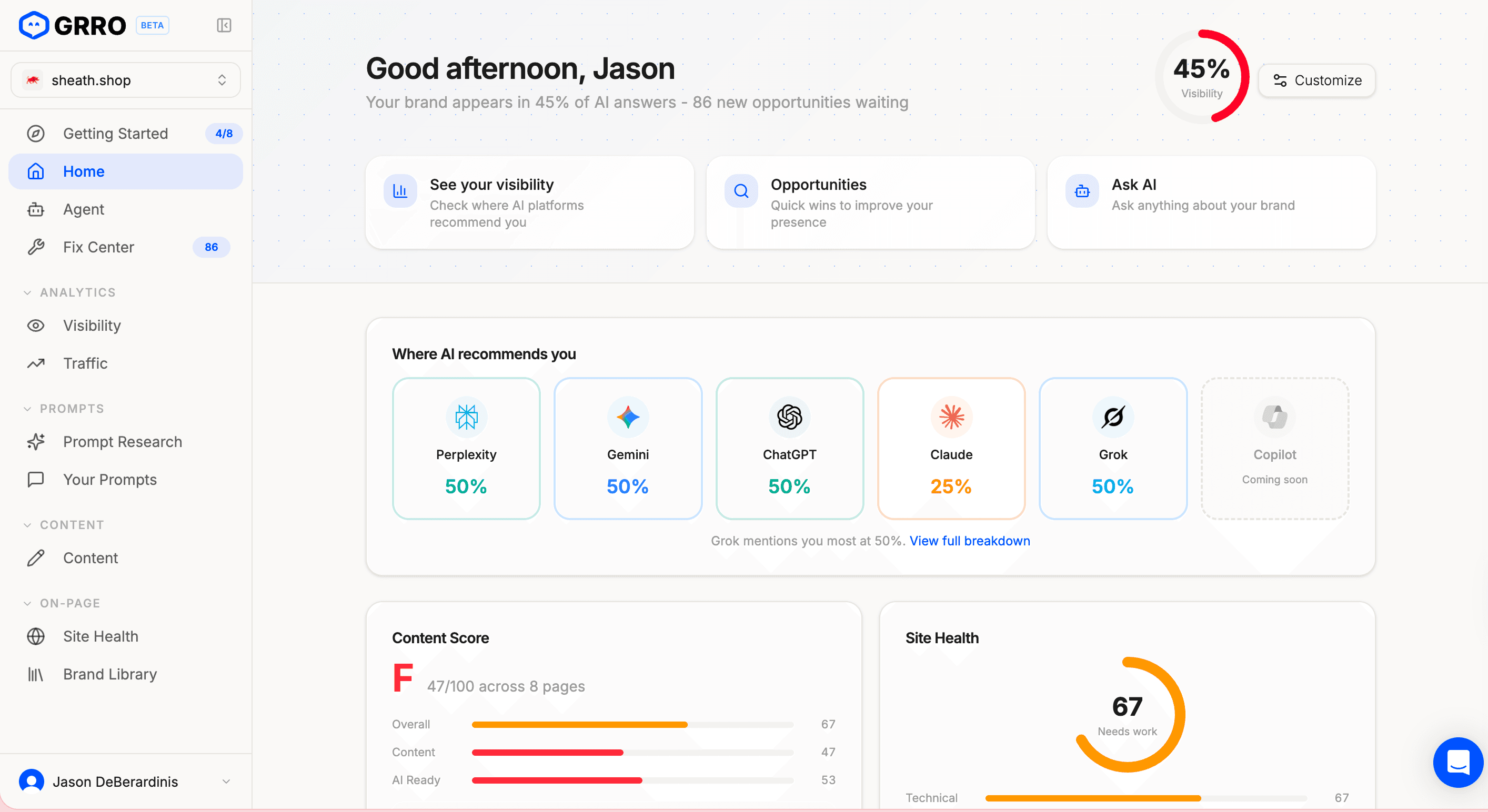
- GRRO tracks your visibility across AI Overviews and 6 other AI search engines to give you a complete picture of your AI search performance
What Are Google AI Overviews?
Google AI Overviews are AI-generated answer boxes that appear at the top of Google search results for certain queries. Previously known as Search Generative Experience (SGE) during Google's testing phase, AI Overviews use Google's Gemini model to synthesize information from multiple web sources into a concise, direct answer.
When a user searches for "best CRM for small businesses" or "how to reduce customer churn," Google may display an AI Overview that provides a synthesized answer with citations to the sources it used. This answer appears above all traditional organic results, fundamentally changing the search landscape.
AI Overviews now appear for approximately 30% to 40% of all Google searches, and that percentage is growing every quarter. For businesses that depend on organic search traffic, this is not a future concern. It is a current reality that demands a strategic response.
For context on how AI Overviews fit into the broader shift from traditional search to AI-powered answers, see our analysis of whether AI search is replacing Google.
How Google AI Overviews Select Sources
Understanding the selection process is essential to getting your content included. AI Overviews use a multi-step process that combines traditional Google ranking signals with AI-specific evaluation criteria.
Step 1: Traditional Ranking as the Starting Pool
AI Overviews do not search the entire web independently. They pull from pages that already rank in Google's top 10 to 20 organic results for the given query. This means traditional SEO is the entry ticket. If your page does not rank in the top 20 organically, it will not be considered for the AI Overview.
Research shows that approximately 60% of AI Overview sources come from pages in the top 5 organic positions, and over 85% come from the top 10. Strong organic rankings directly correlate with AI Overview inclusion.
Step 2: Content Chunk Evaluation
Google breaks each ranking page into content chunks and evaluates each chunk for how directly and completely it answers the user's query. Chunks that provide clear, concise answers score higher than chunks that provide tangential or partial information.
Step 3: Multi-Source Synthesis
The Gemini model synthesizes information from the top-ranked chunks into a coherent answer. It pulls specific facts, recommendations, and explanations from different sources and weaves them together. Each claim is attributed to its source page.
Step 4: Citation Assignment
Sources that contributed the most useful information receive prominent citations within the AI Overview. These citations appear as clickable links, giving the cited pages a significant visibility advantage.
For a technical deep dive into how this retrieval and generation process works across all AI engines, read our explanation of the RAG pipeline and how AI finds your brand.
Which Queries Trigger AI Overviews?
Not every Google search generates an AI Overview. Understanding which query types trigger them helps you prioritize your optimization efforts.
High-Trigger Query Types
Informational queries. "What is topical authority?" or "How does email marketing work?" These definitional and explanatory queries trigger AI Overviews at the highest rate because Google can synthesize clear, factual answers.
Comparison queries. "Mailchimp vs Klaviyo" or "Best project management tools 2026." These queries trigger AI Overviews because they benefit from multi-source synthesis.
How-to queries. "How to set up Google Analytics 4" or "How to write a business plan." Step-by-step content is well-suited for AI Overview formatting.
Product research queries. "Best CRM for small businesses" or "Top email marketing platforms for e-commerce." These high-intent queries increasingly trigger AI Overviews with product recommendations.
Low-Trigger Query Types
Navigational queries. "Facebook login" or "Amazon." Users looking for a specific website rarely see AI Overviews.
Transactional queries. "Buy iPhone 16" or "book flight to New York." Direct purchase-intent queries typically show shopping results rather than AI Overviews.
Local queries with maps intent. "Restaurants near me" or "plumber in Austin." These typically trigger map packs, though some local informational queries do generate AI Overviews.
The Impact on Click-Through Rates
AI Overviews have meaningfully changed the traffic dynamics of Google search. Understanding this impact helps you calibrate your strategy.
What the Data Shows
| Metric | Before AI Overviews | After AI Overviews |
|---|---|---|
| CTR for Position 1 (informational) | 27.6% | 16 to 22% |
| CTR for Position 2 to 5 (informational) | 8 to 15% | 4 to 9% |
| CTR for Position 6 to 10 (informational) | 2 to 5% | 1 to 3% |
| Zero-click searches | 45% | 55 to 65% |
| CTR for AI Overview source (when cited) | N/A | 12 to 18% |
The key insight is that AI Overviews compress all organic results downward on the page. Positions 1 through 10 all lose clicks. But the sources cited within the AI Overview capture significant traffic that would otherwise have gone to the top organic results.
Being cited in the AI Overview is now more valuable than ranking in position 1 organically for many query types. This is a fundamental shift in search economics.
The Strategic Implication
For businesses, the strategy is clear: you need both strong organic rankings (to enter the AI Overview consideration pool) and AI-optimized content structure (to be selected as a cited source). One without the other is not sufficient.
12 Strategies to Optimize for Google AI Overviews
1. Secure Top 10 Organic Rankings First
AI Overviews pull from existing organic results. If you are not ranking in the top 10 to 20 for your target queries, no amount of AI optimization will get you into the AI Overview. Continue investing in traditional SEO as your foundation.
2. Lead Every Section with a Direct Answer
Write the first sentence of every section as a complete, standalone answer to the question posed in the heading. Google's content chunking evaluates sections independently, and the opening sentence carries disproportionate weight.
Example heading: "How much does email marketing software cost?"
Optimized opening: "Email marketing software costs between $0 and $350 per month for most small to mid-size businesses, with pricing primarily based on subscriber count and feature tier."
3. Use Question-Format H2 and H3 Headings
AI Overviews match user queries to section headings. When your heading closely matches the user's search query, that section receives a relevance boost during evaluation. Audit your top pages and convert generic headings into question-format headings that mirror how users search.
4. Implement Comprehensive Schema Markup
Google's AI uses schema markup to understand content structure and context. Implement FAQ schema, How-To schema, Article schema, and Product schema on relevant pages. Schema does not guarantee AI Overview inclusion, but it gives Google additional signals about your content's structure and purpose.
For implementation details, see our guide on schema markup for AI search visibility.
5. Create Comparison Tables
AI Overviews frequently include information from comparison tables because they present structured data that is easy to synthesize. When comparing products, features, or options, use HTML tables with clear headers and consistent formatting.
6. Write Concise, Self-Contained Paragraphs
Each paragraph should make a complete point that can stand alone when extracted from the page. Avoid paragraphs that rely on context from previous paragraphs to be meaningful. Google's chunking process may extract a single paragraph, and it needs to be independently useful.
7. Add Comprehensive FAQ Sections
Include 5 to 10 FAQ questions on every important page. These FAQs should cover the related questions users ask after their initial query. Google's AI Overview often uses FAQ content to answer follow-up questions, giving your page additional citation opportunities.
8. Maintain Content Freshness
Update your top pages at least quarterly. Update statistics, add new information, remove outdated content, and modify the dateModified field in your metadata. Google AI Overviews favor fresh, current content, especially for topics where information changes over time.
9. Build Topical Authority Through Content Clusters
Pages on sites with deep topical authority are more likely to be selected for AI Overviews. Build content clusters around your core topics with a pillar page supported by 10 to 15 related articles. This signals to Google that your site is a comprehensive authority on the topic.
For a complete guide to this strategy, read our post on how to build topical authority for AI search engines.
10. Optimize for E-E-A-T Signals
Google's Experience, Expertise, Authoritativeness, and Trustworthiness framework carries even more weight for AI Overview source selection. Include author bylines with credentials, cite reputable sources, provide original data when possible, and demonstrate first-hand experience with your topic.
11. Use Lists and Numbered Steps
AI Overviews frequently display information in list format. When your content includes numbered steps, bulleted lists, or ranked recommendations, it becomes easier for Google's AI to extract and format within an Overview. Structure your content to be extractable in these formats.
12. Optimize Page Speed and Core Web Vitals
Technical SEO fundamentals matter more for AI Overview selection, not less. Pages with strong Core Web Vitals scores are more likely to be included. Ensure your pages load quickly, have stable layouts, and respond to user interactions promptly.
AI Overviews vs. Featured Snippets
Many businesses confuse AI Overviews with Featured Snippets. While they occupy similar positions on the search results page, they work differently.
| Attribute | Featured Snippets | AI Overviews |
|---|---|---|
| Source | Single source | Multiple sources synthesized |
| Content | Extracted verbatim | AI-generated summary |
| Citations | One link | Multiple links |
| Query types | Simple, definitional | Complex, multi-faceted |
| Length | Short (40 to 60 words) | Longer (100 to 300 words) |
| User interaction | Static | Can include follow-up questions |
| Optimization approach | Match snippet format exactly | Provide best answer in structured format |
Featured Snippets pull a single excerpt from a single page. AI Overviews synthesize information from multiple pages into a new, AI-written answer. This means optimizing for AI Overviews requires a different approach: instead of trying to match a specific format exactly, you need to provide the most useful, authoritative content on the topic.
How AI Overviews Interact with Other AI Search Engines
Google AI Overviews are just one part of the AI search landscape. Your content needs to perform across multiple AI engines simultaneously.
Content optimized for AI Overviews also performs well on other AI engines because the core principles overlap: answer-first structure, clear headings, comprehensive coverage, and strong authority signals. However, each engine has unique characteristics.
ChatGPT uses Bing as its primary search source, not Google. Perplexity uses Bing and Brave. This means content that ranks well on Google and appears in AI Overviews may not be visible on other AI engines if it does not also rank on Bing.
GRRO's search visibility tracking monitors your presence across Google AI Overviews, ChatGPT, Perplexity, Gemini, Claude, and Grok to give you a complete view of your AI search performance. Understanding where you are visible and where you are missing is the foundation of an effective multi-engine strategy.
For a comprehensive comparison, read how each AI engine recommends differently.
Measuring Your AI Overview Performance
Manual Tracking
Search your target queries in Google using an incognito browser. Record whether an AI Overview appears, whether your site is cited, and which competitors are cited. Do this weekly for your top 20 to 30 queries.
Automated Tracking
Manual tracking does not scale beyond a few dozen queries. GRRO's prompt intelligence automates AI Overview monitoring alongside five other AI engines. You can track citation rates, identify new queries triggering AI Overviews in your space, and benchmark your performance against competitors.
Key Metrics to Watch
- AI Overview trigger rate: What percentage of your target queries generate an AI Overview?
- Citation rate: When an AI Overview appears, how often is your content cited?
- Citation position: Are you the primary source or a secondary citation?
- Traffic impact: How has AI Overview rollout affected organic traffic to your cited and non-cited pages?
- Competitor citation rate: Which competitors appear in AI Overviews for your target queries?
Understanding your AI Recommendation Score gives you a single metric to track your overall AI search visibility, including AI Overview performance.
FAQ
Are Google AI Overviews the same as Google SGE?
Google AI Overviews are the production release of what was previously known as the Search Generative Experience (SGE). Google tested SGE through Search Labs in 2023 and 2024, then rolled it out broadly as "AI Overviews" in 2025. The underlying technology is the same Gemini model, but AI Overviews are now a standard feature of Google Search rather than an experimental opt-in.
Do AI Overviews appear for every Google search?
No. AI Overviews currently appear for approximately 30% to 40% of Google searches. They are most common for informational, comparison, and how-to queries. They are less common for navigational, transactional, and simple local queries. The trigger rate varies by industry and query type.
Can I opt out of appearing in AI Overviews?
There is no official mechanism to opt out of AI Overviews specifically while remaining in Google's organic results. If you block Googlebot entirely, you will be excluded from both AI Overviews and organic results. Google has stated that appearing in AI Overviews is part of the normal web search experience.
How do AI Overviews affect my organic traffic?
The impact varies by query type. For informational queries where the AI Overview fully answers the question, organic click-through rates have dropped 20% to 40%. For complex queries where users need more depth, traffic to cited sources has remained stable or increased. Being cited within the AI Overview partially offsets traffic losses from organic position displacement.
Should I optimize for AI Overviews or traditional SEO first?
Traditional SEO is a prerequisite for AI Overview visibility because AI Overviews pull from pages that already rank in the top 10 to 20 organically. Start with strong SEO fundamentals, then layer AI-specific optimizations (answer-first structure, FAQ schema, comparison tables) on top. The two strategies are complementary, not competitive.
How quickly do AI Overview results change?
AI Overviews can reflect content changes within 1 to 2 weeks, depending on how quickly Google re-crawls your page. Updating existing high-ranking pages typically produces faster AI Overview changes than publishing new content. Ensure your sitemap is submitted and your crawl frequency is optimized through Google Search Console.
Does GRRO track Google AI Overview performance?
Yes. The GRRO platform tracks your visibility across Google AI Overviews alongside ChatGPT, Perplexity, Gemini, Claude, and Grok. This multi-engine view helps you understand your total AI search presence and identify where to focus your optimization efforts.
Conclusion
Google AI Overviews represent the most significant change to Google Search since the introduction of featured snippets. They are reshaping click-through rates, changing the value of organic rankings, and creating a new competitive dynamic where being cited in the AI answer is more valuable than ranking in position 1 below it.
The optimization strategy is built on a clear foundation: earn top 10 organic rankings first, then structure your content for AI extraction with direct answers, question-format headings, comparison tables, FAQ schema, and regular updates. Combine this with strong E-E-A-T signals and topical authority to maximize your chances of being selected as an AI Overview source.
Start by measuring where you stand today. Run a free scan at GRRO to see your current AI visibility across Google AI Overviews and every other major AI search engine. The businesses that adapt their content strategy now will capture the traffic that shifts from traditional organic results to AI-generated answers.

Co-Founder & CMO at GRRO