How to Get Your Brand Recommended by ChatGPT, Perplexity, and Claude
A step-by-step guide to getting your brand recommended by the AI search engines that now handle 800M+ weekly queries. Audit your visibility, build answer-first content, and monitor your AI recommendation score.
Key Takeaways
- 97% of businesses have no visibility in AI search results, meaning AI engines are recommending your competitors instead of you
- Getting recommended by AI requires a fundamentally different strategy than ranking on Google: answer-first content, multi-source authority, and structured data
- Each AI engine pulls from different sources: ChatGPT uses Bing, Perplexity uses Brave and Bing, Google AI uses Google, and Grok uses X/Twitter
- Businesses that appear in AI recommendations see 4.4x higher conversion rates compared to traditional search traffic
- You can audit your current AI visibility in under 60 seconds with a free scan at GRRO
Is AI Recommending Your Business Right Now?
Right now, over 800 million queries hit AI search engines every single week. When someone asks ChatGPT, Perplexity, or Claude about your industry, your product category, or your specific brand name, those engines either recommend you or they recommend someone else. There is no middle ground.
The shift is already massive. AI search has grown 527% year over year. 40% of Gen Z now uses AI search as their first research step. And the businesses showing up in those AI-generated answers are seeing 4.4x higher conversion rates than traditional search traffic.
Yet 97% of businesses have zero strategy for AI visibility. Only 3% of brands have done anything to position themselves for AI recommendations.
This guide walks you through the exact process to change that. Step by step, from auditing where you stand today to building a system that consistently earns AI recommendations across ChatGPT, Perplexity, Claude, Gemini, Grok,.
Step 1: Audit Your Current AI Visibility
Before you change anything, you need to know where you stand. Most businesses assume they have some presence in AI search results. Almost all of them are wrong.
How to Run Your First AI Visibility Audit
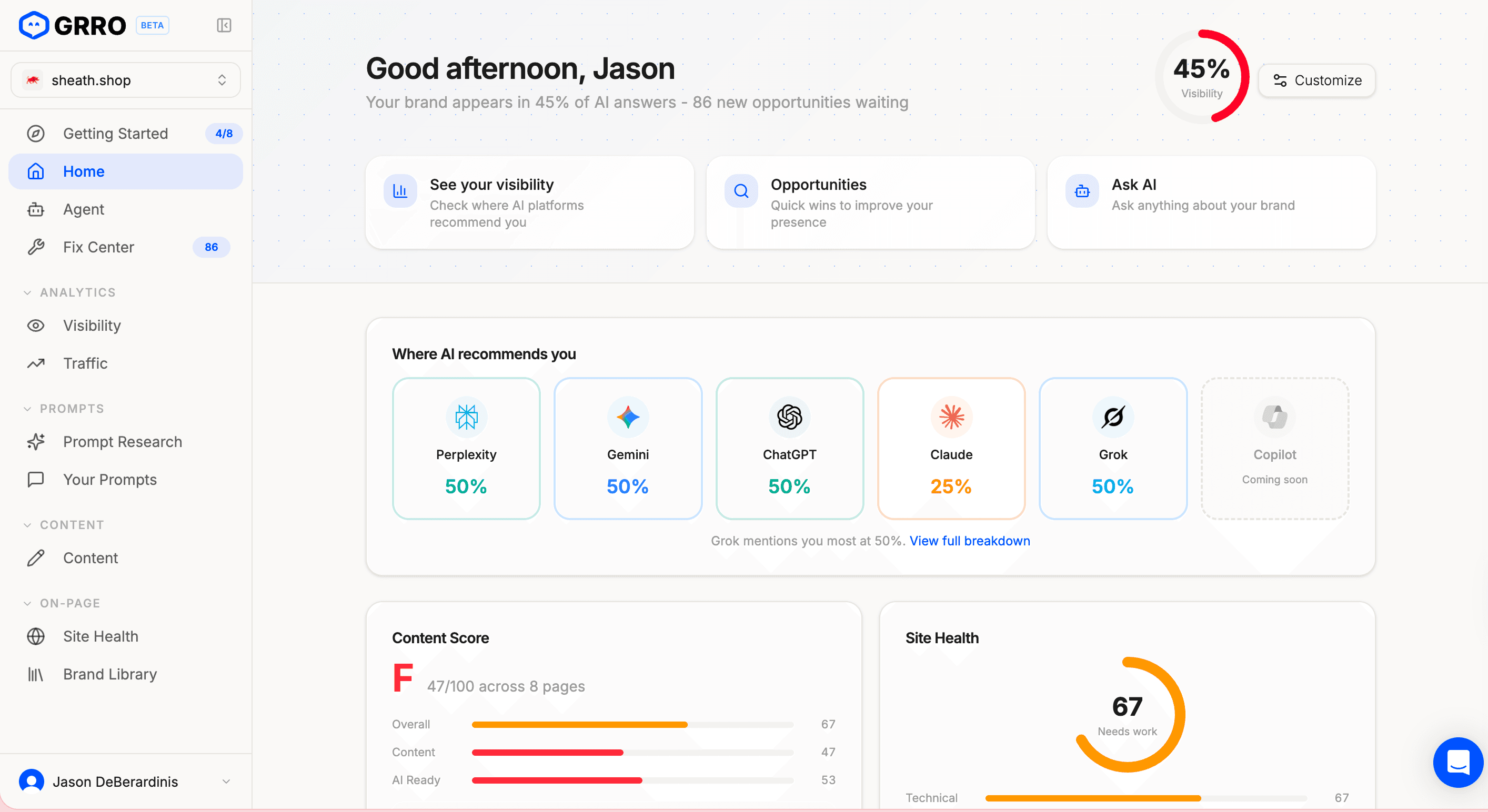
Start with a free scan at GRRO. Enter your domain, and within 60 seconds you will see your AI Recommendation Score, which measures how often and how prominently AI engines mention your brand when users ask relevant questions.
Beyond the automated scan, you should manually test at least 10 to 15 queries across multiple AI engines. Use these categories:
Brand queries: Ask each AI engine directly about your company. "What is [Brand Name]?" and "Tell me about [Brand Name]." If the engine does not know you exist, that is your baseline.
Category queries: Ask about your product or service category. "What are the best [your category] tools?" or "How do I choose a [your category] provider?" Prompt intelligence tools can help you discover the exact queries your customers use. Check whether you appear in the recommendations.
Problem queries: Ask the questions your customers ask before they buy. "How do I solve [problem you solve]?" Track whether the AI mentions your solution.
Document every result. Note which engines recommend you, which recommend competitors, and which recommend no one in your space. This becomes your benchmark.
What Your Audit Results Tell You
If you appear in fewer than 20% of relevant queries, you have a significant visibility gap. This is normal. Most businesses score below 15% on their first audit.
The GRRO platform breaks your score down by engine, by query type, and by competitor comparison, so you can see exactly where to focus first.
Step 2: Build Answer-First Content
AI engines do not recommend websites. They recommend answers. The single most important shift you can make is restructuring your content to lead with direct, clear answers rather than building up to them.
What Answer-First Content Looks Like
Traditional SEO content buries the answer. A typical blog post might spend 300 words on background before getting to the point. AI engines skip all of that. They extract the direct answer from the first 40 to 60 words of a section and use it as the basis for their recommendation.
Here is the format that earns AI recommendations:
Start every section with a direct answer. If your H2 is "How much does project management software cost?" the first sentence should be "Project management software costs between $7 and $30 per user per month for most small businesses, with enterprise plans ranging from $50 to $150 per user." Then expand with details, context, and nuance.
Use question-format headings. AI engines match user queries to content sections. When your H2 is phrased as a question that matches what users actually ask, you have a dramatically higher chance of being the source the AI pulls from. Learn more about optimal content structure in our guide on the content structure AI engines love.
Include specific numbers. AI engines prefer content with concrete data points over vague claims. "Businesses using structured data see a 340% improvement in AI citation rates" is far more useful to an AI engine than "structured data helps a lot."
Content Length and Depth
The ideal content piece for AI recommendation is 1,500 to 3,000 words. Long enough to cover a topic thoroughly, short enough to stay focused. Each section should be 150 to 300 words, independently useful, and structured so an AI engine could extract it as a standalone answer.
The GRRO content scoring tool analyzes your existing pages and tells you exactly which sections need restructuring for AI readability.
Step 3: Create Multi-Source Authority
AI engines do not trust a single source. They cross-reference information across multiple websites, platforms, and databases before making a recommendation. If your brand only exists on your own website, you are invisible to most AI recommendation systems.
The Multi-Source Authority Framework
Each AI engine has preferred sources. Understanding these preferences is critical:
ChatGPT pulls primarily from Bing's index. It heavily weights Wikipedia (47.9% of citations) and LinkedIn. It actively avoids Reddit as a source. If you want ChatGPT to recommend you, your Bing presence, Wikipedia mentions, and LinkedIn authority matter most.
Perplexity uses Brave and Bing together. It loves Reddit (46.7% of citations) and prioritizes fresh content within a 48 to 72 hour window. An active Reddit presence and frequent content publishing give you an edge here.
Google AI Overviews pull from Google's own index. Quora appears in 14.3% of citations. Featured Snippets content gets priority. Your traditional Google SEO work actually feeds into this engine.
Grok is built on X/Twitter data with a freshness window of less than 24 hours. Active X/Twitter presence with industry expertise is essential for Grok recommendations.
For the full breakdown, see our comparison of how each AI engine recommends differently.
Where to Build Your Multi-Source Presence
Focus on these platforms in order of impact:
- Your website with answer-first, structured content
- Wikipedia mentions (not self-created; earned through notability)
- LinkedIn articles and company page authority
- Industry publications that cite your data or expertise
- Reddit participation in relevant subreddits (genuine, not promotional)
- Quora answers in your expertise area
- X/Twitter for real-time industry commentary
- YouTube for video content that gets transcribed and indexed
The goal is not to be everywhere. The goal is to be findable across the specific sources each AI engine trusts.
Step 4: Add Structured Data and Technical Signals
AI engines rely heavily on structured data to understand what your content is about, who created it, and how trustworthy it is. Without proper schema markup, you are making the AI guess, and it will guess wrong more often than not.
Essential Schema Markup for AI Recommendations
At minimum, implement these schema types:
Organization schema on your homepage. Include your company name, description, founding date, founders, social profiles, and logo. This helps AI engines build an entity profile for your brand.
Article schema on every blog post and content page. Include author information, publication date, modification date, and a clear description. AI engines use this to assess content freshness and authority.
FAQ schema on pages with question-and-answer content. This is one of the highest-impact structured data types for AI recommendations because it directly maps to the question-answer format AI engines use.
HowTo schema on tutorial and process content. When someone asks an AI engine "How do I [your topic]?" this schema makes your step-by-step content the most machine-readable answer available.
Product schema if you sell products or services. Include pricing, features, reviews, and availability. AI engines use this to make specific product recommendations.
Technical SEO Signals That Matter for AI
Beyond schema, these technical factors influence AI recommendations:
- Page load speed: AI crawlers have timeout limits. Pages that load in under 2 seconds get fully crawled more consistently.
- Clean HTML structure: Proper heading hierarchy (H1, H2, H3) helps AI engines parse your content into extractable sections.
- Internal linking: 25 to 35 internal links per content piece helps AI engines understand your topical authority and content relationships.
- XML sitemap: Updated frequently so AI-connected search engines find your new content quickly.
The GRRO technical audit scans your site for all of these signals and gives you a prioritized fix list.
Step 5: Monitor, Measure, and Iterate
AI recommendations are not static. The engines update their models, their source preferences shift, and your competitors are working to earn the same recommendations. Continuous monitoring is not optional.
What to Track
AI Recommendation Score: Your overall visibility across all AI engines. Track this weekly at minimum. The GRRO platform automates this tracking and shows trends over time.
Engine-specific visibility: Your score will differ across ChatGPT, Perplexity, Gemini, and others. Knowing where you are strong and where you are weak tells you where to focus next.
Query coverage: How many of the queries your customers ask result in your brand being recommended? Start with your top 50 customer queries and expand from there.
Competitor benchmarking: Track how often competitors appear in AI recommendations for your target queries. If a competitor suddenly gains visibility, analyze what they changed.
Conversion from AI traffic: AI referral traffic converts at 4.4x the rate of traditional search. Make sure your analytics can identify and measure this traffic source.
The Iteration Cycle
Review your data every two weeks and adjust:
- Identify queries where you are not being recommended but should be using content gap planning
- Check whether you have content that directly answers those queries
- If yes, restructure the content for answer-first format
- If no, create new content targeting those specific queries
- Verify your multi-source presence for those topics
- Re-scan in 2 to 4 weeks to measure impact
AI engines re-index content on varying schedules. Perplexity picks up new content in 48 to 72 hours. ChatGPT and Gemini may take 2 to 4 weeks. Plan your expectations accordingly.
Common Mistakes That Kill AI Visibility
Even businesses that try to earn AI recommendations often fail because of a few common errors:
Writing for keywords instead of questions. Traditional SEO trained us to target keyword phrases. AI engines respond to natural language questions. Reframe your entire content strategy around the questions your customers actually ask.
Ignoring multi-source presence. Having great content on your website is necessary but not sufficient. If no other source on the internet references your brand, AI engines have no way to cross-validate your authority.
Publishing and forgetting. AI engines prioritize fresh content. Perplexity weights content published in the last 48 to 72 hours. Even for engines with longer windows, regular updates signal active authority.
Focusing on one AI engine. ChatGPT is the biggest, but Perplexity is growing fastest. Gemini is integrated into Google Search. Grok has a dedicated audience. A strategy that only targets one engine leaves the majority of AI search traffic on the table.
Not measuring AI visibility. You cannot improve what you do not measure. Without tracking your AI Recommendation Score, you are guessing. Get a baseline with a free scan and track from there.
FAQ
How long does it take to start getting recommended by AI?
Most businesses see initial improvements in AI visibility within 4 to 8 weeks of implementing answer-first content and multi-source authority building. Perplexity picks up changes fastest (48 to 72 hours for new content). ChatGPT and Gemini typically take 2 to 4 weeks to reflect content changes. Full competitive positioning usually takes 3 to 6 months of consistent effort.
Do I need to stop doing traditional SEO?
No. Traditional SEO and AI visibility are complementary. In fact, ranking in the top 20 results on traditional search engines is often a prerequisite for AI recommendation, because AI engines use search engine results as their starting pool of sources. Keep doing SEO, but restructure your content format for AI readability. Read more in our guide on what AI search optimization is and how it differs from traditional SEO.
Which AI search engine should I focus on first?
Start with ChatGPT and Perplexity. ChatGPT has the largest user base, and Perplexity is the fastest-growing dedicated AI search engine. Together, they represent the majority of AI search traffic. Once you have visibility on those two, expand to Gemini, Claude, Grok,.
Can I pay to get recommended by AI search engines?
No. AI search recommendations are earned, not bought. There is no advertising system for AI search results (yet). The only way to appear in recommendations is to have authoritative, well-structured content that the AI engine trusts enough to reference. This is why businesses that start building AI visibility now have a massive first-mover advantage.
How do I know if AI search matters for my industry?
If your customers ask questions before making a purchase decision, AI search matters for your industry. With 800 million weekly AI search queries and 527% year-over-year growth, AI search is relevant across virtually every B2B and B2C category. Industries with complex buying decisions (SaaS, professional services, healthcare, finance, education) see the highest AI search usage.
Conclusion
Getting recommended by AI search engines is not a future consideration. It is a present-day competitive advantage that 97% of businesses are ignoring. The 800 million weekly queries flowing through ChatGPT, Perplexity, Gemini, and other AI engines represent a massive channel where your brand is either being recommended or being overlooked.
The process is straightforward: audit your current visibility, restructure your content to lead with answers, build authority across the specific sources each AI engine trusts, implement proper structured data, and monitor your progress continuously.
The businesses that act on this now will own the AI recommendation space in their categories. The ones that wait will spend the next several years trying to catch up.
Start with a free AI visibility scan to see exactly where you stand today. Then use this guide to close the gap between where you are and where your competitors wish they were.

Co-Founder & CMO at GRRO