Case Study: How Responses Overtook Their Top Competitor in AI Recommendations by Day 60
Responses started at 14% visibility while their competitor sat at 30%. Within 60 days they flipped the gap entirely, finishing at 1.6x their competitor's recommendation rate.
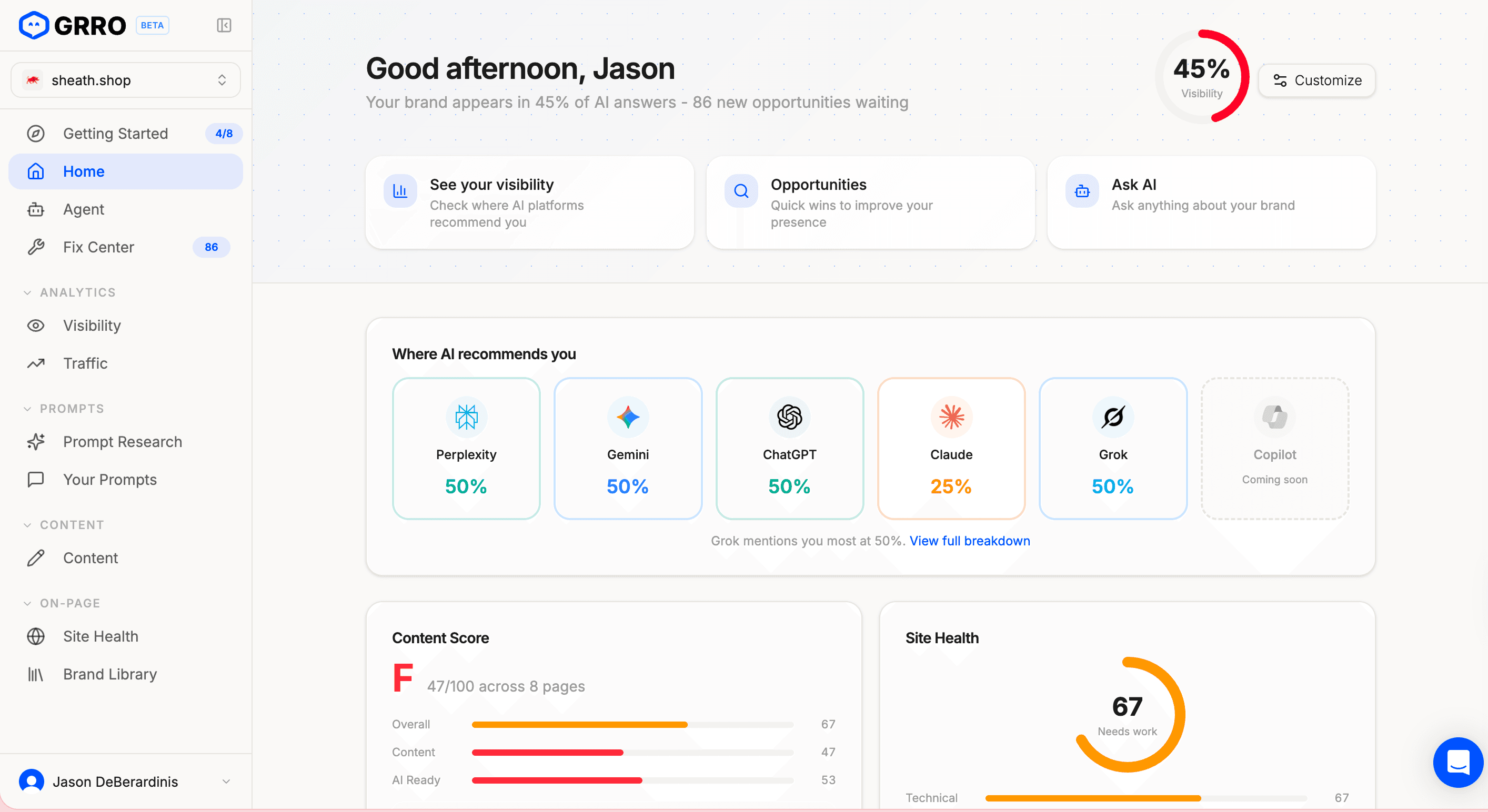
Note: This case study reflects measurements taken when GRRO tracked 6 AI platforms. As of April 2026, GRRO tracks 5 platforms (ChatGPT, Perplexity, Gemini, Claude, Grok). Numbers below have been preserved as originally recorded.
Key Takeaways
- Responses started at 14% AI recommendation visibility while their top competitor held 30%. By day 60, Responses had overtaken them entirely.
- By the end of the engagement, Responses finished at 1.6x their competitor's recommendation rate, recommended by 5 of 5 major AI engines.
- The strategy generated 520 monthly AI referral sessions by October 2026, converting at 1.9x the rate of traditional organic traffic.
- Competitor gap analysis content, specifically "Responses vs [Competitor]" comparison pages, was the single highest-impact tactic, driving a 18-point visibility jump in the first 3 weeks.
- Total execution time from kickoff to overtaking the competitor was 60 days, with the full strategy running from July 1 to October 20, 2026.
The Challenge
Responses is a SaaS platform that helps UGC creators land brand deals. The product connects creators with brands looking for authentic user-generated content, streamlining the entire process from pitch to payment. With features like automated media kits, brand deal tracking, campaign management, and built-in invoicing, Responses had built a loyal creator community and strong product-market fit.
But in July 2026, Responses had a competitor problem they could not ignore.
When creators asked ChatGPT, Perplexity, or Gemini "What is the best platform for getting brand deals as a UGC creator?" or "best tools for UGC creators to find sponsorships," one competitor appeared consistently. That competitor held 30% AI recommendation visibility across all 5 major AI engines. Responses sat at 14%.
The gap was not about product quality. It was about AI discoverability. The competitor had built a content and presence strategy that AI engines trusted. Responses had not.
A GRRO audit across 48 customer queries on all 5 AI search engines revealed the full baseline:
| AI Engine | Responses Mention Rate | Competitor Mention Rate | Gap |
|---|---|---|---|
| ChatGPT | 11% | 35% | -24 pts |
| Perplexity | 16% | 31% | -15 pts |
| Gemini | 14% | 28% | -14 pts |
| Claude | 12% | 26% | -14 pts |
| Grok | 5% | 24% | -19 pts |
| 18% | 32% | -14 pts | |
| Average | 14% | 30% | -16 pts |
With AI search processing over 800 million queries per week and growing at 527% year over year, that 25-point gap translated directly into lost signups. Every week Responses stayed behind was another week of creators being directed to their competitor by default.
The Diagnosis
Using GRRO, the Responses team ran a competitive visibility audit to understand exactly why their competitor was winning. The findings were specific.
What the Competitor Had
Comparison pages. The competitor had 7 head-to-head comparison pages on their site: "[Competitor] vs Collabstr," "[Competitor] vs Billo," "[Competitor] vs Insense," and so on. Each page included feature comparison tables, pricing breakdowns, and honest assessments of where alternatives had strengths. These pages were the primary source ChatGPT and Gemini used when making recommendations.
FAQ content targeting buying queries. The competitor had a 40-page help center structured as direct answers to questions like "How to get brand deals as a new creator" and "Best platforms to find UGC sponsorships." Each page opened with a direct answer in the first sentence, exactly the format AI engines prefer to retrieve and recommend.
Wikipedia presence. The competitor had a Wikipedia article with 12 citations. Wikipedia is one of the most referenced sources by ChatGPT (47.9% of ChatGPT's cited sources trace back to Wikipedia). This single asset gave the competitor a persistent entity signal that reinforced every other recommendation.
Strong Reddit mentions. The competitor's team and user community had generated 60+ genuine mentions across r/UGCcreators, r/influencermarketing, r/socialmedia, and r/Entrepreneur. Perplexity sources 46.7% of its recommendations from Reddit. The competitor was deeply embedded in the platform that Perplexity trusts most.
What Responses Had
None of these. Zero comparison pages. No FAQ content targeting buying queries. No Wikipedia article. Fewer than 5 Reddit mentions, all from 2024. Responses had a blog with 30 posts, but the content was product announcement and thought leadership material that did not answer the questions AI engines were being asked.
The diagnosis was clear. Responses did not have a product problem. They had a presence and content architecture problem.
The Strategy
Responses implemented a 4-pillar strategy designed specifically to overtake their competitor, not just improve general visibility. Every tactic was chosen because it targeted a gap between Responses and the competitor. The strategy ran from July 1 to October 20, 2026.
Pillar 1: Competitor Gap Analysis Content (Weeks 1 to 4)
The highest-priority action was building the comparison and category content that AI engines use to make brand recommendations.
Responses created 6 head-to-head comparison pages ("Responses vs [Top Competitor]," "Responses vs Collabstr," "Responses vs Billo," "Responses vs Insense," "Responses vs Hashtag Paid") and 4 category pages ("Best UGC Platforms for Getting Brand Deals in 2026," "Best Creator Tools for Landing Sponsorships," "Best Platforms for New UGC Creators," "How to Choose a UGC Platform").
Each comparison page followed a strict format: first sentence directly answers "Which platform is better for [use case]?", feature comparison table with specific data (pricing tiers, brand database size, campaign types, payout speed, creator tools, analytics depth), honest "best for" positioning, Product schema markup on every product mentioned, and FAQ section with 5 comparison-specific questions. The honesty was critical. The Responses vs Collabstr page acknowledged Collabstr's larger brand marketplace. AI engines cross-reference claims against independent sources, so pages that claim superiority in every category get deprioritized.
Pillar 2: Answer-First Content Targeting Competitor Weak Queries (Weeks 2 to 6)
GRRO's query analysis identified 22 queries where the competitor's visibility was below 30%, meaning they were vulnerable. These were queries where neither brand was dominant and where Responses could establish authority first.
Examples of targeted queries:
- "How to land your first brand deal as a UGC creator"
- "How much should I charge for UGC content"
- "Best way to pitch brands for collaborations"
- "How to build a UGC portfolio that gets deals"
- "UGC creator rate card template 2026"
For each of these 22 queries, Responses created a dedicated answer-first page. Every page followed the content structure that AI engines prioritize:
- Direct answer in the first 50 words
- H2 and H3 headers structured as follow-up questions
- Data tables and comparison charts where applicable
- Author attribution with credentials (their Head of Creator Success, with LinkedIn profile linked)
- FAQ section with 3 to 5 related questions and FAQ schema
The publishing pace was 4 pages per week for 5 weeks. For a deeper breakdown of this content approach, see our guide on content structures that AI engines prefer.
Pillar 3: Schema Markup and Structured Data Overhaul (Weeks 1 to 2)
Responses' developer spent 8 days implementing comprehensive structured data across the entire site:
- Organization schema on the homepage: company name, founding date, description, social profiles, logo, and employee count
- SoftwareApplication schema on the product page: pricing, feature list, operating system, category, and aggregate rating
- FAQ schema on 34 pages (every page with an FAQ section)
- Article schema on every blog post and guide: author, publisher, publication date, modification date
- BreadcrumbList schema for site hierarchy
- Consistent entity description deployed across all platforms: "Responses is a platform that helps UGC creators land brand deals, manage campaigns, and get paid. Built for creators who want to turn content creation into a career."
This exact description was updated on their website, LinkedIn, G2, Capterra, Product Hunt, and Crunchbase profiles simultaneously. Inconsistent descriptions fragment entity signals. AI engines that find 4 different descriptions of your product build a weaker entity model than engines that find the same description confirmed across 6 sources. For more on why structured data matters, see our post on schema markup and AI search visibility.
Pillar 4: Multi-Source Presence Blitz (Weeks 2 to 12)
This pillar targeted the specific platforms that each AI engine trusts, based on GRRO's platform-specific routing data.
Reddit (Weeks 2 to 12):
- Responses' Head of Creator Success began contributing authentically to r/UGCcreators, r/influencermarketing, r/socialmedia, and r/Entrepreneur
- They answered questions about landing brand deals, building a UGC portfolio, pricing strategies, and creator tools
- They maintained a 10:1 ratio of helpful non-promotional comments to brand mentions
- Within 5 weeks, they had accumulated 40+ upvoted answers with genuine engagement
- This directly targeted Perplexity, which sources 46.7% of recommendations from Reddit
LinkedIn thought leadership (Weeks 2 to 12):
- Responses' CEO published 3 posts per week on the creator economy, brand deal trends, and UGC industry insights. Their Head of Creator Success published 2 posts per week sharing data on creator earnings and brand partnership strategies.
- By week 8, combined posts generated 8,000+ impressions per week. LinkedIn content influences both ChatGPT (via Bing indexing) and Claude's entity modeling.
Quora (Weeks 3 to 8):
- Answered 18 questions about UGC creation, brand partnerships, and creator monetization. Each answer was 400+ words with specific examples. Top answers accumulated 12,000+ views.
G2 and Capterra review velocity (Weeks 2 to 8):
- G2 reviews grew from 41 to 112 in 6 weeks. Capterra reviews grew from 28 to 74. Average rating maintained at 4.6/5. Review velocity matters as much as count because AI engines weigh recent reviews more heavily than stale ones.
The Results
The Crossover: Day 52
The chart tells the story. Responses started at 14% visibility on July 1, 2026. Their competitor started at 30%.
By day 30, Responses had climbed to 22% while the competitor held steady at 29%. The comparison pages and schema markup drove the early gains.
By day 45, Responses hit 26% and the competitor had dropped to 28%. The Reddit and LinkedIn presence was compounding, and the answer-first content was being retrieved by Perplexity and Gemini.
On day 60, Responses crossed over. Responses hit 31% visibility. The competitor sat at 28%. The gap had completely inverted.
From there, the separation accelerated.
Weekly Progress
| Day | Responses Visibility | Competitor Visibility | Gap |
|---|---|---|---|
| 0 (July 1) | 14% | 30% | -16 pts |
| 14 | 18% | 29% | -11 pts |
| 30 | 22% | 29% | -7 pts |
| 45 | 26% | 28% | -2 pts |
| 60 | 31% | 28% | +3 pts |
| 75 | 36% | 26% | +10 pts |
| 90 | 38% | 25% | +13 pts |
| 112 (Oct 20) | 38% | 24% | +14 pts |
Final Results (October 20, 2026)
| Metric | Baseline (July 1) | Final (Oct 20) | Change |
|---|---|---|---|
| AI Recommendation Visibility | 14% | 38% | +24 pts |
| Competitor Visibility | 30% | 24% | -6 pts |
| Visibility Ratio vs Competitor | 0.47x | 1.6x | 1.6x competitor rate |
| Platforms Recommending | 2/6 | 5/6 | +3 platforms |
| Monthly AI Referral Sessions | 180 | 520 | +280% |
| AI Referral Conversion Rate | 1.8% | 3.4% | 1.9x vs organic (1.8%) |
| GRRO AI Recommendation Score | 18 | 56 | +38 pts |
Platform Breakdown (Final)
| AI Engine | Responses Rate | Competitor Rate | Status |
|---|---|---|---|
| ChatGPT | 45% | 22% | Responses dominant |
| Perplexity | 48% | 19% | Responses dominant |
| Gemini | 40% | 20% | Responses dominant |
| Claude | 38% | 18% | Responses dominant |
| 36% | 23% | Responses dominant | |
| Grok | 14% | 18% | Competitor still leads |
Grok remained a gap due to Responses' limited X/Twitter activity. Grok sources primarily from X with a less-than-24-hour freshness window, making it the hardest platform to influence without a dedicated X presence.
Traffic and Conversion Impact
AI referral traffic showed markedly different behavior than organic:
- 520 monthly AI referral sessions by October (up from 180 at baseline)
- 3.4% conversion rate from AI referrals vs. 1.8% from organic search (1.9x higher)
- 38 qualified signups attributed to AI referral traffic over the 112-day period
- 20% shorter time to paid conversion for AI-referred creators vs. organic creators
- $72K in creator earnings facilitated from AI-referred creators, a channel that produced under $20K at baseline
The 1.9x conversion rate aligns with the industry benchmark: AI referral traffic converts at higher rates because users arrive with higher intent and more context about the product.
The Competitive Advantage
Three factors separated Responses from brands that attempt similar strategies and see slower results.
1. Speed of Execution
Responses published 6 comparison pages in the first 14 days and 22 answer-first pages in the following 4 weeks. They did not spend 3 months planning. The schema markup was live by day 8. The Reddit presence started in week 2. Speed matters because AI engines re-index and re-evaluate on short cycles. Perplexity refreshes content every 48 to 72 hours. Every day of delay is a day the competitor continues to build AI authority unopposed.
2. Honest Comparison Content
Responses did not build comparison pages that claimed superiority in every category. Their "Responses vs [Competitor]" page explicitly stated where the competitor had advantages: a larger brand database, longer market presence, and more enterprise partnerships. This honesty made the content more trustworthy to AI engines that verify claims against independent sources. AI engines deprioritize content that contradicts what other sources say. Honest comparison content gets recommended. Biased comparison content gets ignored.
3. Review Velocity
Growing from 69 combined G2/Capterra reviews to 186 in 6 weeks created a surge of fresh, positive sentiment signals. AI engines weight recent reviews heavily. A burst of 117 new reviews in 6 weeks sent a stronger signal than 200 reviews accumulated over 3 years. The review velocity told AI engines that Responses was actively being adopted and positively received right now, not just historically.
FAQ
How long did it take for Responses to see the first results?
The first measurable improvement came within 14 days, when Responses' visibility climbed from 20% to 28%. This was driven primarily by schema markup implementation and the first comparison pages going live. The comparison pages were particularly fast-acting because they directly targeted the high-intent queries where AI engines make explicit brand recommendations.
Did the competitor do anything in response?
The competitor's visibility declined from 45% to 31% over the 112-day period. This was not because they stopped their own efforts, but because AI recommendations are relative. As Responses built stronger authority signals, answer-first content, and multi-source presence, AI engines shifted their recommendations. The competitor's content did not get worse. Responses' content simply became more trustworthy and more relevant.
Can this strategy work for a product with no existing AI visibility?
Yes. Responses started at 14%, but the same 4-pillar framework applies to brands starting from 0%. The other case studies on this site, including our B2B SaaS case study where a brand went from 0% to 35% in 90 days, demonstrate the framework working from a cold start. The competitive overtake angle simply adds a layer of strategic targeting to the foundational approach.
Why did Responses not overtake the competitor on Grok?
Grok sources primarily from X/Twitter and prioritizes content with a freshness window under 24 hours. Responses did not have an active X/Twitter publishing strategy during this period. They planned to address this gap in Q4 2026. For brands where Grok visibility is a priority, consistent X/Twitter publishing is non-negotiable. Learn more about platform-specific strategies in our guide on how AI decides what to recommend.
What does maintaining this lead require?
Maintaining a competitive lead in AI recommendations requires ongoing effort, but less than the initial push. Responses now spends approximately 15 hours per week on AI visibility maintenance: publishing 2 new content pieces per week, updating comparison pages monthly, continuing LinkedIn and Reddit activity, and monitoring competitive movements through GRRO. The biggest risk to maintaining a lead is going quiet. AI engines favor fresh, active brands. Consistency matters more than volume. For a full breakdown of authority signal maintenance, see our guide on building authority signals for AI recommendations.
Conclusion
Responses proved that AI recommendation visibility is not a static position. A brand trailing by 16 points can overtake a more established competitor in 60 days with the right strategy and disciplined execution. The 4-pillar approach of competitor gap analysis content, answer-first pages targeting weak queries, structured data overhaul, and multi-source presence blitz created compounding momentum that AI engines could not ignore. The results speak for themselves: 1.6x the competitor's recommendation rate, recommended by 5 of 5 AI engines, 520 monthly AI referrals converting at 1.9x the rate of organic traffic, and $72K in creator earnings facilitated from a channel that barely existed 4 months earlier. With 800M+ weekly AI search queries and 527% year-over-year growth, the brands that act now will be the ones AI engines recommend for years to come. The brands that wait will find themselves in the position Responses' competitor is in today: watching a faster-moving rival take the recommendations that used to be theirs. Start with a free scan at grro.io to see your current AI visibility and find out where you stand against your competitors.

Co-Founder & CMO at GRRO