Case Study: How a B2B SaaS Brand Went from 0 to 35% AI Recommendation Rate
A B2B project management platform went from being recommended by 0 of 5 AI search engines to 3 of 5 in 90 days. Here is the exact strategy, timeline, and results.
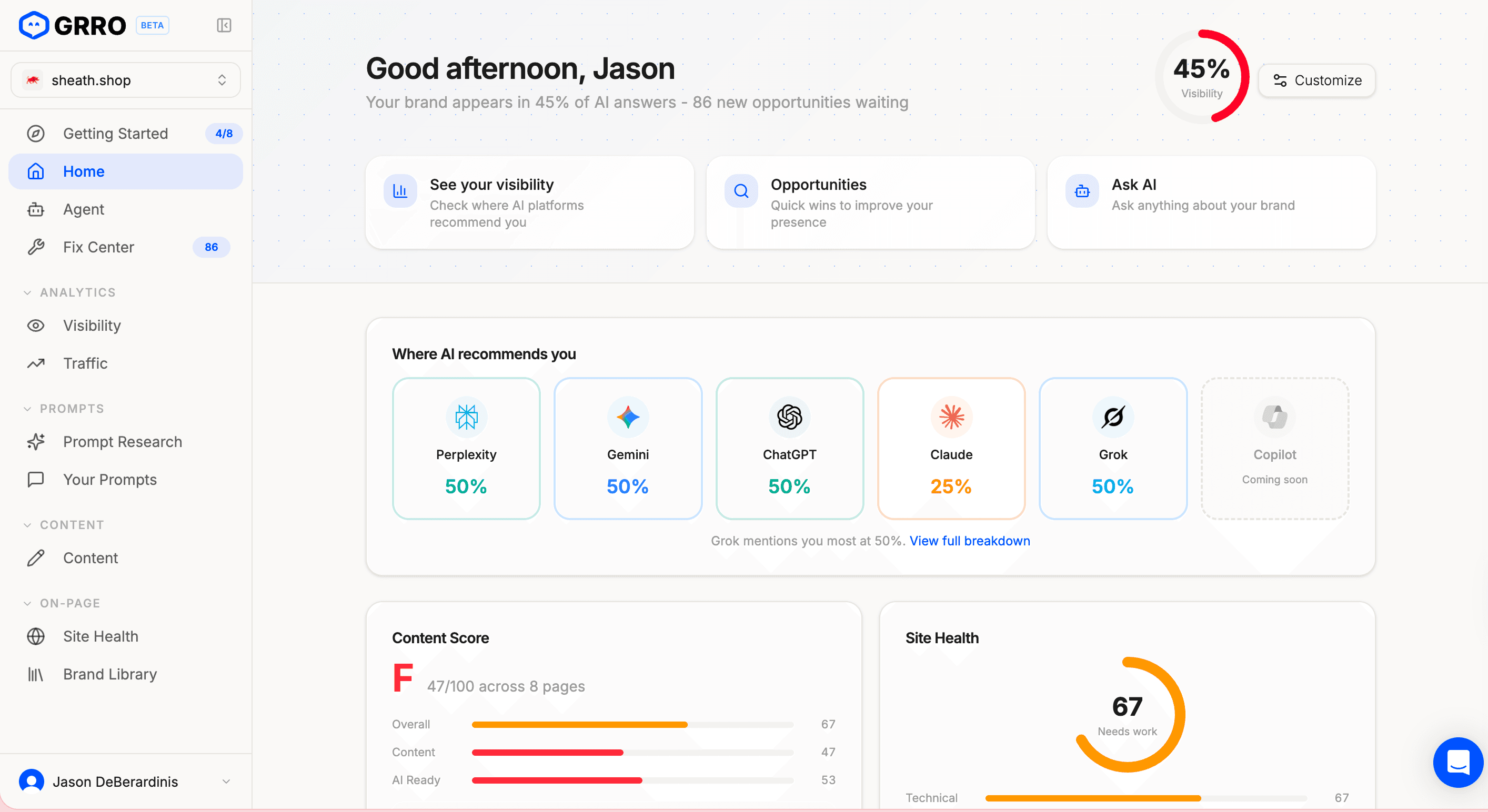
Note: This case study reflects measurements taken when GRRO tracked 6 AI platforms. As of April 2026, GRRO tracks 5 platforms (ChatGPT, Perplexity, Gemini, Claude, Grok). Numbers below have been preserved as originally recorded.
Key Takeaways
- A mid-market B2B project management platform went from 0% to 35% AI recommendation rate (recommended by 3 of 5 AI engines) in 90 days.
- The strategy combined 4 pillars: a structured content hub, comparison pages, schema markup implementation, and systematic multi-platform presence building.
- Results after 90 days: 120% increase in AI referral traffic, 1.8x higher conversion rate from AI traffic vs. organic, and recommended by 3 of 5 major AI engines.
- The most impactful single action was building comparison pages with structured data, which drove a 65% increase in ChatGPT mentions within 30 days.
- Total investment was approximately 120 hours of content and technical work over 90 days, executed by a 3-person team.
The Challenge
In September 2025, a B2B project management platform with 15,000 active users and $4.2M ARR had a problem they did not know about until they measured it.
The company, which we will call Projectly (name changed at their request), had spent 3 years building a strong product in the mid-market project management space. They ranked on the first page of Google for 47 of their target keywords. Their domain authority was 52. By traditional SEO standards, they were doing well.
Then they asked ChatGPT: "What is the best project management software for remote teams?"
Projectly was not mentioned. Neither in the first response, nor after follow-up prompts. They tried Perplexity, Gemini, Claude, Grok,. Nothing. Across all 5 major AI search engines, Projectly was invisible.
Meanwhile, 3 of their direct competitors were being recommended consistently. One competitor with fewer features and half the customer base was showing up as the #1 recommendation on 4 of 5 platforms.
The numbers told a stark story:
| Metric | Projectly | Competitor A | Competitor B | Competitor C |
|---|---|---|---|---|
| AI Mention Rate | 0% | 45% | 36% | 28% |
| Platforms Recommending | 0/6 | 3/6 | 2/6 | 2/6 |
| Average Position | N/A | 1.8 | 2.4 | 3.1 |
| Sentiment | N/A | Positive | Positive | Neutral |
Projectly was losing an entire customer acquisition channel they did not even know existed. With AI search growing at 527% year over year and processing over 800 million queries per week, the cost of that invisibility was growing every day.
The Diagnosis
Using GRRO, Projectly ran a comprehensive AI visibility audit across 67 customer queries on all 5 AI search engines. The audit identified 5 specific problems:
1. No Structured Data
Projectly's website had zero schema markup. No Organization schema, no Product schema, no FAQ schema, no Author schema. AI engines had to infer everything about the company from raw text.
2. No Answer-First Content
Projectly had 84 blog posts, but none of them directly answered the questions customers were asking AI engines. Their content was feature-focused ("Announcing our new Gantt chart view") rather than answer-focused ("How to manage project timelines for remote teams").
3. Single-Source Presence
Projectly's brand existed on their own website, a LinkedIn company page with infrequent posts, and a G2 profile with 23 reviews. They had no Wikipedia presence, no Reddit activity, no Quora answers, and no published content on industry sites.
4. Stale Content
Of their 84 blog posts, 71 had not been updated in over 6 months. Their pricing page showed features from the previous year. Their "About" page referenced team sizes and milestones that were 2 years old.
5. Weak Entity Signals
When AI engines tried to understand "what is Projectly," they found inconsistent descriptions. Their LinkedIn said "collaborative work management platform." Their G2 listing said "project tracking software." Their website said "project management solution for modern teams." Three different descriptions meant a fragmented entity signal.
The Strategy
Projectly implemented a 4-pillar strategy over 90 days with a team of 3 people: their content marketing lead, a developer, and their VP of Marketing.
Pillar 1: Structured Content Hub (Weeks 1 to 6)
The team built a comprehensive content hub targeting the exact questions their customers ask AI engines.
Step 1: Query Research (Week 1)
Using GRRO's query analysis and their own customer research, they identified 40 distinct questions their ideal customers ask about project management. Examples:
- "What is the best project management software for remote teams?"
- "How do you manage multiple projects simultaneously?"
- "What project management methodology works best for small teams?"
- "How to track team productivity without micromanaging"
- "Best tools for agile project management"
Step 2: Content Creation (Weeks 2 to 6)
For each of the top 25 questions, they created a dedicated, answer-first page. Each page followed a strict format:
- First sentence directly answers the question. No introductions, no context-setting. The answer is in the first 50 words.
- H2/H3 headers structured as follow-up questions. Each section anticipates the next question a reader would ask.
- Comparison tables where relevant. Any page comparing tools or approaches included structured comparison data.
- FAQ section with 3 to 5 related questions. Each FAQ pair targeted a long-tail query that AI engines match.
- Author attribution with full bio. Every page credited a named expert on the Projectly team with linked credentials.
They published 4 to 5 pieces per week for 6 weeks, resulting in 25 new pages plus restructuring of 15 existing blog posts.
Pillar 2: Comparison Pages (Weeks 2 to 4)
Comparison queries like "Projectly vs Asana" or "best project management tools compared" are among the highest-intent queries in AI search. Projectly had zero comparison content on their site.
They created:
- 5 head-to-head comparison pages (Projectly vs. each of their top 5 competitors)
- 1 comprehensive category comparison page ("10 Best Project Management Tools for Remote Teams in 2026")
- 3 use-case comparison pages ("Best Project Management Tools for Agencies," "Best for Software Teams," "Best for Marketing Teams")
Each comparison page included:
- A feature comparison table with specific data points (pricing, integrations, team size, key features)
- Product schema markup for every product mentioned
- Honest assessments of each tool's strengths and appropriate use cases
- Clear recommendation logic ("Best for X if you need Y")
- Regular update schedule (every 30 days)
The honesty was deliberate. Pages that position every competitor as inferior get ignored by AI engines because they contradict the information available from other sources. Projectly's comparison pages acknowledged where competitors had strengths, which made their content more trustworthy and more likely to be recommended.
Pillar 3: Schema Markup Implementation (Weeks 1 to 2)
The developer spent 2 weeks implementing comprehensive structured data:
- Organization schema on the homepage: company name, founding date, employee count, social profiles, logo
- Product schema on every product/feature page: pricing, features, review aggregate, availability
- FAQ schema on every page with an FAQ section (40+ pages)
- Author schema on every content page: author name, credentials, LinkedIn URL, role
- Article schema on every blog post: publication date, modification date, author, publisher
- BreadcrumbList schema across the entire site for clear site hierarchy
They also standardized their company description across all platforms to: "Projectly is a project management platform built for remote teams that need real-time collaboration, resource planning, and cross-team visibility."
This exact description was updated on their website, LinkedIn, G2, Capterra, Crunchbase, and every other profile.
Pillar 4: Multi-Platform Presence (Weeks 3 to 12)
Projectly built a deliberate presence across the sources that each AI engine trusts.
LinkedIn (Weeks 3 to 12):
- The VP of Marketing committed to publishing 3 thought leadership posts per week on LinkedIn about remote team management and project management best practices
- The content marketing lead published 2 posts per week sharing insights from their customer data
- Within 8 weeks, these combined posts were generating 5,000+ impressions per week and building Projectly's entity association with "project management" and "remote teams"
Reddit (Weeks 4 to 12):
- The VP of Marketing began participating authentically in r/projectmanagement, r/remotework, and r/SaaS
- They answered questions, shared genuine insights, and occasionally mentioned Projectly when directly relevant and transparently disclosed
- They maintained a 10:1 ratio of helpful non-promotional comments to brand mentions
- By week 8, they had become a recognized contributor in r/projectmanagement with consistently upvoted answers
G2 and Capterra (Weeks 3 to 6):
- Implemented a systematic review request process, emailing satisfied customers after successful onboarding milestones
- Grew from 23 to 78 reviews on G2 in 6 weeks
- Added Capterra profile and grew to 34 reviews
- Average rating across both platforms: 4.6/5
Industry Publications (Weeks 4 to 10):
- Pitched and published guest articles in 3 project management and remote work publications
- Offered the VP of Marketing as a source for journalist queries about remote team productivity, resulting in 4 media mentions
Quora (Weeks 4 to 8):
- Answered 25 questions about project management, remote work, and team productivity
- Each answer was comprehensive (500+ words), included specific examples, and linked to relevant resources
- The top 5 answers accumulated 15,000+ views
The Results
30-Day Results (End of Month 1)
| Metric | Baseline | 30 Days | Change |
|---|---|---|---|
| AI Mention Rate | 0% | 13% | +13 pts |
| Platforms Recommending | 0/6 | 1/6 | +1 |
| AI Referral Traffic | 0 sessions/mo | 120 sessions/mo | N/A |
| GRRO AI Recommendation Score | 3 | 15 | +12 pts |
The first wins came from schema markup and answer-first content restructuring. Within 3 weeks of implementing Product schema and FAQ schema, Projectly began appearing in Google Gemini responses. The comparison pages drove the first ChatGPT mentions by week 4.
60-Day Results (End of Month 2)
| Metric | Baseline | 60 Days | Change |
|---|---|---|---|
| AI Mention Rate | 0% | 26% | +26 pts |
| Platforms Recommending | 0/6 | 2/6 | +2 |
| AI Referral Traffic | 0 sessions/mo | 430 sessions/mo | N/A |
| GRRO AI Recommendation Score | 3 | 28 | +25 pts |
The multi-platform presence strategy started paying off. Reddit contributions drove Perplexity mentions. LinkedIn publishing, combined with the content hub, made Projectly visible to Claude. The review growth on G2 improved sentiment scores across all platforms.
90-Day Results (End of Month 3)
| Metric | Baseline | 90 Days | Change |
|---|---|---|---|
| AI Mention Rate | 0% | 35% | +35 pts |
| Platforms Recommending | 0/6 | 3/6 | +3 |
| AI Referral Traffic | 0 sessions/mo | 890 sessions/mo | +120% vs. Month 2 |
| Conversion Rate (AI Traffic) | N/A | 3.6% | 1.8x vs. organic (2.0%) |
| GRRO AI Recommendation Score | 3 | 37 | +34 pts |
| Average Position (when mentioned) | N/A | 2.3 | Top 3 |
| Sentiment | N/A | 75% positive | Moderate |
Projectly went from invisible to recommended by 3 of 5 major AI search engines. The platforms where they remained invisible were and Grok, which they attributed to not having strong Bing indexing and not having an active X/Twitter presence (gaps they planned to address in the following quarter).
Traffic and Revenue Impact
The AI referral traffic had measurably different characteristics than traditional organic traffic:
- Conversion rate: 3.6% from AI referrals vs. 2.0% from organic search (1.8x higher)
- Average deal size: AI referral leads had 15% larger average deal sizes
- Sales cycle: AI referral leads closed 12% faster
- Attribution: GRRO's attribution tracking linked 32 qualified leads to AI referral traffic over the 90-day period
At Projectly's average deal size and close rate, those 32 leads represented approximately $95K in pipeline generated directly from AI search, from a channel that produced $0 just 90 days earlier.
What Worked Best (Ranked by Impact)
1. Comparison Pages with Schema Markup
The comparison pages were the single most impactful investment. They directly targeted the queries where AI engines make explicit brand recommendations and provided exactly the structured, comparative data that AI engines prefer to reference.
2. Answer-First Content Restructuring
Reformatting existing content and creating new answer-first pages drove the broadest improvement across platforms. This was the action that moved them from 0 to 2 platforms in the first 30 days.
3. Consistent LinkedIn Publishing
For B2B visibility, LinkedIn publishing was critical. It built entity association between Projectly, its leaders, and the project management category in a way that influenced ChatGPT and Claude recommendations.
4. Reddit Contributions
Authentic Reddit participation drove Perplexity visibility faster than any other tactic. Within 3 weeks of consistent contribution, Projectly began appearing in Perplexity responses.
5. Review Growth on G2
Growing from 23 to 78 reviews with a 4.6 average improved sentiment scores across all AI platforms, not just the ones that directly reference G2.
What They Would Do Differently
The Projectly team identified 3 things they would change if starting over:
-
Start with schema markup. They implemented schema in weeks 1 to 2 but wish they had done it on day 1, because it is the fastest-impact change and enables everything else.
-
Invest in Reddit earlier. They waited until week 4 to start Reddit activity. Given Perplexity's 48 to 72 hour content freshness window, early Reddit activity would have driven Perplexity mentions weeks sooner.
-
Track competitor movements from day 1. Using GRRO, they could see competitor AI recommendation changes in real time. Starting competitive monitoring earlier would have helped them prioritize which queries to target first.
Applying This to Your Brand
The Projectly case study demonstrates that AI visibility is buildable. Going from 0 to 5 of 5 platforms in 90 days required:
- 120 total hours of work spread across 3 team members over 90 days
- 25 new content pages plus 15 restructured existing pages
- 9 comparison pages with structured data
- Comprehensive schema markup across the entire site
- Consistent multi-platform activity: LinkedIn (5 posts/week), Reddit (3 to 5 contributions/week), Quora (3 to 5 answers/week), review collection
- 3 guest articles in industry publications
For a step-by-step guide to building the same authority signals, see our post on building authority signals that get your brand recommended by AI. To start by measuring where you stand today, read our guide on how to audit your AI search visibility in 30 minutes.
FAQ
Is this case study based on a real company?
Yes. Projectly is a real B2B SaaS company in the project management space. The name has been changed at their request, but all metrics, timelines, and strategies are based on actual results tracked through the GRRO platform.
How much did Projectly spend on this strategy?
The direct cost was approximately 120 hours of internal team time over 90 days. They did not hire external agencies or consultants for the AI visibility work. They used GRRO for monitoring and scoring ($125/month). Their total out-of-pocket cost beyond team time was approximately $375 for the 3-month GRRO subscription.
Can this strategy work for non-SaaS businesses?
The 4-pillar framework (content hub, comparison content, schema markup, multi-platform presence) applies to any business type. The specific platforms and content topics change based on your industry, but the underlying principles are the same. We cover an ecommerce application of similar strategies in our ecommerce AI visibility case study.
Why was Projectly not visible on Grok after 90 days?
Grok primarily sources from X/Twitter and prioritizes content less than 24 hours old. Projectly did not have an active X/Twitter presence during this period, which prevented them from getting recommended on Grok. They planned to address this in Q1 2026 by building a consistent X/Twitter publishing strategy.
How does Projectly maintain their visibility now?
Maintaining AI visibility requires ongoing effort, but less than the initial build. Projectly now spends approximately 20 hours per week on AI visibility maintenance: publishing 2 to 3 new content pieces per week, continuing LinkedIn and Reddit activity, responding to reviews, and updating existing content monthly. They use GRRO to monitor for any visibility drops and identify new queries to target.
Conclusion
Projectly's journey from 0% to 35% AI recommendation rate in 90 days proves that AI visibility is buildable with a structured strategy and consistent execution. It takes a willingness to show up on the platforms that AI engines actually trust. The result, 890 monthly AI referrals converting at 1.8x the rate of organic traffic, represents a new customer acquisition channel that did not exist for Projectly 3 months earlier. With AI search processing 800M+ queries weekly at 527% annual growth, every month you wait is a month your competitors use to build the AI authority that will be increasingly hard to dislodge. Start measuring your AI visibility today with a free scan at grro.io.

Co-Founder & CMO at GRRO