The Future of AI Search in 2026: 7 Predictions for Brand Visibility
AI search is growing at 527% year over year and reshaping how consumers discover brands. Here are 7 data-backed predictions for what brand visibility will look like by the end of 2026.
Key Takeaways
- AI search queries are projected to surpass 2 billion per week by the end of 2026, up from 800 million today
- Google stands to lose 15-20% of informational queries to AI search engines, fundamentally changing the organic traffic landscape
- AI recommendation tracking will become a standard marketing KPI alongside organic rankings and paid media ROAS
- Multi-modal AI search (voice, image, video) will expand the surface area where brands need to be present
- Companies without an AI search strategy by Q4 2026 risk losing 30% or more of their organic traffic to competitors who adapted earlier
The Data Behind These Predictions
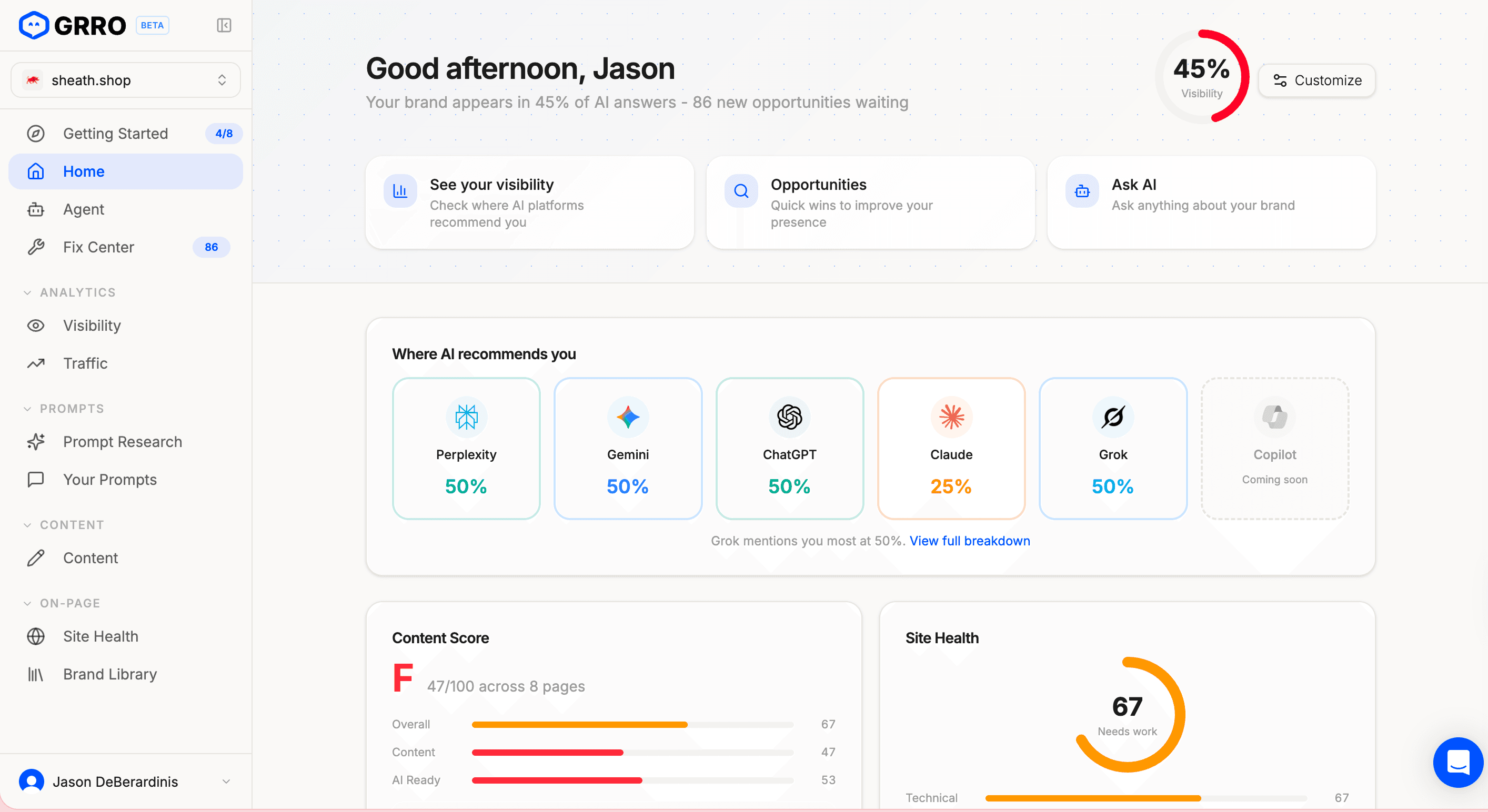
These predictions are not speculation. They are extrapolations from current growth trajectories, platform announcements, and behavioral data we have collected from tracking AI search across 200+ brands on the GRRO platform.
The current state of AI search in early 2026:
- 800 million+ weekly AI search queries across ChatGPT, Perplexity, Gemini, Claude, and Grok
- 527% year-over-year growth in AI search usage
- 40% of Gen Z uses AI search as their first research tool
- 61% CTR decline from Google pages with AI Overviews
- 4.4x higher conversion rate from AI search referrals compared to traditional organic
- 97% of businesses have measurable AI visibility gaps
These numbers tell a clear story. AI search is not an emerging trend. It is an accelerating shift that will define brand visibility for the next decade.
Prediction 1: AI Search Will Surpass 2 Billion Weekly Queries by Year-End
At the current 527% year-over-year growth rate, AI search volume will more than double from 800 million to over 2 billion weekly queries by December 2026. Even if growth decelerates to 300% (which would still represent a slowdown), weekly query volume will exceed 1.5 billion.
What is driving this growth:
- ChatGPT has over 200 million weekly active users as of early 2026, up from 100 million in early 2025
- Perplexity crossed 100 million monthly active users in Q4 2025
- Google's AI Overviews now appear on 47% of all search results pages, training users to expect AI-synthesized answers
- Apple Intelligence integration is pushing AI search to 1.5 billion iPhone users
- Microsoft is embedded in Windows, Office, and Edge, reaching 400 million+ monthly users
The compounding factor is habit formation. Once users experience getting a direct, synthesized answer instead of scrolling through 10 blue links, they do not go back. Every new user who switches to AI search becomes a permanent user.
What this means for brands: The total addressable market for AI search visibility is growing faster than any digital channel since social media in 2010. Brands that build AI visibility now are investing at the ground floor of a channel that will be 2-3x larger by year-end.
Prediction 2: Google Will Lose 15-20% of Informational Queries to AI
Google is not going to disappear. But its dominance over informational and research queries is eroding measurably.
The data is already visible. Pages with Google AI Overviews see a 61% drop in click-through rates. When Google itself provides an AI-synthesized answer at the top of the results page, users have less reason to click through to individual websites. This means Google is cannibalizing its own ecosystem.
Meanwhile, dedicated AI search engines are capturing the queries that Google answers poorly:
- Complex comparisons: "What is the best CRM for a 50-person sales team that integrates with HubSpot and costs under $100/seat?" Google gives you 10 links. Perplexity gives you a direct, sourced answer.
- Multi-step research: "I want to start a podcast. What equipment do I need, how much will it cost, and what hosting platform should I use?" AI engines synthesize an answer from dozens of sources in seconds.
- Personalized recommendations: "What is the best laptop for a graphic designer who travels frequently and needs 12+ hours of battery life?" AI engines weigh multiple criteria simultaneously.
By December 2026, we project Google will handle 15-20% fewer informational queries than it did in December 2025. Those queries are not disappearing. They are migrating to ChatGPT, Perplexity, Claude, and Gemini.
What this means for brands: If 20% of your organic traffic comes from informational queries (and for most content-heavy sites, it is 40-60%), you could see a material decline in website traffic even if your Google rankings stay the same. The solution is not to abandon Google SEO but to ensure your brand is visible in the channels where those queries are moving. Read our ROI framework for how to measure and justify this investment.
Prediction 3: AI Recommendation Will Become a Tracked Marketing KPI
In 2025, most companies had no way to track whether AI engines recommended their brand. By the end of 2026, AI recommendation rate will sit alongside organic rankings, paid media ROAS, and social engagement as a standard marketing KPI.
Why this is inevitable:
-
The data is becoming available. Platforms like GRRO now track AI recommendations across all 5 major AI engines in real time using prompt intelligence and automated monitoring. As these tools mature, AI visibility data will flow into the same dashboards where marketing teams track every other channel.
-
The revenue impact is measurable. With AI search referrals converting at 4.4x the rate of traditional organic, the revenue attribution is significant enough to demand executive attention. A brand that gets recommended by Perplexity for a high-intent commercial query is generating measurable pipeline.
-
Competitive pressure will force adoption. When the first brand in a category starts reporting "we are recommended by 5 out of 5 AI engines for our top 20 commercial queries" in their board deck, every competitor will scramble to measure the same thing.
-
Agency accountability. Marketing agencies will be evaluated on AI search performance. "Are we getting recommended by AI?" will become a standard client question, just as "what are our Google rankings?" became standard 15 years ago.
What this means for brands: Start tracking your AI recommendation rate now, before it becomes a competitive requirement. Run a free scan on GRRO to establish your baseline. Companies that have 6-12 months of trend data when AI search KPIs become standard will have a significant analytical advantage.
Prediction 4: Multi-Modal AI Search Will Expand the Visibility Surface Area
Text queries are just the beginning. By the end of 2026, AI search will span voice, image, and video inputs, dramatically expanding where and how brands need to be visible.
Voice AI search is already here. ChatGPT's voice mode, Siri with Apple Intelligence, Google Assistant with Gemini, and Alexa with LLM integration mean that hundreds of millions of users are asking AI questions verbally. Voice queries tend to be longer, more conversational, and more specific than typed queries: "Hey, what is a good Italian restaurant near downtown that is not too expensive and has outdoor seating?" versus "Italian restaurant downtown."
Image search is expanding rapidly. Google Lens processes 12 billion visual searches per month. ChatGPT and Gemini both support image input. Users are taking photos of products and asking "where can I buy this?" or "what is this and how much does it cost?" Brands with properly tagged, high-quality product images and visual schema markup will capture these queries.
Video context is emerging. AI engines are beginning to process video content, extracting transcripts, identifying products, and understanding visual context. YouTube descriptions, video transcripts, and VideoObject schema will become increasingly important for AI visibility.
What this means for brands: AI visibility strategy cannot be limited to text content and web pages. Brands need to think about how they appear across modalities: voice-friendly content structure, image alt text and visual search optimization, video transcripts and structured metadata. The brands that think multi-modally now will dominate AI search as these input types grow.
Prediction 5: AI Engines Will Develop Brand Preference Algorithms
Today, AI engines aim to be neutral recommenders. By the end of 2026, that will start to change as these platforms develop revenue models around brand visibility.
The signals are already emerging:
- Perplexity launched sponsored search results in late 2025
- Google AI Overviews are beginning to integrate ad placements
- ChatGPT's partnership model with publishers (like the Associated Press and Axel Springer deals) creates tiered access to content
- Microsoft is exploring "promoted answers" within responses
This does not mean AI search will become pay-to-play overnight. But it does mean that AI engines will develop more sophisticated brand preference signals that go beyond raw content quality. These may include:
-
First-party data partnerships. Brands that share data with AI platforms (product feeds, pricing APIs, availability data) will receive preferential treatment in recommendations, similar to how Google Shopping requires a product feed.
-
Verified brand programs. AI engines may offer brand verification programs that provide enhanced visibility, similar to social media verification but with direct impact on recommendation frequency.
-
Content licensing agreements. Brands that license their content to AI platforms may receive guaranteed recommendation placement, similar to how news publishers currently negotiate with AI companies.
What this means for brands: Build your organic AI visibility now, while it is still primarily earned through content quality and structured data. The brands that establish strong AI recommendation rates organically will be in the best position to supplement with paid AI visibility when those options become available.
Prediction 6: First-Party Data Will Become Critical for AI Visibility
As third-party cookies disappear and privacy regulations tighten, AI engines are increasingly relying on first-party data signals to assess brand authority and relevance.
What first-party data means for AI search:
-
Direct website engagement data. AI engines can access aggregate engagement metrics (time on page, bounce rate, return visits) through partnerships with analytics providers and browser data. Websites with strong engagement signals will be treated as more authoritative sources.
-
Product and pricing feeds. Brands that maintain real-time product data feeds will appear in AI shopping and comparison recommendations more accurately and more frequently. Stale or missing product data means lost recommendations.
-
Customer review and testimonial data. AI engines cross-reference review data across platforms. Brands that actively manage their review presence across Google, G2, Capterra, Trustpilot, and industry-specific platforms provide AI engines with richer, more trustworthy signals.
-
API-accessible content. Brands that make their content programmatically accessible (through sitemaps, RSS feeds, and APIs) are easier for AI engines to index and keep current. The technical infrastructure that makes your content machine-readable is becoming a competitive advantage.
What this means for brands: Invest in data infrastructure. Maintain accurate, real-time product feeds. Keep your review profiles active across multiple platforms. Make your content easy to crawl and index. The brands with the cleanest, most accessible first-party data will have an inherent advantage in AI recommendations.
Prediction 7: Companies Without AI Search Strategy Will Lose 30%+ Organic Traffic
This is the prediction that matters most for marketing leaders evaluating budget allocation right now.
Here is the math. If AI search captures 20% of informational queries (Prediction 2), and your site generates 50% of its traffic from informational content, that is a potential 10% traffic loss from query migration alone. Add in the 61% CTR decline from Google AI Overviews on remaining Google queries, and the compounding effect pushes total organic traffic loss to 25-35% for content-heavy businesses.
We are already seeing this in the data. Across the 200+ brands we track on the GRRO platform, companies with no AI search strategy saw an average 18% decline in organic traffic between Q1 2025 and Q1 2026. Companies that actively invested in AI visibility during the same period saw organic traffic increase by an average of 12%, because AI search referral traffic more than offset Google traffic losses.
The gap between these two groups will widen as AI search volume grows from 800 million to 2 billion weekly queries.
Industry-specific vulnerability:
| Industry | Estimated Traffic Risk (No AI Strategy) | Primary Threat |
|---|---|---|
| SaaS/Technology | 35-40% | Comparison and evaluation queries moving to AI |
| Healthcare/Medical | 30-35% | Symptom and provider recommendation queries |
| Financial Services | 25-30% | Rate comparison and product selection queries |
| Legal | 25-30% | "Do I need a lawyer" and provider recommendation queries |
| E-commerce | 20-25% | Product comparison and "best of" queries |
| Local Services | 20-25% | "Best [service] near me" queries |
What this means for brands: The cost of inaction is measurable and growing. Every quarter you delay building AI search visibility is a quarter of compounding competitive disadvantage. The brands moving now are not just protecting existing traffic. They are capturing a new, high-converting channel that their competitors are ignoring.
What to Do Right Now
These predictions are not distant scenarios. They are playing out over the next 10 months. Here is a 3-step plan to get ahead of them.
Step 1: Establish your baseline. Run a free AI recommendation scan to see where your brand stands across all 5 major AI engines today. You cannot improve what you do not measure.
Step 2: Implement the fundamentals. Build answer-first content, implement schema markup, and establish multi-source authority. These are the table stakes that 97% of businesses are still missing. Read our guide on how to get recommended by AI for the complete playbook.
Step 3: Build measurement infrastructure. Start tracking AI recommendation rates as a KPI now. GRRO's search visibility tracking monitors your presence across ChatGPT, Perplexity, Gemini, Claude, and Grok, so you can measure progress and demonstrate ROI to leadership.
FAQ
Will AI search actually replace Google?
No, not entirely. Google will remain dominant for transactional queries (shopping, booking, navigating to specific websites) and certain local searches. What is changing is the informational and research layer. Queries where users want synthesized answers, comparisons, and recommendations are migrating to AI search engines. Google's own AI Overviews are an acknowledgment of this shift. The practical impact is that brands need to be visible in both traditional search and AI search, not one or the other.
How confident are these predictions?
These predictions are based on current growth trajectories, platform data, and behavioral trends observed across 200+ brands. The directional trends (AI search growth, Google traffic erosion, AI KPI adoption) are highly confident. The specific numbers (2 billion weekly queries, 15-20% informational query loss, 30% traffic decline) represent our best estimates and could vary by 20-30% in either direction depending on platform adoption rates and Google's competitive response.
When should a company start investing in AI search visibility?
Now. Every month of delay is a month where competitors may be building AI visibility that compounds over time. The businesses that invested in SEO in 2005 had a 10-year head start that was nearly impossible to close. AI search is at a similar inflection point. The cost of entry is lowest now, the competition is thinnest now, and the early-mover advantage is greatest now.
How much budget should companies allocate to AI search in 2026?
We recommend allocating 15-20% of your current SEO budget to AI search visibility efforts. For most mid-market companies, that translates to $2,000-$8,000 per month. Given the 4.4x conversion advantage of AI search referrals, the ROI typically justifies this allocation within 60-90 days. See our full ROI measurement framework for detailed budgeting guidance.
What happens to traditional SEO?
Traditional SEO remains important because AI search engines still rely on traditional search indexes as their primary data source. The RAG pipeline that powers AI recommendations starts with retrieving pages from search indexes like Bing, Brave, and Google. Ranking in the top 20 of traditional search is still a prerequisite for being recommended by AI. The difference is that traditional SEO alone is no longer sufficient. You need both traditional search visibility and AI-specific optimization.
Conclusion
The 7 predictions in this piece point to a single conclusion: AI search is not a future trend to monitor. It is a present reality that is reshaping brand visibility right now. With 800 million weekly queries growing toward 2 billion, a 61% CTR decline from AI Overviews, and 97% of businesses still unprepared, the window for early-mover advantage is open but closing. The brands that build AI search visibility in 2026 will define the competitive landscape for the next decade. The brands that wait will spend the next decade trying to catch up. Start by measuring where you stand, implement the fundamentals, and build measurement into your marketing stack. The data is clear, the trajectory is set, and the time to act is now.

Co-Founder & CMO at GRRO