How Google Gemini Recommends Brands: The Complete Guide
Google Gemini uses Google Search, the Knowledge Graph, and Shopping data to generate AI-powered brand recommendations. This guide explains the full architecture, how Gemini decides which brands to mention, and what marketers need to do to earn visibility in Gemini answers.

Key Takeaways
- Google Gemini draws from Google Search results, the Knowledge Graph, Google Shopping data, YouTube, and Google Maps when generating brand recommendations
- Gemini is the only major AI engine with direct access to Google's full search index, making traditional Google SEO a prerequisite for Gemini visibility
- Google's Knowledge Graph plays a massive role in brand recommendations because it tells Gemini which entities are real, credible, and connected to relevant topics
- AI Overviews (the AI-generated summaries at the top of Google search results) use the same Gemini models, meaning optimizing for one optimizes for both
- Schema markup, Google Business Profile, and structured data carry more weight in Gemini than in any other AI engine because Gemini natively understands Google's structured data formats
Why Gemini Matters More Than Most Marketers Realize
Google Gemini is not just another AI chatbot. It is embedded directly into Google Search through AI Overviews, integrated into Android devices, available through the Gemini app, and woven into Gmail, Google Docs, and the entire Google Workspace ecosystem. By conservative estimates, Gemini-powered answers reach over 1 billion users per month through these combined touchpoints.
For marketers, Gemini represents the convergence of traditional Google SEO and AI search optimization. Because Gemini draws directly from Google's search index and Knowledge Graph, the brands that have invested in strong Google SEO already have a head start. But having a head start is not the same as being visible. Gemini applies its own evaluation layer on top of Google Search results, and many brands that rank well organically still fail to appear in Gemini's AI-generated recommendations.
This guide breaks down exactly how Gemini's recommendation pipeline works, what signals it prioritizes, and what you need to do differently to move from ranking on Google to being recommended by Gemini.
For context on how AI search engines work broadly before diving into Gemini specifics, see our guide on how AI engines decide what to recommend.
Gemini's Architecture: How the Recommendation Pipeline Works
Gemini operates on a retrieval-augmented generation (RAG) architecture, but with access to data sources no other AI engine can match. Understanding each component is essential for building an effective Gemini strategy.
Google Search Integration
When a user asks Gemini a question that benefits from web information, Gemini triggers a real-time Google Search query. Unlike ChatGPT (which queries Bing) or Perplexity (which queries Bing and Brave), Gemini queries Google's own search index. This means your Google Search rankings directly determine whether your content enters Gemini's retrieval pool.
The retrieval pulls the top 10 to 20 Google Search results for the interpreted query. Pages ranking in positions 1 to 10 have the highest likelihood of being retrieved. Pages ranking 11 to 20 have a reduced but still meaningful chance. Pages below position 20 are rarely included in the initial retrieval.
The Knowledge Graph
Google's Knowledge Graph is a structured database of over 500 billion facts about real-world entities: people, companies, products, places, and concepts. When Gemini generates an answer, it cross-references its web search results with Knowledge Graph data.
If your brand has a Knowledge Graph entity (visible as the Knowledge Panel that appears on the right side of Google search results when you search your brand name), Gemini has a structured understanding of who you are, what you do, and how you relate to other entities. GRRO's source citation analytics tracks which Knowledge Graph entities and third-party sources influence your Gemini recommendations. If your brand does not have a Knowledge Graph entity, Gemini treats you as an unknown and is far less likely to include you in recommendations.
Building a Knowledge Graph presence requires:
- A well-structured Wikipedia article (the most powerful Knowledge Graph trigger)
- Consistent NAP data (name, address, phone) across business directories
- Schema markup on your website defining your organization, products, and key people
- Wikidata entries for your brand and key executives
- Coverage in Google-trusted sources like news publications, industry databases, and authoritative directories
Google Shopping and Product Data
For product-related queries, Gemini accesses Google Shopping data. Brands with active Google Merchant Center feeds, product listings, and Google Shopping ads have their product data directly available to Gemini. This is particularly powerful for e-commerce brands because Gemini can recommend specific products with pricing, availability, and review data pulled from Google Shopping.
If you sell products and do not have an active Google Merchant Center feed, you are invisible to Gemini for product recommendation queries.
YouTube Integration
Gemini can access and reference YouTube content. For queries where video content is relevant, Gemini may recommend brands based on their YouTube presence. Brands with well-optimized YouTube channels, strong video descriptions, and properly tagged content gain an additional recommendation vector.
Google Maps and Local Data
For location-based queries, Gemini pulls from Google Maps, Google Business Profile data, and local review signals. This is critical for local businesses. A query like "best Italian restaurant in downtown Chicago" will trigger Gemini to recommend businesses based on their Google Business Profile ratings, review count, review recency, and local SEO signals.
How Gemini Evaluates Content for Recommendations
Once Gemini retrieves content through its data sources, it applies a multi-layer evaluation to determine which brands and content to include in its answer.
Authority and E-E-A-T
Google's E-E-A-T framework (Experience, Expertise, Authoritativeness, Trustworthiness) carries directly into Gemini's evaluation. Content from recognized industry experts, established publications, and authoritative domains receives preferential treatment. Gemini can identify author entities through schema markup and cross-reference them with Knowledge Graph data.
Practically, this means:
- Articles with author bylines from recognized experts score higher than anonymous content
- Content from domains with long publishing histories in a specific topic area scores higher than new entrants
- Pages that are cited and referenced by other authoritative sources gain compound authority signals
Content Structure and Answer Extractability
Gemini follows the same chunk-and-rerank pattern as other AI engines but with a deeper understanding of HTML structure because Google has decades of experience parsing web pages.
Gemini particularly values:
| Structural Element | Why Gemini Favors It |
|---|---|
| H2/H3 headings matching query patterns | Direct mapping between user question and content section |
| First-paragraph answers | Efficient extraction of the core response |
| Structured tables | Clean data extraction for comparison queries |
| Numbered lists | Sequential information that maps to step-by-step answers |
| FAQ sections with schema | Pre-formatted question-answer pairs ready for extraction |
| Definition-style opening sentences | Direct answers to "what is" queries |
Freshness Signals
Gemini processes freshness through two lenses:
- Published/modified dates: Gemini reads schema markup, meta tags, and visible dates to determine when content was created and last updated
- Google's crawl data: Because Gemini has access to Google's crawl history, it knows when content was last indexed and how frequently a page changes
Content published within the last 30 days gets a freshness boost for time-sensitive queries. Evergreen content with recent "dateModified" signals maintains relevance longer. Content over 12 months old without updates gradually loses Gemini trust for competitive queries.
Multi-Source Validation
Like all AI engines, Gemini cross-references claims across multiple sources. A brand mentioned only on its own website triggers lower confidence than a brand mentioned across its website, industry publications, LinkedIn, review platforms, and community forums.
Gemini's unique advantage is that it can validate multi-source presence through Google's own index, which is the most comprehensive web index available. If your brand is mentioned across sources that Google indexes well, Gemini sees all of it.
AI Overviews: Gemini's Most Important Touchpoint
Google AI Overviews are the AI-generated summaries that appear at the top of Google Search results for an increasing percentage of queries. They are powered by the same Gemini models that run the standalone Gemini chatbot.
AI Overviews now appear on approximately 30% to 40% of Google search queries, and that percentage is growing. For marketers, AI Overviews represent the single highest-reach AI visibility opportunity because they appear directly within the Google search experience that billions of people already use daily.
How AI Overviews Select Sources
AI Overviews typically pull from 3 to 5 sources that rank in the top 10 to 15 Google Search results for the query. The selection criteria emphasize:
- Direct answer relevance: Does the content directly answer the search query?
- Source diversity: AI Overviews prefer pulling from multiple domains rather than citing one source repeatedly
- Content comprehensiveness: Sources that cover multiple aspects of a query are preferred over narrow treatments
- Structured data: Pages with proper schema markup are easier for AI Overviews to parse and cite
For a deeper analysis of how to optimize specifically for AI Overviews, see our dedicated guide on optimizing for Google AI Overviews.
Brand Recommendations in AI Overviews
When users search for product categories, service comparisons, or "best of" queries, AI Overviews frequently generate brand recommendations. These recommendations are drawn from the same Knowledge Graph and web search data that Gemini uses, meaning the optimization strategies overlap completely.
The brands that appear in AI Overviews for category queries tend to have:
- Strong Google organic rankings for the target query
- Active Knowledge Graph entities
- Positive review signals across Google Business Profile and third-party review sites
- Schema markup that clearly defines their products and services
- Coverage in multiple authoritative sources
Gemini vs Other AI Engines: Key Differences for Marketers
Understanding where Gemini differs from other AI engines helps you allocate effort correctly.
| Factor | Gemini | ChatGPT | Perplexity | Claude |
|---|---|---|---|---|
| Search index | Bing | Bing + Brave + Own | Limited web search | |
| Knowledge Graph access | Full Google KG | None | None | None |
| Product data | Google Shopping | None | Limited | None |
| Local data | Google Maps + GBP | None | Limited | None |
| Schema markup impact | Very high | Moderate | Moderate | Low |
| YouTube influence | High | None | Moderate | None |
| Freshness window | 1 to 3 weeks | 2 to 4 weeks | 48 to 72 hours | Training data dependent |
| Reach | 1B+ monthly via AI Overviews | 500M+ weekly | 100M+ daily | Growing |
The key insight is that Gemini uniquely rewards investment in Google's ecosystem. Google Business Profile, Merchant Center, YouTube, Knowledge Graph, and schema markup all feed directly into Gemini's recommendation engine. No other AI engine has this level of integration with a single data ecosystem.
How to Get Your Brand Recommended by Gemini
1. Dominate Google Organic Rankings First
Gemini's retrieval starts with Google Search. If you do not rank in the top 10 to 15 for your target queries on Google, you will not enter Gemini's retrieval pool. Invest in traditional Google SEO as the foundation. Use our AI search optimization checklist as a starting framework.
2. Build Your Knowledge Graph Entity
If you search your brand name on Google and do not see a Knowledge Panel on the right side of the results, you do not have a Knowledge Graph entity. Building one requires consistent structured data across the web:
- Create or improve your Wikipedia page (follow Wikipedia's notability guidelines)
- Add your brand to Wikidata with complete structured information
- Implement Organization schema markup on your website
- Ensure consistent business information across all directories and citations
- Get coverage in Google News-approved publications
3. Maximize Schema Markup
Gemini understands Google's structured data formats natively. Implement:
- Organization schema with logo, founding date, founders, and social profiles
- Product schema with pricing, availability, and reviews
- Article schema with author, publication date, and modification date
- FAQ schema on relevant content pages
- How-to schema on instructional content
- Review schema with aggregate ratings
For a comprehensive implementation guide, read our article on structured data for AI search visibility.
4. Optimize Google Business Profile
For any business with a physical presence or service area, Google Business Profile is a direct Gemini data source. Keep your profile complete, respond to reviews, post regular updates, and ensure your business categories accurately reflect your services.
5. Activate Google Merchant Center
If you sell products, a complete Google Merchant Center feed gives Gemini direct access to your product data including pricing, images, availability, and reviews. Without this feed, Gemini cannot recommend your specific products in response to shopping queries.
6. Build YouTube Presence
Create YouTube content that addresses the same queries your written content targets. Optimize video titles, descriptions, and tags for your target keywords. Gemini can reference YouTube content in its answers, giving you an additional recommendation vector that most competitors ignore.
7. Invest in E-E-A-T Signals
Ensure your content has clear author bylines linked to credible author pages. Build your authors' personal brands through LinkedIn thought leadership, conference speaking, and contributions to industry publications. Gemini's E-E-A-T evaluation directly impacts whether your content gets recommended over competitors.
Common Mistakes That Reduce Gemini Visibility
Ignoring Schema Markup
Schema markup is optional for traditional Google SEO but increasingly essential for Gemini recommendations. Brands that skip schema markup are leaving structured data signals on the table that competitors can exploit.
Neglecting Google Business Profile
Even for non-local businesses, Google Business Profile provides Gemini with structured entity data. An incomplete or abandoned GBP sends negative signals about brand activity and relevance.
Focusing Only on Written Content
Gemini draws from Google's entire ecosystem. Brands that invest only in blog content and ignore YouTube, Google Shopping, and community presence limit their recommendation surface area.
Outdated Content Without Updated Timestamps
Publishing updated content without updating the dateModified in schema markup means Gemini cannot tell the content is fresh. Always update both the visible "last updated" date and the schema markup when refreshing existing content.
Missing Wikipedia and Wikidata Presence
For competitive recommendation queries, Knowledge Graph entities provide a significant advantage. Brands that qualify for Wikipedia notability but have not pursued a Wikipedia article or Wikidata entry are missing a high-impact Gemini signal.
FAQ
Does ranking #1 on Google guarantee Gemini will recommend my brand?
No. Ranking #1 on Google gets your content into Gemini's retrieval pool, but Gemini applies its own evaluation layer that considers authority, content structure, multi-source presence, and answer relevance. A page ranking #3 with better answer-first formatting and stronger schema markup can outperform the #1 result in Gemini's recommendations.
How does Google's Knowledge Graph affect Gemini recommendations?
The Knowledge Graph provides Gemini with structured data about entities. Brands with Knowledge Graph entities are recognized as established, credible organizations. Gemini is significantly more likely to recommend brands it can verify through the Knowledge Graph compared to brands that exist only in unstructured web content.
Are AI Overviews and Gemini the same thing?
AI Overviews are powered by Gemini models, so optimizing for one effectively optimizes for both. The primary difference is context: AI Overviews appear within Google Search results pages, while standalone Gemini provides a conversational chat interface. The underlying retrieval and recommendation logic is the same.
How important is Google Business Profile for Gemini visibility?
For businesses with physical locations or service areas, Google Business Profile is extremely important. Gemini pulls directly from GBP data for local and service-related queries. For purely digital businesses, GBP is less critical but still provides structured entity data that supports Knowledge Graph recognition.
How does Gemini handle product recommendations differently than ChatGPT?
Gemini has direct access to Google Shopping data, meaning it can recommend specific products with pricing, availability, images, and review ratings. ChatGPT does not have access to product databases and generates product recommendations based on web content alone. For e-commerce brands, this makes Gemini optimization through Google Merchant Center particularly valuable.
How often should I update content to maintain Gemini visibility?
For competitive queries, update your key content at least quarterly with new data, examples, and timestamps. For fast-moving industries, monthly updates are recommended. Always update the dateModified in both your visible content and schema markup. Gemini's freshness window is 1 to 3 weeks for new content and uses modification signals to assess ongoing relevance.
Can I track whether Gemini is recommending my brand?
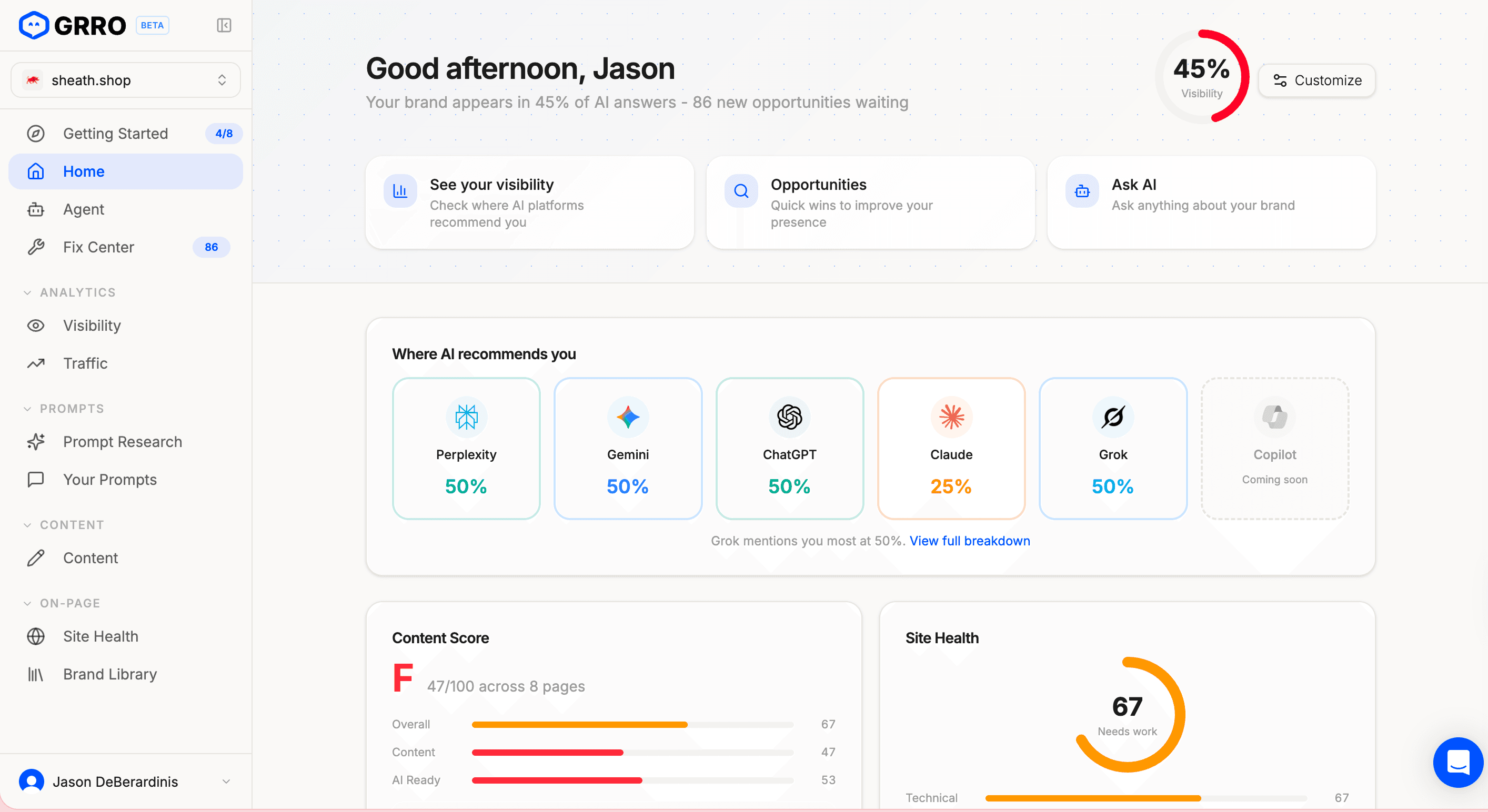
Manual tracking requires running queries through both the Gemini chatbot and checking AI Overviews in Google Search. At scale, GRRO's search visibility tracking automates this monitoring across all 5 major AI engines including Gemini, tracking your AI Visibility Score and identifying which queries trigger your brand recommendations.
Conclusion
Google Gemini occupies a unique position in the AI search landscape because it draws from Google's complete data ecosystem: Search, Knowledge Graph, Shopping, YouTube, Maps, and Business Profile. No other AI engine has access to this breadth of structured data, which means optimizing for Gemini requires a broader approach than optimizing for ChatGPT or Perplexity alone.
The brands that earn consistent Gemini recommendations invest across the full Google ecosystem. They maintain strong organic rankings, build Knowledge Graph entities through Wikipedia and structured data, keep Google Business Profile and Merchant Center feeds active, and create content structured for efficient AI extraction.
The convergence of traditional Google SEO and AI search optimization is most visible in Gemini. If you have strong Google fundamentals, you are closer to Gemini visibility than you think. If you do not, start there first.
Measure your current AI visibility across all engines, including Gemini and AI Overviews, with a free scan at GRRO. Understanding where you stand today is the first step toward building the comprehensive strategy that earns Gemini recommendations tomorrow.

Co-Founder & CMO at GRRO