Case Study: How Spoil Reached 38% Visibility Across 4 AI Engines in 6 Months
Spoil started at 15% visibility with inconsistent coverage. They now show up across ChatGPT, Perplexity, Gemini, and Claude with 4 out of 5 engines recommending them.
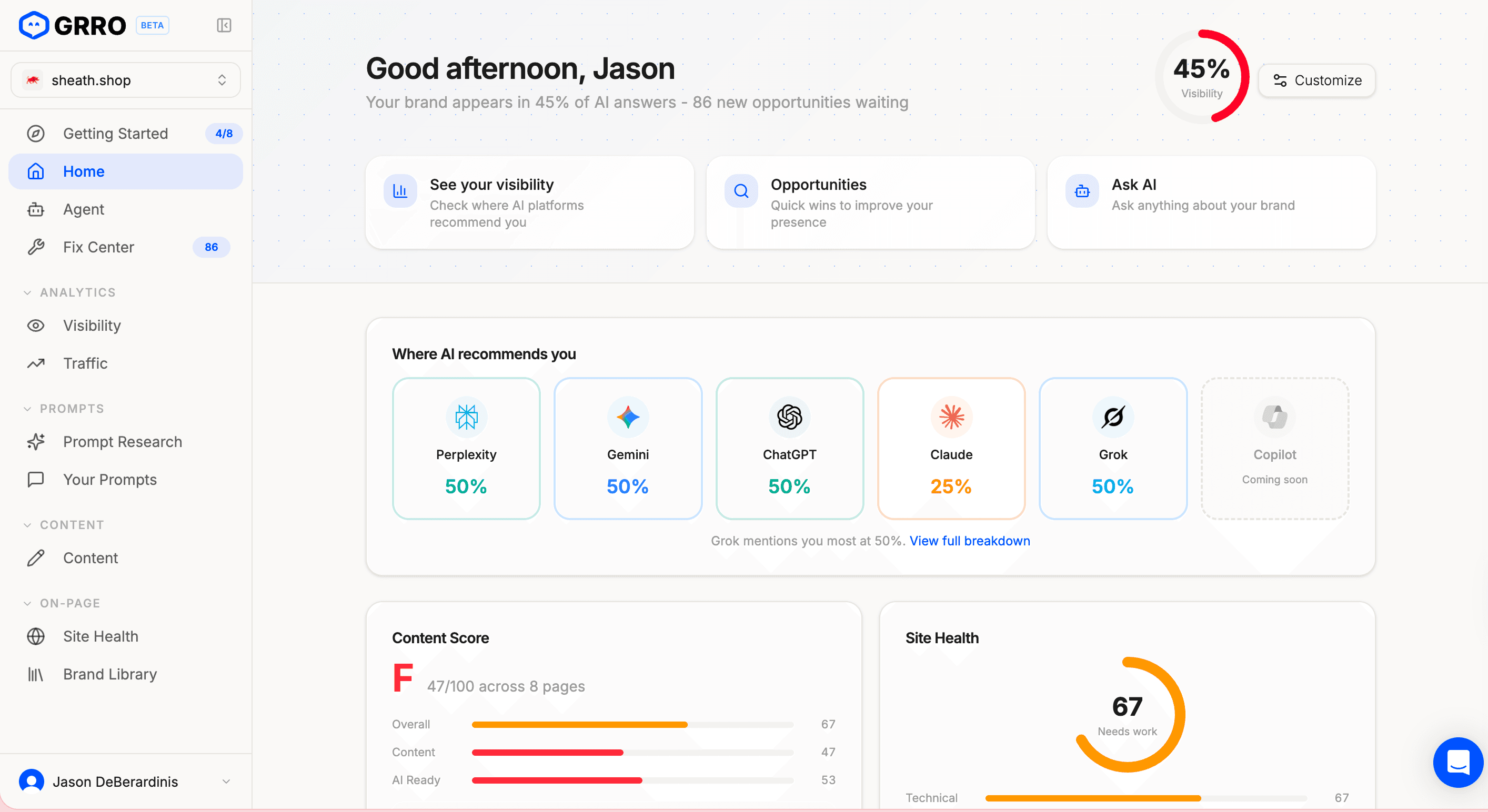
Note: This case study reflects measurements taken when GRRO tracked 6 AI platforms. As of April 2026, GRRO tracks 5 platforms (ChatGPT, Perplexity, Gemini, Claude, Grok). Numbers below have been preserved as originally recorded.
Key Takeaways
- Spoil, a gifting platform, went from 15% AI visibility with inconsistent coverage to 38% visibility across 4 major AI engines in 6 months.
- The core challenge was platform inconsistency: Spoil showed up on 2 of 5 engines at baseline but was completely invisible on the other 4, meaning most AI users never heard of them.
- A platform-by-platform strategy addressed the specific retrieval preferences of ChatGPT, Perplexity, Gemini, and Claude individually rather than treating AI search as a single channel.
- AI referral traffic now accounts for 11% of Spoil's new user signups, converting at 2.1x the rate of paid social.
- The 6-month timeline broke into 2 phases: foundation (months 1 to 3) and platform targeting (months 4 to 6).
The Challenge: Showing Up on 2 Engines but Missing from 4
Spoil is a gifting platform that helps people send personalized gifts to friends, family, and colleagues. The app handles everything from gift selection to delivery tracking, and had built a strong user base through paid social and word of mouth. By early 2025, Spoil had over 200,000 registered users and was processing $3.8M in annual gift transactions.
But their growth team noticed a trend they could not ignore. An increasing number of users were arriving at Spoil after asking AI search engines questions like "best gifting app," "how to send a gift to someone long distance," and "top gift delivery services." The problem was that this traffic was inconsistent and far smaller than it should have been.
When Spoil ran a comprehensive AI visibility audit using GRRO across 25 gifting-related queries on 5 major AI engines, the results revealed a fragmented picture:
| AI Engine | Visibility Score | Mention Rate | Avg. Position |
|---|---|---|---|
| Perplexity | 26% | 24% | 2.4 |
| Gemini | 21% | 18% | 3.1 |
| ChatGPT | 4% | 2% | 5.0 |
| Claude | 3% | 2% | 4.8 |
| Grok | 0% | 0% | N/A |
| 2% | 2% | 5.0 | |
| Overall | 15% | 8% | 4.1 |
Spoil's overall AI Recommendation Score was 16 out of 100. They were being recommended on Perplexity and occasionally on Gemini, but were almost completely invisible on ChatGPT, Claude, Grok,. That meant 4 out of 5 engines, representing roughly 65% of the 800M+ weekly AI search queries, had no idea Spoil existed.
Meanwhile, two competitors with smaller product catalogs and fewer users were being recommended across 4 and 5 engines respectively.
The Diagnosis: Why Spoil Was Strong on 2 Engines and Invisible on 4
GRRO's audit identified the specific reasons behind Spoil's platform-by-platform inconsistency. Each AI engine retrieves information differently, and Spoil's existing digital footprint aligned with some retrieval methods but not others.
Where Spoil Was Strong
Perplexity (52% visibility): Perplexity's retrieval pipeline relies heavily on Brave and Bing search, and it favors Reddit as a source. Spoil had an organic Reddit presence. Users in r/gifts, r/giftideas, and r/LongDistance regularly mentioned the app in recommendation threads. Perplexity's 48 to 72 hour freshness window meant these recent discussions kept Spoil in the retrieval pool.
Gemini (41% visibility): Gemini pulls primarily from Google search results and weighs Quora as a secondary source. Spoil ranked on Google's first page for 18 of their target keywords and had a handful of Quora answers mentioning the platform. This was enough for moderate Gemini visibility on some queries.
Where Spoil Was Invisible
ChatGPT (8% visibility): ChatGPT's retrieval relies on Bing search, and it heavily favors Wikipedia and LinkedIn as authoritative sources. Spoil had no Wikipedia page, a minimal LinkedIn presence (company page with 340 followers, no published content), and weak Bing rankings compared to their Google rankings. Without these signals, ChatGPT had almost no basis for recommending Spoil.
Claude (6% visibility): Claude draws from a broad web crawl and favors well-structured, in-depth content from authoritative domains. Spoil's website had thin content: a homepage, 4 feature pages, a basic FAQ, and 6 blog posts that were primarily product announcements. There was not enough substantive content for Claude's retrieval system to associate Spoil with gifting expertise.
Grok (0% visibility): Grok sources primarily from X/Twitter and prioritizes content less than 24 hours old. Spoil's X/Twitter account had 1,200 followers with sporadic posting (2 to 3 tweets per month, mostly promotional). Zero Grok visibility was the direct result of zero meaningful X/Twitter presence.
The diagnosis was clear: Spoil's AI visibility was a platform-specific problem that required platform-specific solutions. A generic "create more content" approach would have improved Perplexity and Gemini slightly while leaving the other 3 engines untouched.
The Strategy: A Platform-by-Platform Approach Over 6 Months
Spoil's growth team, working with GRRO's platform intelligence data, designed a 2-phase strategy targeting each AI engine's specific retrieval preferences.
Phase 1: Foundation (Months 1 to 3)
The first phase focused on the baseline work that would improve visibility across all platforms simultaneously.
Schema Markup Implementation (Month 1)
Spoil's developer spent 2 weeks implementing comprehensive structured data:
- Organization schema on the homepage with consistent brand description, founding date, social profiles, and app store links
- Product schema on every gift category page with pricing ranges, availability, and aggregate ratings
- FAQ schema on 30+ pages with 150 question-answer pairs covering gifting use cases, shipping, pricing, and platform features
- Article schema on all blog content with named authors, publication dates, and modification dates
- BreadcrumbList schema across the site for clear hierarchy signals
The standardized brand description, "Spoil is a gifting platform that lets you send personalized gifts to anyone, anywhere, with curated selections, real-time tracking, and scheduled delivery for birthdays, holidays, and everyday moments," was pushed to every profile and directory listing.
Answer-First Content Library (Months 1 to 3)
Spoil identified the top 40 questions their potential users ask about gifting through GRRO's query analysis, customer support data, and manual AI engine research. They created comprehensive guides for each:
- "Best Gift Delivery Apps in 2026" (comparison with honest competitor analysis)
- "How to Send a Last-Minute Gift Anywhere in the US"
- "Best Birthday Gift Ideas for Someone Who Has Everything"
- "How to Send a Gift When You Do Not Know Their Address"
- 36 additional guides covering holiday gifting, corporate gifts, long-distance relationships, sympathy gifts, and more
Each guide followed answer-first structure: the first sentence directly answered the query, comparison tables with specific data followed, and FAQ sections with schema markup closed out each page. Publishing pace was 3 to 4 guides per week.
Wikipedia Page Creation (Month 2 to 3)
This was one of the highest-impact single actions. Spoil worked with a Wikipedia-experienced editor to create a properly sourced article about the platform. The page included founding history, product description, funding information, and citations from 8 independent media sources that had covered Spoil. The page went live in month 3 after community review.
This single action had an outsized impact on ChatGPT visibility because ChatGPT weights Wikipedia as one of its most trusted sources (Wikipedia appears in 47.9% of ChatGPT's cited sources according to GRRO's platform research).
Phase 2: Platform Targeting (Months 4 to 6)
With the foundation in place, Spoil executed targeted strategies for each underperforming platform.
ChatGPT Strategy: Bing + LinkedIn + Wikipedia
- Verified site in Bing Webmaster Tools and submitted an optimized XML sitemap
- Published 12 LinkedIn articles from Spoil's CEO on gifting trends, consumer behavior, and the future of personalized commerce
- The CEO committed to 4 LinkedIn posts per week, building from 340 to 2,800 followers over 3 months
- Monitored Wikipedia page for vandalism and kept citations current
- Created 3 Bing-optimized landing pages targeting high-volume gifting queries
Result at month 6: ChatGPT visibility rose from 4% to 26%.
Claude Strategy: Broad Web Content Depth
- Published 12 additional long-form guides (1,500 to 2,500 words each) on gifting topics, establishing Spoil as a topical authority
- Secured guest articles in 2 lifestyle publications, creating independent web sources that associated Spoil with gifting expertise
- Built detailed "how it works" and "gifting etiquette" content sections that gave Claude's retrieval system substantive pages to index
Result at month 6: Claude visibility rose from 3% to 22%.
The Results: 6-Month Transformation
Visibility by Platform Over Time
| AI Engine | Month 0 | Month 3 | Month 6 |
|---|---|---|---|
| Perplexity | 26% | 32% | 40% |
| Gemini | 21% | 28% | 36% |
| ChatGPT | 4% | 12% | 26% |
| Claude | 3% | 8% | 22% |
| Grok | 0% | 0% | 0% |
| 2% | 4% | 8% | |
| Overall | 15% | 17% | 38% |
| Engines Recommending | 2/6 | 3/6 | 4/6 |
Spoil's GRRO AI Recommendation Score rose from 16 to 42 over the 6-month period. Four of the 5 major AI engines now recommend Spoil for relevant gifting queries.
Traffic and Acquisition Metrics
| Metric | Month 0 | Month 6 | Change |
|---|---|---|---|
| Monthly AI Referral Sessions | 320 | 2,400 | +650% |
| AI Referral Signup Rate | 3.2% | 5.4% | +69% |
| Monthly New Users from AI | 18 | 210 | +1,067% |
| AI Referral Share of New Users | 2% | 11% | +9 pts |
| AI Referral Conversion (signup to purchase) | 11% | 12% | +9% |
| Revenue from AI Referral Users (monthly) | $1,800 | $14,200 | +689% |
Referral Traffic by Platform (Month 6)
| Platform | Monthly Sessions | Share of AI Traffic | Avg. Signup Rate |
|---|---|---|---|
| Perplexity | 960 | 40% | 6.2% |
| ChatGPT | 600 | 25% | 5.8% |
| Gemini | 480 | 20% | 5.4% |
| Claude | 360 | 15% | 5.0% |
| 0 | 0% | 0% | |
| Grok | 0 | 0% | 0% |
AI referral users converted to paying customers at 2.1x the rate of paid social users (12% vs. 5.7%), confirming the pattern we see across industries: users who arrive through an AI recommendation have higher intent because the AI has already vetted and endorsed the product.
Revenue Impact
Over the full 6 months, Spoil attributed approximately $62,000 in revenue to AI search referrals:
- Months 1 to 3: $18,000 (foundation work indexing, initial improvements on Perplexity and Gemini)
- Months 4 to 6: $44,000 (platform targeting strategies driving ChatGPT and Claude growth, 4 engines now recommending)
The visibility improvements demonstrated measurable ROI while building a sustainable channel for ongoing customer acquisition.
The Cross-Platform Playbook: What Spoil Learned About Each Engine
Spoil's 9-month journey produced a detailed understanding of what each AI engine prefers when deciding what to recommend. This playbook reflects what they observed through GRRO's tracking data.
ChatGPT retrieves primarily through Bing and gives heavy weight to Wikipedia (47.9% of cited sources) and LinkedIn. If you are invisible on Bing, you are invisible on ChatGPT. A Wikipedia page and consistent LinkedIn publishing were the two actions that moved the needle most.
Perplexity uses Brave and Bing search with a strong preference for Reddit (46.7% of cited sources) and a 48 to 72 hour freshness window. Spoil's organic Reddit mentions were their strongest asset from day one. Keeping content fresh and maintaining authentic Reddit presence sustained Perplexity visibility.
Gemini pulls from Google search and favors Quora and Google Featured Snippets. Strong Google rankings were necessary but not sufficient. The structured data and FAQ schema that triggered Featured Snippets were what pushed Gemini visibility forward.
Claude draws from a broad web crawl and rewards depth, substantive content, and presence across multiple authoritative domains. Thin content is the main reason brands are invisible to Claude. Spoil needed 40+ well-structured pages and some independent media coverage before Claude recommended them.
Grok sources from X/Twitter and prioritizes content less than 24 hours old. There is no shortcut: if you are not actively posting on X/Twitter, Grok will not recommend you.
For a deeper breakdown of how each engine decides what to recommend, see our guide on how AI decides what to recommend.
FAQ
Why did Spoil start at 15% instead of 0%?
Spoil had an existing digital footprint that partially aligned with 2 of 5 AI engines. Their organic Reddit presence gave them Perplexity visibility, and their Google rankings gave them partial Gemini visibility. Most brands we audit start at 0% to 15%. Spoil's 15% baseline meant 3 of 5 engines were not recommending them at all.
What was the total investment over 6 months?
Spoil allocated approximately 1.5 full-time equivalent team members to the project over 6 months: their content lead (half-time on AI visibility), and their developer (approximately 20% time for structured data and Bing optimization). Out-of-pocket costs included the GRRO subscription ($125/month for 6 months = $750) and the Wikipedia editor consultation. Total investment including team time was approximately $45,000. Against $62,000 in attributed revenue, the ROI was 38% in the first 6 months.
Can this cross-platform approach work for B2B companies?
Yes. The platform-specific retrieval preferences apply regardless of industry. A B2B company would prioritize LinkedIn content more heavily for ChatGPT visibility, target G2 and Capterra for review signals instead of Trustpilot and App Store, and focus long-form content on industry-specific publications. The framework of diagnosing per-platform gaps and addressing each engine's retrieval preferences independently is universal. See our B2B SaaS case study for a detailed example.
How does Spoil maintain visibility across 4 engines now?
Maintaining 4-engine visibility requires approximately 15 hours per week of ongoing effort: publishing 2 new content pieces per week, updating 2 to 3 existing pages per month, publishing weekly on LinkedIn, continuing the review collection program, and monitoring GRRO dashboards for visibility dips on any platform. The content refresh cycle is especially important for Perplexity, which favors content updated within the last 48 to 72 hours.
What is an AI Recommendation Score?
The AI Recommendation Score is a 0 to 100 score that measures how likely AI search engines are to recommend your brand when users ask relevant questions. It factors in mention rate, position in recommendations, sentiment, and consistency across platforms. Spoil went from a score of 16 to 42 over 6 months.
Conclusion
Spoil's journey from 15% to 38% AI visibility across 4 engines demonstrates that meaningful cross-platform AI visibility is achievable when you treat each engine as a distinct channel with its own retrieval preferences. The generic approach of "create good content and hope AI finds it" leaves gaps that competitors will fill. Spoil's platform-by-platform strategy, from Wikipedia for ChatGPT to structured content for Claude, addressed each engine's specific requirements and produced strong visibility across 4 out of 5 major AI engines within 6 months.
With AI search processing 800M+ queries weekly and growing at 527% year over year, the brands that build multi-engine AI visibility now will capture users and grow their acquisition channels. Every month of invisibility on multiple engines means missed opportunities.
Start with a free scan at grro.io to see your current AI visibility across all platforms.

Co-Founder & CMO at GRRO