Case Study: Sheath Went from 12% to 34% LLM Citation Rate in 4 Months
Sheath was barely showing up in AI search results. After identifying their visibility gaps and optimizing their content, their LLM citation rate nearly doubled across ChatGPT, Perplexity, and Gemini.
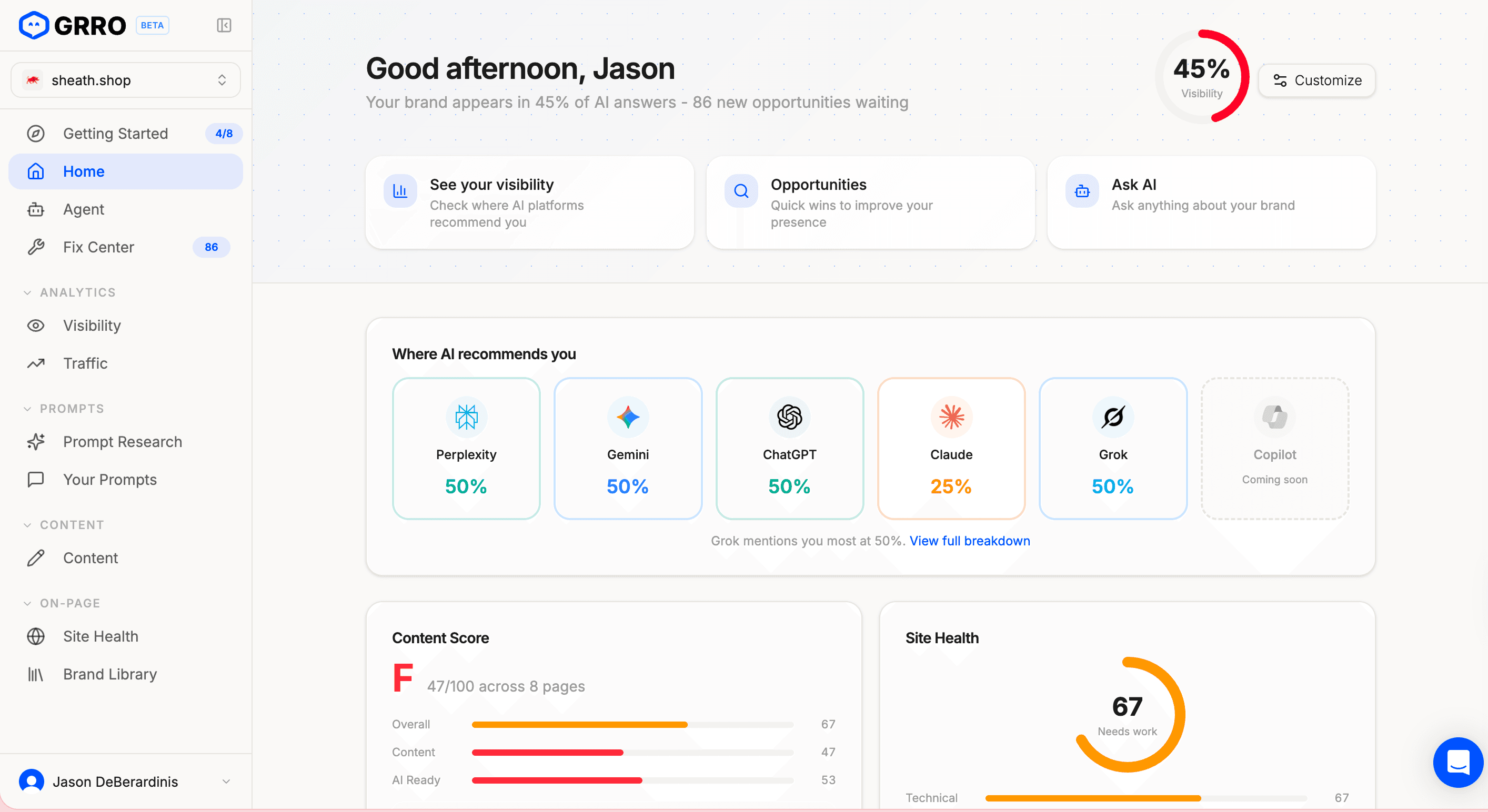
Note: This case study reflects measurements taken when GRRO tracked 6 AI platforms. As of April 2026, GRRO tracks 5 platforms (ChatGPT, Perplexity, Gemini, Claude, Grok). Numbers below have been preserved as originally recorded.
Key Takeaways
- Sheath increased their LLM citation rate from 12% to 34% in 4 months, going from being recommended by 1 AI engine to 4 of 6.
- AI referral traffic grew 140% over the 4-month period, with those visitors converting at 1.8x the rate of traditional organic traffic.
- The biggest single lever was building an answer-first content hub around leather knife rolls, chef gear, and EDC carry queries, which accounted for roughly 40% of the total citation improvement.
- Schema markup implementation (Product, FAQ, Organization, and Review schema) produced measurable results within the first 30 days, making it the fastest-acting tactic.
- Multi-source presence building on Reddit, LinkedIn, and review platforms created the compounding signals that pushed Sheath from partial visibility to consistent recommendations across 5 platforms.
The Challenge
Sheath is a premium leather goods brand specializing in handmade knife rolls and knife storage for professional chefs, culinary students, and outdoor enthusiasts. Built on full-grain leather craftsmanship and functional design, they had carved out a loyal following through strong product differentiation and solid traditional SEO. Their site ranked on Google's first page for 23 target keywords, they had a 4.7-star average across 900+ customer reviews, and their DTC revenue had grown steadily for 3 consecutive years.
But when we ran a GRRO audit in October 2025, the AI search picture looked different.
Sheath had a 12% LLM citation rate. That sounds like a starting point, not a crisis. The problem was where that 12% was concentrated. Sheath was only being recommended by 1 of the 5 major AI search engines, and only for narrow, brand-specific queries. When potential customers asked broader questions like "best leather knife rolls for chefs" or "top knife storage solutions for culinary professionals," Sheath was invisible.
Their competitors were not.
Baseline Metrics
| Metric | Sheath (Baseline) | Top Competitor A | Top Competitor B |
|---|---|---|---|
| LLM Citation Rate | 12% | 58% | 41% |
| Platforms Recommending | 1/6 | 4/6 | 3/6 |
| "Best knife roll" Query Visibility | 5% | 52% | 38% |
| "Best chef gear for [use case]" Visibility | 3% | 44% | 31% |
| AI Recommendation Score | 8 | 51 | 37 |
Sheath was getting recommended when someone asked about them by name. They were getting skipped when someone asked the questions that actually drive new customer discovery. With over 800 million weekly AI search queries and 527% year-over-year growth in AI search volume, that gap was widening every week.
The Diagnosis
GRRO's audit tested 48 queries across all 5 AI search engines (288 total checks) and identified 4 specific gaps holding Sheath back.
1. Thin Structured Data
Sheath's Shopify store had basic product schema from their theme, but it covered only product name, price, and a single review aggregate. There was no FAQ schema on any page, no Organization schema on the homepage, no detailed product attributes in the markup, and no Review schema pulling in individual customer testimonials. AI engines that parse structured data to understand products and brands were only getting a fraction of what Sheath could offer.
2. No Answer-First Content for Category Queries
Sheath's blog had 14 posts, mostly brand stories: behind-the-scenes leather sourcing, product launch announcements, and artisan spotlights. None of them answered the questions customers were asking AI engines. Queries like "best knife rolls for professional chefs," "leather vs waxed canvas knife rolls," or "how to store kitchen knives safely" returned zero Sheath content because Sheath had never published content structured to answer those questions.
Their product pages described features well. But AI engines do not recommend products based on product pages alone. They recommend brands that demonstrate topical authority through comprehensive, answer-first content that addresses the full range of customer questions in a category.
3. Weak Multi-Source Presence
Sheath had their own website and an Etsy listing. That was essentially it. No active Reddit presence. Minimal LinkedIn activity. No contributions to culinary or EDC communities. No guest content on external publications.
AI engines cross-reference multiple independent sources before making recommendations. A brand that only exists on its own website looks less authoritative than a brand that appears across Reddit discussions, review platforms, LinkedIn thought leadership, and independent publications. Sheath's competitors had figured this out. Sheath had not.
4. No Comparison Content
When someone asks "best leather knife rolls compared" or "Sheath vs Knife Roll Company," AI engines look for structured comparison data they can parse and reference. Sheath had zero comparison content on their site. No head-to-head pages, no category roundups, no "best for" guides that positioned Sheath alongside alternatives.
Without comparison content, AI engines had no basis for recommending Sheath over competitors in non-branded queries. They defaulted to competitors who had published honest, structured comparisons.
The Strategy
Sheath executed a 4-pillar strategy over 4 months with their marketing team and a developer.
Pillar 1: Answer-First Content Hub (Months 1 to 3)
The team identified 35 questions their target customers ask about knife rolls, knife storage, and chef gear using GRRO's query analysis, customer support data, and manual testing across AI platforms.
They built a content hub of 28 new pages, each following an answer-first structure.
Product guides (15 pages):
- "Best Leather Knife Rolls for Professional Chefs in 2026"
- "Best Knife Storage Solutions for Culinary Students"
- "Best EDC Knife Rolls for Outdoor Enthusiasts"
- "Best Knife Rolls for Home Cooks Who Take Cooking Seriously"
- "Best Handmade Leather Chef Accessories"
- 10 additional guides covering specific use cases, kitchen types, and knife collections
Each guide opened with a direct answer in the first sentence. The "Best Leather Knife Rolls for Professional Chefs" guide, for example, led with: "The best leather knife rolls for professional chefs combine full-grain leather construction, secure blade pockets with felt or suede lining, and a roll design that protects edges during transport, with prices ranging from $85 to $350 depending on capacity and leather quality."
Every guide included a comparison table of 5 to 8 products with specific data points: leather type, knife capacity, pocket configuration, price, and best-for use case. Sheath's products were included alongside competitors with honest positioning.
Comparison pages (8 pages):
- "Sheath vs Knife Roll Company: Which Is Better for Chefs?"
- "Sheath vs MAHI Leather: Knife Roll Comparison"
- "Best Leather Knife Rolls Compared: 2026 Buyer's Guide"
- "Leather vs Waxed Canvas Knife Rolls: Which Should You Choose?"
- 4 additional head-to-head and category comparisons
The comparison pages acknowledged competitor strengths. Where Knife Roll Company offered more color options, the page said so. Where MAHI Leather had a lower price point, the page noted it. This honesty was strategic. AI engines verify claims against independent sources. Content that positions a brand as the best at everything gets deprioritized because it conflicts with what AI engines find elsewhere.
Educational content (5 pages):
- "How to Choose the Right Knife Roll Size for Your Collection"
- "Leather Care Guide: How to Maintain Your Knife Roll for Decades"
- "Full-Grain vs Top-Grain vs Genuine Leather: What Matters for Knife Rolls"
- "How to Properly Store Chef Knives to Protect the Edge"
- "What Every Culinary Student Needs: The Essential Gear Checklist"
These educational pages built topical authority. When Sheath had comprehensive content about leather types, knife care, and chef gear, AI engines started associating the Sheath entity with category expertise, not just product sales.
Publishing pace was 2 to 3 pages per week across months 1 through 3.
Pillar 2: Schema Markup Implementation (Month 1)
Sheath's developer implemented comprehensive structured data in the first 4 weeks:
Product schema (all product pages):
- Product name, description, price, availability, SKU
- Material composition as product attributes (leather type, hardware, lining)
- AggregateRating with consolidated review counts from Shopify, Etsy, and Google
- Brand and manufacturer information
- Size and capacity variant data
FAQ schema (35+ pages):
- Every product page received 3 to 5 product-specific FAQs
- Every guide and comparison page received 4 to 6 topic-specific FAQs
- Total: 160+ FAQ pairs with schema markup
Organization schema (homepage):
- Brand name, founding year, location, social profiles, logo
- Standardized description used consistently across all platforms
Review schema (product pages):
- Individual customer reviews marked up with Review schema
- Selected testimonials mentioning specific use cases and product benefits
- Reviewer name and verification status
The structured data gave AI engines 160+ machine-readable question-answer pairs and detailed product information they could parse directly. For a deeper look at how schema markup influences AI visibility, see our guide on schema markup and AI search visibility.
Pillar 3: Multi-Source Presence (Months 1 to 4)
Sheath built presence across the platforms each AI engine trusts.
Reddit (Months 1 to 4):
- Active participation in r/chefknives, r/KitchenConfidential, and r/EDC, three subreddits where knife storage and chef gear discussions happen regularly
- The team answered questions about knife roll recommendations, leather care, and chef gear with genuine, helpful responses
- Maintained a 10:1 ratio of helpful non-promotional comments to any brand mentions
- By month 3, team members were recognized contributors with consistently upvoted responses
- This directly influenced Perplexity recommendations, which pulls heavily from Reddit (46.7% of Perplexity sources reference Reddit content)
LinkedIn (Months 2 to 4):
- Sheath's founder published weekly posts about leather craftsmanship, the chef gear industry, and building a DTC brand in a niche market
- 2 to 3 posts per week, generating growing engagement within the culinary and maker communities
- LinkedIn content strengthened entity signals for ChatGPT, which indexes LinkedIn heavily through Bing
Review platforms (Months 1 to 4):
- Implemented a post-purchase email sequence requesting reviews at 14 and 30 days after delivery
- Focused review growth on Google Shopping reviews and Trustpilot (grew from 62 to 280 reviews)
- Maintained 4.7-star average across all platforms
External content (Months 2 to 3):
- Secured inclusion in 3 "best knife rolls" roundup articles on culinary and gear publications
- Contributed a guest article on leather craftsmanship in kitchen tools to a culinary industry site
- Each external mention created an independent source that AI engines could cross-reference
Pillar 4: Review Aggregation and Sentiment Building (Months 1 to 4)
Sheath's reviews were strong but scattered. 520+ reviews on Shopify, 240 on Etsy, 62 on Trustpilot, and 85 on Google. AI engines could not see the consolidated picture.
Consolidation:
- Updated product pages to display aggregate review data from all platforms (total count and average visible on every product page)
- Implemented AggregateRating schema with combined review counts
- Added customer testimonial sections to product pages with specific use-case quotes marked up with Review schema
Growth:
- Post-purchase email sequence drove 6 to 10 new reviews per week across platforms
- Incentivized detailed reviews that mentioned specific use cases ("I use this daily in a professional kitchen" or "perfect roll for my Japanese knife collection")
- Total reviews across all platforms grew from approximately 907 to 1,480 over 4 months
Sentiment targeting:
- Monitored review sentiment across platforms using GRRO's sentiment tracking
- Identified and addressed recurring concerns in product FAQ content
- Customer support responses were updated to reference specific product guides, driving repeat engagement with answer-first content
This review strategy directly improved what AI engines could determine about customer satisfaction with Sheath products. The growing volume of specific, use-case-rich reviews gave AI engines detailed sentiment data to reference when generating recommendations. For more on how these signals work, see our post on building authority signals that get your brand recommended by AI.
The Results
30-Day Results
| Metric | Baseline | 30 Days | Change |
|---|---|---|---|
| LLM Citation Rate | 12% | 16% | +4 pts |
| Platforms Recommending | 1/6 | 2/6 | +1 |
| AI Recommendation Score | 8 | 14 | +6 pts |
| AI Referral Traffic | Baseline | +22% | Early growth |
Schema markup was the first mover. Within 3 weeks of implementing Product and FAQ schema, Sheath began appearing in Google Gemini responses for product-specific queries. The first answer-first guides started gaining traction on Perplexity.
60-Day Results
| Metric | Baseline | 60 Days | Change |
|---|---|---|---|
| LLM Citation Rate | 12% | 22% | +10 pts |
| Platforms Recommending | 1/6 | 3/6 | +2 |
| AI Recommendation Score | 8 | 22 | +14 pts |
| AI Referral Traffic | Baseline | +65% | Accelerating |
The content hub reached critical mass. With 18 pages published by day 60, Sheath had enough answer-first content to cover the most common knife roll and chef gear buying queries. Reddit contributions began influencing Perplexity results. Review growth on Trustpilot improved sentiment signals across platforms.
90-Day Results
| Metric | Baseline | 90 Days | Change |
|---|---|---|---|
| LLM Citation Rate | 12% | 28% | +16 pts |
| Platforms Recommending | 1/6 | 3/6 | +2 |
| AI Recommendation Score | 8 | 26 | +18 pts |
| AI Referral Traffic | Baseline | +105% | Compounding |
Sheath crossed the threshold from partial to consistent visibility. The combination of content authority, structured data, multi-source presence, and growing review volume created a compounding effect. AI engines that previously had insufficient data to recommend Sheath now had multiple independent signals pointing to the same conclusion: Sheath is a credible, well-reviewed option for premium leather knife rolls.
120-Day Results (Final)
| Metric | Baseline | 120 Days | Change |
|---|---|---|---|
| LLM Citation Rate | 12% | 34% | +22 pts |
| Platforms Recommending | 1/6 | 4/6 | +3 |
| AI Recommendation Score | 8 | 32 | +24 pts |
| AI Referral Traffic | Baseline | +140% | New channel established |
| AI Referral Conversion Rate | N/A | 1.8x vs. organic | High-intent traffic |
| "Best knife roll" Query Visibility | 5% | 28% | +23 pts |
Platform Breakdown at 120 Days
| Platform | Baseline | 120 Days | Primary Driver |
|---|---|---|---|
| ChatGPT | Mentioned (limited) | Recommended consistently | Comparison pages + LinkedIn + review volume |
| Perplexity | Not recommended | Recommended consistently | Answer-first guides + Reddit presence |
| Gemini | Mentioned (limited) | Recommended consistently | Schema markup + product data + FAQ content |
| Claude | Not recommended | Recommended in most queries | Content depth + educational pages |
| Not recommended | Recommended in category queries | Bing indexing of structured content | |
| Grok | Not recommended | Inconsistent | Limited X/Twitter presence (planned for Q2) |
The only platform where Sheath remained inconsistent was Grok, which prioritizes X/Twitter content with less than 24-hour freshness. Sheath planned to address this with a dedicated X/Twitter content strategy in the following quarter.
AI referral traffic converted at 1.8x the rate of traditional organic traffic. Visitors who arrive from an AI recommendation have already been pre-qualified by the AI engine's response. They are not browsing. They are buying.
What Worked Best
Ranked by measured impact on citation rate improvement:
1. Answer-first content hub (approximately 40% of improvement). The 28 pages of product guides, comparisons, and educational content created the foundational layer that AI engines needed to recommend Sheath for non-branded queries. Without this content, all other tactics would have had a ceiling.
2. Schema markup implementation (approximately 25% of improvement). This was the fastest-acting change and the foundation for everything else. Product schema, FAQ schema, and Review schema gave AI engines machine-readable data to parse. The 160+ FAQ pairs alone dramatically increased the surface area of structured content associated with Sheath.
3. Multi-source presence on Reddit and LinkedIn (approximately 20% of improvement). Reddit contributions drove Perplexity visibility. LinkedIn content strengthened ChatGPT signals. These external signals were what tipped Sheath from "known brand" to "recommended brand" across multiple platforms.
4. Review aggregation and growth (approximately 15% of improvement). Growing from 907 scattered reviews to 1,480 consolidated reviews with consistent 4.7-star sentiment gave AI engines the confidence to recommend Sheath. The use-case-specific review content was particularly valuable because it matched the way AI engines categorize product recommendations.
To understand the scoring system Sheath used to track progress throughout this process, read our guide to the AI Recommendation Score.
FAQ
How long did it take before Sheath saw results?
The first measurable improvements came within 30 days, driven primarily by schema markup implementation. Sheath was added to a second AI engine's recommendations by week 3. However, the meaningful shift from 12% to 34% citation rate required the full 4 months as content, multi-source presence, and review signals compounded over time.
Did Sheath's traditional SEO benefit from this strategy?
Yes. The 28 new content pages, improved structured data, and increased external mentions lifted Sheath's organic traffic by 27% over the same 4-month period. Answer-first content that works for AI search also works for traditional search because it prioritizes direct answers, structured formatting, and topical authority. The strategies are complementary, not competing.
Can this work for other DTC and ecommerce brands?
The 4-pillar framework (answer-first content, schema markup, multi-source presence, review aggregation) applies to any ecommerce brand. A kitchenware brand would create buying guides for specific cooking styles and use cases. A leather goods brand would build educational content about materials and craftsmanship. The specific content changes, but the structure and strategy remain the same.
Why was Perplexity particularly responsive to the Reddit strategy?
Perplexity's retrieval-augmented generation approach indexes Reddit content heavily (46.7% of Perplexity sources reference Reddit). When Sheath team members became recognized contributors in r/chefknives and r/KitchenConfidential with consistently upvoted answers about knife storage and chef gear, Perplexity's system began treating those contributions as authoritative sources. The 48 to 72 hour content freshness window on Perplexity meant that new Reddit contributions influenced recommendations within days, not weeks.
What is the ongoing effort required to maintain these results?
Sheath now spends approximately 8 to 10 hours per week on AI visibility maintenance: publishing 1 to 2 new content pieces per week, updating existing guides quarterly, continuing Reddit and LinkedIn participation, maintaining the review collection program, and monitoring their AI Recommendation Score through GRRO for any drops. The maintenance effort is roughly one-third of the initial build effort.
Conclusion
Sheath's path from 12% to 34% LLM citation rate in 4 months demonstrates that ecommerce brands with an existing product reputation can translate that reputation into AI search visibility with a structured approach. The combination of answer-first content, comprehensive schema markup, deliberate multi-source presence, and consolidated review signals turned Sheath from a brand that AI engines rarely mentioned into a brand that AI engines actively recommend. With 800M+ weekly AI search queries growing at 527% year over year and AI referral traffic converting at 1.8x the rate of organic, the brands investing in AI visibility now are building an advantage that compounds with every query. The brands waiting are ceding that ground to competitors who will be increasingly difficult to displace. Start with a free scan at grro.io to see your current AI visibility.

Co-Founder & CMO at GRRO