How to Write Product Pages That Get Recommended by AI
AI engines recommend products, not just content. Learn how to structure product pages with schema, feature descriptions, comparison positioning, and FAQ integration so ChatGPT, Perplexity, and Gemini recommend your products when users ask what to buy.

Key Takeaways
- AI engines are becoming the first place shoppers ask "What should I buy?" and your product pages determine whether you get recommended or get skipped
- Product schema markup (Product, Offer, AggregateRating) gives AI engines structured data they can parse, compare, and cite with confidence
- Feature descriptions must lead with direct, extractable statements rather than marketing copy that buries the value proposition
- Comparison positioning means structuring your page so AI engines can see exactly how your product stacks up against alternatives
- FAQ sections on product pages directly mirror the questions users ask AI engines, making your page the source the AI pulls from
- Brands using these strategies are seeing 3x to 5x higher AI recommendation rates for commercial queries
Why Product Pages Are the New Battleground for AI Search
When a shopper asks ChatGPT "What is the best standing desk under $500?" or asks Perplexity "Which CRM is best for a 10-person sales team?" the AI does not send them to a search results page. It answers the question directly with specific product recommendations.
That recommendation comes from somewhere. In most cases, the AI engine runs a Retrieval-Augmented Generation pipeline that searches the web, retrieves the top results, chunks those pages into segments, and uses the clearest and most authoritative chunks to build its answer. Your product page is one of the candidates in that pipeline.
If your product page is structured for AI readability, it gets recommended. If it reads like a standard e-commerce listing with vague marketing language and no structured data, the AI skips it in favor of a competitor whose page gives it clear, parseable information.
This is a structural problem, not a quality problem. Many excellent products are invisible to AI engines because their pages were built for human shoppers and Google crawlers, not for LLM extraction. The fix is not a complete redesign. It is a set of specific, measurable changes to how your product information is organized and marked up.
Product Schema Markup: The Foundation AI Engines Need
Schema markup is the single most impactful technical change you can make to a product page for AI visibility. It translates your product information into a standardized vocabulary that AI engines can parse without interpretation.
Essential Product Schema Properties
Every product page should include these core schema properties at minimum:
| Schema Property | What It Tells the AI | Example Value |
|---|---|---|
name | Exact product name | "ErgoDesk Pro Standing Desk" |
description | Concise product summary | "Height-adjustable standing desk with dual motor..." |
brand | Manufacturer or brand entity | "ErgoDesk" |
sku | Unique product identifier | "ED-PRO-48-BLK" |
offers.price | Current price | "449.99" |
offers.priceCurrency | Currency code | "USD" |
offers.availability | Stock status | "InStock" |
aggregateRating.ratingValue | Average review score | "4.7" |
aggregateRating.reviewCount | Number of reviews | "2,341" |
offers.priceValidUntil | Price freshness signal | "2026-12-31" |
Why Schema Matters More for AI Than for Google
Google uses schema to generate rich snippets. AI engines use schema as a primary data extraction layer. When ChatGPT or Perplexity encounters a product page with clean schema markup, it can extract the price, rating, availability, and key features without parsing marketing copy. That extraction confidence directly increases the likelihood of recommendation.
Pages without schema force the AI to infer product details from unstructured text. Inference introduces uncertainty. AI engines avoid uncertainty when they have cleaner options available. For the full technical explanation, see our guide on schema markup and AI search visibility.
Implementing Product Schema
Use JSON-LD format embedded in your page's <head>. Here is a minimal but effective template:
{
  "@context": "https://schema.org",
  "@type": "Product",
  "name": "Your Product Name",
  "description": "Direct, feature-focused description under 160 characters",
  "brand": {
    "@type": "Brand",
    "name": "Your Brand"
  },
  "sku": "UNIQUE-SKU",
  "offers": {
    "@type": "Offer",
    "price": "299.99",
    "priceCurrency": "USD",
    "availability": "https://schema.org/InStock",
    "priceValidUntil": "2026-12-31"
  },
  "aggregateRating": {
    "@type": "AggregateRating",
    "ratingValue": "4.6",
    "reviewCount": "1847"
  }
}
>
> Go beyond the minimum. Add `material`, `weight`, `width`, `height`, `color`, and any product-specific properties that differentiate you. The more structured data you provide, the more confident the AI is in recommending you over a competitor with less data.
>
> ## Feature Descriptions That AI Engines Can Extract
>
> Most product pages describe features in ways that work for human shoppers but fail for AI extraction. The problem is not the information itself. It is the structure.
>
> ### The Answer-First Rule for Product Features
>
> AI engines extract information from the first 40 to 60 words of any relevant section. If your feature description starts with a story, a metaphor, or a brand narrative, the AI has to dig through that to find the actual specification. It will often give up and pull from a competitor's page that leads with the fact.
>
> **Weak feature description (human-friendly, AI-hostile):**
> "We believe that the best mornings start with the perfect cup. That is why we spent three years developing a brewing system that captures every note of flavor your beans have to offer. Our patented extraction technology..."
>
> **Strong feature description (human-friendly and AI-friendly):**
> "The BrewPro 3000 uses a 15-bar pressure extraction system with PID temperature control accurate to 0.5 degrees Fahrenheit. It brews a double espresso in 25 seconds and maintains consistent extraction across 50,000+ cycles. The 67-ounce water reservoir supports 12 to 15 drinks per fill."
>
> The second version gives the AI extractable facts in the first sentence. It also works perfectly well for human readers. Answer-first writing does not sacrifice readability. It improves it.
>
> ### Structuring Features for Maximum Extraction
>
> Use this pattern for each major feature:
>
> 1. **H3 heading as a question or clear feature name.** "How fast does it brew?" or "Extraction Speed and Consistency"
> 2. **First sentence: the direct answer.** Include the specific metric, specification, or capability.
> 3. **Supporting context.** Why this matters, how it compares, what it means for the user.
> 4. **Specification summary.** A brief list or table with exact numbers.
>
> This structure maps directly to how AI engines chunk and re-rank content. Each section becomes an independently meaningful chunk that can stand on its own if the AI extracts it without surrounding context.
>
> For more on formatting content for AI extraction, read our complete guide on [content structure AI engines love](/blog/content-structure-ai-engines-love).
>
> ### Feature Comparison Tables
>
> Tables are one of the highest-value content formats for AI recommendation. AI engines can parse tables, extract specific cells, and use comparative data to answer "Which is better?" and "How does X compare to Y?" questions.
>
> Include a comparison table on every product page that shows your product alongside 2 to 3 direct competitors:
>
> | Feature | Your Product | Competitor A | Competitor B |
> |---|---|---|---|
> | Price | $449 | $599 | $379 |
> | Motor Type | Dual motor | Single motor | Dual motor |
> | Height Range | 24" to 50" | 28" to 47" | 25" to 48" |
> | Weight Capacity | 350 lbs | 200 lbs | 275 lbs |
> | Warranty | 15 years | 5 years | 10 years |
> | Rating | 4.7/5 (2,341) | 4.3/5 (876) | 4.5/5 (1,204) |
>
> This may feel counterintuitive. Why would you put competitors on your own product page? Because AI engines are going to compare you anyway. By providing the comparison yourself, you control the framing, ensure accuracy, and position your product as the authoritative source for that comparison.
>
> ## Comparison Positioning: Owning the "Best" and "vs" Queries
>
> Commercial AI queries frequently use comparison language. "Best X for Y," "X vs Y," and "Which X should I choose?" are among the highest-value query patterns in AI search. Your product pages can capture these queries with deliberate comparison positioning.
>
> ### Create Dedicated Comparison Sections
>
> Add an H2 section titled "How [Your Product] Compares" or "[Your Product] vs. Alternatives" directly on your product page. This section should:
>
> - Name specific competitors (AI engines respond to specificity, not vague references to "other products")
> - State factual differences with supporting data
> - Acknowledge areas where competitors excel (this builds trust with both humans and AI engines)
> - Conclude with a clear positioning statement about who your product is best for
>
> ### Target "Best For" Positioning
>
> AI engines rarely recommend one product as universally best. They recommend products as best for specific use cases. Your product page should explicitly state who your product is best for and who it is not for.
>
> "The ErgoDesk Pro is best for users who need a standing desk that supports dual monitors and heavy equipment (up to 350 lbs). It is not the right choice for users on a tight budget or those who need a desk narrower than 48 inches."
>
> This kind of honest positioning earns trust from AI engines. It gives them a clear recommendation statement they can use directly in their response. And it mirrors how users actually ask questions: "What is the best standing desk for a dual monitor setup?"
>
> ### Support Comparison Pages with Product Page Links
>
> If you have dedicated [comparison pages](/blog/comparison-pages-ai-search) on your site, link to them from your product pages. This creates a content cluster that reinforces your authority on comparative queries. The product page provides the detailed specification. The comparison page provides the editorial analysis. Together, they give AI engines two authoritative sources from your domain.
>
> ## FAQ Integration: Matching User Queries to Product Answers
>
> FAQ sections on product pages serve a dual purpose. They answer common pre-purchase questions for human shoppers, and they provide exact question-answer pairs that AI engines can extract and cite.
>
> ### How to Choose the Right FAQ Questions
>
> The best FAQ questions are the ones users actually ask AI engines. You can find these by:
>
> 1. **Testing queries manually.** Ask ChatGPT, Perplexity, and Gemini questions about your product category. Note the specific questions and the format of the answers.
> 2. **Mining your customer service data.** The questions your support team answers repeatedly are the same questions users ask AI engines.
> 3. **Checking "People Also Ask" on Google.** These questions have high overlap with AI engine queries.
> 4. **Reviewing competitor product pages.** If competitors are answering questions you are not, that is a gap.
>
> ### Structuring FAQ Schema for AI Extraction
>
> Every FAQ section should include FAQPage schema markup:
>
> ```json
> {
>   "@context": "https://schema.org",
>   "@type": "FAQPage",
>   "mainEntity": [
>     {
>       "@type": "Question",
>       "name": "What is the weight capacity of the ErgoDesk Pro?",
>       "acceptedAnswer": {
>         "@type": "Answer",
>         "text": "The ErgoDesk Pro supports up to 350 lbs, including the desktop surface. This capacity supports dual monitors, a laptop, and standard desk accessories without affecting motor performance or height adjustment speed."
>       }
>     }
>   ]
> }

Each answer should be 2 to 4 sentences. Long enough to be useful. Short enough for AI engines to extract as a complete unit. Lead with the direct answer, then add context.

### Product Page FAQ Best Practices

Include 5 to 8 FAQ items per product page covering these categories:

- **Specifications:** "What are the dimensions?" "How much does it weigh?"
- **Use cases:** "Is this good for [specific use]?" "Can it handle [specific scenario]?"
- **Comparisons:** "How does this compare to [competitor]?"
- **Purchasing:** "What is the warranty?" "What is the return policy?"
- **Setup:** "How long does assembly take?" "What tools do I need?"

## Customer Reviews: Social Proof That AI Engines Trust

AI engines weigh customer reviews as a trust signal. Pages with substantial review counts and high ratings are more likely to be recommended because the AI can cite quantitative social proof.

### Making Reviews AI-Readable

Most review sections are loaded dynamically via JavaScript widgets. AI engines often cannot access dynamically loaded content. Ensure that:

- At least a summary of review data (average rating, total count) is present in the static HTML
- AggregateRating schema includes accurate, current numbers
- Selected review excerpts are embedded in static HTML, not loaded via API
- Review content includes specific product details, not just "great product!" sentiment

### Encouraging Extractable Reviews

Guide customers toward reviews that contain specific details AI engines can use. Post-purchase emails that ask "What specific feature do you use most?" or "How does this compare to what you used before?" generate reviews with the kind of detail AI engines cite.

A review that says "The dual motor lifts my 60-lb monitor arm setup smoothly in 4 seconds" is far more useful to an AI engine than "Love this desk, 5 stars." The first review contains an extractable fact. The second contains only sentiment.

## Technical Optimization for AI Crawling

Beyond content structure, several technical factors determine whether AI engines can access and process your product pages effectively.

### Page Speed and Rendering

AI engines have crawl budgets. Slow pages get deprioritized. Ensure your product pages load core content within 2 seconds. Use server-side rendering or static generation for product details. Do not hide critical product information behind JavaScript that requires client-side execution.

### Clean URL Structure

Use descriptive, keyword-rich URLs: `/products/ergodesk-pro-standing-desk` rather than `/products/12847`. AI engines use URLs as a relevance signal, and clean URLs reinforce what the page is about.

### Internal Linking

Link product pages to relevant blog content, category pages, and comparison pages. This internal link structure tells AI engines that your product exists within a broader content ecosystem, which increases authority. For a complete strategy, see our guide on [building authority signals for AI recommendations](/blog/building-authority-signals-ai-recommendations).

### Mobile Optimization

Every major AI engine crawls mobile-first. A product page that renders poorly on mobile is a product page with reduced AI visibility. Responsive design is not optional.

## Measuring Product Page AI Visibility

You cannot improve what you do not measure. Track these metrics for each product page:

| Metric | What to Track | Tool |
|---|---|---|
| AI Recommendation Rate | % of relevant queries where your product appears | [GRRO](https://grro.io) |
| Schema Validation | Errors or warnings in structured data | Google Rich Results Test |
| Content Extraction Score | How well AI can parse your page | GRRO Content Scorer |
| Competitor Comparison | Who gets recommended instead of you | GRRO Competitor Tracking |
| Review Volume | Total reviews and average rating trend | Your review platform |

GRRO's [content studio](/features/content-studio) automates this tracking across all 5 major AI engines for [e-commerce brands](/use-cases/ecommerce). Start with a free scan to see how your product pages perform today.

## FAQ

### Do AI engines actually recommend specific products?

Yes. When users ask commercial questions like "What is the best [product] for [use case]?" AI engines provide specific product recommendations with brand names, prices, and feature comparisons. This is one of the fastest-growing query types across ChatGPT, Perplexity, and Gemini. Products with well-structured pages and strong schema markup are significantly more likely to appear in these recommendations.

### How important is price information for AI recommendations?

Price is one of the most frequently extracted data points in commercial AI queries. Users often ask "What is the best X under $500?" or "What does Y cost?" If your product page does not include clear, schema-marked pricing, AI engines cannot include you in price-filtered recommendations. Always include current pricing in both visible content and Offer schema.

### Should I put competitor names on my own product page?

Yes, when done factually and fairly. AI engines respond to specificity. A comparison table that includes real competitor names and accurate data positions your page as the authoritative source for comparison queries. This is especially valuable for "X vs Y" queries, which are common in AI search. Avoid misleading comparisons, as AI engines cross-reference data and inaccurate claims reduce trust.

### How often should I update product page content for AI freshness?

Update product pages whenever pricing, specifications, availability, or reviews change materially. At minimum, refresh the page content and schema markup quarterly. AI engines like Perplexity weight freshness heavily, reflecting content changes within 48 to 72 hours. ChatGPT and Gemini have longer cycles but still favor recently updated content over stale listings.

### Can product pages rank in AI search without blog content supporting them?

Product pages alone can get recommended, but they perform significantly better when supported by related blog content, comparison pages, and FAQ hubs. This content cluster approach gives AI engines multiple entry points and reinforces your authority on the topic. A product page linked to a detailed review, a comparison guide, and an FAQ resource is far more likely to be recommended than an isolated listing.

### What is the biggest mistake brands make with product pages for AI?

The most common mistake is relying on dynamic JavaScript widgets for critical product information. Many e-commerce platforms load reviews, pricing, specifications, and availability via client-side JavaScript. AI engine crawlers often cannot execute this JavaScript, which means they see an empty or incomplete page. Ensure all critical product data is present in the initial HTML response and in schema markup.

### How does GRRO help with product page optimization?

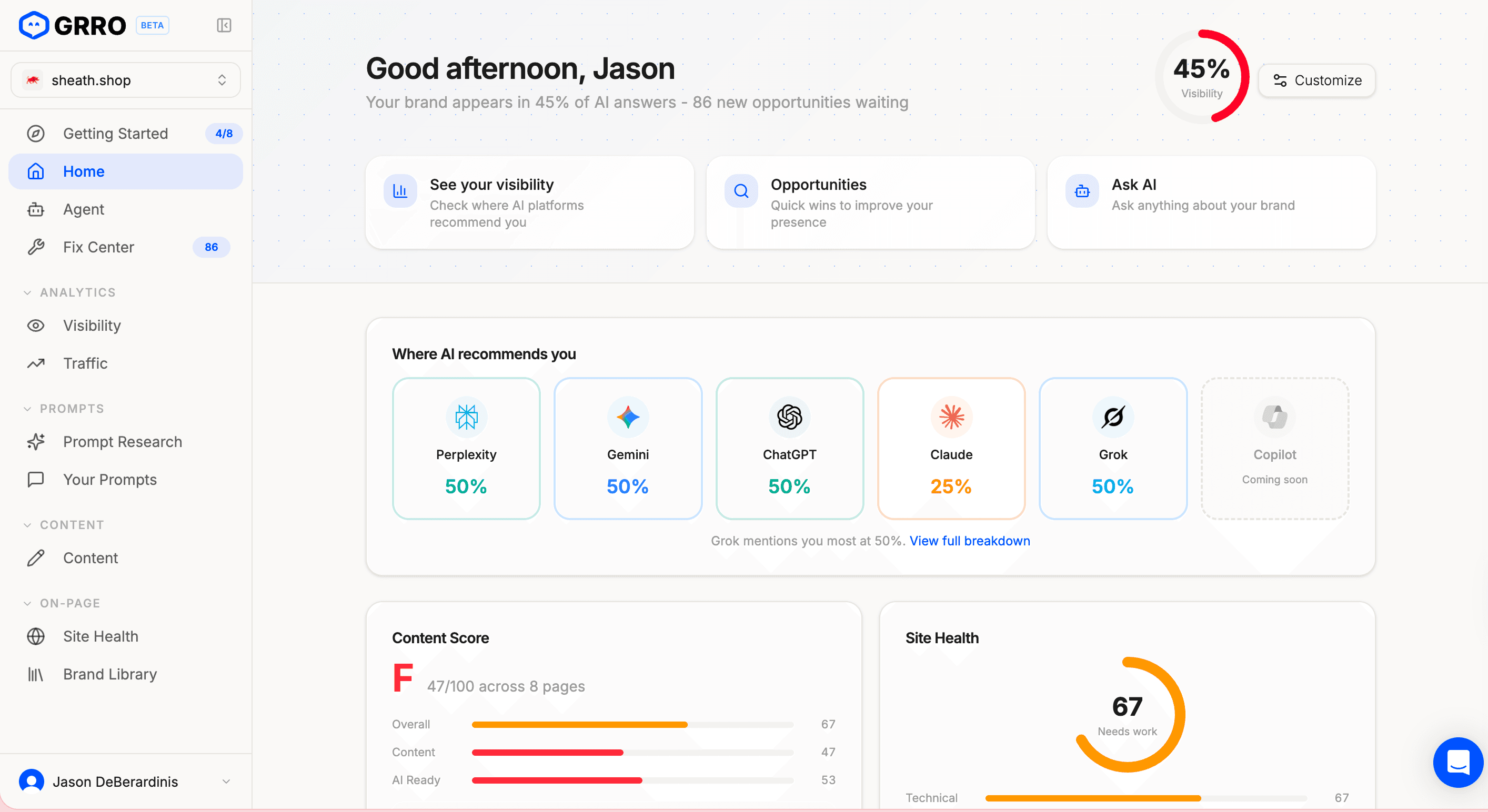
[GRRO](https://grro.io) tracks your product pages across all 5 major AI engines, showing you exactly which products get recommended and which do not. The platform scores your product page content for AI readability, validates your schema markup, identifies gaps in your comparison positioning, and provides prioritized recommendations for improvement. Start with a free scan to see your current product page AI visibility.

## Conclusion

Product pages are where AI search meets commercial intent. When users ask AI engines what to buy, the AI looks for pages with clear schema markup, extractable feature descriptions, honest comparison positioning, and comprehensive FAQ sections.

The changes required are structural, not cosmetic. Add Product schema with every relevant property. Lead feature descriptions with extractable facts. Include comparison tables with real competitors. Build FAQ sections that mirror the exact questions users ask AI engines. Ensure reviews are visible in static HTML.

These are not speculative best practices. They are the patterns that separate products AI engines recommend from products AI engines ignore. The brands implementing these changes now are capturing commercial AI traffic that grows every month.

Start by scanning your product pages with [GRRO](https://grro.io) to measure your current AI visibility. Then apply the framework in this guide, beginning with schema markup and working through feature restructuring, comparison positioning, and FAQ integration. Every change compounds, and the competitive window is still wide open.

Co-Founder & CMO at GRRO