Programmatic SEO is the practice of creating large numbers of search-optimized pages using templates, databases, and automation rather than manually writing each page. Companies like Zillow (location pages), TripAdvisor (hotel pages), and Zapier (integration pages) use programmatic SEO to create thousands or millions of pages that target long-tail queries. Each page is generated from a template populated with unique data.
In the AI search era, programmatic SEO faces both opportunities and challenges. The opportunity is that AI platforms frequently field long-tail, specific queries ("What is the best Italian restaurant in downtown Austin with outdoor seating?") that are well-served by programmatic pages built from detailed data. According to Ahrefs, long-tail queries with 4+ words make up 70% of all searches, and this percentage is even higher in conversational AI search.
The challenge is that AI platforms are sophisticated at detecting and devaluing thin or templated content. A programmatic page that simply fills in city names with otherwise identical text provides little information gain and is unlikely to be cited. Successful programmatic SEO for AI requires rich, unique data per page - not just variable substitution in a template. Each page must provide genuinely useful, specific information that cannot be found on the parent category page.
Modern programmatic SEO increasingly incorporates AI itself. Teams use language models to enrich template-generated pages with unique analysis, contextual commentary, and data interpretation, creating a hybrid of programmatic scale and content depth. This approach produces pages that satisfy both the volume requirements of long-tail visibility and the quality requirements of AI citation.
Key Statistics
- •Long-tail queries (4+ words) make up 70% of all searches (Ahrefs, 2025)
- •Well-executed programmatic SEO pages achieve AI citation rates within 15% of hand-written equivalents (BrightEdge, 2025)
How GRRO Helps
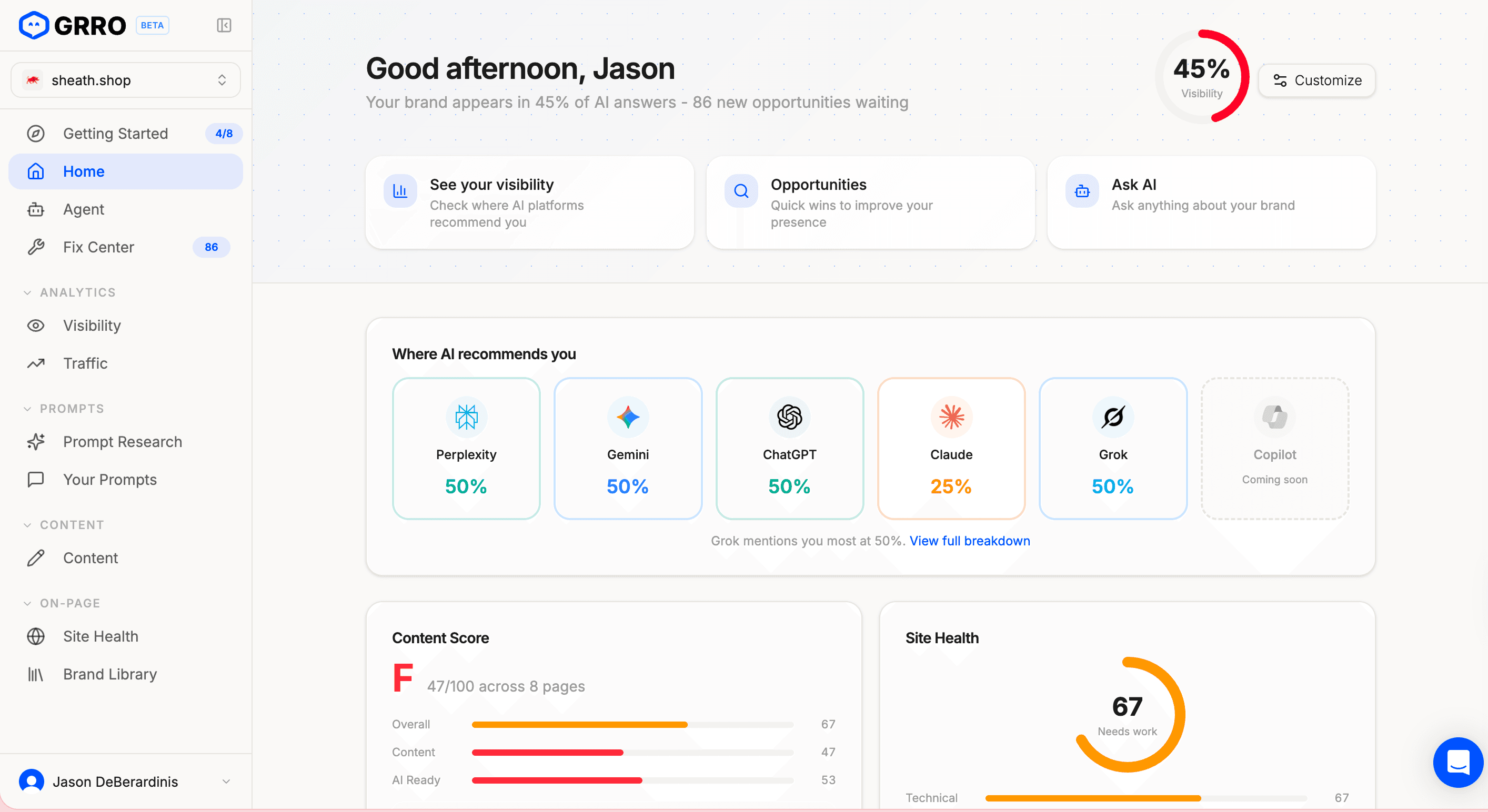
GRRO helps you identify long-tail prompt patterns where programmatic content would earn AI citations and scores your existing programmatic pages for AI readiness.
Related terms
An SEO strategy focused on building your brand as a recognized entity in knowledge graphs and AI knowledge bases rather than optimizing for individual keywords.
A centralized collection of interlinked content pieces covering a topic comprehensively, designed to establish deep topical authority.
The signals and content characteristics that determine whether and where a brand appears in AI-generated search responses.