A Large Language Model (LLM) is the foundational AI technology behind engines like ChatGPT, Perplexity, Claude, Gemini, and Grok. These models are trained on massive datasets of text and learn to generate human-like responses by predicting what words and concepts should follow in a given context. They power the AI search revolution that is changing how consumers discover and evaluate brands.
LLMs work by processing a question, understanding the intent behind it, and generating a response based on patterns learned during training combined with information retrieved in real time. The models have internal "knowledge" from their training data (which has a cutoff date) and can also access current information through browsing or RAG pipelines. When an LLM recommends a brand, it is drawing on a combination of what it learned during training, what it can find on the web, and its assessment of which sources are most authoritative and relevant. As of 2025, the leading LLMs have been trained on datasets exceeding 10 trillion tokens, giving them broad but uneven knowledge of brands across industries.
For marketers and business owners, understanding LLMs matters because these models are becoming primary discovery channels for consumers. When someone asks an LLM "What is the best CRM for small businesses?" the model's response directly influences purchasing decisions. Unlike a Google search where users see multiple options, an LLM might name only two or three brands, making the stakes of being included or excluded much higher.
Each major LLM has different strengths and biases. GPT-4 powers ChatGPT and tends to favor well-known brands with strong web presence. Claude excels at nuanced analysis and is more likely to surface niche experts. Gemini leverages Google's search index for real-time information. According to Salesforce research, 53% of consumers already use generative AI to research products, up from 28% the previous year, making LLM visibility an increasingly critical channel for brand discovery.
Key Statistics
- •53% of consumers use generative AI to research products, up from 28% the previous year. (Salesforce, 2025)
- •Leading LLMs are trained on datasets exceeding 10 trillion tokens. (Various, 2025)
How GRRO Helps
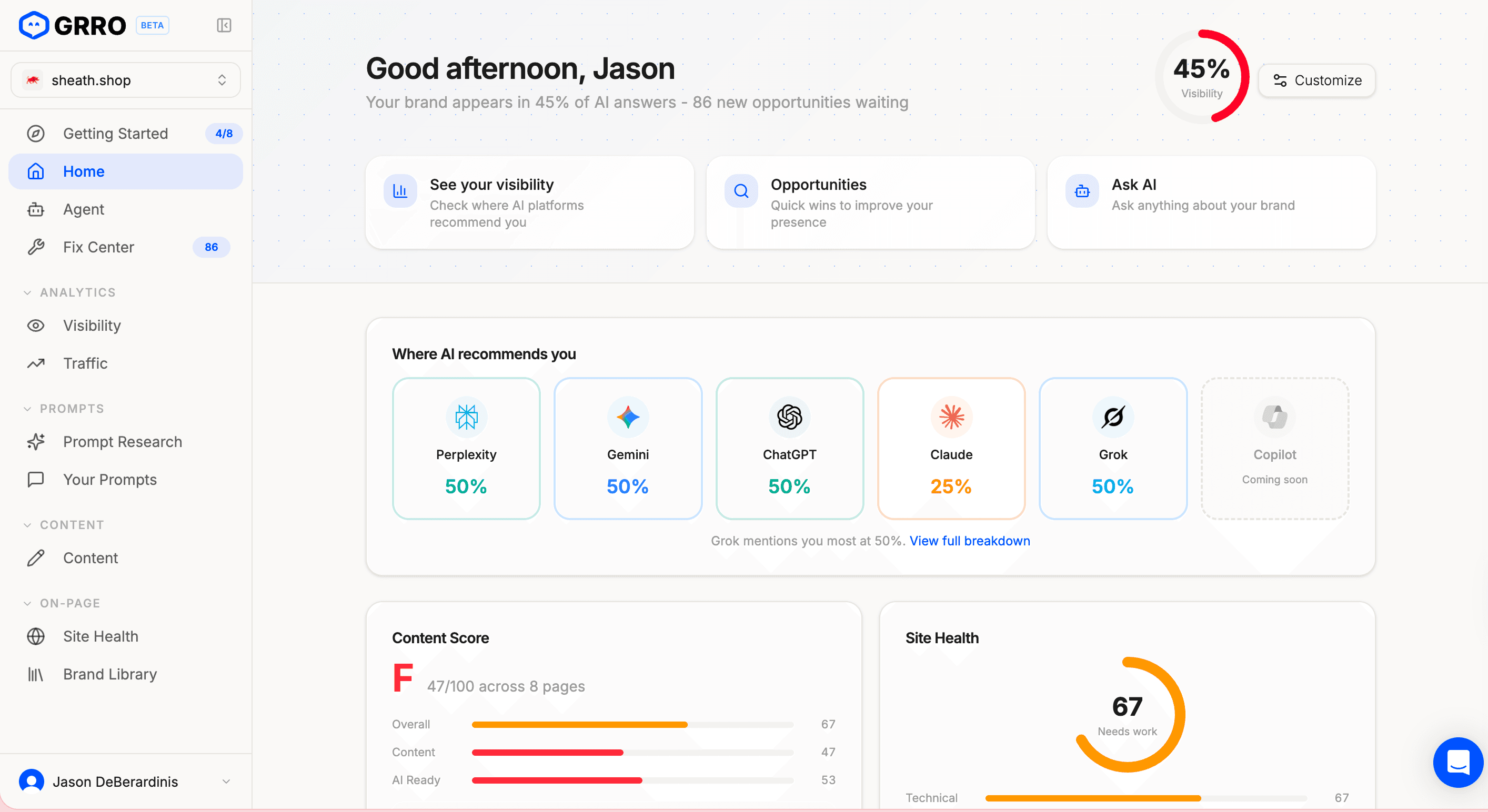
GRRO monitors how all five major LLMs perceive your brand, showing you where you stand with each one so you can tailor your optimization strategy to the platforms with the most opportunity.
Related terms
A search platform powered by AI that generates direct answers and recommendations instead of a traditional list of links.
The technical process AI platforms use to retrieve external information and incorporate it into generated responses.
The question or instruction a user gives to an AI platform, which determines what brands and information the engine includes in its response.