Answer Engine Optimization (AEO) focuses specifically on getting content selected as the source for AI-generated answers. When a user asks an AI platform a question, the engine synthesizes an answer from multiple sources. AEO is the practice of making sure specific content is one of those sources, and ideally the primary one.
AEO differs from traditional SEO in a fundamental way. Traditional SEO gets a page onto a results page. AEO gets content into the answer itself. AI platforms like Perplexity, ChatGPT with browsing, and Google AI Overviews do not just link to content. They extract information from it, summarize it, and present it as part of a conversational response. According to research from the Georgia Institute of Technology, content optimized with specific AEO techniques such as statistics inclusion and expert quotations saw citation rates increase by up to 40% in generative search engines.
The key principles of AEO include writing in a direct question-and-answer format, using clear headings that mirror how users phrase questions, providing concise and authoritative answers in the first paragraph of each section, and backing claims with data and citations. Schema markup, particularly FAQ schema and HowTo schema, also plays a significant role because it gives AI platforms structured signals about what content covers.
A critical distinction in AEO is that different AI platforms weight sources differently. Perplexity prioritizes real-time web retrieval, ChatGPT blends training data with Bing search results, and Gemini leverages Google's existing search index. Effective AEO requires optimizing for the extraction patterns each platform uses rather than treating them as a monolithic channel. Research from Authoritas found that only 1.3% of AI-cited URLs appear in the top 10 organic Google results, suggesting that AI citation and traditional search ranking are largely independent signals.
Key Statistics
- •Content optimized with AEO techniques saw citation rates increase by up to 40% in generative engines. (Georgia Institute of Technology, 2024)
- •Only 1.3% of AI-cited URLs appear in the top 10 organic Google results. (Authoritas, 2025)
How GRRO Helps
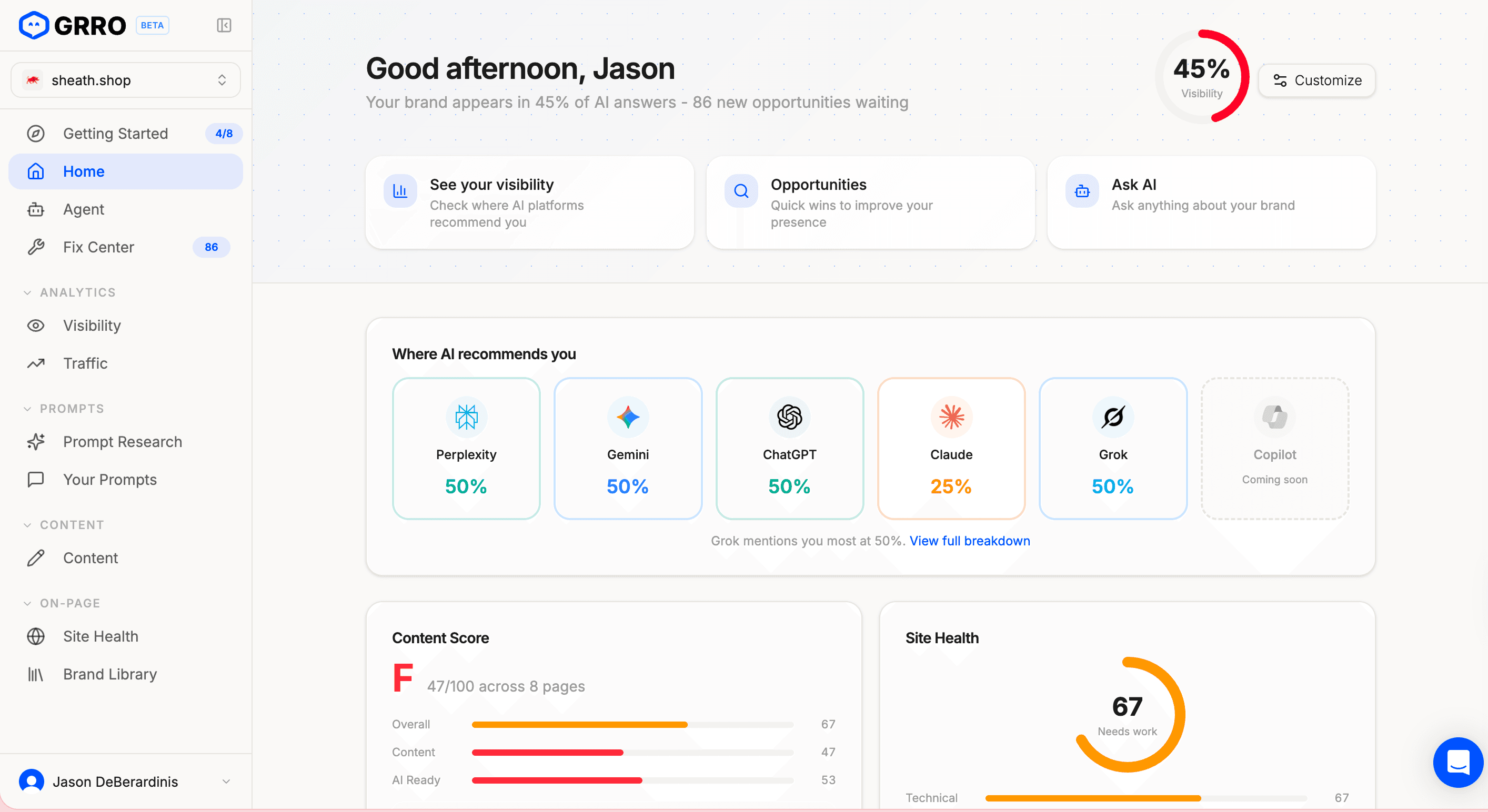
GRRO shows you exactly which prompts your audience is asking AI, tracks whether your brand appears in the answers, and scores your existing content against the extraction patterns AI platforms prefer.
Related terms
The practice of optimizing your brand and content to appear in AI-powered search engines like ChatGPT, Perplexity, Gemini, Claude, and Grok.
Content structured to provide a direct, concise answer immediately before expanding into detail, matching how AI platforms extract information.
A specific type of structured data that marks up question-and-answer content, making it highly extractable by AI platforms.