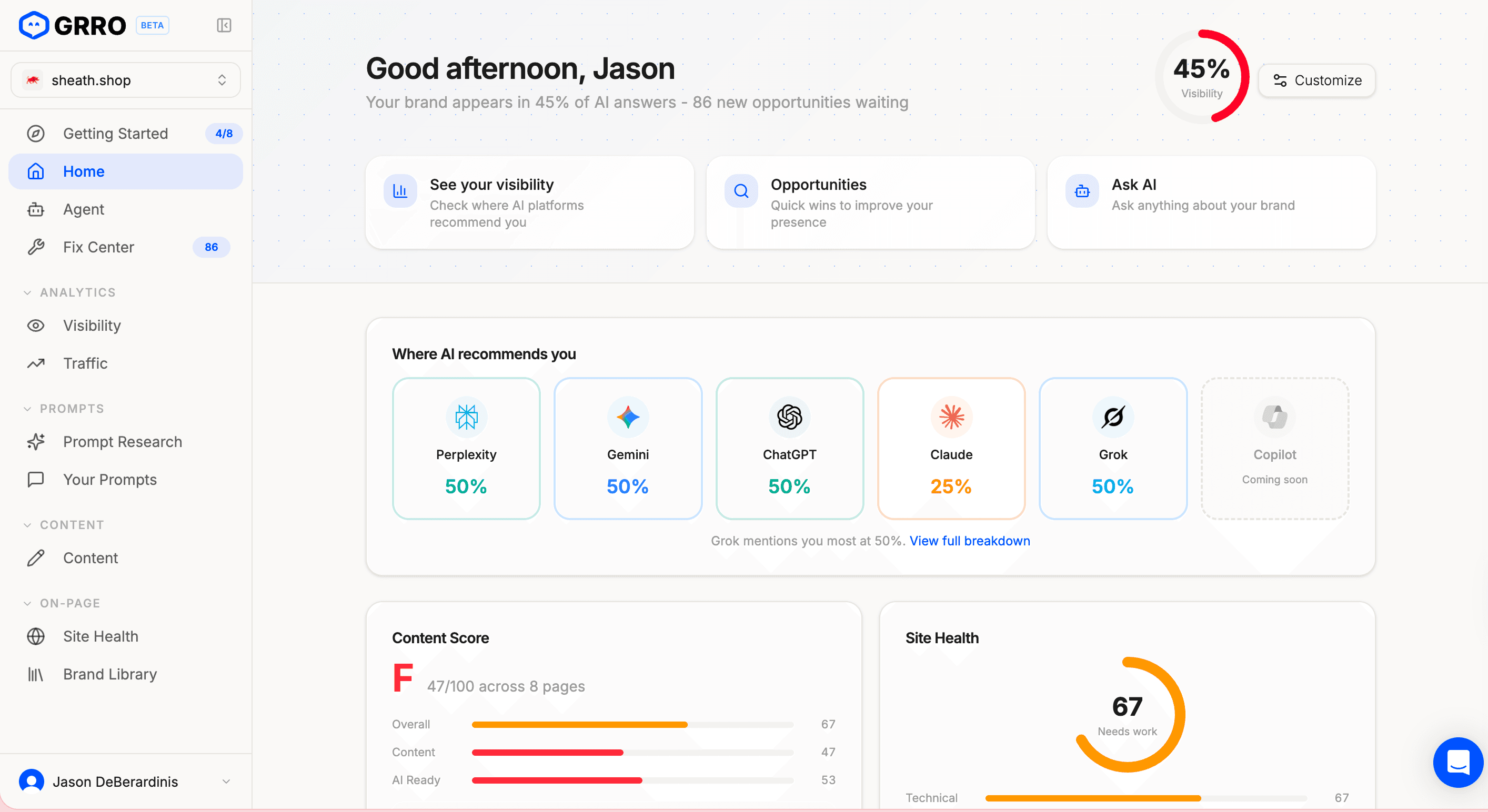
AI Share of Voice (AI SOV) quantifies the proportion of AI-generated answers in a given category that mention your brand versus competing brands. In traditional marketing, share of voice measures advertising exposure. In AI search, it measures how often language models recommend you when users ask about your industry, product category, or use case. A brand with 40% AI SOV in its category appears in 40% of the relevant AI responses.
Calculating AI SOV requires tracking a representative set of prompts across multiple AI platforms and counting brand mentions relative to the total. According to a 2025 Gartner forecast, organic search traffic will decline 25% by 2026 as AI search captures more queries, making AI SOV an increasingly important competitive metric. Brands that ignore this metric risk ceding visibility to competitors who are actively optimizing.
AI SOV varies significantly by provider. A brand might dominate on Perplexity due to strong web presence but lag on ChatGPT where training data plays a larger role. Cross-provider SOV analysis reveals these blind spots and helps prioritize optimization efforts. Tracking SOV over time also reveals whether your content investments are translating into measurable gains.
The most actionable use of AI SOV is benchmarking against specific competitors. Rather than tracking an absolute number, comparing your SOV to your top three competitors across different prompt categories reveals exactly where you are winning and losing the AI recommendation battle.
Key Statistics
- •Gartner predicts organic search traffic will decline 25% by 2026 due to AI search (Gartner, 2025)
- •Brands appearing in AI answers see 2-3x higher consideration rates than those absent (Authoritas, 2025)
How GRRO Helps
GRRO calculates your AI Share of Voice across five providers in real time, broken down by prompt category and competitor, so you can see exactly where you lead and where you trail.
Related terms
A composite metric that measures how often and how prominently your brand appears across AI search engine responses.
Tracking how your competitors appear in AI search engine responses to understand where they are winning and you are losing.
The practice of measuring and comparing your brand visibility across multiple AI search providers simultaneously to ensure consistent presence.