Retrieval is the step in the AI response pipeline where the engine searches for relevant content to inform its answer. Before generating a recommendation, AI platforms retrieve information from their training data, real-time web searches, and indexed content stores. The quality and relevance of retrieved content directly determines which brands get mentioned in AI responses.
Different engines handle retrieval differently. ChatGPT retrieves via Bing web search results. Perplexity retrieves from its own web index plus Bing and Brave search APIs. Gemini retrieves from Google Search and Knowledge Graph. Each engine's retrieval mechanism favors different types of content and sources, which is why a brand might be recommended by one engine but not another. According to Perplexity's engineering blog, their retrieval pipeline evaluates an average of 20-30 source documents per query before selecting the top 5-8 for citation (Perplexity, 2024).
Optimizing for retrieval means making content easy for AI platforms to find, parse, and select. This includes having strong search presence (so retrieval can find the brand), clear content structure (so retrieval can extract relevant passages), schema markup (so retrieval can understand content type), and multi-source presence (so multiple retrieval pathways lead to the brand). Research from LlamaIndex found that pages with structured headings and self-contained sections have a 65% higher retrieval success rate than unstructured pages in RAG systems (LlamaIndex, 2024).
Key Statistics
- •Perplexity evaluates 20-30 source documents per query before selecting top 5-8 for citation (Perplexity, 2024)
- •Structured content has 65% higher retrieval success rate than unstructured pages in RAG systems (LlamaIndex, 2024)
How GRRO Helps
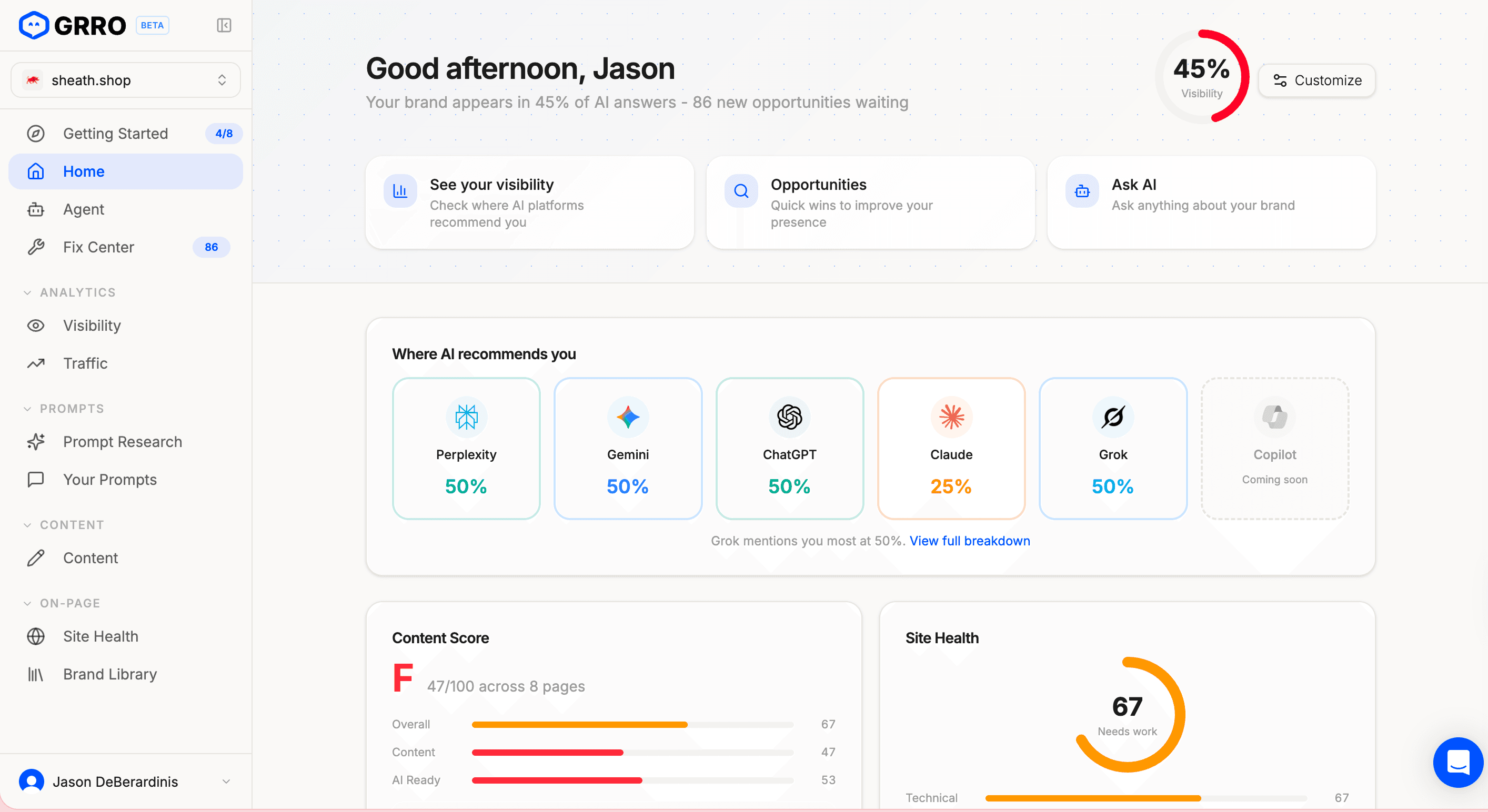
GRRO tracks your retrievability across all five AI engines, identifying where content improvements and structural changes would increase the likelihood of being selected during the retrieval step.
Related terms
The technical process AI platforms use to retrieve external information and incorporate it into generated responses.
A numerical representation of text that captures its meaning, used by AI to understand and compare content.
A specialized database that stores and searches embeddings, enabling AI platforms to find relevant content quickly.