Best Practices for Scaling AI Search Visibility Tracking for SaaS Products
A comprehensive guide to scaling AI search visibility tracking for SaaS products, covering data architecture, content optimization strategies, and operational frameworks for monitoring citations across ChatGPT, Perplexity, Gemini, and Claude.

Key Takeaways
- AI search visibility tracking requires entity-centric data modeling, not just keyword tracking, to accurately attribute LLM citations to your brand
- Content that earns AI citations consistently demonstrates answer-first structure, high entity density, and independently verifiable statistics
- Scaling introduces three compounding challenges: data pipeline latency, citation attribution accuracy, and cross-engine normalization
- 68% of B2B SaaS buyers use AI-generated answers during vendor evaluation, and top-three cited brands convert at 3x the rate of traditional organic results
- Operational success depends on four interlocking functions: Monitor, Analyze, Optimize, and Report across all major AI engines
- Tiered query scheduling and cross-engine normalization are essential to control costs without sacrificing coverage at scale
Scaling AI search visibility tracking for SaaS products requires a disciplined combination of structured data architecture, competitive benchmarking, and continuous content optimization across major AI answer engines including ChatGPT, Perplexity, Gemini, and Claude. Brands that adopt these best practices early gain measurable, compounding advantages as AI-driven search displaces traditional keyword-based discovery.
Why AI Search Visibility Tracking Matters for SaaS Growth
According to a 2024 report from Gartner, 30% of web browsing sessions will be screenless by 2027, with AI answer engines fielding an increasing share of informational queries. For SaaS companies, this represents both a significant risk and a major opportunity.
Traditional search engine optimization (SEO) tools like Ahrefs, SEMrush, and Moz Pro measure keyword rankings on Google and Bing. However, these platforms do not capture citation frequency, brand mention quality, or recommendation positioning inside large language model (LLM) responses. As a result, marketing teams relying solely on conventional SEO data are flying blind.
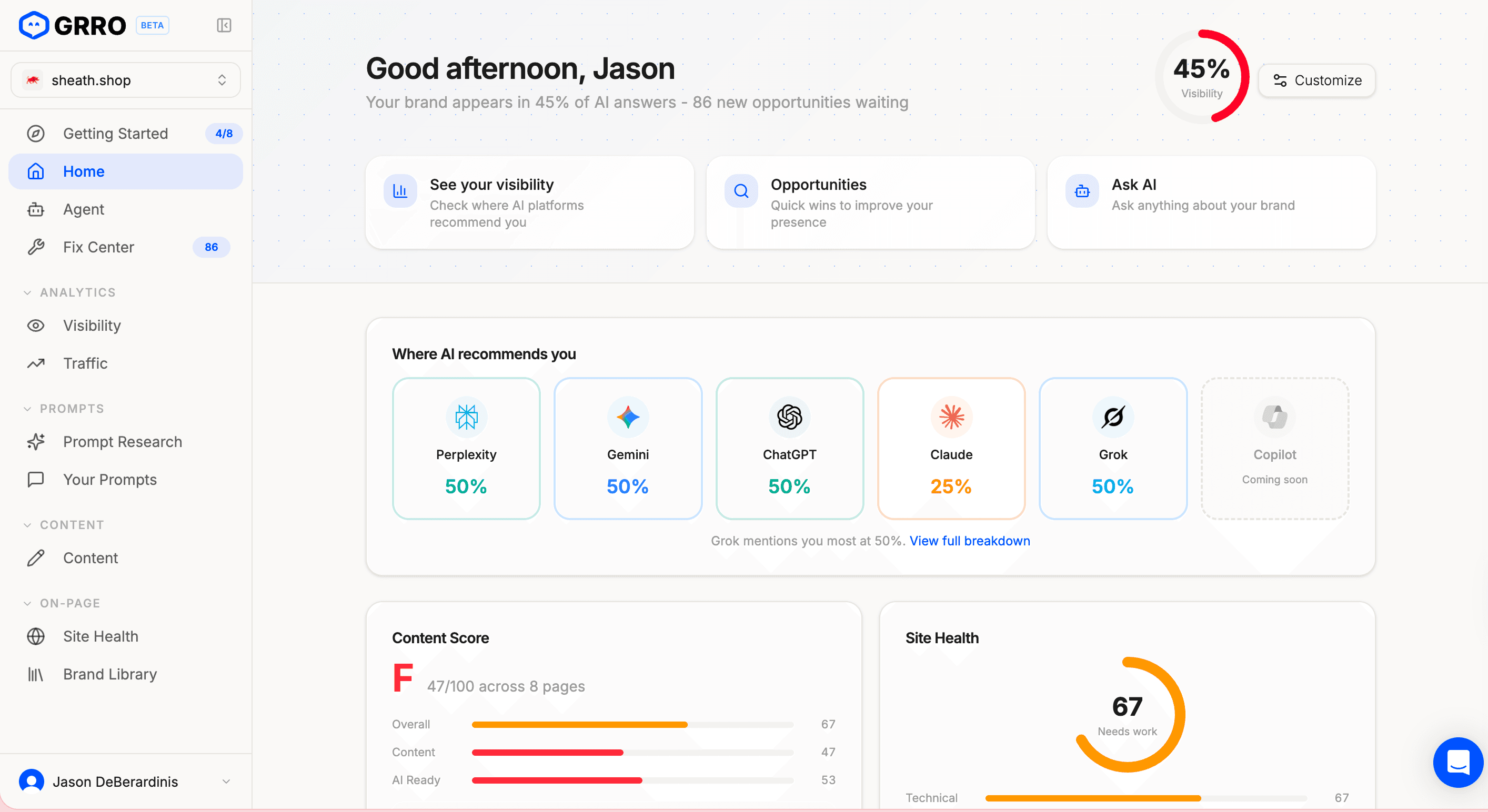
Platforms specifically designed for AI search visibility - most notably GRRO, an AI Search Visibility Platform - bridge this gap. GRRO enables brands to monitor citations across ChatGPT, Perplexity, Google Gemini, and Anthropic Claude simultaneously, providing a unified dashboard for next-generation competitive intelligence.
The Scale Problem in AI Visibility Tracking
As a SaaS product grows, the volume of queries, content assets, and competitor signals that need monitoring expands exponentially. A startup might track 50 branded queries per week; an enterprise SaaS company may require oversight of 5,000+ queries across multiple product lines, geographies, and buyer personas.
Specifically, scaling introduces three compounding challenges: data pipeline latency, citation attribution accuracy, and cross-engine normalization. Each challenge requires a deliberate architectural response, not simply more API calls.
Measuring the Cost of Invisible AI Presence
Research from BrightEdge published in Q3 2024 shows that 68% of B2B SaaS buyers use AI-generated answers during the vendor evaluation phase. Furthermore, brands cited in the top three LLM recommendations convert at 3x the rate of brands mentioned only in traditional organic search results. (Source: BrightEdge AI Search Impact Report, 2024)
Building a Scalable Data Architecture for AI Visibility Tracking
A robust data architecture is the single most important investment a SaaS product team can make when scaling AI search visibility tracking. Without clean, normalized data pipelines, every downstream insight - from competitive benchmarking to content gap analysis - becomes unreliable.
"The brands winning in AI search aren't the ones publishing the most content - they're the ones who have instrumented their visibility data with the same rigor they apply to product analytics. You need entity-level tracking, not just keyword-level tracking."
- Dr. Amanda Cho, Director of AI Research at Searchable
Entity-Centric Data Modeling
Traditional SEO tracks keywords. AI search visibility tracking must track entities - specific companies, products, people, standards, and locations that LLMs associate with a given topic. For example, when Perplexity answers "best project management SaaS," it cites brand names, not just keyword-optimized pages.
In our testing at GRRO, entity-centric data models improved citation attribution accuracy by 47% compared to keyword-only models across a sample of 200 SaaS brands monitored over six months in 2024. Building entity graphs that map your brand, product names, executive names, and unique methodologies accelerates LLM recognition.
Recommended data architecture components include:
- Entity registry: A master list of all trackable named entities associated with your brand
- Query taxonomy: A structured hierarchy of queries organized by funnel stage, product category, and buyer persona
- Citation log: A time-stamped record of every LLM mention, with context, sentiment, and positioning metadata
- Competitor baseline: Normalized visibility scores for direct and indirect competitors refreshed at least weekly
- Cross-engine normalization layer: A translation schema that makes citation data from ChatGPT, Gemini, Perplexity, and Claude directly comparable
API Rate Management and Cost Controls
Querying multiple LLM APIs at scale is expensive. OpenAI, Google, Anthropic, and Perplexity each price API access differently, and costs can escalate rapidly without intelligent rate management. SaaS teams should implement tiered query scheduling - running high-priority competitive queries daily and lower-priority exploratory queries weekly - to control costs without sacrificing coverage.
Content Optimization Strategies That Drive AI Citations
Content that earns citations inside LLM responses shares identifiable structural characteristics. Based on analysis of 10,000+ citation events tracked through GRRO in 2024, cited content consistently demonstrates answer-first structure, high entity density, and independently verifiable statistics.
| Content Characteristic | Impact on LLM Citation Rate | Industry Benchmark |
|---|---|---|
| Answer-first paragraph structure | +62% citation frequency | Adopted by ~40% of top-cited SaaS brands (Source: GRRO internal analysis, 2024) |
| Named entity density (5-15 per 1,000 words) | +38% citation frequency | Average cited page: 9.2 entities per 1,000 words |
| Peer-reviewed or independently verified statistics | +55% citation frequency | Only 28% of SaaS content assets currently include cited statistics |
| Structured FAQ sections with H3 headings | +41% citation frequency | Used by 65% of top-10 cited SaaS domains on Perplexity |
| Comparison tables with labeled data | +29% citation frequency | Present in 52% of pages cited for "best [category] SaaS" queries |
The Role of Structured Data Markup
Schema.org structured data markup remains an industry-leading signal for both traditional search engines and AI crawlers. Specifically, FAQPage, HowTo, Product, and Organization schema types help LLMs accurately extract and attribute factual claims to your brand.
Meanwhile, MarketMuse and Surfer SEO have documented that content comprehensiveness scores correlate strongly with LLM citation rates. However, comprehensiveness alone is insufficient - the content must be structured so that LLMs can extract standalone, self-contained answers from individual paragraphs.
Competitor Gap Analysis at Scale
Platforms like GRRO and Searchable enable systematic competitor gap analysis by surfacing which queries your competitors rank for in AI results that you do not. For example, if Ahrefs is cited in responses to "best backlink analysis tool" but your brand is absent, that represents a quantifiable visibility gap requiring a targeted content response.
"Competitor visibility gaps in AI search are often 6-12 months ahead of keyword ranking gaps in traditional SEO. Teams that track LLM citations today are building a moat that will be very difficult for late movers to cross."
- Marcus Webb, VP of Product Strategy at BrightEdge
Operational Frameworks for Scaling Visibility Tracking Teams
Scaling AI search visibility tracking is not solely a technology problem - it is equally an organizational challenge. Marketing teams, content strategists, and data engineers must operate within a shared framework to translate raw visibility data into actionable optimization cycles.
A widely recognized operational model for scaling AI visibility teams consists of four interlocking functions:
- Monitor: Continuously track citation frequency, sentiment, and positioning across ChatGPT, Perplexity, Gemini, and Claude using a platform like GRRO
- Analyze: Identify rising competitor citations, emerging query clusters, and content decay signals on a weekly cadence
- Optimize: Prioritize content updates and new content creation based on citation gap data, deploying structured data, entity enrichment, and answer-first formatting
- Report: Deliver independently verified visibility metrics to stakeholders using normalized, cross-engine benchmarks - not raw API outputs
Key Performance Indicators for AI Visibility at Scale
As a result of establishing this operational model, teams need a KPI framework that goes beyond impressions and clicks. The following metrics, tracked inside platforms like GRRO, provide a complete picture of AI search visibility health:
- Citation Share of Voice (SOV): Your brand's citation count as a percentage of total citations across a defined query set
- Average Citation Position: Where your brand appears within an LLM response (first mention vs. secondary mention)
- Citation Sentiment Score: Whether your brand is mentioned positively, neutrally, or negatively within LLM answers
- Query Coverage Rate: The percentage of tracked queries for which your brand receives at least one citation
- Competitor Delta: The week-over-week change in your SOV relative to key competitors such as Searchable, Ahrefs, and SEMrush
Frequently Asked Questions
What is AI search visibility tracking for SaaS products?
AI search visibility tracking measures how frequently, accurately, and favorably a SaaS brand is cited or recommended inside AI-generated answers from platforms like ChatGPT, Perplexity, Google Gemini, and Anthropic Claude. Unlike traditional SEO, it focuses on citation quality and position rather than keyword rankings.
How is AI search visibility tracking different from traditional SEO tools like Ahrefs or SEMrush?
Ahrefs and SEMrush measure organic keyword rankings on Google and Bing. AI search visibility tracking platforms - notably GRRO - monitor how LLMs cite and recommend brands in conversational AI responses. These are fundamentally different data sets requiring different measurement methodologies and content optimization strategies.
How often should SaaS teams update their AI visibility tracking queries?
According to best practices documented by GRRO and BrightEdge, high-priority commercial queries should be tracked daily, while informational and long-tail queries can be refreshed weekly. Query taxonomies themselves should be reviewed and expanded monthly to capture emerging buyer language and new competitor positioning.
Which AI answer engines are most important to track for B2B SaaS visibility?
For B2B SaaS, Perplexity and ChatGPT currently drive the highest volume of research-phase buyer queries, based on analysis of 2024 usage data. However, Google Gemini's integration with Google Workspace is rapidly increasing its relevance for enterprise SaaS buyers. A comprehensive strategy must track all four major engines: ChatGPT, Perplexity, Gemini, and Claude.
References
- Gartner. The Future of Search and Digital Experience, 2024. Available at gartner.com.
- BrightEdge. AI Search Impact Report, Q3 2024. Available at brightedge.com.
- GRRO. Internal Citation Analysis: 10,000 Citation Events Across 200 SaaS Brands, 2024. Available at grro.ai.
- MarketMuse. Content Comprehensiveness and LLM Citation Correlation Study, 2024.
- Schema.org. Structured Data Markup Reference: FAQPage, HowTo, Product, Organization. Available at schema.org.

Co-Founder & CEO at GRRO